👻 HAUNTED PLACE · EXP. Nº9477
ACTIVE
Pemberton Hall (Eastern Illinois University)
Every autumn the residents of Pemberton Hall, at Eastern Illinois University in Charleston, hear the same story: that a student was beaten to death by a janitor on the closed fourth floor, and that the housemother, Mary Hawkins, went mad with guilt and haunts the building still.
Where is Pemberton Hall (Eastern Illinois University)?
- Location
- Illinois, United States
- Type
- School / university
- Coordinates
- 39.484, -88.176
- Last updated
LOCATION
Why is Pemberton Hall (Eastern Illinois University) said to be haunted?
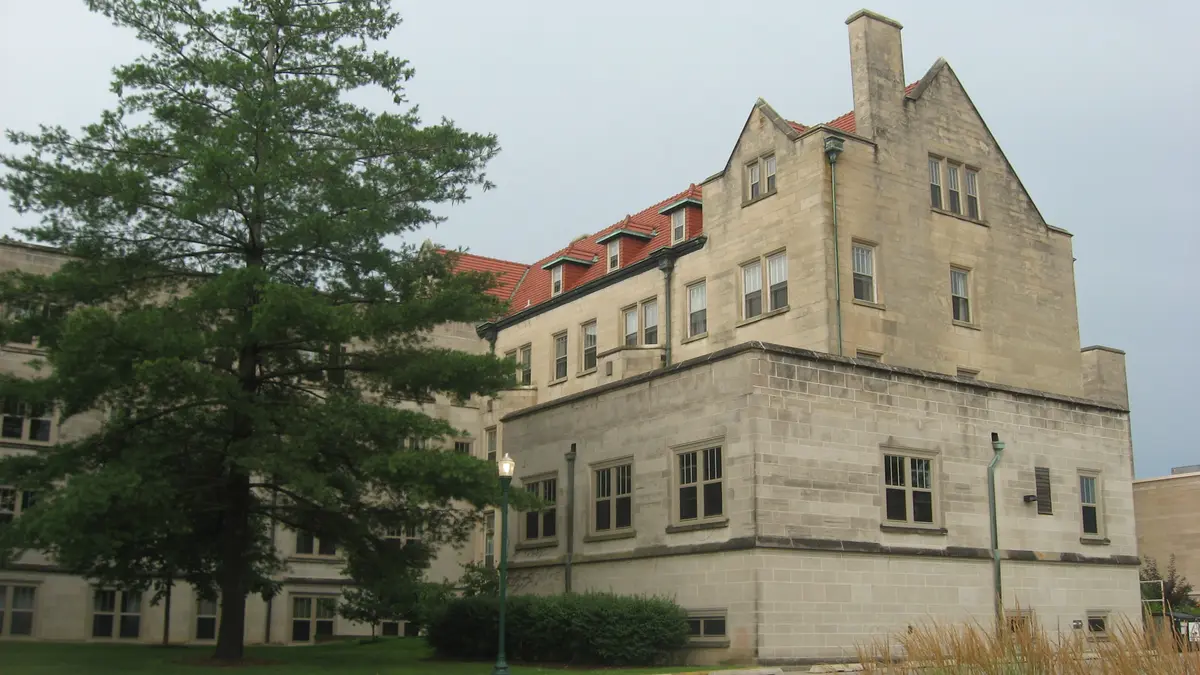
The building is real and opened on 4 January 1909, the first residence hall the State of Illinois ever built for women. Mary Hawkins was real too — and she was neither a student nor a murder victim. Mary Elizabeth Hawkins was born in England in 1877 and ran Pemberton Hall from August 1910 to March 1917, imposing a 7:30 curfew on "her girls" and, in her own words, keeping them "under my control entirely". She died in the state hospital at Kankakee on 29 October 1918, aged 41, of an illness with no cure at the time; her friends unveiled a bronze tablet to her in the lobby two years later, and it is still there. The murder appears in no record before the 1970s, and folklorists recognise it as a story told on campuses across America. This is what happens when a real woman is remembered only through a ghost story.
What is the history of Pemberton Hall (Eastern Illinois University)?
Pemberton Hall exists because one man spent seven years being told no.
Livingston C. Lord arrived in 1899 as the first president of the Eastern Illinois State Normal School in Charleston, and he wanted something no state school in Illinois had: a residence hall for women. In 1900 he told the Board of Trustees that a women's dormitory was "absolutely necessary", partly because there were "not a few parents who hesitate to send their daughters away to school" without supervision. He asked for a building for a hundred students and estimated it would cost at least $60,000. In the winter of 1901 he went before the legislature's Appropriations Committee and, in his own words, the request was taken "partly as a joke and partly as an affront" — one member asked whether he wanted to go into the lunch-counter business.
What changed things was Senator Stanton C. Pemberton of Oakland, a few miles up the road. Pemberton carried the fight in 1903, when the bill passed with $25,000 for a gymnasium and Governor Richard Yates vetoed the item; in 1905, when $100,000 for dormitory and gymnasium cleared the legislature and Governor Charles S. Deneen vetoed it too; and in 1907, when the same $100,000 finally survived. Lord wrote to him afterwards: "Generations of young women will be grateful to you for making it possible for them to have a delightful home while attending this school." The Trustees named the building after him at Lord's suggestion.
The hall — designed by the Illinois state architect W. Carbys Zimmerman, in a collegiate Gothic Revival that echoed the campus's Old Main — opened formally on 4 January 1909 with a dinner attended by the Senator and his wife. Room and board cost students $4.00 a week, laundry included, against six or seven dollars in town. It housed a hundred women and fed twenty-five more. A further $3,000 in 1909 finished ten rooms in the basement and attic. It was the first building of its kind put up by the State of Illinois, and Lord knew it: "I made the fight for all the other colleges, and Senator Pemberton is the man who really won it… I never go by in the evening when the girls are in their rooms and the lights in all the windows without feeling anew the satisfaction of it."
The first Head of the Hall was Miss Estelle Gross. The second — the one everybody now remembers, and remembers wrongly — was Miss Mary Elizabeth Hawkins.
Timeline: the documented record of Pemberton Hall (Eastern Illinois University)
- December 1900 President Livingston C. Lord tells the Board of Trustees that a women's dormitory is "absolutely necessary" and estimates the cost at $60,000. No state school in Illinois has one.
- 1903 and 1905 Senator Stanton C. Pemberton gets appropriations through the legislature twice and both are vetoed — the gymnasium item by Governor Richard Yates in 1903, the full $100,000 by Governor Charles S. Deneen in 1905.
- 4 January 1909 Pemberton Hall opens with a dinner attended by Senator and Mrs. Pemberton, the Trustees and the faculty. Board and lodging cost students $4.00 a week. It is the first residence hall built by the State of Illinois.
- August 1910 Mary Elizabeth Hawkins, born in England in 1877 and in the United States since 1901, becomes the second Head of the Hall at the age of 33, succeeding Miss Estelle Gross.
- 27 October 1915 Hawkins writes to President Dearmont of the Cape Girardeau normal school describing her regime: "As head of Pemberton Hall they are under my control entirely." The letter survives in the Lord Papers and is the clearest thing we have in her own voice.
- March 1917 Hawkins leaves her post after almost seven years. By October the Head of the Hall is Miss Grace M. Peters, who introduces student self-government among the residents.
- 29 October 1918 Mary Hawkins dies at 41 in the state hospital at Kankakee, after two weeks that September in a Charleston sanatorium. The death certificate gives "general paralysis of the insane"; her obituary in the Charleston Daily Courier calls her "a woman of education and refinement".
- 6 November 1920 A bronze tablet to Hawkins is unveiled in the entrance lobby at a Homecoming memorial service. Friends of "Our Mary" read tributes and letters; the tablet is still there.
- October 1976 Karen Knupp publishes in the Eastern News the earliest account of the legend anyone has traced — 58 years after Hawkins died. Residents had already held a "Mary Hawkins Day" that spring.
- 1978 The residents turn Pemberton Hall into a Halloween haunted house for the first time and open the fourth floor "for the first time in many, many years". The tradition returns in 1997 with an actress playing the X-Files theme on the fourth-floor piano.
- October 1984 William M. Michael, of the Decatur Herald and Review, spends the night in the fourth-floor piano room and reports no encounter of any kind. The same edition carries the account of Patty O'Neill, a former resident who described a woman in a nightgown by her bed in the spring of 1981.
- 25 September 2014 Gilbert and Annette Hawkins arrive from New Zealand, tracing the family history that led them from a headstone in England to Charleston. They stay in Pemberton Hall, visit Mary's grave and give the university a kauri-wood sculpture, mounted in a frame made from the burr oak that once stood outside Old Main.
Is there a rational explanation for Pemberton Hall (Eastern Illinois University)?
The legend says a student was beaten to death by a janitor on the fourth floor and that Mary Hawkins, the housemother, went mad with guilt. Almost none of that survives contact with the documents.
Mary Elizabeth Hawkins was not a student and was not murdered. She was born in England in 1877, emigrated to the United States in 1901 and took over as Head of Pemberton Hall in August 1910, at thirty-three. She ran it until March 1917. Her rules — a 7:30 p.m. curfew, lights out at 10:30, chaperones for dances and the theatre — she described herself in a letter of October 1915: "As head of Pemberton Hall they are under my control entirely." Eighteen months after leaving the post she was dead: two weeks in a Charleston sanatorium in September 1918, then the state hospital at Kankakee, where she died on the night of 29 October 1918, aged 41. The folklorist Michael Kleen, who holds a history degree from the university and worked from the death certificate and the Charleston Daily Courier, records the cause as "general paralysis of the insane" — the late neurological stage of untreated syphilis, in an era with no cure for it. Her obituary called her "a woman of education and refinement… a fine influence over young women".
The university's own official history got this wrong too: Charles Coleman's 1950 book states she "died in the summer of 1917 while Head", which is neither the date nor the circumstances.
The murder itself is a travelling story. Folklorists classify it as "The Roommate's Death", a motif first written down by Linda Dégh in Indiana Folklore in 1969 and catalogued by Jan Harold Brunvand: empty dorm over a holiday, an attacker, a victim clawing at a locked door, scratches found in the morning. It is told at campuses across the United States with the names swapped. Kleen's verdict on the Pemberton version is that it is "about 80 percent fiction, 15 percent anecdotes about strange things that have happened in the hall and about 5 percent facts".
The published details contradict each other, which is what folklore does and archives do not: the murder is dated to winter break, to May, to Spring Break, to 1920, to "the 1920s"; the weapon is an axe, a blunt object, bare hands, piano wire. The earliest account of the legend anyone has found is an Eastern News article by Karen Knupp from October 1976 — sixty-seven years after the hall opened — and a follow-up that November in which a former resident argued the whole thing began with a student who used to jump out of the janitor's closet to frighten the freshmen. In 1984 a Decatur Herald and Review journalist spent the night in the fourth-floor piano room and reported nothing at all.
Even the closed fourth floor, the legend's centrepiece, has a dull explanation: the university closed it to residents to meet safety codes, not because anything happened there.
Can you visit Pemberton Hall (Eastern Illinois University)?
Pemberton Hall stands at the corner of Lincoln Avenue and Fourth Street, at the north-west end of the Eastern Illinois University campus in Charleston; its postal address is 1521 4th Street, Charleston, Illinois 61920. It is a women's residence hall in use. The university's housing page lists it as all-female, with a capacity of 120 residents, a front desk on 217-581-2578, and the building closed during university break periods. The legend is told about the hall's own residents, who are current undergraduates.
EIU's On-Campus Handbook for 2026-2027 limits access to residence halls "to those with keys" and states that "all guests must be escorted at all times when in University Housing Areas", so the interior is open to residents and to the guests they accompany. The fourth floor, the one in the story, is closed; The Daily Eastern News reported in 2019 that it was shut because it did not meet newer safety regulations and that it still holds old furniture and fixtures. Michael Kleen wrote in 2014 that the university hung a bronze tablet commemorating Mary Hawkins near the entrance two years after her death, and that it "remains there to this day".
The exterior is visible from Lincoln Avenue and Fourth Street, both public streets. The building has been on the National Register of Historic Places since 26 August 1982 as "Pemberton Hall and Gymnasium" (reference 82002521). The gymnasium built into the south end of the hall, the old "Cracker Box Gym", is now Pemberton Hall South and houses the Sandra and Jack Pine Honors College, which gives its address as 1535 Fourth Street.
For the history, EIU Housing and Dining publishes online the Pemberton Hall chapter of Charles Coleman's 1950 history of the college, pages 119 to 134, and hall scrapbooks from 1964 to 1993. Mary Hawkins is buried in Charleston, and Kleen places her grave in Mound Cemetery. In September 2014 her great-grandnephew Gilbert Hawkins and his wife Annette came from New Zealand to Pemberton Hall and gave the university a sculpture of New Zealand kauri, mounted in a frame made from a bur oak that had stood outside Old Main.
Sources consulted
- Charles H. Coleman, «Eastern Illinois State College: Fifty Years of Public Service (chapter on Pemberton Hall, pp. 119-134)» — Eastern Illinois State College Bulletin 189, 1950 book
- Michael Kleen, «The Legend of Pemberton Hall (expanded, revised and updated)» — Published by the author, Rockford, Illinois, 2014 book
- National Park Service, «Pemberton Hall and Gymnasium — National Register of Historic Places record 82002521» — National Register Information System / NPGallery, 1982 report
- Corryn Brock, «Pemberton Hall legends continue to flourish» — The Daily Eastern News, 2019 newspaper archive
- Luke Taylor, «History of Pemberton Hall: its namesake, legends» — The Daily Eastern News, 2021 newspaper archive
- Liz Surbeck, «Column: Pemberton's legend, Mary» — The Daily Eastern News, 2008 newspaper archive
- Bob Galuski, «Relatives trace Mary Hawkins' historical footsteps» — The Daily Eastern News, 2014 newspaper archive
- T'Nerra Butler, «Pemberton radiates legacy» — The Daily Eastern News, 2015 newspaper archive
- EIU Housing and Dining, «Pemberton Hall — official residence hall information» — Eastern Illinois University, 2026 web
Reviewed by V. Serrano on 2026-08-11 · How we verify our content
💬 Field testimonies (0)
No testimonies yet. Add the first.
Add your testimony
🔒 Log in to add a testimony