👻 HAUNTED PLACE · EXP. Nº9478
ACTIVE
Penitentiary of New Mexico
Fifteen miles south of Santa Fe, on State Road 14, stands the building the New Mexico Corrections Department calls "Old Main".
Where is Penitentiary of New Mexico?
- Location
- New Mexico, United States
- Type
- Prison
- Coordinates
- 35.562, -106.06
- Last updated
LOCATION
Why is Penitentiary of New Mexico said to be haunted?
It opened in 1956, was built for 900 men, and on 2 February 1980 it became the site of the deadliest prison riot in United States history. Prisoners seized the control centre during the overnight count and held the building for 36 hours. Thirty-three men were killed, many of them in Cell Block 4, the protective-custody unit; twelve officers were taken hostage and beaten, and all twelve came out alive. Not one member of staff died. The riot produced a federal consent decree that governed the prison for decades.
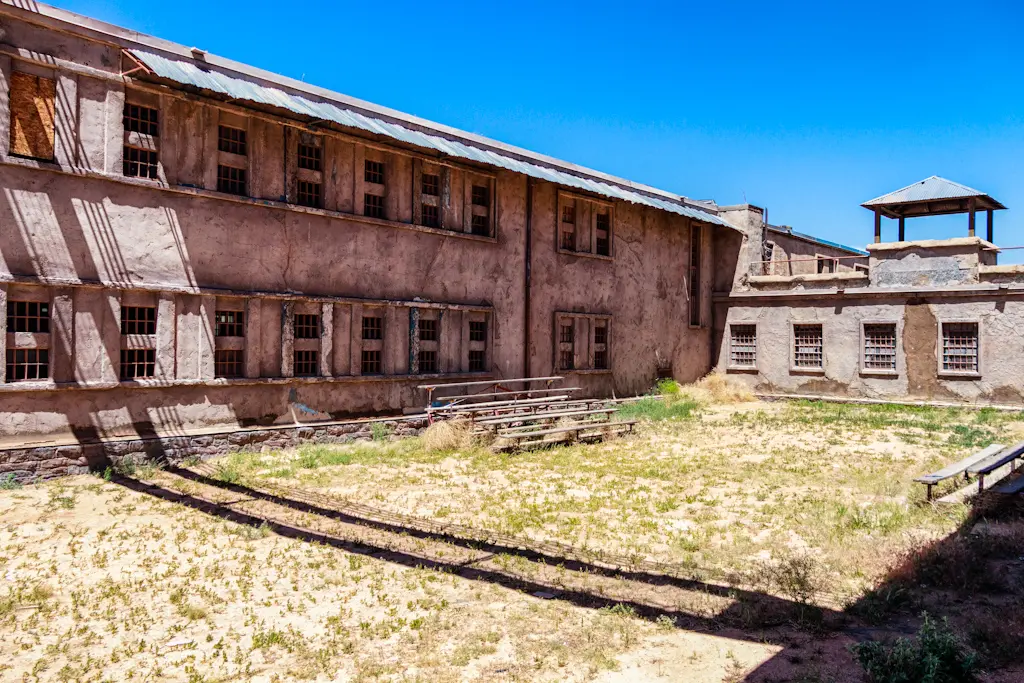
Old Main has held no prisoners since 1998. The maximum-security prison still operating on the same complex is a different set of buildings, and it is not open to the public. The riot block itself is an unheated concrete shell with no electricity and no running water, opened only for booked historical tours and film crews.
We found no named witness behind the ghost stories attached to it — and a great deal of documentation behind what actually happened there.
What is the history of Penitentiary of New Mexico?
There are two prisons behind this one name, and confusing them is the reason most accounts of the place are wrong.
The first Penitentiary of New Mexico was built in 1885 on what is now Cerrillos Road in Santa Fe. In 1956 the state replaced it with a new main prison some fifteen miles south, on State Road 14. That building — the one the New Mexico Corrections Department now calls "Old Main" — was designed to hold 900 men.
By the late 1970s it held far more. The department's own account of the period is blunt: overcrowded, underfunded, "on a path to disaster". The conditions had already reached federal court. On 6 July 1978 a group of prisoners led by Dwight Duran filed an amended class-action complaint against Governor Jerry Apodaca, corrections secretary Charles Becknell, division director Edwin Mahr, warden Levi Romero and deputy wardens Robert Montoya and Joseph Lujan. The complaint described men held two or more to cells measuring roughly six feet by nine, dormitories that could not be kept clean, mice, roaches and clogged toilets, and the collapse of educational, vocational and recreational programmes. In 1979 the parties signed partial consent agreements on food, visitation and access to legal services. The rest was still unresolved when the prison exploded.
It began during the overnight count on 2 February 1980. Prisoners overpowered officers and, within minutes, took the control centre — the room from which every door in the building was operated. Twelve correctional officers were taken hostage. Some were beaten, stabbed and sexually assaulted; others were hidden and protected by prisoners who wanted no part of what was happening.
What followed over the next thirty-six hours is why this riot is remembered differently from Attica. There was no unified prisoner demand and no prisoner solidarity. Rioters found power tools left behind by an ongoing construction project and used them to cut into Cell Block 4, the protective-custody unit that housed men labelled informants along with prisoners with mental illness and others who had asked to be separated for their own safety. The killings there were prolonged and deliberate. Elsewhere the pharmacy was ransacked, fires were set and the prison was flooded; the records of who was housed in the building burned with the offices.
After thirty-six hours the prisoners handed the building back to the National Guard, the State Police and corrections officials. Thirty-three men were dead. Every one of them was a prisoner: not a single officer was killed, a fact that sits uncomfortably against the scale of the violence. The Tenth Circuit later summarised the toll as thirty-three inmates killed and "at least ninety" seriously injured.
The consequences were legal and permanent. On 14 July 1980 the district court approved a consent decree running well over a hundred printed pages, regulating classification, discipline, maximum security, living conditions, medical and mental-health care, mail, legal access and visitation. When the state moved in 1987 to vacate seven parts of it, the district court refused and the Tenth Circuit affirmed on 15 September 1989. That same year of 1980, New Mexico opened the first correctional training academy in the country, and the attorney general published a two-volume investigation whose second part was written under a legislative mandate.
Old Main was repaired and reopened. It held prisoners for another eighteen years and closed in 1998.
Timeline: the documented record of Penitentiary of New Mexico
- 1885 New Mexico builds its first state penitentiary, in Santa Fe. It is not the building associated with the riot and it no longer stands.
- 1956 The state opens a new main prison on State Road 14, south of Santa Fe, built to hold 900 men. It is the building later known as "Old Main".
- 6 July 1978 Dwight Duran and other prisoners file an amended class-action complaint against Governor Jerry Apodaca and prison officials, alleging that overcrowding and conditions at PNM are unconstitutional.
- 1979 The parties sign partial consent agreements on visitation, food services and access to legal services. The core claims about overcrowding remain unresolved.
- 2 February 1980 During the overnight count, prisoners attack officers and take the control centre. Twelve correctional officers are held hostage; the department records that some were beaten, stabbed and sexually assaulted, and that others were protected by sympathetic prisoners.
- 3 February 1980 After 36 hours the prisoners hand control back to the National Guard, State Police and corrections officials. Thirty-three prisoners are dead and, by the Tenth Circuit's later account, at least ninety are seriously injured. No officer is killed.
- 14 July 1980 The federal district court approves the Duran consent decree — over a hundred printed pages regulating classification, discipline, maximum security, living conditions, medical and mental-health care, mail, legal access and visitation.
- 1980 The Attorney General of New Mexico publishes a two-volume report on the riot. The second volume, on the conditions that led to it, is written under a legislative mandate and includes the report of a Citizens Advisory Panel.
- 1980 New Mexico opens the New Mexico Corrections Training Academy, which the department describes as the first correctional training academy in the country. Before it, officers had no specialised training.
- 15 September 1989 The Tenth Circuit affirms the district court's refusal to vacate seven parts of the consent decree, which the state had challenged in 1987. The decree stands.
- 1998 Old Main closes after housing prisoners for eighteen more years following the riot. It has held nobody since.
- 2012 For the state centennial, corrections secretary Gregg Marcantel opens Old Main to public tours. The department reports that the whole year's dates were booked within about four days, that doubling the schedule filled just as fast, and that 22 tours were scheduled with more than 150 people signed up for each.
- 2 February 2015 On the thirty-fifth anniversary both chambers of the New Mexico legislature unanimously pass memorials to those affected. Several legislators who had worked at the prison speak about post-traumatic stress among officers and state police.
Is there a rational explanation for Penitentiary of New Mexico?
The version of this page we are replacing said that staff had described banging from empty cellblocks, a sense of dread in Cell Block 4 and cold spots that persist in any season, and it closed with a line attributed to "a former officer" speaking to "a reporter". We could not find that quotation anywhere, we could not find the officer, and we could not find the article. It has been removed rather than reworded.
We also could not find much of a haunting at all. Old Main does not appear on hauntedplaces.org, which lists ninety-two sites in New Mexico. Neither Ghost Adventures nor Ghost Hunters has filmed there, despite the two series between them having investigated Moundsville, the Old Idaho Penitentiary, Eastern State, the Wyoming Frontier Prison and the Missouri State Penitentiary. For a building with this history, the silence is conspicuous.
The state agency that owns it does nothing to encourage the idea. The New Mexico Corrections Department opened Old Main to visitors in 2012 under the motto "Respecting our past to create a better future", and its tour and filming pages contain no reference to ghosts of any kind.
Those same official pages happen to explain the one detail people repeat most. The department's advice to visitors is to "bring a light jacket or sweater, even in the summer months there are cold areas in the Old Main", to bring a flashlight because parts are dark, and to expect no running water, no electricity and no working restrooms. The cold spots of Old Main are a documented property of an unheated concrete building that has had no power since 1998.
The honest question is why a place like this attracts ghost stories at all, and the answer may be that nothing here is unexplained. On the thirty-fifth anniversary, in February 2015, both chambers of the New Mexico legislature passed memorials to those affected. Senator Richard Martinez, who had worked at the prison, called the gesture "long overdue" and said guards and state police had been left with PTSD. Senate majority leader Michael Sanchez said of the officers that "they've never been recognized, they've never been thanked". Representative Eliseo Alcon, another former prison employee, said that when he left he told himself "I never, never will go back and work in corrections". Survivors and families are still alive. Ghost stories are the easier thing to repeat.
Can you visit Penitentiary of New Mexico?
Two buildings share the name. The pin on this file, at 35.56194444, -106.06027778, falls on Old Main, the prison of 1956 where the riot happened; OpenStreetMap maps the "Penitentiary of New Mexico Old Main Unit" about 130 m from it. The department's facility page says the old building "closed in 1998 and is now used for tours and film sets". The Penitentiary of New Mexico that operates today, at 4311 State Highway 14, is described on the same page as "the state's maximum security, housing the highest security classification of male offenders", with Level 2 and Level 4 units, a Predatory Behavioral Management Program and a Special Management Unit. Visits there follow the department's visitation policy.
Old Main tours are run by the Corrections Department's Corrections Industries office. Its tour page, read on 23 September 2026, offers private tours for a maximum of 25 guests, large group and school tours for a maximum of 50, and special affiliated group trainings. The page lists no prices: "For Old Main Tour Fees, bookings, and additional information please email" [email protected].
Each visitor turns in four forms: the Old Main waiver, or its version for under-18s; the NCIC background form; a copy of a driving licence; and the Active Prison Grounds Entry Rules. "No one will be allowed on the Prison grounds without first fully completing all the forms", and the background checks need a minimum of five days. The minimum age is 16, with exceptions for under-16s made "for educational purposes and are on a case-by-case basis"; anyone under 18 needs a parent or guardian's signature and must be accompanied by an adult.
The department's safety tips describe the building. "There is a lot of walking to include stairs in different areas." Visitors are asked to wear closed-toe shoes, to bring "a light jacket or sweater, even in the summer months there are cold areas in the Old Main", and a flashlight "as there will be dark areas". There is "no running water, electricity, nor working restrooms".
Filming goes through the same office on (505) 437-8785. The first scout is free, limited to six hours and twenty people; prep and shoot days, and the hourly fee for each corrections officer on the property, are quoted by telephone.
The complex is on NM 14, the road signed as the Turquoise Trail, about 18 km (11 miles) south-west of the Santa Fe Plaza in a straight line; the address on the tour page is 4337 NM 14, Santa Fe, NM 87508. Thirty-three prisoners died in Old Main during the riot of 2 and 3 February 1980. In February 2015 both chambers of the state legislature passed memorials to those affected, and survivors and families of the dead are alive.
Sources consulted
- United States Court of Appeals for the Tenth Circuit, «Duran v. Carruthers, 885 F.2d 1485 (10th Cir. 1989)» — Federal Reporter, Second Series, 1989 archive
- New Mexico Attorney General's Office (Jeff Bingaman), «Report of the Attorney General on the February 2 and 3, 1980 riot at the Penitentiary of New Mexico (2 vols.)» — State of New Mexico, Office of the Attorney General, Santa Fe (LCCN 80623176), 1980 report
- New Mexico Corrections Department, «1980 Prison Riot at the "Old Main" / Old Main History» — Official departmental page, archived by the Wayback Machine, 2014 archive
- New Mexico Corrections Department, Corrections Industries, «Old Main / Filming and Tours» — Official visitor and production information, 2026 archive
- New Mexico Corrections Department, «Penitentiary of New Mexico» — Official facility page, 2026 archive
- Matthew Reichbach, «Legislature remembers State Pen prison riot» — New Mexico Political Report, 2015 newspaper archive
- Mark Colvin, «The 1980 New Mexico Prison Riot» — Social Problems, vol. 29, no. 5, pp. 449-463, 1982 academic
- Andrew Brininstool, «High Desert Blood: The 1980 New Mexico Prison Riot and the Tragedy of the Williams Brothers» — University of Iowa Press, 2025 book
- New Mexico Corrections Department, «Annual Report 2025» — Official annual report (statewide capacity 6,364; population over 5,800), 2025 report
Reviewed by V. Serrano on 2026-08-11 · How we verify our content
💬 Field testimonies (0)
No testimonies yet. Add the first.
Add your testimony
🔒 Log in to add a testimony