👻 HAUNTED PLACE · EXP. Nº9478
ACTIVE
Pennhurst State School and Hospital
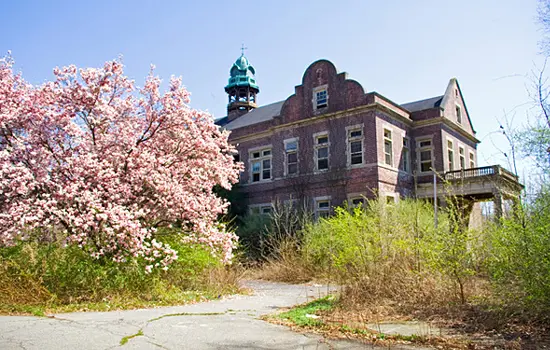
Opened in 1908 as the Eastern Pennsylvania State Institution for the Feeble-Minded and Epileptic, Pennhurst warehoused thousands of disabled children and adults.
Where is Pennhurst State School and Hospital?
- Location
- Pennsylvania, United States
- Type
- Hospital / asylum
- Coordinates
- 40.194, -75.56
- Last updated
LOCATION
Why is Pennhurst State School and Hospital said to be haunted?
Bill Baldini's 1968 documentary for Philadelphia's NBC station, "Suffer the Little Children", showed the country what went on inside: patients neglected and restrained in overcrowded wards. Out of it came Halderman v. Pennhurst, a case almost always told backwards: in 1977 federal judge Raymond Broderick ruled for the residents, but the Supreme Court reversed twice, in 1981 and 1984, and the case ended up a landmark of federalism — the so-called Pennhurst doctrine — rather than of disability rights, which were won at trial and in the 1985 settlement. The institution closed in 1987 after 79 years. Since 2010 the site has run seasonally as a haunted attraction, staged atop a documented history that disability organisations have publicly objected to.
What is the history of Pennhurst State School and Hospital?
The word on the tickets is wrong. Pennhurst was never an asylum and never a psychiatric hospital. It opened in 1908 as the Eastern Pennsylvania Institution for the Feeble Minded and Epileptic, on some 1,400 acres outside Spring City, in rural Chester County, and the people sent there were children and adults with intellectual and developmental disabilities. The historian Dennis Downey, of Millersville University, records that the campaign to build it was driven by Philadelphia public health figures — Martin Barr, Joseph Neff and George Stanley Woodward — alarmed at what they described as a rising tide of hereditary "feeble-mindedness". The remedy they proposed was "perpetual quarantine". That is the founding idea of the place, and it is worth stating plainly before any ghost is mentioned: Pennhurst was not built to treat anybody. It was built to remove them.
It then did what such institutions did everywhere. Billy Penn reports that the campus was laid out for about 500 residents; by 1957 it held some 3,500. Downey puts the peak at more than 3,500 people in custodial care, and the total across the institution's eight decades at more than 10,500 individuals. Those are not the numbers of a hospital. They are the numbers of a warehouse with a school's name on the gate.
What broke the silence was five nights of local television. Between 1 and 5 July 1968, the reporter Bill Baldini ran a five-part series on Channel 10 in Philadelphia — the station now known as NBC10 — under the title Suffer the Little Children. Downey, writing in the Philadelphia Inquirer fifty years later, notes that Baldini was granted access to film inside the buildings that had never been given before, and credits the broadcast with introducing "a new style of television journalism" and demonstrating "the persuasive power of the media to shape public opinion". Downey's summary of what the cameras found is unsparing: "Medical experimentation, cruel punishments, and the constant threats to physical and psychological well-being were part of the institutional culture." Baldini's own line to camera, quoted by Billy Penn, was blunter: "These unfortunates are being deprived of their dignity and self-respect. Why? Because only a very, very few seem to care."
Public outrage is not a legal remedy, and improvements after 1968 proved temporary. The remedy arrived on 30 May 1974, when a class action was filed in the U.S. District Court for the Eastern District of Pennsylvania on behalf of a resident named Terri Lee Halderman — a young woman who, according to Billy Penn, had accumulated unexplained injuries across roughly a decade inside. Her lawyer was David Ferleger. The trial before Judge Raymond J. Broderick ran thirty-two days.
The findings of that court, quoted afterwards by the Supreme Court itself and never disputed on appeal, are the reason this entry exists. "Conditions at Pennhurst are not only dangerous, with the residents often physically abused or drugged by staff members, but also inadequate for the 'habilitation' of the retarded," the District Court held; it further found "that the physical, intellectual, and emotional skills of some residents have deteriorated at Pennhurst." The same Supreme Court opinion describes the institution as housing roughly 1,200 residents at the time, of whom seventy-five per cent were classed as severely or profoundly disabled, with about half committed by court order and half placed there by a parent or guardian. Broderick found the place overcrowded and understaffed, identified constitutional violations, ordered Pennhurst eventually closed, ordered community living arrangements and individual treatment plans for every resident, and appointed a Special Master to supervise the whole thing.
The case reached the Supreme Court twice, and here the popular version usually goes wrong. Both trips were defeats for the residents. On 20 April 1981, in an opinion by Justice Rehnquist, the Court held that section 6010 of the Developmentally Disabled Assistance and Bill of Rights Act created no substantive rights at all, only a statement of congressional preference, and reversed the Third Circuit. On 23 January 1984, by five votes to four, in an opinion by Justice Powell, it went further: "the Eleventh Amendment prohibited the District Court from ordering state officials to conform their conduct to state law." That second ruling is genuinely a landmark — but it is a landmark of federalism and sovereign immunity, taught in law schools as the Pennhurst doctrine, and it made it harder, not easier, for people in institutions to get relief in federal court. The disability-rights victory at Pennhurst was won downstairs, in Broderick's courtroom, and then at the negotiating table.
It was also won with evidence. While the appeals ground on, James W. Conroy and Valerie J. Bradley were running the Pennhurst Longitudinal Study for the U.S. Department of Health and Human Services, tracking what actually happened to people moved out. Their combined five-year report, delivered in February 1985, took as its baseline the 1,154 residents living at Pennhurst on 17 March 1978 — eighty-six per cent of them severely or profoundly disabled, more than half non-verbal — and documented adaptive-behaviour gains among those who moved to community living arrangements, together with family agreement with the placements after the fact. The Minnesota Governor's Council on Developmental Disabilities notes that more than sixty per cent of families had initially opposed the transfers and that six months later they overwhelmingly approved, and puts the scale of the litigation at roughly five hundred court orders and twenty-eight published opinions.
On 5 April 1985 Judge Broderick handed down the opinion reported at 610 F. Supp. 1221 that closed the litigation with a settlement between the parties. Pennhurst shut in 1987, seventy-nine years after it opened. The buildings were left to rot. Pennsylvania sold the site in 2008; a historical marker went up in 2010 and the campus was designated an International Site of Conscience, tying it to the disability civil rights movement it had accidentally created. And in the autumn of that same year, a for-profit haunted attraction opened in the wards.
Timeline: the documented record of Pennhurst State School and Hospital
- 1908 The Eastern Pennsylvania Institution for the Feeble Minded and Epileptic opens on some 1,400 acres outside Spring City, Chester County. Philadelphia public health figures Martin Barr, Joseph Neff and George Stanley Woodward had promoted it against a supposed rising tide of hereditary "feeble-mindedness", advocating "perpetual quarantine".
- 1957 A campus laid out for about 500 residents is holding some 3,500 people. Across its eight decades more than 10,500 individuals will pass through.
- 1-5 July 1968 Bill Baldini's five-part series "Suffer the Little Children" airs on Channel 10 in Philadelphia. He was allowed to film inside as no reporter had been before; the historian Dennis Downey credits the broadcast with introducing "a new style of television journalism".
- 30 May 1974 A class action is filed in the U.S. District Court for the Eastern District of Pennsylvania on behalf of resident Terri Lee Halderman. Her attorney is David Ferleger; the case will be tried before Judge Raymond Broderick over thirty-two days.
- 1977 The District Court finds that "Conditions at Pennhurst are not only dangerous, with the residents often physically abused or drugged by staff members, but also inadequate for the 'habilitation' of the retarded", and that some residents' physical, intellectual and emotional skills had deteriorated there. It orders Pennhurst closed, community placements and individual treatment plans, and appoints a Special Master.
- 17 March 1978 The baseline of the federally funded Pennhurst Longitudinal Study: 1,154 people living at Pennhurst, 86% of them severely or profoundly disabled and more than half non-verbal.
- 20 April 1981 The U.S. Supreme Court, per Justice Rehnquist, holds that section 6010 of the Developmentally Disabled Assistance and Bill of Rights Act creates no substantive rights but only expresses a congressional preference, and reverses the Third Circuit.
- 23 January 1984 By 5-4, in an opinion by Justice Powell, the Supreme Court holds that "the Eleventh Amendment prohibited the District Court from ordering state officials to conform their conduct to state law" — a landmark of federalism known as the Pennhurst doctrine, and a second defeat for the residents.
- February 1985 James W. Conroy and Valerie J. Bradley deliver the combined five-year Pennhurst Longitudinal Study to the U.S. Department of Health and Human Services, documenting adaptive-behaviour gains among residents moved to community living arrangements and family agreement with the placements.
- 5 April 1985 Judge Broderick hands down the opinion reported at 610 F. Supp. 1221 in the Eastern District of Pennsylvania; the litigation ends in a settlement between the parties after roughly five hundred court orders and twenty-eight published opinions.
- 1987 Pennhurst closes, seventy-nine years after opening. The buildings are abandoned and fall into disrepair; Pennsylvania sells the site in 2008.
- 2010 Pennsylvania erects a historical marker on the campus and the site is designated an International Site of Conscience, linking it to the national and international disability civil rights movement.
- 24 September 2010 The for-profit "Pennhurst Asylum" haunted attraction opens over the objections of disability advocates. The Arc of Pennsylvania calls it "an abomination"; the Public Interest Law Center writes that it "threatens to exploit the tragedy at Pennhurst for cheap thrills", comparing it to an "Escape from the Twin Towers" ride at Ground Zero.
- 2017 New investors buy the property and change the backstory, imagery and exhibits; performers become generic monsters instead of caricatures of disabled people. Members of the Pennhurst Memorial and Preservation Alliance later report that more than 80% of the performers identify as living with a disability.
- 25 October 2022 The Philadelphia Inquirer reports that opposition continues — Jeanne Meikrantz, of the Arc of Chester County, calls the attraction "horrible and traumatic" — while disabled cast members defend their work in it. James Conroy recalls the early years of the haunt: "It was sickening."
Is there a rational explanation for Pennhurst State School and Hospital?
Pennhurst is one of the few haunted sites where the sceptical case does not need to argue about cold spots at all. It only needs to point at what the fiction is standing on top of.
Start with the framing. The attraction is called Pennhurst Asylum, and the word does the whole job: it converts a state institution for people with intellectual disabilities into a madhouse, which is a different and much more marketable thing. Disability Scoop reported in September 2010, before the doors opened on the 24th, that advocacy groups had already read the transaction correctly. The Arc of Pennsylvania called it "an abomination because it merely perpetuates such stereotypes about people with intellectual and developmental disabilities". The Public Interest Law Center — the organisation that had litigated on behalf of Pennhurst's residents — wrote that "this haunted house threatens to exploit the tragedy at Pennhurst for cheap thrills", and offered a comparison that has not aged: a thrill ride called "Escape from the Twin Towers" at Ground Zero.
The early version made the point for them. Reporting for the Philadelphia Inquirer in October 2022, Abraham Gutman recorded that the attraction initially used original artefacts from the institution, restraining jackets and wheelchairs among them, while actors performed as patients — talking to themselves, rocking back and forth. The medical sociologist James Conroy, who had spent five years measuring what happened to the real residents for the federal government, gave Gutman a two-word review: "It was sickening."
Then the commercial incentive, which is the part visitors rarely weigh. The site does not merely tolerate a ghost reputation; it sells one. Its own tours page advertises overnight paranormal investigations of seven hours, with a campus tour led by a paranormal expert and access to detection equipment, plus private site rentals starting at a $1,250 minimum for up to ten people. A building whose income depends on anomalies is not a neutral witness to anomalies, and every EVP recorded there is recorded inside a purpose-built horror attraction. The venue's own FAQ notes fog and strobe effects sufficient to warn people with asthma or epilepsy, and states that actors may touch visitors. Add four decades of decay, no daylight, no working lights, and disorientation is not a mystery: it is the product.
There is also a simple test of what the place is really selling. Phones and cameras are banned inside the haunted attractions but permitted on the paranormal and history tours. The scares are protected as intellectual property; the ghosts are offered as documentation.
And the deepest objection is the one the Myrtles teaches. A ghost story about faceless inmates occupies precisely the space where 10,500 named people should be. We are not short of records here. We know that on 17 March 1978 there were 1,154 people living at Pennhurst, that eighty-six per cent were severely or profoundly disabled, that more than half had no spoken language — and, unusually for any institution anywhere, we know what happened to them afterwards, because Conroy and Bradley followed them for five years and reported that the people who moved out gained ground. That is a real story with a real ending, and no apparition improves it.
The honest coda is that the fiction has since been renegotiated rather than simply condemned. Writing in Impact, the journal of the Institute on Community Integration at the University of Minnesota, Diana Muller Katovich, Jess Gallagher and James Conroy — all associated with the Pennhurst Memorial and Preservation Alliance, which had opposed the attraction — record that after investors bought the property in 2017 the backstory, imagery and exhibits were changed, performers became generic monsters rather than caricatures of disabled people, revenue rose anyway, and more than eighty per cent of the performers identified themselves as living with a disability. Not everyone is persuaded: Gutman quotes Jeanne Meikrantz, chief executive of the Arc of Chester County, calling the attraction "horrible and traumatic", and the legal scholar Natalie Chin asking whether education and commodification can genuinely coexist — "Can you really do both?" One of the disabled cast members, the psychology student Autumn Werner, told Gutman she saw it as a necessary evil, and framed her own part in it exactly the other way round: "I'm scaring people. I'm in a position of power." That is a sentence with a century of Pennhurst behind it.
Can you visit Pennhurst State School and Hospital?
The campus is at 601 N Church Street, Spring City, Pennsylvania 19475, roughly an hour north-west of Philadelphia by road. The land is private and every form of access to it is ticketed.
Haunted Attraction Network reported on 18 July 2026 that the 2026 Halloween season opens on Friday 25 September and runs Fridays and Saturdays until 7 November, with Sundays added through October. On 9 September 2026 the operator's ticket page gave box office hours of 18:30 to 22:30 on Friday and Saturday and 18:30 to 21:30 on Sunday, under the line "Haunt remains open past ticket hours! Must be on site before box office closes." The same page states "All ticket sales are final. No refunds or returns" and "All tickets are printed online"; group sales go through 484-886-6080. No ticket price was published on that page on the date of this check.
The house rules are the operator's own, and the age line is the one most often reported wrongly. The FAQ reads: "We will allow children as young as 10 to go through the attraction but we did not recommended it." Actors may touch guests; guests may not touch the actors or the props. Phones and cameras are barred from the four haunted attractions — Pennhurst Asylum, The Morgue, The Tunnels and The Catacombs — and permitted on the paranormal and history tours. The FAQ warns of fog and strobe lighting for anyone with asthma or epilepsy and asks asthmatic guests to carry an inhaler; on footwear it says "Proper shoes are necessary- flip flops, sandals or high heels are not recommended." The attraction runs in rain and closes only in extreme weather. Cash and most major credit cards are taken. The military and police discount requires valid ID at the gate and extends to immediate family. No accessibility or wheelchair policy appeared anywhere on that FAQ on 9 September 2026.
The overnight paranormal investigations are sold separately: 19:00 to 02:00, arrival by 18:30, seven hours, over-18s unless a guardian stays with the minor throughout. They cover the four floors of Mayflower Hall and the tunnels linking the Philadelphia, Devon and Rockwell buildings. Private site rental runs the same hours from a $1,250 minimum for up to ten people, Sunday to Thursday; Friday and Saturday go by special arrangement.
The daytime history tour is the one built on the documented site: about three hours on the exteriors of sixteen Lower Campus buildings, led by the operator's history guides, carrying its own warning that "the information shared may be triggering to some guests." The Pennsylvania Historical and Museum Commission marker stands off the campus, on Schuylkill Road — Route 724, East Vincent Township, Chester County — where it was dedicated on 10 April 2010. The Pennhurst Memorial and Preservation Alliance, which campaigned for that marker, is a member of the International Coalition of Sites of Conscience. Bill Baldini's 1968 broadcast Suffer the Little Children, the reason the campus has a public history at all, is on the Internet Archive at no charge.
Sources consulted
- Dennis Downey, «Pennhurst State School and Hospital» — The Encyclopedia of Greater Philadelphia, Rutgers University, 2013 academic
- Supreme Court of the United States, «Pennhurst State School and Hospital v. Halderman, 451 U.S. 1 (1981)» — Legal Information Institute, Cornell Law School, 1981 archive
- Supreme Court of the United States, «Pennhurst State School and Hospital v. Halderman, 465 U.S. 89 (1984)» — Legal Information Institute, Cornell Law School, 1984 archive
- James W. Conroy and Valerie J. Bradley, «The Pennhurst Longitudinal Study: Combined Report of Five Years of Research and Analysis» — U.S. Department of Health and Human Services, Office of the Assistant Secretary for Planning and Evaluation, 1985 report
- Dennis B. Downey, «Remembering 'Suffer the Little Children' and Pennhurst's legacy» — The Philadelphia Inquirer, 2018 newspaper archive
- Avi Wolfman-Arent, «Pennhurst, a real-life horror story that changed disability law» — Billy Penn at WHYY, 2023 newspaper archive
- Minnesota Governor's Council on Developmental Disabilities, «Pennhurst (Basic Legal Rights)» — disabilityjustice.org, 2026 report
- Michelle Diament, «Haunted 'Asylum' At Site Of Former Institution Has Disability Advocates Cringing» — Disability Scoop, 2010 newspaper archive
- Abraham Gutman, «Pennhurst Asylum haunted house draws criticism every Halloween. A group of disabled actors running the show says there is more to the story» — The Philadelphia Inquirer, 2022 newspaper archive
- Diana Muller Katovich, Jess Gallagher and James W. Conroy, «Fear and Loathing at Abandoned Institutions: Is There Any Redemptive Value?» — Impact 36(3), Institute on Community Integration, University of Minnesota, 2023 academic
- Bill Baldini, «Suffer the Little Children (1968 television series on Pennhurst State School)» — Internet Archive, 1968 archive
- Pennhurst Asylum, «Pennhurst Asylum — Frequently Asked Questions» — pennhurstasylum.com, 2026 web
- Pennhurst Asylum, «Pennhurst Asylum — Tours and Events» — pennhurstasylum.com, 2026 web
- U.S. District Court for the Eastern District of Pennsylvania, «Halderman v. Pennhurst State School & Hospital, 610 F. Supp. 1221 (E.D. Pa., 5 April 1985)» — CourtListener, Free Law Project, 1985 archive
Reviewed by V. Serrano on 2026-07-31 · How we verify our content
💬 Field testimonies (0)
No testimonies yet. Add the first.
Add your testimony
🔒 Log in to add a testimony