👻 HAUNTED PLACE · EXP. Nº9477
ACTIVE
Peoria State Hospital
The Peoria State Hospital opened above Bartonville, Illinois, in 1902 as the Illinois Asylum for the Incurable Insane, and Dr George A. Zeller took charge of it on 1 November that year.
Where is Peoria State Hospital?
- Location
- Illinois, United States
- Type
- Hospital / asylum
- Coordinates
- 40.639, -89.662
- Last updated
LOCATION
Why is Peoria State Hospital said to be haunted?
Within three years he had emptied the wards of restraints: the biennial report of 1908 claimed two full years in which two thousand patients were cared for without mechanical restraint, without bars on the windows and "without once turning a key upon a single patient". It closed in 1973. What made it famous, though, was a ghost — "Old Book", a patient written into the ledger as A. Bookbinder because nobody knew his name, said to have wept at every burial and to have been seen weeping at his own funeral beside an elm that withered soon after. The story is Zeller's own, but he published it as "The Graveyard Elm", one of a set of tales he called asylum romances and which bibliographers have filed under fiction ever since. The buildings are almost all gone. The four cemeteries, with more than 4,000 graves and many marked only by a number, are not.
What is the history of Peoria State Hospital?
The hospital that became famous for a ghost kept a first-hand record of itself, and the record is stranger than the ghost.
The institution opened in 1902 on a hilltop above Bartonville, Illinois, as the Illinois Asylum for the Incurable Insane — a name, its superintendent wrote, that "conveyed neither cheer nor hope". Governor John R. Tanner had appointed George Anthony Zeller to run it four years earlier, in 1898; Zeller spent those four years as an Army surgeon in the Philippines and never drew a dollar of the salary. He finally took charge on 1 November 1902, and found 690 patients already there, every one of them moved in from the overflow of the other state asylums during what he called his long delay in reaching home. "Not one was from a poor house, as our county homes were designated at that time," he wrote. "In not a single instance had the institution risen to the situation it was specifically charged to remedy."
That situation was a survey by the state board of charities counting 2,983 insane inmates living in the 101 almshouses of Illinois. Zeller set about emptying them. In the autumn of 1904 eight new cottages opened, a hundred beds each, and a circular went to the county judges offering to take twenty women from each poorhouse; some seven hundred people arrived in three months.
One of them was Rhoda Derry, carried up the hill from the railway in a clothes basket. Zeller reprinted the Adams County state's attorney's description of her in the state report for 1908, under the heading "Twentieth Century Witchcraft": a woman of about sixty-six, forty-three of them in the county house, blind because "she beat out her own eyes", kept in a box whose straw had to be changed several times a day, and with an identity that was "practically unknown". Her neighbours, the letter said, ascribed her malady to witchcraft. She died on 19 October 1906, and Zeller recorded exactly where she went: "buried in grave number 217, asylum cemetery".
Against that background his reform reads less like progressive theory than like a rescue. On 1 November 1905 — "exactly three years from the day we took charge" — the hospital held two thousand patients "without a bar on any window, without a locked room, without a vestige of mechanical or medicinal restraint, and with a female attendant or nurse in charge of every ward for men". The official report of 1906 listed the innovations as a programme: non-restraint, non-imprisonment, the eight-hour tour of duty, women attendants for insane men, segregation of consumptives, colonisation of epileptics, phototherapy. The biennial report of 1908 opened by claiming two full years in which two thousand of "the most violent, destructive and dangerous insane in the world" had been cared for without mechanical restraint, without narcotics outside the sick wards, without a screen or bar on any door or window and "without once turning a key upon a single patient". In 1909 Illinois renamed the system it had built: asylums became State hospitals, inmates became patients, poorhouses became county homes.
Zeller ran the place until 1913, served as State Alienist of Illinois until 1917, returned to the hilltop in 1921 and stayed into the mid-1930s. He died in 1938, and the paper the patients and employees printed, Asylum Light, gave him its issue of 29 June that year. The hospital itself closed in 1973.
And the ghost. In the story that made the place famous, a patient entered in the ledger as A. Bookbinder — the trade written down because nobody knew his name — worked on the burial detail and wept at every grave, which earned him the nickname Old Book. At his own funeral, the retellings say, hundreds of staff and patients heard weeping from an elm beside the cemetery and saw his shape leaning against it; the tree withered soon afterwards. Where that story came from is a question with a documented answer.
Timeline: the documented record of Peoria State Hospital
- 1898 Governor John R. Tanner appoints George Anthony Zeller superintendent of the unfinished Illinois Asylum for the Incurable Insane. Zeller spends the next four years as an Army surgeon in the Philippines and, by his own account, never draws a dollar of the salary.
- 1 November 1902 Zeller finally takes charge at Bartonville. He finds 690 patients, all transferred from the overflow of other state asylums and none from an almshouse — the population the institution had been created to relieve.
- Autumn 1904 Eight new cottages open with a hundred beds each and a circular goes out to the county judges offering to take twenty women from each poorhouse. Around seven hundred people arrive in three months, among them Rhoda Derry, carried up the hill in a clothes basket.
- 1 November 1905 Three years to the day after taking charge, Zeller reports two thousand patients held "without a bar on any window, without a locked room, without a vestige of mechanical or medicinal restraint". The hospital issues its book of rules the same day.
- 19 October 1906 Rhoda Derry dies at the hospital. Zeller records her burial "in grave number 217, asylum cemetery", and reprints in the 1908 state report the letter describing her forty-three years in the Adams County almshouse, blind, with an identity "practically unknown" and a condition her neighbours blamed on witchcraft.
- 1908 The biennial report claims a complete two-year period in which two thousand of "the most violent, destructive and dangerous insane in the world" were cared for without mechanical restraint, without narcotics outside the sick wards and "without once turning a key upon a single patient".
- 1909 Illinois renames the system: asylums become State hospitals, inmates become patients and poorhouses become county homes. Zeller notes the change in his memoirs as a deliberate act of language.
- Around 1910 The funeral of the patient known as "Old Book", entered in the ledger as A. Bookbinder because his name was unknown, is the scene of the apparition Zeller would publish as "The Graveyard Elm". No document I have been able to consult fixes the year, and the graves are numbered rather than named, so there is nothing to check it against.
- 1926-1927 The Illinois Department of Public Welfare reprints Zeller's short stories from its Welfare Magazine and publishes the collection The Bereft: A Series of Asylum Romances, whose contents include "The Graveyard Elm". Geoffrey D. Smith's American Fiction, 1901-1925 catalogues the book as fiction.
- Around 1930 Zeller finishes the typescript of his autobiography, Befriending the Bereft. It is never published: in the text he complains of "casting about for means to publish these memoirs since the State has not seen fit to do so". The Alpha Park Public Library holds the original and two manuscript copies.
- 29 June 1938 Zeller dies. Asylum Light, the paper printed by the patients and employees of the Peoria State Hospital, devotes its issue of that date to him under the heading "Beloved Physician and Friend".
- 1973 The Peoria State Hospital closes after seventy-one years.
- 25 July 1980 The Reardon Company of Bartonville files the application to list the Peoria State Hospital Historic District in the National Register of Historic Places, with a statement of significance by Tom Edwards and architectural descriptions by Anderson, Notter, Finegold of Boston. The covering letter already announces plans "setting aside space building for a museum". The district is listed in 1982 under reference 82002590.
- 2017 The Bowen Building is demolished, a year after Bartonville approved a $400,000 demolition loan and asbestos abatement costs defeated the last rescue plans. By 2023 only 13 of the original 63 buildings remain standing.
Is there a rational explanation for Peoria State Hospital?
The ghost story of Peoria State Hospital is not a rumour that grew in the dark. It has an author, and the author signed it.
Zeller wrote it up as "The Graveyard Elm". It is one of nine titles in a book he called The Bereft: A Series of Asylum Romances, published by the Illinois Department of Welfare — the same imprint that reprinted his short stories "No Gentleman" (April 1926), "The Rajah's Return" (February 1927) and "Treasure Cab" (May 1927) from its Welfare Magazine. Its companions in the volume are "Fainting Fanny", "The Genealogist", "The Lucid Interval", "The Missing Meissonier", "The Necrophile", "The Port of Missing Identities", "The Post Mortem Finding" and "The Pyromaniac". A copy sits in the Peoria State Hospital collection of the Alpha Park Public Library in Bartonville, whose published inventory lists the contents story by story. And the standard reference work American Fiction, 1901-1925: A Bibliography, compiled by Geoffrey D. Smith, carries the entry: "Zeller, George Anthony, 1858-1938. The bereft: a series of asylum romances". Its author issued it as a set of tales, and bibliographers have filed it under fiction ever since.
The book usually credited with the episode is a different one: Zeller's autobiography, Befriending the Bereft. That autobiography was never published. Gary L. Lisman's history of the hospital cites it as an unpublished autobiography of around 1930; the Alpha Park inventory records the original plus two loose manuscript copies; and in the typescript Zeller says as much himself, complaining that he is "casting about for means to publish these memoirs since the State has not seen fit to do so". Reading the 118-page typescript the library has digitised, I could not find the episode anywhere in it. The chapters on Peoria are a campaign against mechanical restraint, quoting rules, reports and letters — not a ghost story.
Nothing in the tale can be checked against a record, and that is structural rather than sinister. The surname in the ledger was a trade, because the man's name was unknown; the graves in the hospital's four cemeteries are marked, in their thousands, with numbers instead of names; and the tree is gone. The retellings do not even agree on what happened to it: Troy Taylor's Weird Illinois has the elm beginning to wither a few days after the funeral and dead within the year, while Sylvia Shults dates the withering to within weeks of it.
What is verifiable is the motive, and Zeller never hid it. He spent thirty years arguing in print that a public which thought asylums were warehouses should look at the people inside them. In his reports and his memoirs he does that with names, dates and page references — Rhoda Derry in grave 217, Martha of Spring Bay who would otherwise have been "merely a case number on our records". In The Bereft he does it with stories. Both were advocacy; only one of them was reporting.
Can you visit Peoria State Hospital?
No abandoned asylum stands here to be explored, and the building that illustrates most photographs of the site came down years ago.
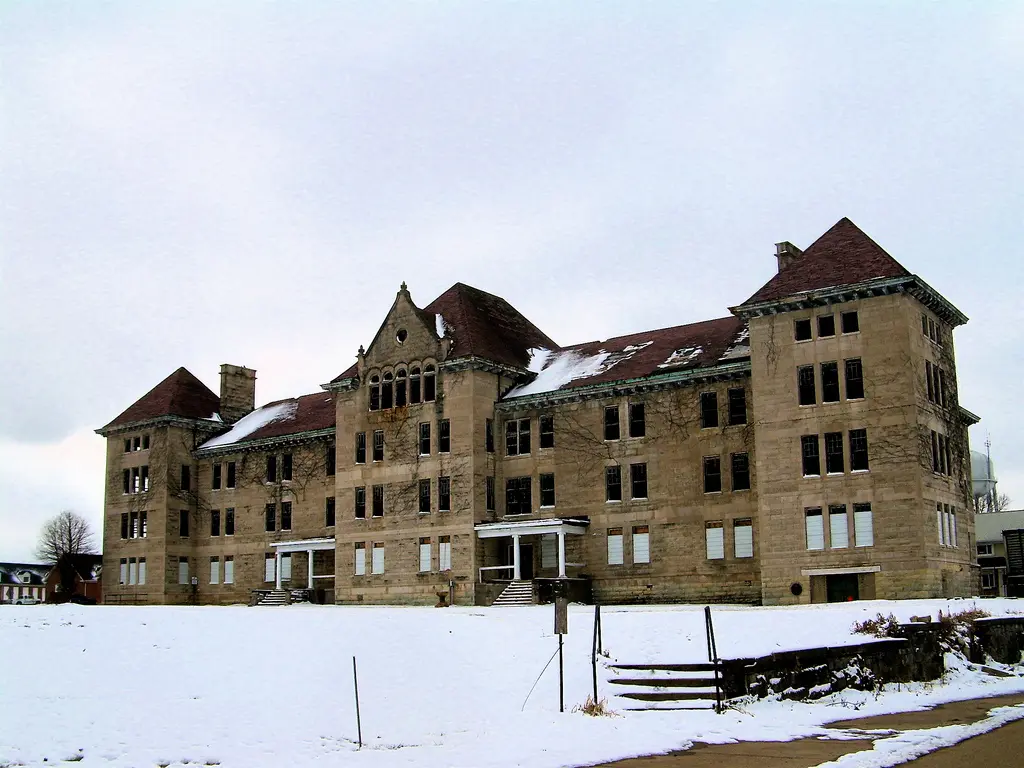
Of the 63 buildings on the original campus, the Peoria Journal Star counted 13 still standing in October 2023. The Bowen Building — the four-storey limestone block with the corner towers that heads almost every article about the place, including the photograph on this page — was demolished in 2017, after the village of Bartonville approved a $400,000 demolition loan in January 2016 and asbestos abatement costs defeated every attempt to save it.
The Peoria State Hospital Museum, founded in 2013, has acquired three of the surviving buildings and is the part of the site open to the public. It is at 4400 Industry Road, Bartonville, Illinois 61607, telephone (309) 232-8794, and its own page says it is "Open by appointment during the winter season". Its exhibits include Dr Zeller's personal display case and what it describes as the only surviving Peoria State Hospital Utica crib, a restraint bed of exactly the kind Zeller abolished.
The museum's tour page, read on 11 September 2026, advertises three kinds of visit. The private historical tour runs on Fridays from 6 to 9 p.m., costs $175 for up to five people and takes three hours on foot, covering the four asylum cemeteries and the surviving structures and ending in Cottage B1 with the artefacts on display and questions to the guide. The public history-and-paranormal evenings fall on four Saturdays of the 2026 calendar, at $20 for the history programme or $50 with the investigation. Private paranormal bookings are priced by season and day: $300 on a winter Friday and $350 on a winter Saturday, $400 and $450 in spring and summer, six hours included, extra hours at $100 and extra team members at $100 each, against a deposit of $200 in winter and $250 for the rest of the year. The calendar is short and the dates move from one year to the next.
More than 4,000 people are buried in those four cemeteries, a great many of them under a number instead of a name.
Sources consulted
- George Anthony Zeller, «The Autobiography of George A. Zeller, M.D. (typescript of Befriending the Bereft, 118 pp.)» — Peoria State Hospital Collection, Alpha Park Public Library, Bartonville, Illinois, 1930 archive
- Alpha Park Public Library District, «Website List: Books (Including Zeller autobiography/publications) and Reports — inventory of the Peoria State Hospital Collection» — Alpha Park Public Library, Bartonville, Illinois, 2011 archive
- The Reardon Company, with Tom Edwards and Anderson, Notter, Finegold Inc., «Peoria State Hospital Historic District: Application for Listing in the National Register of Historic Places» — Illinois Department of Conservation, Division of Historic Sites, 1980 report
- Geoffrey D. Smith, «American Fiction, 1901-1925: A Bibliography (entry for Zeller, George Anthony, The bereft: a series of asylum romances)» — Cambridge University Press, 1997 book
- Dean Muellerleile, «The history and mystery surrounding Peoria State Hospital in Bartonville» — Peoria Journal Star, 2023 newspaper archive
- Peoria State Hospital Museum, «Tours and Museum & Exhibits» — peoriastatehospital.com, 2026 web
- M. A. Kleen, «Ethereal Remains of Peoria State Hospital» — michaelkleen.com, 2018 web
- Troy Taylor, «Weird Illinois (retelling of the Graveyard Elm)» — Sterling, 2005 book
- Sylvia Shults, «Fractured Spirits: Hauntings at the Peoria State Hospital» — History Press, 2010 book
- Gary L. Lisman, «Bittersweet Memories: A History of the Peoria State Hospital» — AuthorHouse, 2005 book
Reviewed by V. Serrano on 2026-08-13 · How we verify our content
💬 Field testimonies (0)
No testimonies yet. Add the first.
Add your testimony
🔒 Log in to add a testimony