👻 HAUNTED PLACE · EXP. Nº1189
ACTIVE
Preston Manor, Brighton
Preston Manor, Brighton is a location reputed to be haunted in Brighton, GB. Its reputation comes from reported apparitions, unexplained phenomena and eyewitness accounts gathered over time.
Where is Preston Manor, Brighton?
- Location
- Brighton, GB
- Type
- House / mansion
- Coordinates
- 50.843, -0.15
- Testimonies
- 0
- Last updated
LOCATION
Why is Preston Manor, Brighton said to be haunted?
Preston Manor is the former manor house of Preston, now a Brighton museum of Edwardian upstairs-downstairs life, and one of the few English haunted houses whose story can be dated to the day. On Wednesday 11 November 1896 the medium Ada Goodrich Freer and Thomas Douglas Murray of the Ghost Club held a séance in the manor's Cleves Room for Eleanor Macdonald and her daughter Lily, who had seen a white-robed figure in the drawing room weeks before. The ouija board gave a name: Sister Agnes, an excommunicated nun buried outside the house in unconsecrated ground. On Friday 29 January 1897 workmen digging up the drains found a woman's skeleton under the south terrace. No coroner was called; a doctor aged the bones by eye, and they were reburied at night in St Peter's churchyard. The shorthand notes of the sitting are still kept at the manor, and the museum's own venue officer says of Sister Agnes that the story was made up. The house, listed Grade II* in 1952, has a medieval basement, an 1738 datestone signed by Thomas Western and a 1905 remodelling by Charles Stanley Peach.
What is the history of Preston Manor, Brighton?
Preston Manor stands beside St Peter's Church at the north end of Preston Park, two miles from the Brighton seafront, on ground the Bishops of Chichester held before and after the Norman Conquest. The Victoria County History of Sussex, published in 1940, describes what is left of the first house inside the present basement: a building "about 50 ft. long and half as wide, with walls a little over 2 ft. thick", holding a hall 27 feet by 21 and a smaller room of 18 by 21, linked by "a round-headed doorway with plain chamfered head and jambs and no imposts". Its judgement on the layout runs to one line: "This form of plan is typical of the 13th century."
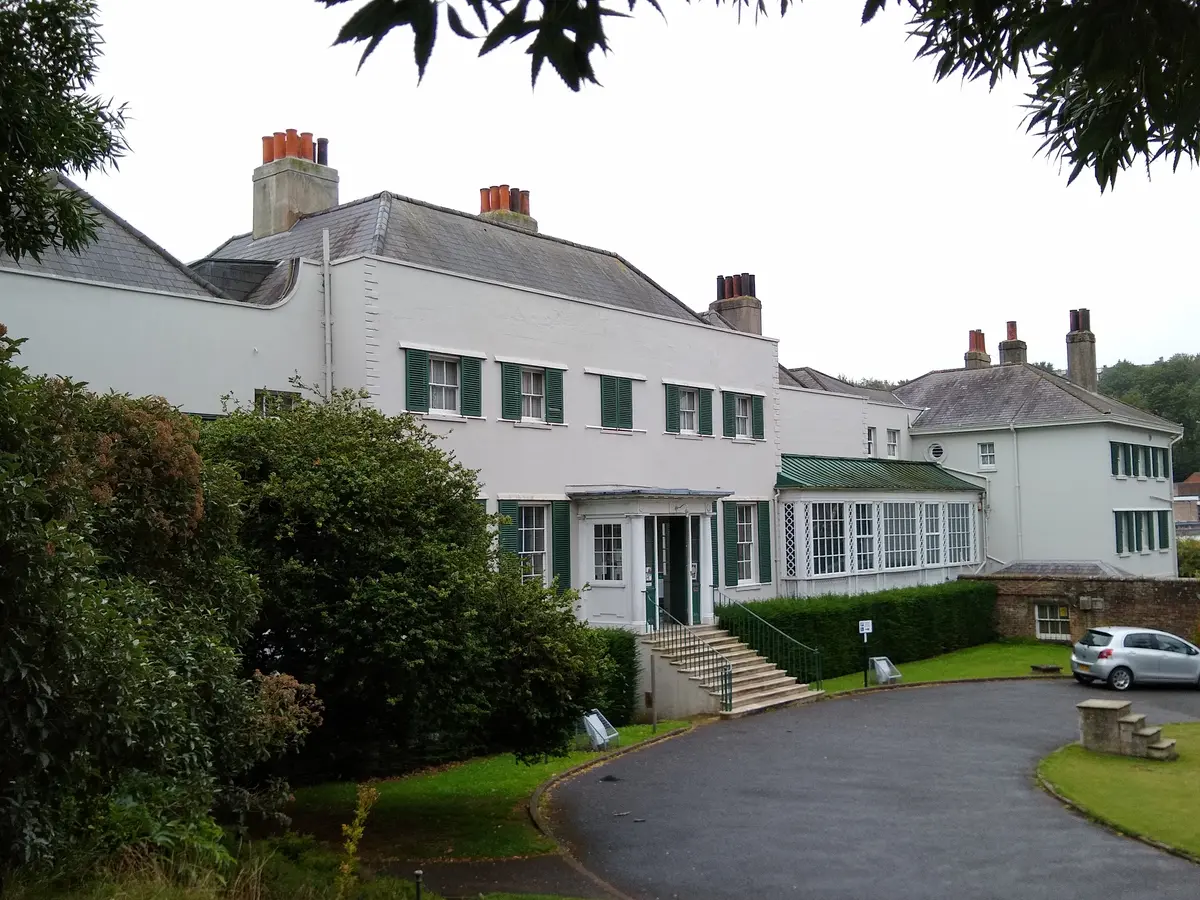
That two-roomed shell was left alone for four centuries. The VCH fixes the moment it grew with a physical object rather than a document: the medieval house "does not seem to have grown outside its original limits until 1738, which date is carved on a stone in the basement and coupled with the signature 'Thos. Western'". The Westerns had come in through Mary Shirley, who with her husband Thomas Western of Rivenhall, Essex, bought her sister Anne's share of the property for £6,275; in 1794 "Thomas Callis Western sold it to William Stanford of Preston". Stanford's granddaughter Ellen married first Vere Fane-Benett, who took the Stanford name and died in 1894, and then Charles Thomas, afterwards Sir Charles Thomas-Stanford. In 1905 Charles Stanley Peach enlarged the house for them, adding a dining room, a servants' wing and the glazed verandahs with tented copper roofs that flank the entrance front in the photograph of the house. Historic England's list entry records a second one built in 1910 by WT Cripps, surveyor to the Stanford Estate, "as a duplicate of that of 1905".
The manor's ghost story belongs to that household, and the people in it can be named. Ellen's mother Eleanor Macdonald lived at Preston Manor with her twin daughters, born there in 1866: Diana, and Christiana Blanche Ashworth Macdonald, who called herself Lily. Both twins said they had seen the figure. Lily's account survives because her nephew John Benett-Stanford wrote it out for Henry Roberts, the museum's first curator, hoping it would go into the guidebook: "Miss Lily Macdonald tells me that in October or November 1896 as she was trying a new lampshade in the Drawing Room at Preston Manor, the ghost walked in at the door and came straight to her as if to speak. Miss M recognised it as the ghost, seeing her white dress and hair hanging down. She followed the ghost through the Billiard Room to the foot of the stairs, then put her arm around her saying 'No - you don't go now'. Miss M's arms went through the figure and it disappeared at once."
On Wednesday 11 November 1896 Lily and her mother received two visitors in the Cleves Room, the small leather-lined sitting room off the entrance hall. Thomas Douglas Murray belonged to the Ghost Club; he brought Ada Goodrich Freer, who published as "Miss X" and was assistant editor of Borderland, W. T. Stead's spiritualist magazine. Shorthand notes of the sitting are kept at the house. Paula Wrightson, Preston Manor's venue officer, has described how it went: Freer opened with "Is there anybody there?", worked an ouija board, and "The first words spelt out were 'go away'". Pressed further, the board gave a nun, Sister Agnes, accused of immorality by a Friar Martin, excommunicated and buried outside the house in unconsecrated ground; a Christian burial would end the haunting.
Christmas 1896 was spoiled by a smell that nobody could trace. "Bad smells wafted about the rooms and corridors," Wrightson writes, and the family moved out to a Brighton hotel, leaving the servants and orders to find the cause. The drains along the south side were dug up in January. On Friday 29 January 1897 the workmen found "the hastily buried skeletal remains of a person identified as a middle-aged woman", under the terrace outside the room that is now the Macquoid Room. Nobody called the police or the coroner, and a doctor pronounced the bones three or four hundred years old, which settled the matter for the household. St Peter's vicar refused a Roman Catholic burial; John Benett-Stanford later said he had gone out at night and put the bones into another grave already dug in the churchyard.
The family kept talking about the White Lady for another forty years. Eleanor Macdonald died in 1903 in the blue bedroom, and the story preserved at the manor has the figure taking leave of her in front of the night nurse, Nurse Glasspool. In 1935 John Bennet-Stanford wrote that the spectre "is quite harmless and interesting", adding that she "was a great friend of my grandmother, Mrs Macdonald, who constantly saw her".
The house left the family in stages, and the two accounts of how do not quite agree. Museums Journal records that it "was sold to Brighton Corporation on 6 April 1925 for £5,000"; Tim Carder's Encyclopaedia of Brighton has the couple keeping it until their deaths in 1932 and the doors opening as the Thomas-Stanford Museum in 1933.
Timeline: the documented record of Preston Manor, Brighton
- c. 1250 The first manor house on the site: two rooms, a hall of 27 by 21 feet and a smaller room of 18 by 21, walls "a little over 2 ft. thick". Its shell survives inside the present basement, and the VCH calls the layout "typical of the 13th century".
- 1738 The medieval house grows for the first time. The VCH dates the work by an object rather than a deed: the year "is carved on a stone in the basement and coupled with the signature 'Thos. Western'".
- 1877 A Roman villa is found "in the angle between Preston Road, Springfield Road, and Stanford Avenue", a few hundred metres from the manor. It is the first recorded evidence of Roman occupation in the parish.
- October or November 1896 Lily Macdonald sees the figure in the Drawing Room while trying a new lampshade, follows it to the foot of the stairs and puts an arm round it: "Miss M's arms went through the figure and it disappeared at once." Her nephew John Benett-Stanford writes the account down for the museum's first curator, Henry Roberts.
- Wednesday 11 November 1896 Ada Goodrich Freer and Thomas Douglas Murray hold the séance in the Cleves Room. The ouija board first spells "go away", then produces Sister Agnes, excommunicated and buried in unconsecrated ground; a Christian burial would end the haunting. Shorthand notes of the sitting are kept at the manor.
- Friday 29 January 1897 Workmen digging up the drains after weeks of smells find "the hastily buried skeletal remains of a person identified as a middle-aged woman" under the south terrace. No police and no coroner are called; a doctor pronounces the bones three or four centuries old and they are reburied at night in St Peter's churchyard.
- 8 June 1897 The Times prints "On the Trail of a Ghost", an anonymous attack on Goodrich Freer's Ballechin House investigation, holding that a woman who is also the hostess "is unfit to carry out the actual work of investigating the phenomena in question". Her standing collapses seven months after the Preston Manor séance.
- 1903 Eleanor Macdonald dies in Preston Manor's blue bedroom, the room that later became the library. The account kept at the house has the White Lady taking leave of her in front of the night nurse, Nurse Glasspool.
- 6 April 1925 Preston Manor "was sold to Brighton Corporation on 6 April 1925 for £5,000". Sir Charles and Lady Ellen Thomas-Stanford stay on until their deaths in 1932, and the house opens as the Thomas-Stanford Museum in 1933.
- 1935 John Bennet-Stanford writes of the White Lady that she "is quite harmless and interesting" and "was a great friend of my grandmother, Mrs Macdonald, who constantly saw her". Henry Roberts decides against putting the ghosts in the museum guidebook.
- 13 October 1952 Preston Manor and its attached railings are listed at Grade II*, entry 1380750. The list description opens "Manor house. 1250, rebuilt 1738, altered 1905" and records "some remains of a house of c1250 in basement".
- 25 March 1976 A clergyman from Bexhill writes to the curator that at Preston Manor "they found the bricked-up skeleton of a nun, who had probably been there since the days of the original manor". The manor's own séance papers say nothing about anyone being bricked up.
- June 2006 LIVINGtv's Most Haunted films at Preston Manor. Presenter Yvette Fielding is quoted by the city council: "We were thrilled by our experiences at Preston Manor... Karl is convinced he was confronted by the Manor's White Lady!"
- 31 May 2019 Brighton & Hove Archaeological Society digs test pits in the grounds near the pet cemetery. The report lists 29 bones, all animal: "The majority of the bones, 19 in all, were long bones possibly from sheep/goats."
- 5 April 2025 Preston Manor reopens after five years shut, with an audio trail set in 1912 and a Café Rust tearoom. Adult admission that season is £12.50, and £9.50 for Brighton residents.
Is there a rational explanation for Preston Manor, Brighton?
The sharpest sceptic on this house works in it. Paula Wrightson, the venue officer who runs Preston Manor's after-dark events, told Museum Crush in 2018 that Freer "concocted a compelling story about a nun called Sister Agnes, who was accused of immorality by a Friar Martin", and then gave her own verdict in five words: "The story was entirely made up." On the bones she went further, and named a suspect inside the family: "I personally think he planted that skeleton in the garden." Her reason is documented behaviour. John Benett-Stanford "used to have an anatomical skeleton that he would dangle outside the windows to frighten lady guests, and in his house in Wiltshire he had a real skeleton, called Molly, in the basement. And he used to take her out and about as well".
The medium can be dated precisely against her own collapse. On 11 November 1896 Ada Goodrich Freer was assistant editor of the leading spiritualist magazine in Britain and a member of the Society for Psychical Research, which is why a wealthy household could get her. Three months later she moved into Ballechin House in Perthshire, and on 8 June 1897 The Times ran an anonymous piece, "On the Trail of a Ghost", by a guest who had been there; it held that a woman who was also the hostess "is unfit to carry out the actual work of investigating the phenomena in question". Newcastle University's Special Collections summarises what followed: "Freer was disowned by the S.P.R following publication of this article." The Preston Manor sitting came seven months before that. The Stanfords hired the best-regarded medium available, and the reputation failed afterwards.
The skeleton has no chain of evidence at all. Wrightson sets out the law that was ignored - the Burial Act of 1857 licence for exhumation, the duty to report remains to the coroner - and concludes: "There is no evidence the inhabitants of Preston Manor adhered to the letter of the law and thereby hangs an unsolved mystery." The dating rests on one doctor's opinion given over the hole, and the bones were reburied without record, so nothing can now be tested.
The bricked-up nun that circulates today is a later addition, and the manor's own papers refute it. "Original documents regarding the findings at the séance are held at Preston Manor but there is no mention of Sister Agnes being bricked-up in a wall," Wrightson writes; she traces the motif to Walter Scott's Marmion of 1808 and to Borley Rectory. By 1976 it had arrived as fact: a clergyman from Bexhill wrote to the curator on 25 March that year that at Preston Manor "they found the bricked-up skeleton of a nun, who had probably been there since the days of the original manor". The drift continues in official hands: Brighton & Hove City Council's own page on the house lists among its ghosts "Sister Agnes, the medieval nun who helped travellers on their way", which is the opposite of the excommunicated outcast the séance produced.
The description of the figure has never matched the identification. Lily and Diana said she wore flowing white robes with her golden hair loose. "However, descriptions of the White Lady do not mention a nun's habit, and what nun has long blonde hair?" Wrightson asks, and offers an alternative that has an archaeological fact behind it: "To me she perfectly matches a Roman woman of a very high class." A Roman villa was found in 1877 "in the angle between Preston Road, Springfield Road, and Stanford Avenue", a few hundred metres away, and the VCH notes it as the first evidence of Roman occupation in the parish.
The commercial incentive is on the museum's calendar with dates. Ghostly Gatherings runs from 2 to 30 October 2026, sold as a chance to "join us after dark at Preston Manor, supposedly one of the most haunted houses in Brighton", and a young people's ghost tour follows on 30 October. When the house reopened in 2025 after five years shut, Hedley Swain, then chief executive of Brighton & Hove Museums, told Museums Journal that "The manor is also steeped in ghostly mystery, with spine-chilling hauntings and tales of eerie sightings and unexplained incidents. It has become an iconic destination for those seeking supernatural thrills." The same organisation employs the historian who calls its most famous ghost an invention.
Can you visit Preston Manor, Brighton?
Preston Manor is a museum run by Brighton & Hove Museums at Preston Drove, Brighton BN1 6SD, roughly two miles north of the city centre. The 2026 season runs from "Saturday 14 March - Monday 30 November", and the house opens "Friday - Monday 10 - 5pm only (last admission 4:15pm)". Admission in 2026 is £14.00 for an adult and £8.50 for a child aged 5 to 18; residents of the BN1, BN2, BN3 and BN41 postcodes pay £10.50 with up to four children, and a resident aged 13 to 18 pays £6.00. Groups of twelve or more pay £11.90 an adult and £7.22 a child, carers go free, and booking online takes 5% off the standard adult and resident prices. Two practical points come straight from the museum: "Please note, Preston Manor is card only", and standard tickets "are valid for one year from the date of purchase". Prices in 2025, the first season after reopening, were £12.50 for an adult and £9.50 for a resident.
There is free parking on site. The 5 and 5a buses from Brighton stop on Preston Drove, five minutes away; Preston Park station is a ten-minute walk and one stop from Brighton. Preston Manor Tearoom by Café Rust is inside the house, open Friday to Monday from 10am to 4pm, and "Admission need not apply".
The building has more than twenty rooms over four floors and its limits are stated plainly: "The first and second floors are not accessible to wheelchair users." Mobility scooters have to be left at the accessible entrance and swapped for one of the museum's manual wheelchairs, with a companion to push. Photography for personal use is allowed, with the instruction "Please do not use flash, tripods or selfie sticks". A family trail, Mystery at the Manor, is free with admission and suits ages seven and up.
The ghost programme is seasonal and needs its own ticket. Ghostly Gatherings runs from 2 to 30 October 2026 after dark, and Haunted Happenings, a ghost tour written for young people, is on 30 October 2026. The walled garden and the pet cemetery, where sixteen dogs and four cats are buried, can be reached from Preston Park.
The paper record is on site rather than at The Keep: "Original documents regarding the findings at the séance are held at Preston Manor." St Peter's Church, where the 1897 bones were reburied without a licence, stands immediately east of the house and the churchyard is open. The garden wall between the two collapsed at about 4.30am on 15 December 1981 and was rebuilt in flint over 25 weeks from 3 May 1983, so the wall a visitor sees today is younger than the museum. Brighton & Hove Museums is raising money for repairs to the house under the title "To the Manor Reborn". Prices, dates and opening hours here were taken from the museum's own pages on 7 September 2026.
Sources consulted
- L. F. Salzman (ed.), «A History of the County of Sussex: Volume 7, the Rape of Lewes — Parishes: Preston (pp. 268-273)» — Victoria County History / British History Online, 1940 book
- Historic England, «Preston Manor and Attached Railings — National Heritage List for England, entry 1380750 (Grade II*, first listed 13 October 1952, amended 26 August 1999)» — National Heritage List for England, 1999 archive
- Paula Wrightson, «Sister Agnes: a buried secret at Preston Manor?» — Brighton & Hove Museums, 2017 web
- Paula Wrightson, «Lily MacDonald: a ghost-seeing enigma at Preston Manor» — Brighton & Hove Museums, 2017 web
- Paula Wrightson, «The House of Ghosts: comparing Preston Manor with Borley Rectory» — Brighton & Hove Museums, 2019 web
- Paula Wrightson, «Murder, vampires, and bricked-up nuns: Preston Manor's intriguing garden walls» — Brighton & Hove Museums, 2017 web
- Paula Wrightson and Richard Moss, «Inside the Victorian Seance Room at haunted Preston Manor — Paula Wrightson, Venue Officer, speaking to Richard Moss» — Museum Crush (Culture24), 2018 interview
- Jo Wadsworth, «Archaeologists attempt to solve 120-year-old mystery of woman's bones found at Preston Manor» — Brighton and Hove News, 2017 newspaper archive
- Brighton & Hove Museums, «Cleves Room — Preston Manor & Gardens, What to see» — brightonmuseums.org.uk web
- Brighton & Hove Museums, «Preston Manor & Gardens — Plan your visit (opening times, admission, access), consulted 7 September 2026» — brightonmuseums.org.uk web
- Newcastle University Special Collections, «The Haunting of Ballechin House — Treasure of the Month, on the 1899 The Alleged Haunting of B— House (Clarke Misc. 437)» — Newcastle University Library, 2020 academic
- Rebecca Atkinson, «Preston Manor to reopen with Downton Abbey-style immersive experience» — Museums Journal (Museums Association), 2025 newspaper archive
- Tim Carder, «Preston Manor — Origins dating to 13th century (extract from the Encyclopaedia of Brighton, 1990)» — My Brighton and Hove / Brighton & Hove Libraries, 1990 book
- Brighton & Hove City Council, «Most Haunted! at Preston Manor, Brighton» — brighton-hove.gov.uk web
Reviewed by V. Serrano on 2026-09-07 · How we verify our content
💬 Field testimonies (0)
No testimonies yet. Add the first.
Add your testimony
🔒 Log in to add a testimony