👻 HAUNTED PLACE · EXP. Nº9478
ACTIVE
Prospect Place
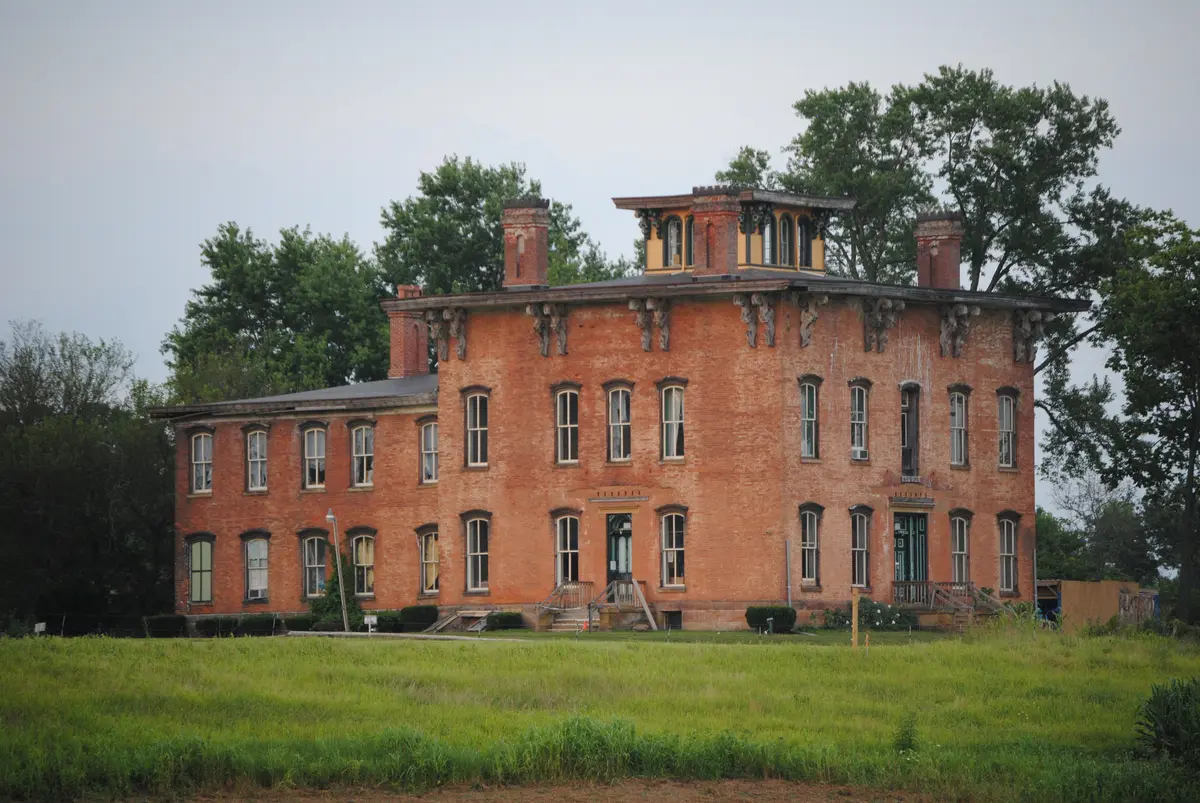
Prospect Place is a 29-room brick mansion at Trinway, Ohio, built in 1856 by the abolitionist George Willison Adams, whose family had left Fauquier County, Virginia, in 1808 after freeing the people they held there.
Where is Prospect Place?
- Location
- Ohio, United States
- Type
- House / mansion
- Coordinates
- 40.135, -82.013
- Last updated
LOCATION
Why is Prospect Place said to be haunted?
It is the rare haunted house whose owner argues with the story it sells. The G. W. Adams Educational Center charges 45 dollars a head for its public ghost hunts and yet uses its history pages to take the legends apart: it states that no Underground Railroad tunnel has been found under the house, and one of its trustees worked through Ohio Penitentiary microfilm to show that George Blackburn, the bricklayer blamed for burning the first mansion in 1855, died of heart disease in prison in 1896 and not under a farmer's axe. The lore itself is more specific than its summaries — a girl kept on ice in the basement through a winter, a servant on the stairwell, a refugee in the basement — and it can be dated: the estate was selling ghost search evenings on its own website by March 2002.
What is the history of Prospect Place?
The house exists because a Virginia planter decided he could not keep slaves.
George Beal Adams held more than five hundred acres in Fauquier and Loudoun counties, Virginia. According to the county history of J. Hope Sutor, printed in 1905, he freed the people he held, sold the plantation and moved his family to Ohio in 1808, settling in Madison Township, Muskingum County, near Dresden — a state whose 1803 constitution barred slavery outright. His youngest son, George Willison Adams (1799-1879), was "nearly eight years of age" on arrival, in Sutor's words.
Around 1828 George Willison and his brother Edward built a large flouring mill on the line of the new Ohio and Erie Canal, at the settlement that took their name, Adams Mills. A second mill followed near Dresden. The brothers ran warehouses, a boatyard and a cooper shop, and floated their own flour down the Ohio and the Mississippi to New Orleans. Adams sat a term in the Ohio General Assembly, gave the right of way for two railroad companies through his land and became a director of both, and when his partners lost their nerve over a suspension bridge across the Muskingum at Dresden he built it at his own expense, with his nephew George Copeland as engineer, and later sold it to the county commissioners for a third of what it had cost him.
The abolitionism is documented; the Underground Railroad station is tradition. Sutor's sketch of Adams, printed in 1905, leads with his father's decision to free his slaves and praises his support for the Union, but never mentions the Underground Railroad — although the same volume names two other Muskingum County men as a conductor and as the keeper of a station. The station account comes from the family and from the non-profit that owns the house today: that Adams became a conductor in the 1840s, "going often himself, and later sending his men, to retrieve refugee slaves from the South", that the mill was the first station, and that as war approached the brothers moved the work from the mill to the new house so that the business would not be endangered. The estate's own history adds a name: Nelson T. Gant, a former slave from Loudoun County, Virginia, freed on his master's death, who started an orchard and a coal-mining business at Zanesville, became a millionaire and, in the estate's words, "a very important local conductor on the Underground Railroad". The centre says he may have been a regular guest at Prospect Place; it does not claim to have proved it.
The first Prospect Place burned. The mansion was all but finished when fire took it — on 5 April 1855, according to the research on George Blackburn that the estate published in the late 2010s; the estate's own page on the house still tells it as the summer of 1856, the night before the family was to move in. It was rebuilt identical, on the same foundation, and the family dated it from an inscription found on the back of a marble mantel when the mantels were reset: "Hurrah for Buchanan!", the campaign of 1856. Schneider's 1948 article records that the roof was covered with copper and that the bathrooms were supplied by copper tanks and lead pipes; the estate describes a sub-floor pit for refrigeration.
Adams died at home on 31 August 1879. The house passed to his eldest daughter Anna and her husband, William E. Cox, who put in a new hall floor and replaced the thirty-year-old copper roof of the barn with slate in 1886 — the date is written into the slate. Then Cox left for Zanesville on business one Friday, 15 November, and never came home; a Dresden acquaintance reported seeing him on a street in San Francisco, and a family genealogist later concluded he had probably died in the earthquake and fire of 1906. Their son George Cox, an engineer who worked on Tennessee Valley Authority dams, spent much of his life and money looking for his father. He sold the house in 1969 to the Cox Gravel Company, which mined the remaining acreage; the mansion was opened for tours in the Bicentennial year of 1976, then closed, gutted by thieves and vandals, and scheduled for demolition in 1988. The basket manufacturer Dave Longaberger bought it, put a roof on it and stopped. It was sold in September 2001 to George Jeffrey Adams; the G. W. Adams Educational Center received charitable status in December 2005 and took ownership in 2006. A new board of trustees took over in the spring of 2017 and inherited collapsed chimneys, ivy through the carriage-house mortar, more than forty feral cats and a property-tax dispute with Muskingum County headed for the Ohio Supreme Court.
Timeline: the documented record of Prospect Place
- 1808 The Adams family reaches Muskingum County from Fauquier County, Virginia. J. Hope Sutor's county history reports that George Beal Adams freed the people he held and sold the plantation before leaving, because he believed that all men are born free and equal.
- 5 April 1855 The first, almost finished mansion burns down. Local legend blamed an elderly Native woman known as "Old Satan"; the version that stuck blamed the bricklayer George Blackburn, said to have set it to make more work for himself.
- 1856 The house is rebuilt identical on the same foundation. The family dated it from an inscription found on the back of a marble mantel when the mantels were reset: "Hurrah for Buchanan!", the presidential campaign of that year.
- 31 August 1879 George Willison Adams dies at Prospect Place at seventy-nine. Sutor's sketch of him, printed in 1905, praises his abolitionism and his Union sympathies and never once mentions the Underground Railroad, although the same volume names two other Muskingum men as a conductor and as a station keeper.
- 1886 William E. Cox, who married Adams's eldest daughter Anna, lays a new hall floor and replaces the thirty-year-old copper roof of the barn with slate. The year is written into the slate. Cox later left for Zanesville on a Friday, 15 November, and was never seen at home again.
- 15 April 1896 George Blackburn dies of heart disease in the Ohio Penitentiary, according to the microfilm record cited by the estate's own trustee Johnathon Robson — not under a farmer's axe, as the legend drawn from a 1967 Coshocton Tribune article has it. He was never charged with the Prospect Place arson.
- 29 August 1948 Norris F. Schneider devotes 2,711 words of the Zanesville Times Signal to the house, with the builder's grandson George W. Cox as his informant. The words ghost, haunt, spirit, apparition and phantom appear zero times in it; legend appears three times and Satan twice.
- 10 May 1979 Prospect Place is listed on the National Register of Historic Places, reference 79001913. The register's record names George Blackburn as architect and lists four areas of significance — commerce, transportation, politics and government, and architecture. The nomination text itself has not been digitised.
- 19 January 2002 Monica Reed, of TrueNorth Paranormal, records the first visit of her team. Her notes say a member stopped twenty feet from the barn and said someone had been hanged inside it, and that the others formed the same impression. Nothing in the note points to a document.
- 23 May 2002 The earliest archived capture of the estate's website already sells "ghost search" evenings at $50 a head, cut to $35 that July, and publishes recorded voices from the cellar. The ghost business is a year older than the non-profit that runs the house today.
- 2 April 2008 The Sci Fi Channel broadcasts the Ghost Hunters visit to Prospect Place under the title "Ghostly Bounty Hunter" — the barn story, six years after it was first written down as a psychic impression. Ghost Adventures followed on 1 January 2010 and Ghost Brothers on 26 April 2016.
- Spring 2017 A new board of trustees takes over a decaying estate and starts publishing corrections to its own legends. Its event pages also date the paranormal claims it does make in its own voice: since the clean-up, "Footsteps in empty rooms and hallways have become commonplace", and "shadowy apparitions and disembodied voices have also become much more frequent".
Is there a rational explanation for Prospect Place?
Prospect Place is unusual: the business that sells the ghost hunts is also the best sceptic available.
The tunnel comes first, because it is the thing most often written about the house and the estate denies it in writing. "Although popular myth of the area maintains that there was an underground tunnel in the basement of Prospect Place," its history page says, "the reality is that the restoration project has yet to discover one." It offers a mundane candidate — "a sub-floor pit refrigeration system that could easily be mistaken for a tunnel and could have been used for emergency egress in case of a home invasion by bounty hunters" — and adds that in "Underground Railroad" the word "simply refers to a clandestine activity and does not always denote the presence of an actual tunnel".
The silence is measurable: the longest early account of the house is Norris F. Schneider's feature in the Zanesville Times Signal of 29 August 1948, written with the builder's grandson as informant: 2,711 words in which ghost, haunt, spirit, apparition and phantom appear zero times, while legend appears three times, Satan twice, Blackburn twice and fire four times. The eleven history pages of the estate's current website, about eleven thousand words as read on 4 October 2026, likewise give ghost, haunt and apparition zero, with legend at eight and Underground Railroad at three, on the same domain that sells the hunts.
The reputation can be dated as well: the earliest archived capture of the estate's haunting page, of 7 March 2002, already advertises "Ghost Searches" at $50 a head, pizza and a drink included; a capture of 2 August 2002 announces that searches booked after 22 July cost $35. The investigator running them, Monica Reed of TrueNorth Paranormal, published her own field notes there. Her entry signed 19 January 2002 records that a member of her group stopped twenty feet short of the barn and said someone had been hanged in it, and that the others formed the same impression. Six years later the Sci Fi Channel broadcast its Ghost Hunters visit under the title "Ghostly Bounty Hunter" (2 April 2008), followed by Ghost Adventures on 1 January 2010 and Ghost Brothers on 26 April 2016. The hanged man in the barn is a psychic impression of 2002 that became a television title.
The local lore is more specific than the summaries of it. The estate's own ghost page, as archived in 2019, indexed six stories by name: the barn and its bounty hunter, Constance, Anna Adams-Cox, William Cox, the servant on the stairwell, and the refugee in the basement. The oldest account, already on the March 2002 page, is a girl who died one winter in the 1860s or 1870s when the ground was too frozen to bury her, whose body was kept on ice in the basement until spring and whose mother visited her every day — and the site said plainly of it that "we have no solid history to support this story". None of these figures is a lady in white: across four bodies of Prospect Place ghost material — the August 2002 and 2019 official pages, an investigator's write-up on HauntedHocking.com and the whole of the current website, some 20,900 words — the phrases lady in white, white lady and woman in white appear zero times, with ghost appearing 16, 19, 18 and 49 times respectively as controls.
The money is not hidden: public ghost hunts begin with a guided tour at 7 p.m. and "conclude promptly at 2:00 am", at $45 a head, capped at twenty people; flashlight tours cost $30. The centre states that the funds go to preservation, and its ghost-hunt FAQ answers the direct question — "Is Prospect Place Mansion haunted?" — with "We welcome our guests to make their own determination." The paranormal claims the trustees do make in their own voice are dated: since the new board took over in the spring of 2017 and the clean-up began, their event page says, "Footsteps in empty rooms and hallways have become commonplace", and "shadowy apparitions and disembodied voices have also become much more frequent".
The historical half has needed corrections too. The estate's own trustees have retracted a piece of it: their research note on George Blackburn, the bricklayer blamed for the 1855 fire, traces the standard story — that he escaped prison and died under a farmer's axe — to a 1967 article in the Coshocton Tribune, and reports that Ohio Penitentiary microfilm shows him dying of heart disease in the prison on 15 April 1896, never charged with the arson. Claims accrete in the other direction too: the widely repeated line that Adams gave money to the American Colonization Society in 1856 cites page 31 of volume 32 of The African Repository, and that page — the Ohio receipts, listing donors at Adams' Mills, Dresden and Muskingum — records a Benjamin Adams for fifty cents and a Washington Adams for five dollars. In the whole volume, 243,352 words, the word Willison appears not once, with colonization appearing 262 times as a control.
Can you visit Prospect Place?
Prospect Place is at 12150 Main Street, Trinway, Ohio 43842 — also given as 12150 County Road 706 — half a mile north of Dresden and about eleven miles north of Zanesville on old Route 60. The estate publishes its own coordinates as N40.13466 W82.01325, and adds a piece of local advice: avoid Ohio State Route 666.
Daylight tours are free. The mansion and grounds are open every Saturday and Sunday from noon to 4 p.m. during the season, March to November, with no reservation or ticket required; visitors go at their own pace and a staff member is usually on hand to explain the house and the Adams family. There is parking on the grounds, enter at the main gate, and a gift shop inside.
The evening programme is paid and is the estate's main fundraiser. Public ghost hunts cost $45 per person, are limited to twenty prepaid places and are strictly 18 and over; gates open at 6 p.m., the guided tour starts at 7, nobody is admitted after 7.30, and the night ends at 2 a.m. Flashlight tours cost $30 and admit visitors of 13 and over accompanied by an adult. Private hunts and non-paranormal lantern tours are also offered. Ouija boards, smudging materials, provoking tools, alcohol, drugs and weapons are all forbidden, and so is reselling tickets.
Practical warnings. The mansion is not ADA compliant and, by the estate's own statement, cannot be made so: stone steps at the public entrance, a steep winding staircase to the upper floors, and a cellar with uneven exterior stairs and a sandy floor that is effectively inaccessible. Evening events are not advisable for anyone with limited mobility. The building is centrally heated but not air conditioned and gets cold on spring and autumn overnights, so bring layers. The tap water is well water and is not drinkable; bottled water is provided at hunts. Security cameras cover most of the interior. Contact: [email protected], (740) 202-1909.
Sources consulted
- Norris F. Schneider, «Bricklayer Burned Mansion Before Owner Could Move In; But Dresden Legend Says Squaw Did It» — Zanesville Times Signal, 1948 newspaper archive
- J. Hope Sutor, «Past and Present of the City of Zanesville and Muskingum County, Ohio (sketch of George W. Adams, pp. 505-506)» — S. J. Clarke Publishing, Chicago, 1905 book
- National Park Service, «Prospect Place — National Register of Historic Places, reference 79001913 (listed 10 May 1979)» — NPGallery / National Register Information System, 1979 archive
- Johnathon Robson, «George Blackburn: Legend Meets Facts» — G. W. Adams Educational Center, Inc. report
- Monica Reed / TrueNorth Paranormal Examiners, «Hauntings (official site of Prospect Place, archived captures of 7 March 2002 and 2 August 2002)» — prospectplace-dresden.com, Internet Archive, 2002 archive
- G. W. Adams Educational Center, «The Disappearance of William Cox (with contemporary newspaper excerpts: "Is Will Cox Dead?" and "W. E. Cox Located")» — Historic Prospect Place newspaper archive
- G. W. Adams Educational Center, Inc., «Historic Prospect Place: history, visiting, daylight tours, public ghost hunts and FAQ» — historicprospectplace.org, 2026 web
- American Colonization Society, «The African Repository, vol. XXXII, p. 31 (Ohio receipts: Adams' Mills, Dresden, Muskingum)» — C. Alexander, Washington, 1856 book
- G. W. Adams Center, «Paranormal & Ghost Investigations (official site of Prospect Place, archived capture of 22 July 2019, listing the named ghost stories)» — prospectplace-dresden.com, Internet Archive, 2019 archive
- Sci Fi Channel, «Ghost Hunters, season 4 episode 5: "Ghostly Bounty Hunter"» — IMDb, 2008 web
- Jannette Quackenbush, «Ghost Investigations: Ohio — Prospect Place in Trinway Ohio» — HauntedHocking.com web
Reviewed by V. Serrano on 2026-08-18 · How we verify our content
💬 Field testimonies (0)
No testimonies yet. Add the first.
Add your testimony
🔒 Log in to add a testimony