👻 HAUNTED PLACE · EXP. Nº1189
ACTIVE
Rocky Hill Castle
Rocky Hill Castle was a plantation house between Town Creek and Courtland, Alabama, built from 1858 to 1861 by attorney and planter James Edmonds Saunders.
Where is Rocky Hill Castle?
- Location
- Courtland, Alabama, United States
- Type
- House / mansion
- Coordinates
- 34.683, -87.364
- Last updated
LOCATION
Why is Rocky Hill Castle said to be haunted?
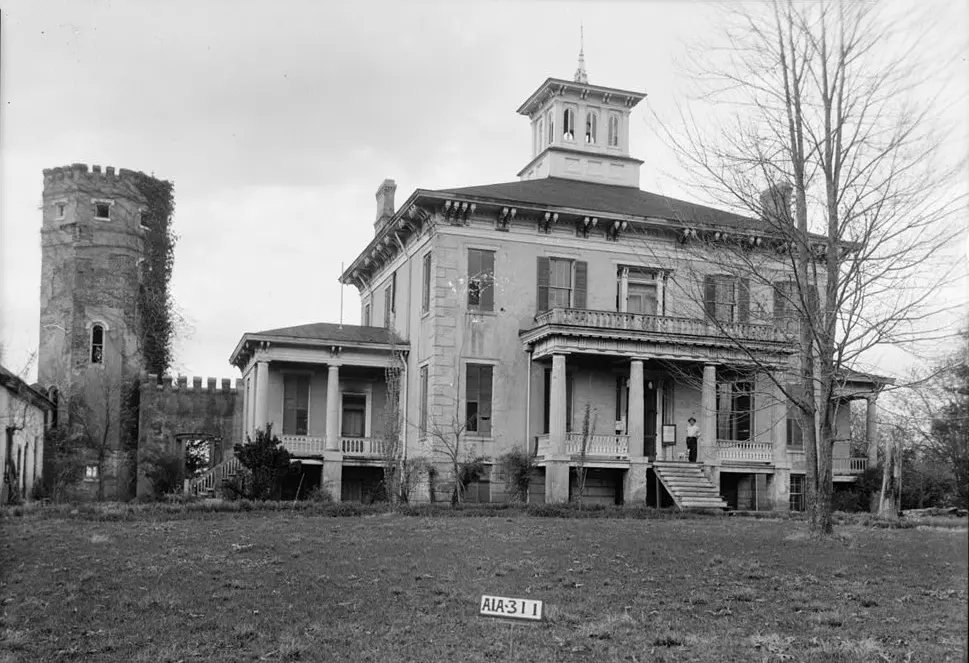
The two-story brick mansion blended Greek Revival and Italianate styles and was crowned by a five-story Gothic Revival tower linked to the main house by a crenelated brick wall. Saunders's family held dozens of enslaved people, whose quarters occupied the tower and the adjoining kitchen. The American Civil War halted construction in 1861, and the house later served as a Confederate hospital. After Saunders died in 1896 the estate passed through heirs and was abandoned in the 1920s, falling into ruin until Gordon McBride demolished it in 1961. Its ghost story, 'The Ghost of the Angry Architect,' was published in Kathryn Tucker Windham and Margaret Gillis Figh's 1969 collection 13 Alabama Ghosts and Jeffrey, which claims a French architect haunts the unfinished tower. No deed, will, or newspaper from the period names such a person; the tale is literary folklore, not documented history, paralleling other Southern plantation ghost legends that displace the violence of enslavement onto a single spectral figure.
What is the history of Rocky Hill Castle?
Rocky Hill Castle was a plantation house standing between Town Creek and Courtland in Lawrence County, Alabama. It was built between 1858 and 1861 by James Edmonds Saunders, a Virginia-born attorney and planter who had moved to Alabama by the mid-1820s and established a 640-acre plantation on the hill. The two-story brick house was constructed in a blend of Greek Revival and Italianate style, with a raised basement, Doric porticoes centered on the front and rear, and a large cupola. A distinctive five-story Gothic Revival brick tower, connected to the main house by a high brick wall pierced by a Tudor arch, was added later and is traditionally attributed to an itinerant Welsh craftsman named Hugh Jones. The tower and the adjoining kitchen building contained slave quarters, reflecting the plantation's dependence on enslaved labor.
The American Civil War interrupted construction in 1861, but the house was substantially complete and was pressed into service as a Confederate hospital. Several soldiers who died there were buried in the Saunders family cemetery on the property. James Saunders died in 1896, and the plantation passed through multiple owners. The last Saunders heir, Dudley Saunders, was a grandson of James; local accounts claim he and his family abruptly abandoned the house in the 1920s, allegedly after experiencing ghostly phenomena. The property was sold in the 1920s to H. D. Bynum and R. E. Tweedy, who farmed the surrounding land but left the house vacant. The building fell into ruin through the mid-twentieth century, and in 1961 a new owner, Gordon McBride, demolished the remaining shell and built a new house on the site using salvaged materials. Nothing of the original structure stands today.
The ghost stories of Rocky Hill Castle derive primarily from the 1969 collection 13 Alabama Ghosts and Jeffrey by Kathryn Tucker Windham and Margaret Gillis Figh, which includes the tale 'The Ghost of the Angry Architect.' The story alleges that the spirit of a French architect, whose work on the house remained unfinished, haunts the site and manifests as a shadowy figure in the tower. The book presents the tale as local folklore collected from unnamed informants, without citing documentary evidence. No contemporary newspaper account, will, or architectural record from the 1860s or 1870s mentions an architect by name or any supernatural occurrence at the house.
The Saunders family was among the most prominent in Lawrence County. James Edmonds Saunders's father, Turner Saunders, had established the neighboring Saunders Hall plantation, and the two estates anchored a local planter elite that also included the descendants of the region's early settlers. The Master Mechanics-style tower at Rocky Hill, with its Gothic crenellation and Tudor-arch connection to the main house, was an unusual feature in Alabama antebellum architecture and may have been inspired by pattern books popular among wealthy planters of the period. The tower's lower floors and the adjacent kitchen building contained the quarters of the enslaved people who maintained the plantation; census and probate records from Lawrence County document the Saunders family's ownership of dozens of enslaved men, women, and children. After the Civil War and emancipation, the plantation's economy collapsed along with that of the broader South, and the Saunders heirs, like many Alabama planter families, struggled to retain their land. The 1920s abandonment and subsequent sale mark the end of the family's direct connection to Rocky Hill, and the building's slow decay through the mid-twentieth century is documented in the Historic American Buildings Survey photographs of 1935, which show the house already roofless and overgrown.
Timeline: the documented record of Rocky Hill Castle
- mid-1820s James Edmonds Saunders, a Virginia-born attorney, has moved to Alabama with his wife by the mid-1820s; his plantation on a hill between Town Creek and Courtland will cover 640 acres.
- 1858 Construction begins on Rocky Hill Castle, a two-story brick plantation house in Greek Revival and Italianate style.
- 1861 Construction is halted by the outbreak of the Civil War; the house is pressed into service as a Confederate hospital.
- 1865 The Civil War ends; the plantation, like many in Alabama, struggles to recover from wartime devastation.
- 1896 James Edmonds Saunders dies; the plantation passes to his grandson Dudley Saunders.
- c. 1920 Dudley Saunders and his family abandon Rocky Hill Castle, allegedly after experiencing ghostly phenomena; the property is sold to H. D. Bynum and R. E. Tweedy.
- 1961 Gordon McBride demolishes the remaining shell of the house and builds a new home on the site using salvaged materials.
- 1969 Kathryn Tucker Windham and Margaret Gillis Figh publish 'The Ghost of the Angry Architect' in 13 Alabama Ghosts and Jeffrey.
- 1987 Robert Gamble includes Rocky Hill Castle in The Alabama Catalog: A Guide to the Early Architecture of the State.
Is there a rational explanation for Rocky Hill Castle?
The ghost story of Rocky Hill Castle is a literary creation rather than a documented historical event. The tale 'The Ghost of the Angry Architect' appears in the 1969 anthology 13 Alabama Ghosts and Jeffrey, a collection explicitly marketed as folklore and ghost stories rather than as historical documentation. The authors, Windham and Figh, present the story as collected oral testimony without naming their sources or citing any primary record. No property deed, will, newspaper account, or architectural drawing from the antebellum or postbellum periods mentions an architect by name, let alone a ghost. The story's central premise—that an unpaid or murdered architect haunts an unfinished tower—is a stock motif in Southern ghost lore, paralleling tales from the Myrtles Plantation and the LaLaurie House. The plantation's documented abandonment in the 1920s was almost certainly motivated by economic factors: the collapse of the cotton economy, soil depletion, and the difficulty of maintaining a large antebellum house during the agricultural depression of the 1920s. The attribution of the haunting to a French architect is unverifiable and, given the absence of any archival reference, likely the invention of a storyteller. The house itself was demolished in 1961, and no physical evidence of paranormal activity has ever been recorded by an independent investigator.
The 'Angry Architect' story has clear structural parallels with other Southern plantation ghost tales, notably the legend of 'Chloe' at the Myrtles Plantation in Louisiana and accounts of wronged builders at the LaLaurie House in New Orleans. In each case, a specific named or unnamed subordinate—a slave, a servant, an artisan—is said to haunt the site after a violent or unjust death. These narratives serve a recognizable cultural function: they externalize the violence of the plantation system into a single spectral figure while leaving the broader history of enslavement unexamined. At Rocky Hill, the most historically documented suffering belongs not to a fictional French architect but to the enslaved people whose quarters were in the tower and kitchen building. The ghost-story framing, as published in 1969, displaces that reality onto a melodramatic European craftsman. No Saunders family letter, probate record, or antebellum newspaper names the architect, describes an unpaid contract, or mentions a death in the tower; the tale is a piece of mid-twentieth-century folklore compilation rather than a recovered historical memory.
Can you visit Rocky Hill Castle?
There is nothing of the house left to see: Rocky Hill was demolished in 1961. The Encyclopedia of Alabama entry was published on 10 November 2008 and last revised on 1 February 2024. It places the building "just west of Courtland, Lawrence County", with a date of "ca. 1857". The Historic American Buildings Survey photographed the building in 1935 and filed the record under the address "Rocky Hill, State Highway 20, Courtland vicinity, Lawrence, AL"; that survey, held by the Library of Congress, is the fullest picture of it that survives.
The land is private and remains in agricultural use. There is no marker at the site and no public access to it. Who built the modern house that stands there is not settled in any source consulted for this entry, so no name is given.
Courtland itself is on the National Register of Historic Places. The Courtland Historic District was listed on 13 May 1991 under reference 91000597, with a boundary increase on 26 June 1998 under 98000710. The nomination covers approximately 96 acres and counts 101 contributing resources against 26 non-contributing, over a core that runs "just over half a mile from east to west and just under half a mile from north to south" on the grid the town was given when it was laid out in 1818-19. The county's records office is the Lawrence County Archives at 698 Main Street, Moulton 35650, on (256) 974-1757, in the old Bank of Moulton building.
Sources consulted
- Historic American Buildings Survey/Historic American Engineering Record, «Rocky Hill, State Highway 20, Courtland vicinity, Lawrence, AL» — Library of Congress, National Park Service, 1935 archive
- Connie Thwaite, «Courtland is town steeped in history» — Times Daily, 2007 newspaper archive
- Marc R. Matrana, «Lost Plantations of the South» — University Press of Mississippi, 2009 book
- Kathryn Tucker Windham; Margaret Gillis Figh, «13 Alabama Ghosts and Jeffrey» — Strode Publishers, 1969 book
- Robert Gamble, «The Alabama Catalog: Historic American Buildings Survey: A Guide to the Early Architecture of the State» — University of Alabama Press, 1987 book
Reviewed by V. Serrano on 2026-08-28 · How we verify our content
💬 Field testimonies (0)
No testimonies yet. Add the first.
Add your testimony
🔒 Log in to add a testimony