👻 HAUNTED PLACE · EXP. Nº9478
ACTIVE
Rose Island (Rhode Island)
A mile off Newport, reachable only by boat, this 18-acre island in Narragansett Bay carries an unfinished fort, a relit lighthouse and a ghost with a name but no witnesses.
Where is Rose Island (Rhode Island)?
- Location
- Rhode Island, United States
- Type
- Island
- Coordinates
- 41.496, -71.341
- Last updated
LOCATION
Why is Rose Island (Rhode Island) said to be haunted?
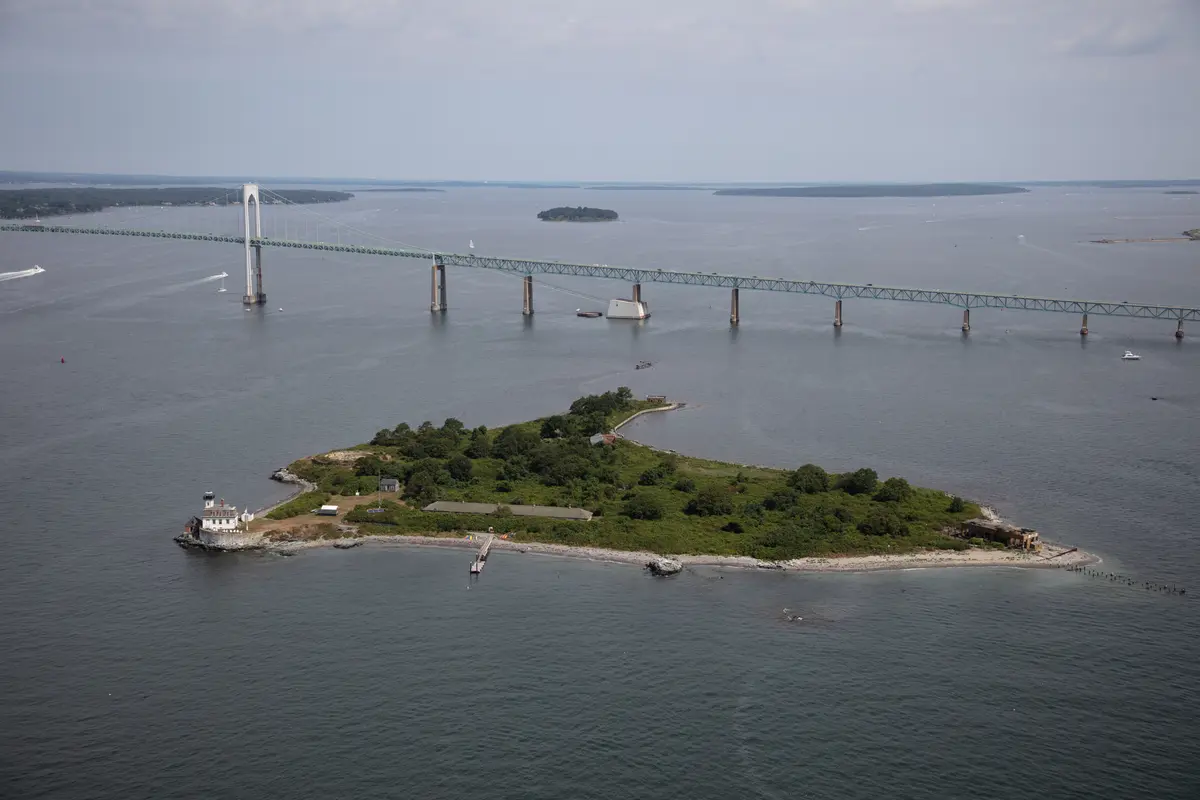
Fort Hamilton was designed in 1798 by the French engineer Anne Louis de Tousard, with circular tower bastions a decade ahead of anything comparable in America, and was never finished, never armed and never garrisoned; its bombproof barracks later served as a cholera quarantine hospital and then stored explosives for the Newport torpedo station through both world wars. The lighthouse was built on one of those bastions in 1869 and lit in January 1870. Its longest-serving keeper, Charles S. Curtis, held the post from 1887 to 1918 and lived there with his wife Christina. He is the figure the ghost stories name: footsteps down the tower stairs, stopping in the kitchen, exactly as he did in life. What those stories never supply is a witness. Neither the Foundation that saved the building nor the Trust that runs it today has ever mentioned a ghost in print, and the tale's earliest firmly dated telling is a television episode broadcast in 2010.
What is the history of Rose Island (Rhode Island)?
Before it was Rose Island it was Conockonoquit, a Narragansett name usually translated as "place of the long point". Colonial deeds put the island in English hands early: a sale of 7 February 1659 from Caleb Carr and John Cranston to Benedict Arnold, and a sale of 1 May 1675 from the Narragansett sachem Conanicus II to Peleg Sanford, later governor of the colony, who sold on to Carr that October.
Where the English name came from, nobody has documented. The story repeated everywhere — that the island looks like a rose at low tide, with the long point as the stem — is offered even by its own retellers as an allegation rather than a fact, and it has no early source attached to it. The rose bushes a summer visitor sees today prove nothing: the multiflora rose that covers the island is an invasive that moved in after the military left in the 1940s. What is worth noticing is that the Narragansett name already described the same feature the rose legend calls a stem.
The island's real subject is defence. A small British battery went up on the western shore before 8 August 1778. After the French fleet arrived, Rochambeau's engineers replaced it in 1780 with a large irregular earthwork fort, armed, by the Trust's account, with forty cannon. Those earthworks became the foundation of the fort that gives the island its historic district name.
Fort Hamilton was designed by Major Anne Louis de Tousard (1749-1817), a French artillery officer recruited for the American Revolution by Benjamin Franklin and Silas Deane, who served under Lafayette and later wrote the American Artillerists' Companion at George Washington's suggestion. Hired to build the second phase of the First System of coastal defences for Narragansett Bay, he gave Rose Island two circular tower bastions — an idea the National Register nomination calls "the most advanced French engineering at the time", predating comparable American castle forts by roughly a decade.
It was never finished. Construction stopped around 1801 when the crisis with France cooled. The fort was designed for at least seventy cannon and was never armed, never garrisoned, never made operational; only the bombproof barracks, a 210-foot building of nine groin-vaulted rooms meant to hold 300 men, was substantially completed, and even that lacked its sod roof. An 1811 report found two wooden officers' quarters and no magazine at all. Guillaume Tell Poussin surveyed the ruin in 1819.
The barracks found other uses. The island served as a quarantine station during a cholera outbreak in the 1820s — the Foundation's own older website dated it to 1820 — and, according to the Trust, for yellow fever in the 1850s. From 1883 the island was a U.S. Naval Magazine, and through both world wars its two-foot brick walls stored explosives and armed torpedo warheads for the Naval Torpedo Station on Goat Island. Barbed wire ringed the shore and guards patrolled around the clock. The military left in the late 1940s.
The lighthouse came in between the wars and the fort. Built in 1869 on the filled-in southwest bastion for a reported $7,500 and lit on 20 January 1870, it is a mansard-roofed wooden building with an octagonal tower and a sixth-order Fresnel lens. Its first keeper, George C. Williams, was a Civil War veteran. Charles S. Curtis held the post longest, from 1887 to 1918, living there with his wife Christina; he earned two life-saving medals, going out to a launch aground on the rocks in August 1906, to a capsized fisherman that October, and to a disabled powerboat drifting seaward in 1914. Their grandson Wanton Chase lived on the island from 1913 to 1918, from age five to ten.
The Newport Pell Bridge made the light redundant and it was switched off in 1970. Vandals gutted the building; the Fresnel lens was smashed and, by local account, thrown into the bay. The federal government offered the place to other agencies, to the state, to the city and even to the University of Rhode Island. Nobody wanted it. In September 1983 four local businessmen bought the bulk of the island for $27,500 and proposed an 850-slip marina with condominiums, which would have required dredging some 150,000 cubic yards of the bay.
What saved it was a residents' group, Citizens to Protect Rose Island, which in 1984 became the Rose Island Lighthouse Foundation under Charlotte Johnson, Betsy deLeiris and Curtis Bunting. In early October 1985 the lighthouse and the acre and a half around it were deeded to the City of Newport at no cost, and the city handed management to the Foundation. That same year a man walked into the Foundation's first office — in Johnson's house — offering help. It was Wanton Chase, then 77. The museum was rebuilt largely from his memories, and is furnished today as the building looked between 1910 and 1918, down to the kitchen stove.
The restoration took eight years and about 1.2 million dollars. On National Lighthouse Day, 7 August 1993, the light went back on as a private aid to navigation sanctioned by the Coast Guard. In 1999 the Foundation bought the remaining 16.5 acres from the private owners for $629,750, largely with a Rhode Island DEM grant, in exchange for a conservation easement that bars development for good; that land became the Rose Island Wildlife Refuge. The lighthouse was listed on the National Register in 1987 and the whole island followed as the Fort Hamilton Historic District in 2001. The operator is now the Rose Island Lighthouse & Fort Hamilton Trust.
Timeline: the documented record of Rose Island (Rhode Island)
- 1 May 1675 The Narragansett sachem Conanicus II sells land on the island, known to the Narragansett as Conockonoquit, to Peleg Sanford, later governor of the colony; Sanford sells on to Caleb Carr that October. An earlier deed of 7 February 1659 records Carr and John Cranston selling to Benedict Arnold.
- 1780 French forces under Rochambeau replace an earlier British battery with a large irregular earthwork fort. Its north curtain wall survives and is a contributing feature of the historic district.
- 1798-1801 Major Anne Louis de Tousard builds Fort Hamilton for the second phase of the First System of coastal defences. Designed for at least seventy cannon, it was never finished, never armed and never garrisoned; work stopped around 1801 as the crisis with France eased.
- 1819 Guillaume Tell Poussin surveys the unfinished fort. His plan, held in the National Archives, is the fullest record of how far construction actually got.
- 1820s The bombproof barracks are used as a quarantine hospital during an outbreak of Asiatic cholera. The Foundation's old website dated it to 1820, the National Register nomination to the 1820s, and a 2025 report on current research to the 1830s.
- 20 January 1870 The lighthouse, built the previous year on the filled-in southwest bastion for a reported $7,500, is lit for the first time. Its first keeper is George C. Williams, a Civil War veteran.
- From 1883 Rose Island is designated a U.S. Naval Magazine. Through both world wars its barracks store explosives and arm torpedo warheads for the Naval Torpedo Station on Goat Island, behind barbed wire and round-the-clock guards.
- 1887-1918 Charles S. Curtis serves as keeper, the longest tenure in the station's history, living on the island with his wife Christina. He earns two life-saving medals; their grandson Wanton Chase lives there from 1913 to 1918.
- 1970 The light is switched off, made redundant by the Claiborne Pell Newport Bridge. The empty building is stripped by vandals and its sixth-order Fresnel lens is smashed.
- September 1983 Four local businessmen buy the bulk of the island for $27,500 and propose an 850-slip marina with condominiums, a scheme that would have required dredging some 150,000 cubic yards of Narragansett Bay.
- October 1985 The lighthouse and the acre and a half around it are deeded to the City of Newport at no cost, and the city delegates management to the Rose Island Lighthouse Foundation, founded the year before. That same year Wanton Chase, then 77, walks into the Foundation's office offering help; the museum is reconstructed from his memories.
- 7 August 1993 After eight years and about $1.2 million, the light is relit on National Lighthouse Day as a private aid to navigation sanctioned by the U.S. Coast Guard and maintained by the Foundation, not by the federal government.
- 1999 The Foundation buys the remaining 16.5 acres from the private owners for $629,750, largely with a Rhode Island DEM grant, in exchange for a conservation easement barring development. The land becomes the Rose Island Wildlife Refuge.
- 22 September 2010 Ghost Hunters broadcasts "Signals from the Past", filmed on the island. It is the earliest widely distributed telling of the haunting that can be firmly dated, and the source of the much-reproduced photograph of a reflection in a picture frame. Kindred Spirits returned to the subject in 2020.
Is there a rational explanation for Rose Island (Rhode Island)?
The haunting of Rose Island has a named ghost and not one named witness, and that asymmetry is the whole story.
The ghost is Charles S. Curtis. The accounts say that at the end of his watch he would come down from the lantern room and stop in the kitchen, and that since his death visitors and staff have heard those footsteps repeat. Every version of that sentence is impersonal. "Witnesses say", "caretakers and guests have heard", "many reports suggest": across the ghost pages, the regional lighthouse blogs and a podcast episode devoted to the island, no one who claims an experience is ever named, dated or quoted directly.
The people who ran the place did not tell the story either. For this entry I swept the Foundation's own website as preserved by the Internet Archive — 309 archived pages captured between 1999 and 2010, about 1.66 million characters. Ghost: no occurrences. Haunted, haunting, phantom, apparition, paranormal, supernatural, séance, psychic: no occurrences. As a control on the same sweep, "lighthouse" appears 1,771 times, "Rose Island" 1,217, "Newport" 675, "keeper" 573, "foundation" 418, "restoration" 105. The current site behaves the same way: 28 pages, about 819,000 characters, zero for the same vocabulary, against 244 for "Rose Island", 207 for "lighthouse", 121 for "Fort Hamilton" and 383 for "overnight". An operator selling ghost nights does not miss the word twice in twenty-seven years.
The ghost literature also fails an arithmetic check it sets for itself. Several pages state that Curtis "stayed in service for 31 years from 1887 - 1908". That span is 21 years. The Trust's own record gives 1887 to 1918, which is 31 — so the number was kept and the end date was corrupted, then copied onward.
There is a plainer reading of the footsteps, and it does not require anyone to be lying. The Rose Island museum is not a generic old building: it is deliberately reconstructed to look as it did between 1910 and 1918, and it was reconstructed from the childhood memories of one man, Wanton Chase, who lived there with his grandparents Charles and Christina Curtis. Guests sleep in rooms named after Chase and after Curtis Bunting. The nightly routine that the ghost is said to repeat — down the tower stairs, into the kitchen — is precisely the domestic detail the museum exists to stage. Visitors arrive already holding the script, in a wooden building on an exposed bastion a mile offshore, and spend the night in it with no staff on the island.
Two television investigations gave the story its reach, and both are datable. Ghost Hunters filmed there for "Signals from the Past", broadcast on 22 September 2010, and returned to the subject through Kindred Spirits, whose fourth season episode "Keeper of the Light" aired in 2020. The photograph most often cited — a reflection in the glass of a picture frame, said to be Curtis — reaches the public through that first programme.
Some claims attached to the island should be treated with more caution still. The quarantine is real, but its date moves between sources: the Foundation's old site said 1820, the National Register nomination says the 1820s, the Trust adds yellow fever in the 1850s, and a 2025 newspaper account of current research says the 1830s. The two unmarked mass graves, and the 1938 hurricane said to have unearthed bodies in Civil War-era clothing, appear only in the ghost literature. They are absent from the National Register nomination, which was written by the Foundation's own people, describes the island resource by resource, and reports the findings of archaeological surveys carried out in 1984-85 without recording any burial.
Can you visit Rose Island (Rhode Island)?
Rose Island lies in Narragansett Bay about a mile from the Newport shore by its managers' own figure, and it is reached only by water; the pin (41.4964, -71.3411) is on the island. The Rose Island Lighthouse & Fort Hamilton Trust, whose website was consulted for everything below on 23 September 2026, names the ways across. Day visitors come on the Jamestown-Newport Ferry, which runs from 16 May to 12 October 2026 and sells the island admission with its ticket. The Trust does not permit anchoring or tying up at the dock; kayaks and inflatables may instead be pulled up on the beach beside it. Overnight guests travel on the Trust's own boat, Rose.
The Trust's frequently asked questions give public opening as daily from 16 May to 12 October, 10:00 to 16:00, with island guides present during those hours; its day-trips page gives the same hours "daily from April - October". Admission is 12 dollars for adults, 8 for children under 12 and 10 for active military and veterans, and members go free.
The northern 17.42 acres (7 ha) of the island, everything beyond the lighthouse, form the Rose Island Wildlife Refuge, bought by the Rose Island Lighthouse Foundation in 1999 and placed under a conservation easement held by the Rhode Island Department of Environmental Management. The refuge is closed during the nesting season, from 1 March to 15 August, when visitors keep to the lighthouse grounds, the beaches beside the lighthouse and the Fort Hamilton barracks; after 15 August the refuge and the island's perimeter open. Among the nesting birds the Trust lists the great egret, the snowy egret, the cattle egret, the black-crowned night heron, the glossy ibis, the little blue heron and the American oystercatcher.
For the 2026 season the overnight page lists four places to stay. The Lighthouse Museum Suite on the first floor sleeps up to four and has a small kitchen and a toilet; its common areas are open to the public from 10:00 to 16:00. The Keeper's Apartment on the second floor is the largest and has a full kitchen and a bathroom with a shower. The Foghorn Room sleeps two adults and has a wood stove and steep stairs. It has no electricity and an outdoor bathroom and shower, like the room in the Fort Hamilton barracks. Rose takes about twelve minutes, leaving for the island at 12:00 and returning to Newport at 10:00 the next day. The minimum stay is two nights, with one-night bookings opened 60 days ahead; members receive 15 per cent off.
The island is off-grid and mainly solar-powered, with no Wi-Fi; the Trust describes mobile service as generally reliable. Water is rainwater stored in cisterns and filtered for washing, and is not fit to drink; most visitors use outhouse-style toilets under a flushing rule the Trust calls its "Tinkle Tally System". The island has no food service. A small honour-system gift shop sells a limited selection of snacks, and rubbish leaves with the visitor under a carry-in, carry-out policy. No staff remain on the island after 16:00, and at least two people must be on it at all times. The Trust recommends closed-toed walking shoes for the uneven ground and a torch or headlamp later in the day. The island became a Naval Magazine in 1883, and the Trust's Fort Hamilton page records that it served for storage and as a torpedo warhead arming facility until the end of the Second World War; besides the 210-foot (64 m) bombproof barracks, the surviving remains include eighteenth-century bastions, gun mounts, magazines and a TNT filling station on the south-east side.
The "Keeper for a Week" scheme, in which the Rose Island Lighthouse Foundation let paying volunteers run the lighthouse after its relighting in 1993, is documented on the Foundation's website as archived between 1999 and 2010. It does not appear among the four accommodations on the Trust's overnight page of 23 September 2026.
Sources consulted
- Richard C. Youngken and Charlotte E. Johnson, «Fort Hamilton Historic District, Rose Island — National Register of Historic Places Registration Form» — Rhode Island Historical Preservation & Heritage Commission / National Park Service, 1994 report
- «Rose Island Lighthouse Foundation — archived website, 1999-2010 (309 pages)» — Internet Archive Wayback Machine, 2010 archive
- «The Lighthouse; Fort Hamilton; Day Trips; Frequently Asked Questions» — Rose Island Lighthouse & Fort Hamilton Trust, 2026 web
- «Pound for Pound, Rose Island Narragansett Bay's Toughest Place» — ecoRI News, 2021 newspaper archive
- John Pantalone, «Long History of Rose Island Emerges in New Exhibits» — Newport This Week, 2025 newspaper archive
- Kraig Anderson, «Rose Island Lighthouse, Rhode Island» — Lighthousefriends.com web
- «Signals from the Past — Ghost Hunters, season 6, episode 15» — Syfy, 2010 web
Reviewed by V. Serrano on 2026-08-13 · How we verify our content
💬 Field testimonies (0)
No testimonies yet. Add the first.
Add your testimony
🔒 Log in to add a testimony