👻 HAUNTED PLACE · EXP. Nº9478
ACTIVE
Scandinavian Evangelical Lutheran Church of Sims
Sims was a Northern Pacific coal town that lasted barely a generation: founded in 1883, past 1,000 people by 1884, down to 86 by the 1910 census, and cut off from the railway in 1947.
Where is Scandinavian Evangelical Lutheran Church of Sims?
- Location
- North Dakota, United States
- Type
- Church / religious site
- Coordinates
- 46.772, -101.499
- Last updated
LOCATION
Why is Scandinavian Evangelical Lutheran Church of Sims said to be haunted?
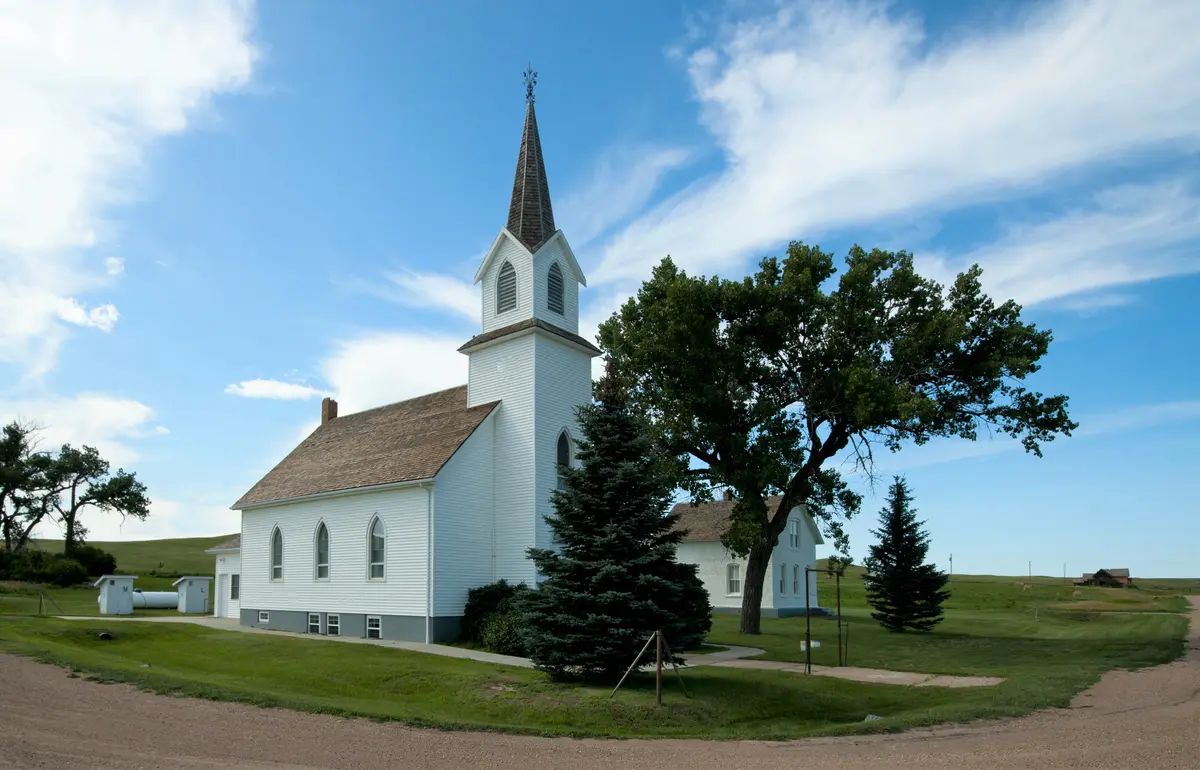
Today the only habitable buildings left are the Scandinavian Evangelical Lutheran Church and the 1884 parsonage beside it, still worshipping on alternate Sundays. The ghost story attached to them is unusually well documented for once, because the family checked it. Bertha Dordal, a trained nurse and the pastor's wife, came from Wisconsin in the autumn of 1916 with tuberculosis, hoping the plains air would help; she died in the parsonage on 8 May 1917, eleven days short of her thirty-seventh birthday, leaving three children under seven. In the 1930s Olga Nelson, who lived in the house with her pastor husband, said she saw "a gray shape upstairs", and the name Gray Lady stuck. What is told about her is gentle: footsteps, an organ that was no longer there, a blanket laid over a sleeping guest. What was printed about her was, for a century, largely wrong.
What is the history of Scandinavian Evangelical Lutheran Church of Sims?
Sims was a company town with a short fuse. The Northern Pacific Railway had reached Bismarck in 1873 and needed coal and water for the line running west of the Missouri, so in 1883 it opened a mine and a townsite in the Morton County grassland and named the place after George Sims, one of its executives. Coal and a brickyard did the rest. Preservation North Dakota puts the population above 1,000 by 1884 — the town's second year — and at around 400 only six years later. The census of 1910 counted 86 people.
In 1884 a group of Scandinavian immigrants, 35 men and eight women, put up a single building that worked as both church and pastor's house. The living quarters took the ground floor; the congregation climbed a narrow winding staircase to an attic room under the rafters, where pastors wheeled in hog troughs to serve as kneeling benches and a good part of the congregation simply stood through the service. The purpose-built church next to it was begun in 1896 and finished in 1900, and the 1884 building became the parsonage it still is. Services and church records were kept in Norwegian until 1946.
The woman at the centre of this story arrived in the autumn of 1916 and was dead within seven months. Bertha Viland had trained as a nurse at the Lutheran Deaconess School of Nursing in Chicago and had worked at an orphanage in Lake Park, Minnesota. At nursing school she met Anna Dordal, who introduced her to her brother Lars; Bertha and Lars married in 1908. By the mid-1910s Rev. Dr. Lars Dordal was serving a congregation in Madison, Wisconsin, and it was there that Bertha contracted tuberculosis. The couple accepted a call to Sims and nearby Almont partly in the hope that a change of climate on the western plains would restore her. They moved with three small children — Raymond, Adeline and Harald — in the autumn of 1916. Lars's brother, Rev. Jacob Dordal, wrote of the arrival: "Joyous and happy, they undertook their work there. The congregations were also happy and thankful for the young and active minister and family God had sent to them."
The climate did not work. Bertha grew too weak to play the church organ or to lead the Ladies' Aid, and she died in the parsonage on 8 May 1917, eleven days short of her thirty-seventh birthday. Her stone in the cemetery on the hill above the church reads "Mrs. L. Dordal, May 19, 1880 - May 8, 1917". She left Raymond, six; Adeline, four; and Harald, two. Less than a year later Lars married Clara, the woman who had been hired to look after the children — not, as decades of retellings have insisted, Bertha's sister. The Dordals left Sims in 1918. Lars went on to a long pastorate in Larimore, North Dakota, and had two more children with Clara.
The town outlived Bertha by three decades and not much more. When the Northern Pacific straightened its mainline in 1947, trains no longer needed the servicing stops that had justified the detour, and Sims lost its rail connection; the post office, opened in 1883, closed the same year. The last pastor moved out of the parsonage in the 1940s and the building stood empty from 1984. In 2005 members of the congregation and volunteers from Preservation North Dakota began stripping five layers of wallpaper off its walls, and by that July they had logged more than 750 hours. A state Save America's Treasures grant followed, and in October 2008 First Lady Laura Bush — honorary chair of the programme — came to see the result. Today the church and the parsonage are the only habitable buildings left in Sims.
Timeline: the documented record of Scandinavian Evangelical Lutheran Church of Sims
- 1883 The Northern Pacific Railway opens a coal mine and a townsite in Morton County and names it after George Sims, one of its executives. A brickyard follows; within two years the population passes 1,000.
- 1884 Thirty-five Scandinavian immigrant men and eight women build a single structure serving as church and parsonage: living quarters below, an attic worship room above reached by a winding stair, with hog troughs wheeled in as kneeling benches.
- 1896–1900 The purpose-built Scandinavian Evangelical Lutheran Church is begun in 1896 and completed in 1900 beside the older building, which becomes the parsonage. Services and records are kept in Norwegian until 1946.
- Autumn 1916 Rev. Dr. Lars Dordal, his wife Bertha and their three children move from Madison, Wisconsin, to Sims. Bertha had contracted tuberculosis in Wisconsin and the family hoped the western climate would help her.
- 8 May 1917 Bertha Dordal dies in the parsonage, eleven days before her thirty-seventh birthday, leaving three children aged six, four and two. Her stone in the Sims cemetery reads "Mrs. L. Dordal, May 19, 1880 - May 8, 1917".
- 1918 Less than a year after Bertha's death Lars marries Clara, hired to care for the children, and the family leaves Sims. Lars later serves a long pastorate at Larimore, North Dakota.
- 1930s Olga Nelson, who lives in the parsonage with her pastor husband Carl Nelson, says she repeatedly sees "a gray shape upstairs" and watches the pump handle move by itself. She describes the presence as friendly. The name Gray Lady comes from her account.
- 1938 According to Preservation North Dakota, the church council asks district officials to investigate supernatural happenings in and around the parsonage. The council's letter itself has not been published.
- 1947 The Northern Pacific straightens its mainline and Sims loses its rail connection; the post office, opened in 1883, closes the same year. The town empties for good.
- c. 1960 Sims historian Sig Peterson recalls having coffee in Sims with Harald Dordal and other pastors; one of them described leaving his first western North Dakota parish because of a ghost. "That's when Harald told him the ghost was his mother."
- 1984 The last occupant closes the parsonage, which had housed its final pastor in the 1940s. The building stands empty and deteriorating for two decades.
- 1988 An Associated Press story about Bertha runs in The Forum. Her granddaughter Kari Dordal Christianson learns from that article that her grandmother is a famous ghost.
- 16 July 2005 The Bismarck Tribune reports the restoration: more than 750 volunteer hours and a $5,000 Preservation North Dakota grant. That summer volunteers camping on the grounds report no sighting, but Dale Bentley describes a repetitive thumping from the house: "It sounded like someone walking."
- October 2008 First Lady Laura Bush, honorary chair of Save America's Treasures, visits the restored church and parsonage.
- 2014 Bertha's grandchildren Kari and H. Mark Dordal travel to Sims. Two people they meet say they have experienced the ghost; the grandchildren do not. "Unfortunately, Bertha did not choose to come and greet her grandchildren. We tried!"
- 30 October 2024 Tracy Briggs publishes the family's corrections in InForum: Bertha died of tuberculosis on 8 May 1917 aged 36, not "between 1916 and 1918" aged 26, and Clara was not her sister.
Is there a rational explanation for Scandinavian Evangelical Lutheran Church of Sims?
The most useful thing to say about the Gray Lady is that her paper trail has been checked, and that it did not survive the check intact.
Start with the name. In July 2005 the Bismarck Tribune reported that the pastor's wife had "died in her sleep" and that her name was "lost from any church record books". Neither statement holds: she died of tuberculosis after months of decline, and her name — or at least her married form of it — has been legible on a stone in the Sims cemetery since 1917. Three years later Preservation North Dakota published a fuller version that named Bertha, but made her 26 years old and dated her death loosely to "sometime between 1916 and 1918". She was 36, and the date is 8 May 1917. The claim that Lars's second wife Clara was Bertha's sister has circulated in newspapers, magazines and books; the family says it is false, and traces it to the period when Lars's own sister Anna helped care for the children. A legend whose basic biography has been wrong in print for a century is not a legend with good sources.
The correct dates, at least, can be checked against something other than a newspaper. Find a Grave's index of Sims Cemetery carries the burial as Bertha Viland Dordal, 19 May 1880 – 8 May 1917, died aged 36, with Lars Andreas Nilsen Dordal recorded as her husband — an independent transcription that agrees exactly with the stone as quoted by her granddaughter. As a control on the same search, a query for burials of 1917 in that cemetery returns six names, and a query for the alternative spelling "Dordahl" returns none: the surname is Dordal, and the date is not in doubt.
Dating the tale is harder than dating the death, and worth being explicit about. The earliest named first-person account is Olga Nelson's, from the 1930s — some fifteen to twenty years after Bertha died — and it reaches us second-hand, through a preservation charity's web page written seventy years later. Preservation North Dakota lists a Bismarck Tribune item of 7 November 1927 first among its sources, which would be the earliest dated printing on the subject if it concerns the ghost at all; I have not been able to read it, because the Library of Congress newspaper archive was inaccessible throughout this review, and I make no claim about its contents. The first version to travel beyond Morton County appears to be an Associated Press story in 1988. The honest summary is that the story is only traceable in print from the late twentieth century, and that everything before Olga Nelson is recollection.
The apparition itself has a plausible physical seed. Tracy Briggs, writing for InForum in 2024, points out that tuberculosis patients often take on a grey pallor — so a congregation that remembered a dying woman's face had a colour ready-made before anyone saw anything. The name itself is traceable to one person: Olga Nelson, who lived in the parsonage with her pastor husband in the 1930s and said she used to see "a gray shape upstairs". Everything else is thinner. The best-known episode — a boarder in the attic room who woke to find an extra blanket over her — is told by Preservation North Dakota without a name, a date or a source. The 1938 request from the church council to district officials is likewise reported only in that same summary, and the council's letter itself has not been published.
Two silences are worth recording. The State of North Dakota's official tourism listing for the church describes its history, its Norwegian-language records and its restoration, and does not mention the ghost at all. And the church, despite being routinely called the oldest of its kind west of the Missouri, is not on the National Register of Historic Places: a search of the register's complete North Dakota listing returns no entry for Sims or Almont, in a document that returns 54 matches for "church" and 26 for "Lutheran".
Finally, a superlative that this file used to carry in its own voice: that Sims is "North Dakota's most visited paranormal site". Nobody counts visitors to paranormal sites in North Dakota, and no source makes the claim. What can be attributed is milder and better sourced: InForum calls Bertha "North Dakota's most famous ghost".
Can you visit Scandinavian Evangelical Lutheran Church of Sims?
The North Dakota tourism office lists the church at 4945 Sims Road, Almont, ND 58520, telephone (701) 843-8785. InForum puts Sims 47 miles (76 km) south-west of Bismarck, a figure that fits the journey by road; in a straight line the church stands about 56 km (35 miles) almost due west of central Bismarck, and the small town of Almont lies about 5 km (3 miles) to the south. InForum reported in October 2024 that the church and the parsonage are the only inhabitable buildings left in Sims.
The congregation still worships here. The Bismarck Tribune reported in July 2005 that the church doors opened every other Sunday for some 50 worshippers, and Preservation North Dakota's page of 2008 described them as coming from the surrounding countryside and nearby Almont. InForum gave the same fortnightly rhythm in October 2024, and the tourism listing, read on 24 September 2026, says the services alternate with the United Lutheran Church of Almont. The listing also recalls that Laura Bush visited in October 2008 as honorary chair of the Save America's Treasures programme.
The same listing gives the visiting terms as "By Appointment Only" and "Free Admission". The parsonage, the 1884 building in which Bertha Dordal died and the one the ghost stories concern, was restored by the congregation with a grant from Preservation North Dakota and volunteer labour. In 2005 the Tribune described a first-floor bedroom fitted with an original four-poster bed and dressers and with reproductions of the original wallpaper, and Preservation North Dakota's page names that bedroom as the room the Gray Lady is said to live in. The site is a working parish church kept by its members.
The cemetery lies on the hill above the church. Bertha's stone there reads "Mrs. L. Dordal, May 19, 1880 - May 8, 1917". Her granddaughter Kari Dordal Christianson went to Sims in 2014 expecting a lonely grave, and told InForum that she found the cemetery "well cared for and well-loved".
Sources consulted
- Tracy Briggs, «The real story behind North Dakota's most famous ghost: The Gray Lady of Sims» — InForum (Forum Communications), 2024 newspaper archive
- Maggie Stehr, «Memories of church linger» — Bismarck Tribune, 2005 newspaper archive
- Preservation North Dakota, «Former Sims Scandinavian Evangelical Lutheran Church, Sims — Morton County» — Prairie Churches project, 2008 web
- William Jackson, «Gray Lady of Sims and other ghost stories, in More Dakota Mysteries & Oddities» — Valley Star Books, Velva, North Dakota, 2000 book
- North Dakota Department of Commerce, Tourism Division, «Scandinavian Evangelical Lutheran Church of Sims» — ndtourism.com, 2026 web
- Find a Grave, «Bertha Viland Dordal (1880–1917), Sims Cemetery, Morton County, North Dakota — memorial 111187017» — Find a Grave cemetery index, 2026 web
Reviewed by V. Serrano on 2026-08-13 · How we verify our content
💬 Field testimonies (0)
No testimonies yet. Add the first.
Add your testimony
🔒 Log in to add a testimony