👻 HAUNTED PLACE · EXP. Nº9475
ACTIVE
Skinwalker Ranch
Skinwalker Ranch, a roughly 512-acre property near Fort Duchesne in Utah's Uintah Basin, took its current name from the Navajo skin-walker legend after the Sherman family, who bought it around 1994, reported cattle mutilations, strange lights, and unexplained animal disappearances over about a year and a half.
Where is Skinwalker Ranch?
- Location
- Utah, United States
- Type
- House / mansion
- Coordinates
- 40.258, -109.888
- Last updated
LOCATION
Why is Skinwalker Ranch said to be haunted?
Their account drew the attention of Las Vegas real estate magnate Robert Bigelow, who purchased the ranch in 1996 and funded a private research team, the National Institute for Discovery Science, to investigate. The ranch changed hands again in 2016, its new owner's staff told VICE in 2020 of equipment problems they put down to electromagnetic interference, and it became the subject of a History Channel series starting in 2020, but locals in the Uintah Basin were trading stories of unexplained lights over that land long before any camera crew arrived.
What is the history of Skinwalker Ranch?
The ranch lies in Utah's Uintah Basin; in 1996 the Deseret News placed the Shermans' 480-acre property beneath a red-rock ridge between Fort Duchesne and Randlett. Its name comes from the skinwalker of Navajo belief, which VICE describes as a shapeshifter who can possess animals' skins, and one local tale told to VICE holds that the Navajo unleashed a skinwalker after the Ute, siding with American military forces in the late nineteenth century, helped force the Navajo out of the area. Asked by VICE about that story, Betsy Chapoose, Cultural Rights and Protection Director for the Ute tribe, said: "That is the first time I have ever heard that story." Louise Tsinijinnie, a spokesperson for the Navajo Nation Parks and Recreation Service, told VICE that skinwalkers were not something many Navajo will discuss, and that she could not confirm with certainty that such a curse had been placed on the land.
Terry and Gwen Sherman bought the ranch around 1994. On 30 June 1996 the Deseret News ran Zack Van Eyck's "Frequent Fliers?", in which the family described fifteen months of activity: three types of craft seen repeatedly, from "a small boxlike craft with a white light" to "a huge ship the size of several football fields"; three circles of flattened grass about 8 feet across in a triangular pattern; and seven cows dead or vanished, four without a trace and three found dead and partially mutilated. One of the dead cows had a hole in the centre of its left eye and no trace of blood, and the family reported a strange chemical-like odour at that carcass and at the later ones. The Shermans had not reported the deaths or the sightings to officials.
Robert Bigelow, the Las Vegas real estate magnate, flew to Vernal weeks after the family went public in July and offered about $200,000 for the ranch; the sale closed in September, and the Shermans bought a smaller ranch 15 miles away near Whiterocks. Bigelow put up an observation building, moved in two scientists and a veterinarian, and kept someone on the property 24 hours a day. The research ran under the National Institute for Discovery Science, which Bigelow had formed the previous October, and its John B. Alexander, a former director of non-lethal weapons testing at Los Alamos, promised "good, high-quality research using a standard scientific approach" and said the results would be published in scientific journals and on the institute's web page. Bigelow also asked the Roosevelt veterinarian Dan Dennis to help with necropsies on any animals mutilated in future.
In 2005 the NIDS scientist Colm Kelleher and the Las Vegas reporter George Knapp published Hunt for the Skinwalker, where the Shermans' story is told under the name of the Gorman family. Bigelow sold the ranch in 2016 to a company called Adamantium Real Estate Holdings. Before the History Channel series aired, VICE reported in January 2020 that the new owner's staff, who had placed large parts of the 512-acre ranch under round-the-clock surveillance, described equipment problems they put down to "some strange electromagnetic interference".
Timeline: the documented record of Skinwalker Ranch
- c. 1994 Terry and Gwen Sherman buy a 480-acre ranch just south of Fort Duchesne, in Uintah County. In June 1996 they say that over the past fifteen months they have repeatedly seen three types of craft, found circles of flattened grass and lost seven head of cattle to death or disappearance.
- October 1995 Robert Bigelow founds the National Institute for Discovery Science in Las Vegas, a privately funded body meant to apply scientific method to cattle mutilations and aerial phenomena.
- 30 June 1996 The Deseret News publishes "Frequent Fliers?" by Zack Van Eyck, the first press account of the Shermans' claims. The same article quotes sceptic Barry Karr of CSICOP: "There is no good, physical evidence that we are being visited."
- September 1996 Bigelow buys the ranch for around $200,000; the Shermans move fifteen miles away, near Whiterocks. An observation building goes up, two scientists and a veterinarian move in and someone is on the property 24 hours a day; Bigelow asks a Roosevelt veterinarian, Dan Dennis, to help with necropsies.
- 2005 Colm Kelleher and George Knapp publish Hunt for the Skinwalker. The Shermans appear under the pseudonym "the Gorman family"; the authors were, respectively, the institute's biochemist and the reporter who had covered it.
- 24 June 2009 Senate Majority Leader Harry Reid writes to Deputy Secretary of Defense William Lynn III asking for Restricted Special-Access-Program status for parts of the Pentagon programme. The letter lists "advanced lift, propulsion, the use of unconventional materials and controls, signature reduction, weaponry, human interface and human effects" — and never mentions a ranch in Utah.
- 2016 Bigelow sells the property, now given as roughly 512 acres, to Adamantium Real Estate LLC. In January 2020 VICE still does not name the buyer, at his request.
- 16 January 2019 The Defense Intelligence Agency releases under the Freedom of Information Act, as Steven Aftergood of the Federation of American Scientists reports, the list of 38 research titles funded by the $22 million programme between 2007 and 2012. They include wormholes, negative energy and invisibility cloaking.
- 2020 VICE reporter MJ Banias, in an article published in January, visits the ranch and puts the alleged Navajo curse to tribal officials. Betsy Chapoose, Cultural Rights and Protection Director for the Ute tribe, answers: "That is the first time I have ever heard that story."
Is there a rational explanation for Skinwalker Ranch?
The researchers who spent Bigelow's money on the ranch published their own assessment of the physical evidence. In Hunt for the Skinwalker, Colm Kelleher and George Knapp write that "after several years of Gorman family trauma and of focused NIDS investigation, we managed to obtain very little physical evidence of anomalous phenomena, at least no physical evidence that could be considered as conclusive proof of anything". The sceptic Robert Sheaffer quoted that passage, with its page number, on his Bad UFOs blog in November 2019, and added that "NIDS never did find anything much anywhere, so Bigelow shut it down in 2004".
The first press account already carried a sceptical reply. In the Deseret News of 30 June 1996, Barry Karr, executive director of the Committee for the Scientific Investigation of Claims of the Paranormal, said: "There is no good, physical evidence that we are being visited by beings from other planets." Karr told the paper that he accepted the conclusions of a 1980 New Mexico study by the retired FBI agent Ken Rommel Jr., who attributed the mutilations there to toxic plants and predatory animals. The same article reported that the Uintah County sheriff's records clerk said her department had received no reports of UFOs or cattle mutilations in recent memory, and that the Duchesne County sheriff knew of none reported in the previous 18 months.
The federal chapter is documented in two papers released by the government. From 2007 to 2012 the Defense Intelligence Agency spent $22 million on the Advanced Aerospace Threat Identification Program, and in January 2019 it released under the Freedom of Information Act a list of 38 research titles funded by it, "many of which are highly conjectural and well beyond the boundaries of current science, engineering — or military intelligence", in the words of Steven Aftergood of the Federation of American Scientists. One of them was "Traversable Wormholes, Stargates, and Negative Energy". Senator Harry Reid's letter of 24 June 2009 asking for restricted special-access status describes studies of "advanced lift, propulsion, the use of unconventional materials and controls, signature reduction, weaponry, human interface and human effects"; its preliminary list of contractor personnel names Bigelow Aerospace Advanced Space Studies, and the letter does not mention Utah or a ranch.
The television years drew the same objection. Reviewing the first episode of the History Channel series in April 2020, Sheaffer identified a light shown in it as a light pillar, "a well-known if uncommon phenomenon in meteorological optics", and wrote that no medical records had been released to substantiate the reported hospitalisation of the ranch supervisor, Tom Winterton, for a swelling on his head. MJ Banias had written in VICE in January 2020 that he was able to confirm with medical records that some of Winterton's tests were inconclusive for common causes of such an injury. Sheaffer's summary of the series was that "nothing is ever really resolved".
Can you visit Skinwalker Ranch?
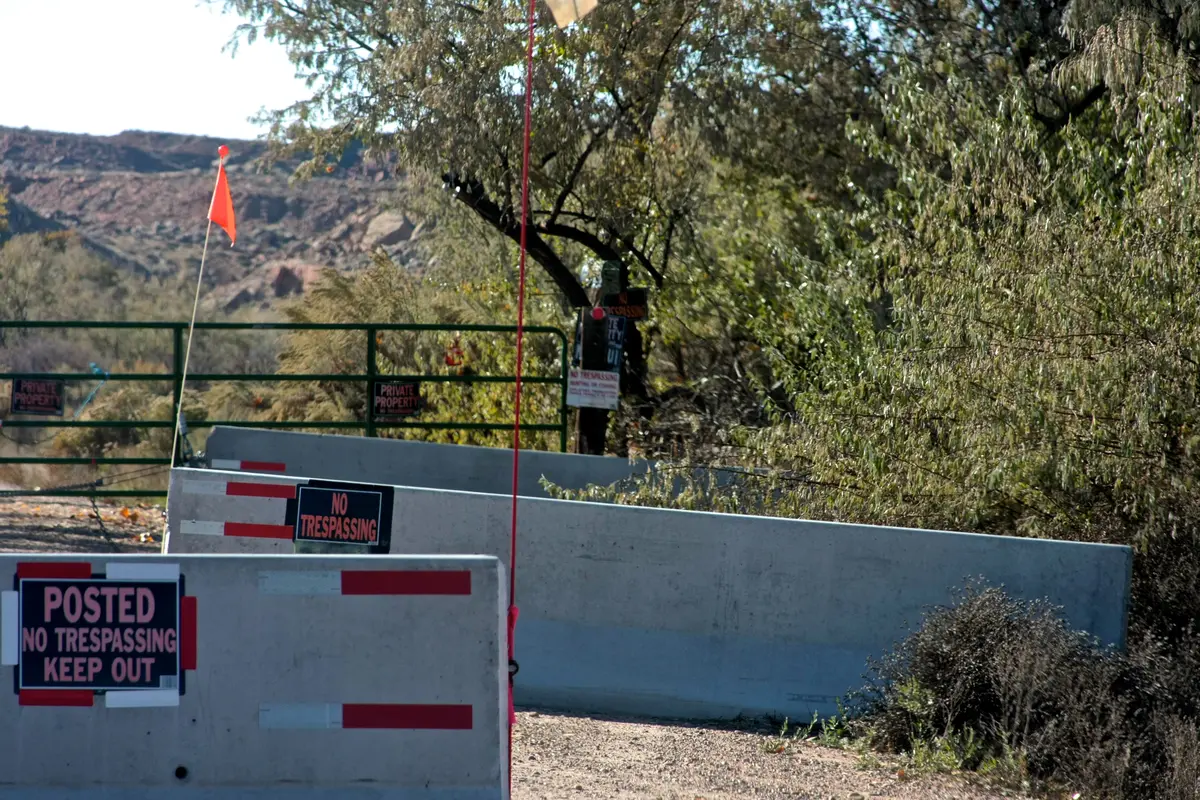
Skinwalker Ranch is closed private property behind a guarded gate. The land is the 480-acre spread south of Fort Duchesne, in west Uintah County, that the Deseret News described in June 1996; MJ Banias, driven in for VICE in 2020, gave the area as 512 acres. He reported that "Large portions of the 512-acre ranch are under 24/7 surveillance". His account of the approach lists what stands at the end of the road: two concrete blockades dotted with "No Trespassing" signs; a massive "STOP" sign; a twenty-foot black steel gate; on the far side of it, "a guard carrying a black rifle". The head of security told him that people show up at the gates all the time wanting to come onto the property and that most of them leave when they are asked to. The ranch runs no public tour and has no visitor centre. Roads leading to it were blocked after the 2016 sale; cameras and barbed wire guard the perimeter.
The Uintah County Heritage Museum, at 155 East Main in Vernal, is free to enter. Its own site gave the hours on 9 September 2026 as 9 a.m. to 5 p.m. from Monday to Thursday between September and May, 9 a.m. to 4 p.m. on Friday, 10 a.m. to 4 p.m. on Saturday; from June to August it opens until 6 p.m. on weekdays. Sunday is the one day of the week it does not open. Vernal and Roosevelt are the towns nearest the ranch, in the Uinta Basin of north-eastern Utah, about three hours by road east of Salt Lake City.
Sources consulted
- Zack Van Eyck, «Frequent Fliers?» — Deseret News, 1996 newspaper archive
- Zack Van Eyck, «Millionaire Leads Quest for UFO Data» — Deseret News, 1996 newspaper archive
- Harry Reid, United States Senate, «Letter to Deputy Secretary of Defense William Lynn III requesting Restricted Special-Access-Program status for the Advanced Aerospace Threat and Identification Program» — Defense Intelligence Agency FOIA release (The Black Vault), 2009 archive
- Steven Aftergood, «More Light on Black Program to Track UFOs» — Federation of American Scientists, 2019 report
- MJ Banias, «Inside Skinwalker Ranch, a Paranormal Hotbed of UFO Research» — VICE, 2020 newspaper archive
- Colm A. Kelleher and George Knapp, «Hunt for the Skinwalker: Science Confronts the Unexplained at a Remote Ranch in Utah» — Paraview Pocket Books, 2005 book
- Robert Sheaffer, «Secret Medical Experiments at the Skinwalker Ranch? — quotes Hunt for the Skinwalker, p. 209, on how little physical evidence NIDS obtained, and dates the end of NIDS to 2004» — Bad UFOs (blog), 21 November 2019, 2019 web
- Robert Sheaffer, «Microwaves, Dead Cows and Light Pillars - "The Secret of Skinwalker Ranch" — review of the first episode of the History Channel series» — Bad UFOs (blog), 2 April 2020, 2020 web
Reviewed by V. Serrano on 2026-07-29 · How we verify our content
💬 Field testimonies (0)
No testimonies yet. Add the first.
Add your testimony
🔒 Log in to add a testimony