👻 HAUNTED PLACE · EXP. Nº9477
ACTIVE
St. Augustine Light
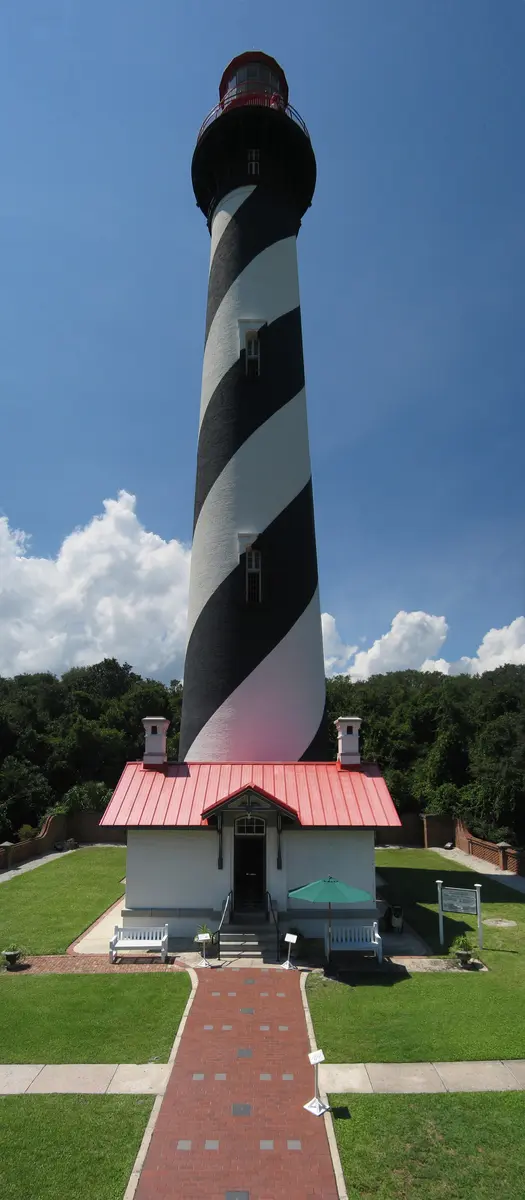
The 165-foot tower on Anastasia Island was built between 1871 and 1874 to replace an older stone watchtower that the sea finally pulled down in 1880.
Where is St. Augustine Light?
- Location
- Florida, United States
- Type
- Lighthouse
- Coordinates
- 29.885, -81.289
- Last updated
LOCATION
Why is St. Augustine Light said to be haunted?
Its ghost story belongs to the building site. On Thursday 10 July 1873, with only forty-two feet of tower standing, the cart that ran on rails down to the supply dock tipped into the water because the wooden stop board was missing. Three children drowned: Mary Pittee, fifteen, and Eliza Pittee, thirteen, daughters of the superintendent of construction Hezekiah Pittee, and an African-American girl of about ten whose name the museum has never been able to establish. A young Black worker, Dan Sessions, lifted the cart off them. Since then, visitors and former staff have reported children's laughter in the tower and a small girl who is there and then is not. The unusual part is the institution: the St. Augustine Lighthouse & Maritime Museum sells the ghost tours and also publishes, in writing, the list of deaths it can document and the ones it cannot.
What is the history of St. Augustine Light?
The black-and-white tower on Anastasia Island is not the first light on this ground, and the man usually named as the father of its ghost girls never kept its lamp.
The watch begins under the Spanish crown. The museum's own timeline dates the first documented archival reference to a wooden watchtower at the north end of the island to Giovanni Battista Boazio's 1589 map of Sir Francis Drake's 1586 raid on St. Augustine. By 1737 the Spanish had replaced it with a thirty-foot tower of coquina, the local shell rock, with a canoe kept at the sentry post and a spar and halyards to signal the direction from which ships were coming. The British, who held Florida from 1763, heightened it with thirty feet of timber, and charts of 1764, 1780 and 1794 mark a balise or a "lighthouse" on Anastasia. The nomination that put the station on the National Register states the American chapter flatly, quoting the county marker at Lighthouse Park: the stone tower "was converted to a lighthouse in 1823 and used until it was lost to the sea". It was raised ten feet in 1852, received a fourth-order Fresnel lens in 1853, went dark during the Civil War when Confederate sympathisers hid the lens and clockwork, and was relit in 1867.
Then the sea won the argument. With the old tower being undermined, Congress funded a replacement: the Lighthouse Board contracted Paulding, Kemble and Company of Cold Spring, New York, on 10 October 1871 for $11,900 of metalwork; Governor Harrison Reed ceded state jurisdiction over the five purchased acres on 16 May 1872; and the finished 165-foot tower cost about $105,000, with a focal plane 101 feet above the sea and a light visible nineteen miles.
The man in charge of building it was Hezekiah H. Pittee (1826–1918), a native of Maine and superintendent of lighthouse construction for the Atlantic coast. The National Register form lists him under "builder/architect"; the man who first lit the new first-order lens, on 15 October 1874, was keeper William R. Russell. Pittee had moved his family down from Cape Elizabeth, Maine, to live on the site while the work dragged on.
By the summer of 1873 only the foundation and forty-two of the tower's 165 feet were standing. A rail cart hauled supplies from the boats that unloaded at Salt Run up to the works, and the children rode it down to the water for fun; a wooden board at the end of the rail was the only thing that stopped the cart from tipping into the bay. On Thursday 10 July 1873 the board was not in place.
The museum has published two accounts. Its 2010 page states that five children went into the water, that workers saved a boy and a girl, and that the dead were "two of Pittee's daughters, Mary (15) and Eliza (13), and a young black girl, either a servant or the daughter of a worker". Its 2020 account, by special programs manager Kelcie Lloyd, puts four girls in the cart — Mary (15), Eliza (13), Carrie (4) and an unnamed African-American girl of about ten whose father may have worked on the site — says that a young African-American worker named Dan Sessions lifted the cart off them, and that only four-year-old Carrie survived. Both versions agree on the part that matters: one of the three dead was a Black child, and the museum has never been able to name her. The Pittees took their daughters home to Maine for burial. "Staff researchers have not yet been able to find the final resting place of the young African American girl," the museum wrote in 2020.
The rest of the station's history is ordinary and well documented. The old tower, undermined by the sea, collapsed in 1880; by the late 1880s Flagler's tourists were taking tea on its rubble at low tide, and in 2001 the museum's archaeologists recorded its foundations. The keepers' brick duplex was ready in 1876 and gained two outside kitchens in 1888. The light was electrified in 1936, dimmed from 20,000 to 5,000 candlepower during the U-boat war, and automated in 1955, when James Pippin, the last resident keeper, moved out. A suspicious fire gutted the keepers' house in 1970; sixteen women of the Junior Service League of St. Augustine took it on in 1980, raised over $1.2 million and restored house, tower and the original Paris-made lens. The site was listed on the National Register on 19 March 1981 and was fully open to the public by 1994; the Coast Guard handed the tower and lens to the museum in 2002.
Timeline: the documented record of St. Augustine Light
- 1589 Giovanni Battista Boazio publishes his map of Francis Drake's 1586 raid on St. Augustine. The museum treats it as the first documented archival reference to a wooden watchtower at the north end of Anastasia Island, the ancestor of the light station.
- 1823 The old Spanish stone watchtower is converted into a lighthouse under the American administration. The marker at Lighthouse Park, quoted in the National Register nomination, says it "was converted to a lighthouse in 1823 and used until it was lost to the sea".
- December 1859 Keeper Joseph Andreu falls to his death whitewashing the old tower. His widow, Maria Andreu, takes over the light in January 1860; the U.S. Coast Guard recognises her as the first Hispanic-American woman to command a federal shore installation.
- 10 October 1871 The Lighthouse Board contracts Paulding, Kemble and Company of Cold Spring, New York, for $11,900 of metalwork for a first-order light at St. Augustine. Hezekiah H. Pittee, superintendent of lighthouse construction and a native of Maine, is in charge of the works.
- Thursday 10 July 1873 With only the foundation and forty-two feet of tower built, the supply cart runs off the rails into the water because the wooden stop board is missing. Mary Pittee (15), Eliza Pittee (13) and an unnamed African-American girl drown. Dan Sessions, a young Black worker, lifts the cart off them; the museum's 2010 account says a boy and a girl were saved, its 2020 account that four-year-old Carrie Pittee was the only survivor.
- 15 October 1874 Keeper William R. Russell lights the oil lamp inside the new first-order Fresnel lens, made in Paris by Sauter & Lemonier, for the first time. The 165-foot tower has cost about $105,000.
- 1880 The old tower, built too close to the shoreline and undermined by the sea, collapses. Its foundations were recorded by the museum's archaeologists in 2001.
- 1955 The light is automated and James Pippin, keeper since 1953 and the last to live at the station, leaves. The museum reports that he had already moved into the small 1941 lookout building, saying the "big house was haunted and he would not stay another night in it".
- 1970 A suspicious fire guts the empty keepers' house, leaving the coquina basement and a few charred timbers. St. Johns County considers demolition; the Junior Service League of St. Augustine takes the building on in 1980 and raises over $1.2 million to restore the station.
- 19 March 1981 The lighthouse and keeper's quarters are listed on the National Register of Historic Places on a nomination signed by Roila L. Queen in December 1980, which calls them the oldest surviving brick structures in the city and records Pittee as builder, not keeper.
- 3 May 2006 The Sci Fi Channel airs the Ghost Hunters episode filmed at the light station — the oldest datable mass-audience appearance of these ghost stories. According to the recap Syfy published, the team reproduced the famous sound of a dropped bucket by slamming a nearby window.
- 29 November 2010 The Wayback Machine captures the museum's page "Get the Facts Behind the 'Ghost Stories'", which lists the documented deaths on the grounds, denies that any keeper fell from the current tower and says there is no proof of the hanging so often retold. At that date the night-time events are still described as invitations for donors.
- 2 March 2020 Special programs manager Kelcie Lloyd publishes the museum's fullest account of the Pittee girls: the names and ages, Dan Sessions, the unlocated grave of the Black girl and a psychic's unverified claim that she was called Ellie or Eleanor.
Is there a rational explanation for St. Augustine Light?
This is a rare case where the business selling the ghost is also the best sceptic available, and it has put both positions in writing.
The commerce is real and unhidden. The museum sells at least four paranormal products — the Dark of the Moon Ghost Experience, an investigation-only night, Lighthouse Ghost Tales and private after-hours investigations — and markets them with lines like "All Ghosts No Gimmicks!" and "See for yourself why we are consistently ranked as one of the most haunted sites in St. Augustine!" The tour is not new: a page archived on 23 May 2011 already advertised Dark of the Moon every Friday, Saturday and Sunday at $25 an adult and $20 a child. The museum also states what the money is for: the tours "help the Museum fund programs including maritime archaeology and historical research" — this is an accredited institution with its own archaeology unit, LAMP, founded in 1999.
And yet the same institution publishes corrections that no ghost-tour operator would bother writing. Its 2010 page "Get the Facts Behind the 'Ghost Stories'" lists every death it can document on the grounds and then knocks down the favourites: "A Lightkeeper never fell from the current tower" (Joseph Andreu fell from the old one and died in 1859; John Carrera died in 1853; head keeper William Harn died of tuberculosis on 1 April 1889), and, on the hanged man of so many retellings, "As far as we know, no one ever hung him/herself here. There is a story that some passing mariner hung himself in the house in the 1930s. We have no proof that this happened." The same page reprints, with visible relish, a notice from The St. Augustine Star of 4 January 1872 about a failed ghost at the fort: "We don't think much of these sham ghosts." In 2020 Kelcie Lloyd handled the stories the same way — "you can read some of them here and determine for yourself if they are fact or fiction" — and closed with "Obviously, we cannot explain the events that are reported to us on our tours, but we invite you to experience it for yourself." When a psychic supplied a name for the drowned Black girl, the museum printed the claim and its own caveat: "recently one told us that the young African American girl's name was Ellie or Eleanor. We continue our archival research and hope to find historical evidence one day to confirm this information."
The museum's 2020 article attributes the accounts: a relief keeper in the 1950s who heard footsteps upstairs and found nobody; James Pippin, keeper from 1953 to 1955, who moved to the small 1941 lookout building swearing the "big house was haunted and he would not stay another night in it"; a leather craftsman who rented the property in the 1960s and woke to a small girl beside his bed; guides and guests who report giggling in the tower and spikes on rented EMF meters. All of them reach us through the museum, decades after the fact.
Two things do not support the legend. First, the dating: nothing ties the ghost story to 1873. The oldest public appearances that can be fixed to a date are recent — the Ghost Hunters episode filmed for the Sci Fi Channel in 2006 (the museum confirms filming in 2006 and 2008, and a return for A&E broadcast on 4 September 2019), the museum's own ghosts page archived in November 2010, and the tour page archived in May 2011. Second, the record: a search of the Library of Congress's Chronicling America on 13 August 2026 found no Florida newspaper page digitised for 1870–1875; as a control, the same collection returned 297 Florida hits for "Augustine" in 1876–1880 and 1,846 in 1885–1889, and "Pittee" across the entire 1873 corpus, every state, returned six pages, none of them about a drowning. The 1873 deaths rest on the museum's archival research, and the ghosts on what visitors and former staff have related.
The mundane explanations are the usual ones and the programme makers found one themselves: in the 2006 investigation, according to the recap published by Syfy, the team reproduced the famous sound of a bucket being dropped on the landing by slamming a nearby window. Add a 165-foot brick flue with 219 iron steps, sea wind, a wooden house, and visitors climbing it in the dark holding a glow stick after an hour of stories about drowned children.
Can you visit St. Augustine Light?
The St. Augustine Lighthouse and Maritime Museum stands at 100 Red Cox Drive, St. Augustine, Florida 32080, which is the address the museum gives for a satellite navigator. Its mailing address, 81 Lighthouse Avenue, is a separate point and does not mark the entrance; parking on the station grounds is free.
The hours on the museum's own visitor pages, read on 22 September 2026, are 9.00 to 18.00 daily from 1 October to 28 February, with the last ticket sold at 17.30, and 9.00 to 18.30 from 1 March to 30 September, with the last ticket at 18.00. The station closes on Thanksgiving Day and on Christmas Day. On Christmas Eve the last admission is at 14.30 and the site shuts at 15.00. The same page warns that "The Lighthouse Tower may close due to weather and other events."
General admission covers the whole station: the 1874 tower with its 219-step spiral staircase, the 1876 Keepers' House with three exhibits, the Maritime Education Center with the conservation lab. The grounds take in the Second World War barracks and garage as well as a maritime hammock nature area with a pirate ship playground.
The tower rules are stated flatly: "Children under 44 inches and animals are restricted from going up the tower"; "Children over 44 inches must be able to climb the tower under their own power"; "Carrying children in the tower is prohibited." Service animals and emotional support animals are welcome on the grounds and barred from the historic buildings.
Admission is sold online and the published figures change. On 22 September 2026 the site advertised the code LH15 for 15 per cent off an online purchase, and it listed the Lens Room Tour at $500 per person, reserved by telephone.
The night programmes are separate tickets bought in advance. The museum lists the Dark of the Moon Ghost Experience; an investigation-only night; Lighthouse Ghost Tales; private ghost tours; Twilight at the Top; Sunset Moonrise; the Lighthouse Keepers' Tour; and Lighthouse Illuminations in the holiday season.
Accessibility is partial, and the museum sets it out: accessible parking with a wheelchair ramp to the visitors' centre and gift shop; all public restrooms wheelchair accessible; a ramp to the main floor of the Keepers' House; full access to the 1936 Second World War garage and the Maritime Education Center. The tower is a historic structure without a lift.
The station is a weapon-free zone in which drones may not fly over the property during operating hours or evening tours, and filming for anything beyond personal use requires a use agreement arranged with the marketing department.
Sources consulted
- Roila L. Queen, Florida Division of Archives, History and Records Management, «St. Augustine Lighthouse and Keeper's Quarters — National Register of Historic Places Inventory/Nomination Form (reference 81000668)» — United States Department of the Interior, National Park Service, 1980 report
- St. Augustine Lighthouse & Museum, «Get the Facts Behind the "Ghost Stories" (archived capture of 29 November 2010)» — Internet Archive Wayback Machine, 2010 archive
- Kelcie Lloyd, Special Programs Manager, «Ghost Stories: The Pittee Girls» — St. Augustine Lighthouse & Maritime Museum, 2020 web
- St. Augustine Lighthouse & Maritime Museum, «History — timeline of the St. Augustine Light Station» — staugustinelighthouse.org, 2026 web
- St. Augustine Lighthouse & Maritime Museum, «Women's History Month: Maria Andreu and Her Legacy in St. Augustine» — staugustinelighthouse.org, 2020 web
- St. Augustine Lighthouse & Maritime Museum, «Sept. 4: New Ghost Hunters episode at the St. Augustine Lighthouse airs on A&E» — staugustinelighthouse.org, 2019 web
- Syfy, «Episode Recap: St. Augustine Lighthouse (Ghost Hunters, season 2)» — syfy.com, 2006 web
- St. Augustine Lighthouse & Museum, «Dark of the Moon after-hours paranormal tour (archived capture of 23 May 2011, $25 adult / $20 child)» — Internet Archive Wayback Machine, 2011 archive
- Library of Congress, «Chronicling America: no Florida newspaper pages digitised for 1870–1875 (controls: 297 hits for "Augustine" in Florida titles 1876–1880, 1,846 in 1885–1889; "Pittee", all states, 1873: 6 pages)» — Chronicling America, consulted 13 August 2026, 2026 archive
- St. Augustine Lighthouse & Maritime Museum, «Plan Your Visit — hours, tower rules, accessibility and ghost experiences (consulted 13 August 2026)» — staugustinelighthouse.org, 2026 web
- St. Augustine Lighthouse & Maritime Museum, «Lighthouse History 1974–1994» — staugustinelighthouse.org, 2015 web
Reviewed by V. Serrano on 2026-08-13 · How we verify our content
💬 Field testimonies (0)
No testimonies yet. Add the first.
Add your testimony
🔒 Log in to add a testimony