👻 HAUNTED PLACE · EXP. Nº9478
ACTIVE
St. John's Episcopal Church (Lafayette Square)
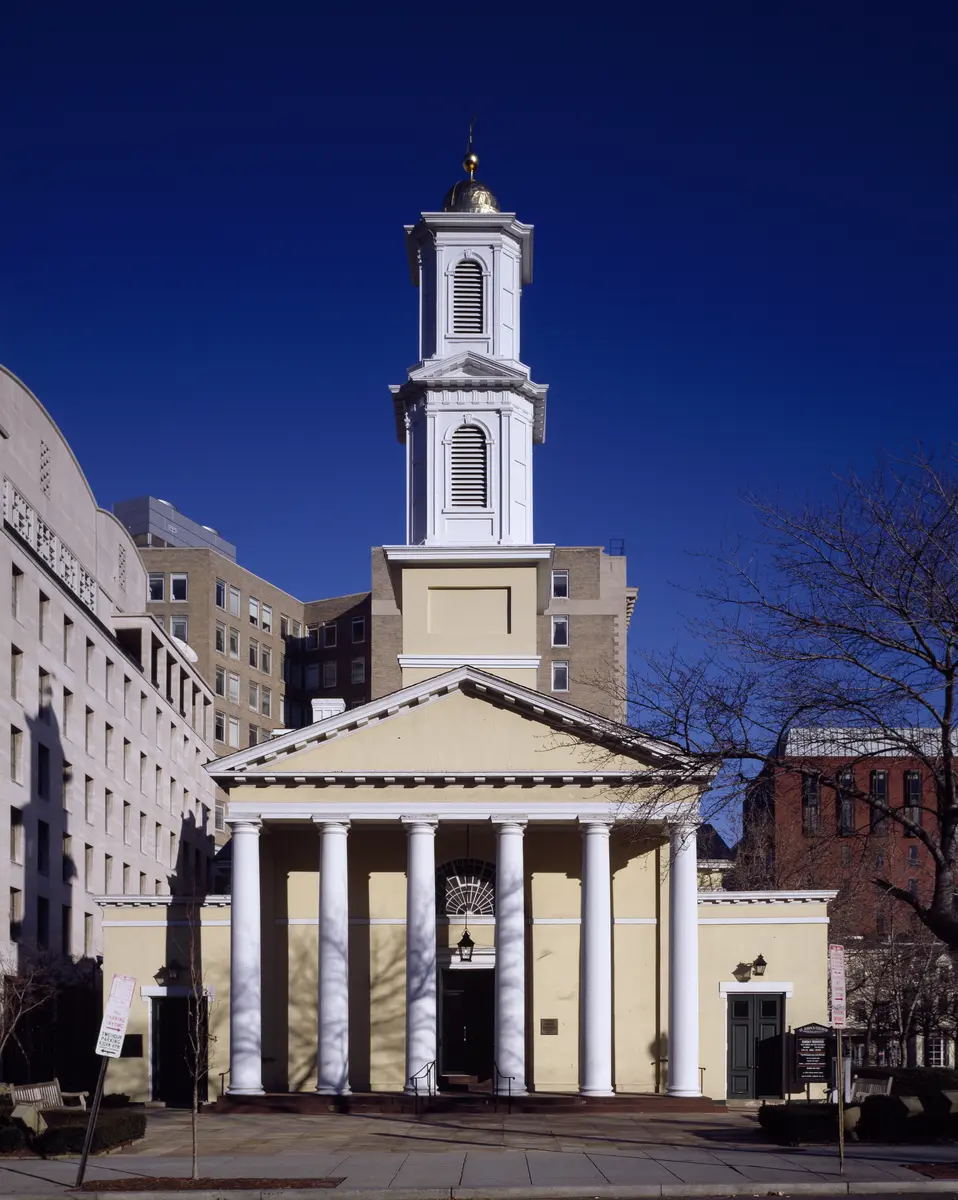
St. John's has stood a block from the White House since 1816, and every president since James Madison has attended at least one service in it; Pew 54 is kept for them.
Where is St. John's Episcopal Church (Lafayette Square)?
- Location
- Washington, D.C., United States
- Type
- Church / religious site
- Coordinates
- 38.9, -77.036
- Last updated
LOCATION
Why is St. John's Episcopal Church (Lafayette Square) said to be haunted?
Its ghost story is easier to tell than to trace: when the bell tolls for the death of someone of national importance, six figures in white are said to appear in the president's pew at midnight and then vanish. Nobody says who they are, who saw them, or on what night. The oldest printed version I have been able to date is a Washington guidebook of 2009, and it admits outright that nobody knows which six. The story is absent from the digitised American press up to 1963 and from the parish's own documented 349-page history, which is full-text searchable. What is real is the bell: cast in Boston in August 1822 by Joseph Revere, son of Paul Revere, hung on 30 November of that year, and weighing 964 pounds rather than the round thousand everyone repeats. It served as the neighbourhood fire alarm, the White House included, and it still rings.
What is the history of St. John's Episcopal Church (Lafayette Square)?
St. John's was not built for presidents. It was built for a neighbourhood — the western end of a capital city that was still repairing itself after British troops burned it in 1814.
The parish was organised in 1815 and the design went to Benjamin Henry Latrobe, the engineer-architect then at work on the Capitol. He laid the church out as a simple Greek cross under a cupola. The cornerstone was set on 14 September 1815, the first service was held on 27 October 1816, and the building was consecrated on 27 December of the same year. Latrobe was pleased with himself: in a letter to his son that December he wrote that the church "is a pretty thing, and has a celebrity beyond all bounds. It has made people religious who were never before at church." The sentence survives in his published papers and in the parish's own documented history.
The portico and the bell tower came next, finished by 1822. On 30 November 1822 the parish hung a bell cast that August by Joseph Revere — Paul Revere's son — at the family foundry in Boston. St. John's own restoration record gives its weight as 964 pounds (about 437 kg) and its price as $400, met by parishioner donations plus $100 of public money authorised by President James Monroe. It was not only a church bell: it served as the fire alarm for the surrounding houses, businesses and public buildings, the White House among them. It is one of two Revere bells in Washington and the only one that has never gone out of service.
The building did not stay as Latrobe left it. The renovations of 1843 replaced his boxed pews with the lower open seating still in use. James Renwick altered the church in 1883, the year of its twenty-five stained-glass windows from the Lorin workshop of Chartres; along the way the Greek cross became a Roman one. Pew 54 is the President's Pew, kept for the president's use when he attends. The nickname was already official language by 1970, when the National Park Service historian John D. McDermott, writing the Lafayette Square Historic District nomination, described St. John's as "sometimes called the 'Church of the Presidents'". The District's inventory of historic sites records the rest of its paperwork: National Historic Landmark on 19 December 1960, District listing on 8 November 1964, National Register listing on 15 October 1966, documented as HABS DC-19.
The part of the history that almost never gets told is who else was inside. William Hawley, the second rector, led the parish from 1817 to 1845, and he baptised and married Black Washingtonians of every legal status. The marriage register, transcribed by the White House Historical Association, records weddings for six couples entered as "slaves", thirty-eight as "colored" and two as "colored (free)". Many took place not in the church but in Hawley's own house next door, with his family standing as witnesses: "John, slave of Colonel Tayloe, and Winny, slave of Mrs. Kedglie. October 3, 1822"; "Thaddeus Hughes, slave of Colonel Tayloe, and Kitty Thomas, slave of Mrs. Jos. Baker. February 2, 1826". On 11 January 1828 Hawley married Emmeline Matthews, entered as "colored", to William Prates, entered as a slave. The very next wedding in the same register is that of John Adams II, the president's son, to Mary Hellen. The two entries sit one under the other.
In 1865 the rector worked with a group of twenty-eight African Americans to found a new Episcopal congregation. A member of St. John's gave land in Foggy Bottom, and in 1867 the building was named St. Mary's Chapel for Colored People. Six years later St. Mary's called Alexander Crummell — later the founder of the city's first independent Black Episcopal church — as its first African-American rector.
The parish house around the corner at 1525 H Street NW has its own history and its own landmark status. Known as Ashburton House, built in 1836 and designated a National Historic Landmark on 7 November 1973, it housed the British legation during the ten months of negotiation that produced the Webster–Ashburton Treaty of 1842, settling the boundary with Canada.
By 1960 the congregation itself had no African-American members. On 28 August 1963 the rector, John C. Harper, was warned by his wardens to shut the doors during the March on Washington because "it might be a bloodbath". He did the opposite: St. John's held a prayer service at eleven that morning and 700 people of all races filled it. Harper then wrote to his parishioners that "this church building is open, as it has always been, to all who want to worship here; the ministry of this parish is extended to any who seek it; our fellowship with one another has no limitations whatsoever."
The most recent chapter is the one visitors ask about. Just after 10 p.m. on Sunday 31 May 2020, during the night of unrest that followed the killing of George Floyd, a fire was set in the basement nursery of the parish house. The nursery was destroyed; there was smoke and water damage elsewhere in the basement and graffiti outside. Nobody was hurt and nothing irreplaceable was lost. The following evening federal officers cleared Lafayette Square with chemical irritants so that the president could be photographed holding a Bible at the church's corner; the rector, Rob Fisher, said afterwards that there had been "no reaching out to us and no conversation before, during or after". A year on, repairs to the nursery, the wiring and the air-conditioning still ran to hundreds of thousands of dollars. By 2024 the parish had finished a separate $1.875 million project: the preservation of the bell tower and cupola, with the Revere bell inspected and repaired, and a new slate roof over the sanctuary.
Timeline: the documented record of St. John's Episcopal Church (Lafayette Square)
- 14 September 1815 The cornerstone of St. John's is laid. The parish, organised that year, has commissioned Benjamin Henry Latrobe — then at work on the Capitol — to design a church for the residential western end of Washington, still repairing itself after the British burned the city in 1814.
- 27 October and 27 December 1816 The first service is held on 27 October and the church is consecrated on 27 December. Writing to his son that December, Latrobe calls the building "a pretty thing" with "a celebrity beyond all bounds" that "has made people religious who were never before at church".
- 30 November 1822 A bell cast that August by Joseph Revere, son of Paul Revere, at the family foundry in Boston is hung in the newly finished tower. The parish records its weight as 964 pounds (about 437 kg) and its price as $400, met by donations plus $100 of public funds authorised by President James Monroe. It doubles as the neighbourhood's fire alarm, covering the White House.
- 11 January 1828 The rector William Hawley marries Emmeline Matthews, entered in the register as "colored", to William Prates, entered as a slave. The next wedding recorded on the same page is that of John Adams II, the president's son, to Mary Hellen. Across his incumbency (1817-1845) Hawley marries six couples entered as "slaves", thirty-eight as "colored" and two as "colored (free)", many of them in his own house next to the church.
- 1842 The parish house at 1525 H Street NW, later known as Ashburton House, is the seat of the British legation during the ten months of negotiation that produce the Webster-Ashburton Treaty settling the boundary with Canada. The building is itself designated a National Historic Landmark on 7 November 1973.
- 1865-1873 The rector of St. John's works with twenty-eight African Americans to establish a new Episcopal congregation. A parishioner donates land in Foggy Bottom and the building is named St. Mary's Chapel for Colored People in 1867; six years later St. Mary's calls Alexander Crummell as its first African-American rector.
- 1883 James Renwick alters the church; the same year brings the twenty-five stained-glass windows made by the Lorin workshop of Chartres. Latrobe's Greek cross has by now become a Roman one, and the 1843 renovation has already replaced his boxed pews with lower open seating.
- 19 December 1960 St. John's is designated a National Historic Landmark. District of Columbia listing follows on 8 November 1964 and National Register listing on 15 October 1966; the building is documented as HABS DC-19. In the same year the congregation has no African-American members.
- 28 August 1963 Warned by his wardens that opening the doors during the March on Washington "might be a bloodbath", the rector John C. Harper holds a prayer service at eleven that morning; 700 people of all races fill the church. He writes afterwards that "this church building is open, as it has always been, to all who want to worship here".
- 10 March 1970 The National Park Service historian John D. McDermott signs the Lafayette Square Historic District nomination, which lists St. John's as a National Historic Landmark by Latrobe (1816) and Renwick (1883), "sometimes called the 'Church of the Presidents'". It is the earliest official use of the nickname located for this file.
- 2009 The oldest datable printed appearance of the ghost story located for this file: Brigette Polmar's guidebook "Washington, D.C.'s Most Wanted" (Potomac Books) has "the ghosts of six great Washingtonians (no one knows which six) appear in the President's Pew at midnight, dressed in white, and vanish after…". No witness, no date, no source.
- 2017 The story reaches a children's guidebook: Moira Butterfield's "Washington, DC City Trails" (Lonely Planet Kids) has "when the bell rings, six men in white robes appear in the President's Pew at midnight to pay their respects". These two guidebooks are the only copies returned by the full-text index searched.
- 31 May and 1 June 2020 Just after 10 p.m. on 31 May a fire is set in the basement nursery of the parish house during the unrest following the killing of George Floyd; the nursery is destroyed, with smoke and water damage elsewhere and graffiti outside, and nobody is hurt. The next evening federal officers clear Lafayette Square with chemical irritants for a presidential photograph at the church's corner; the rector Rob Fisher says there was "no reaching out to us and no conversation before, during or after".
- 2024 The parish completes a $1.875 million project: preservation of the bell tower and cupola, with the Revere bell inspected and repaired, and a new slate roof over the sanctuary. All the work was reviewed by federal and District agencies because the tower sits in the White House viewshed.
Is there a rational explanation for St. John's Episcopal Church (Lafayette Square)?
The problem with the six men in white is not that the story is unlikely. It is that nobody who repeats it can say where it comes from.
I went looking for the oldest datable printed version and could not get further back than 2009. Brigette Polmar's guidebook "Washington, D.C.'s Most Wanted" (Potomac Books, 2009) carries the passage — located by full-text search of the Internet Archive index, which is the form in which I read it — that "the ghosts of six great Washingtonians (no one knows which six) appear in the President's Pew at midnight, dressed in white, and vanish after…". The only other copy the same index returns is Moira Butterfield's "Washington, DC City Trails" (Lonely Planet Kids, 2017): "when the bell rings, six men in white robes appear in the President's Pew at midnight to pay their respects before…". Two guidebooks, neither naming a witness, a date, or a source, and one of them stating outright that nobody knows who the six are supposed to be.
That index is worth pressing, because it also holds the definitive parish history: Richard F. Grimmett's documented 349-page "St. John's Church, Lafayette Square: The History and Heritage of the Church of the Presidents" (2009). It is searchable — a phrase search for Latrobe's "celebrity beyond all bounds" returns Grimmett's book as one of only two hits in the whole corpus. The same corpus returns Grimmett for none of the phrasings of the ghost story I tried.
The American newspaper corpus says the same thing. In Chronicling America — which includes Washington's Evening Star up to 1963 — "six white-robed figures" gives six hits, all between 1921 and 1923 and all about the Ku Klux Klan; "six figures in white" gives one, from 1923; "figures in white robes" gives fifteen, the most recent from 1891. Not one concerns St. John's. Positive controls run in the same corpus and repeated to guard against an intermittent zero: "St. John's Church Lafayette Square", 1,387 hits; "white-robed figures" on its own, 464. The search works. The honest limit is that OCR is imperfect and another wording could be hiding in there.
The parish publishes a great deal about itself — its history, its bell, its presidents' pew, its stained glass, a whole section called "A Witness to American History" — and the legend appears in none of it.
The mechanism, in plain terms and without borrowing anyone else's authority: the story is built so that it cannot be checked. Its trigger is the death of "a person of national importance", which is rare and vaguely defined; its hour is midnight; its stage is the inside of a locked church on the most heavily policed corner in the United States. There is no version of it that says who watched, from where, or on what night. A claim with no observer is not evidence that failed — it is a claim that was never made testable.
And there is one detail worth flagging because it shows how these things travel. Almost every retelling calls it a 1,000-pound bell. The parish's own restoration page gives 964 pounds; the art and architecture page of the same website rounds it to "nearly 1,000-pound". A round number is easier to repeat than 964, so the round number is what everyone copies — this file included, until this revision.
Can you visit St. John's Episcopal Church (Lafayette Square)?
The parish stands at 16th and H Streets NW, Washington DC 20005. The church doors are on 16th Street NW; the entrance to the Parish House is round the corner at 1525 H Street NW, and the parish answers on (202) 347-8766. Sunday worship on 9 September 2026 was listed as 8am Holy Eucharist and 10.30am Choral Eucharist, the second one livestreamed.
The parish's tours page carries a sentence that its own worship schedule contradicts: "Tours of St. John's Church and Parish House take place on Sundays after the 11:00 AM service, free of charge." No 11am service appeared on the schedule that day. Private tours for groups are arranged on request through the parish.
Every president from James Madison onwards has attended at least one service here, often in Pew 54, which is in the nave. The bell above them was cast by the Revere Foundry and installed on 30 November 1822; it weighs 964 pounds and cost $400, of which $100 came from public funds authorised by President Monroe. The parish describes it as "one of two Revere bells in Washington, and the only one that has been in continuous use since its installation". The building is a National Historic Landmark and a contributing property to the Lafayette Square and Sixteenth Street historic districts.
The fire of 1 June 2020 did not gut the church. The rector, Rob Fisher, told the Episcopal News Service that the blaze "was contained to a nursery room, although there was smoke and water damage to other areas of the basement", that nobody was hurt and that no irreplaceable historical item was damaged. The exterior graffiti left that night was cleaned off by city crews.
McPherson Square station on the Blue, Orange and Silver lines is a two-minute walk; Farragut North on the Red line is five minutes away. Free valet parking runs on Sundays from 9am to 1pm. A wheelchair ramp is on the north side of the sanctuary doors on 16th Street NW, with a lift into the Parish House at the H Street entrance.
Sources consulted
- St. John's Episcopal Church, Lafayette Square, «Restoring a Capital City Landmark: The Bell Tower of St. John's Church, Lafayette Square» — Parish restoration record, 2024 archive
- St. John's Episcopal Church, Lafayette Square, «Art and Architecture / The History of St. John's, Lafayette Square» — Parish website, 2026 archive
- White House Historical Association, «St. John's Church: Free and Enslaved African Americans Married and Baptized at the President's Parish (with selected entries from the St. John's marriage register)» — Slavery in the President's Neighborhood, 2020 archive
- John D. McDermott, «Lafayette Square Historic District — National Register of Historic Places Inventory-Nomination Form» — National Park Service, Office of Archeology and Historic Preservation, 1970 report
- District of Columbia Historic Preservation Office, «DC Inventory of Historic Sites (entries: Saint John's Church; Ashburton House)» — Office of Planning, 2009 report
- Episcopal News Service, «Fire causes minor damage to St. John's, the 'church of presidents' in Washington, during night of riots» — Episcopal News Service, 2020 newspaper archive
- Brigette Polmar, «Washington, D.C.'s Most Wanted: The Top 10 Book of Tourist Treasures, Powerful Politicians, and Capital Wonders» — Potomac Books, 2009 book
- Moira Butterfield, «Washington, DC City Trails» — Lonely Planet Kids, 2017 book
- Benjamin Henry Latrobe, «Latrobe's View of America, 1795-1820: Selections from the Watercolors and Sketches» — Yale University Press for the Maryland Historical Society, 1985 book
- Richard F. Grimmett, «St. John's Church, Lafayette Square: The History and Heritage of the Church of the Presidents, Washington, DC» — Minerva Press, 2009 book
- WTOP News, «A year later, DC church leader looks back on the clearing of Lafayette Square» — WTOP, 2021 newspaper archive
- Carol M. Highsmith, «St. John's Church, Washington, D.C. (LC-DIG-highsm-13255) — catalogue record and rights statement» — Library of Congress, Prints and Photographs Division, 2011 archive
- Library of Congress, «Chronicling America: Historic American Newspapers (full-text searches and positive controls run 13-14 August 2026)» — National Digital Newspaper Program, 2026 archive
- St. John's Episcopal Church, Lafayette Square, «Visit St. John's, Lafayette Square / Tours of St. John's, Lafayette Square» — Official visitor information, 2026 archive
Reviewed by V. Serrano on 2026-08-14 · How we verify our content
💬 Field testimonies (0)
No testimonies yet. Add the first.
Add your testimony
🔒 Log in to add a testimony