👻 HAUNTED PLACE · EXP. Nº9477
ACTIVE
Stow House
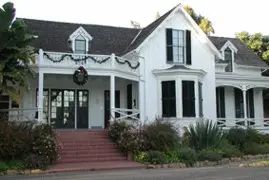
Stow House was finished in 1873, and the order of what came next matters: the National Register nomination says Sherman P. Stow completed the Carpenter Gothic cottage and married Ida Hollister "soon thereafter".
Where is Stow House?
- Location
- California, United States
- Type
- Museum
- Coordinates
- 34.443, -119.851
- Last updated
LOCATION
Why is Stow House said to be haunted?
The land was not his either — his father, Southern Pacific attorney William Whitney Stow, bought 1,043 acres of Rancho La Patera in 1871 so his twenty-year-old son could farm. What the family built here was California's first commercial lemon grove, and the laboratory people whisper about was an agricultural experiment station, where Edgar Stow found a way to beat oak root fungus and sent rootstock as far as Palestine. The ghost story is much younger than the house. In public the haunting is claimed by a Ghost Adventures episode first broadcast on 28 June 2023, selling "a stately California ranch steeped in tragedy". The Goleta Valley Historical Society, which has cared for the house since 1967, has never mentioned a ghost — or that episode — anywhere on its website. The story worth telling is the one the standard version leaves out: the Chinese cooks and laundrymen who lived in the wing that was cut off the back of the house.
What is the history of Stow House?
The house at the centre of Rancho La Patera was not built for a bride, and it was not bought by the man who built it. Both halves of that correction come from the same document: the National Register nomination filed in 2000 by Monte G. Kim, the Goleta Valley Historical Society's own historian.
The land had been Chumash long before it was anyone's ranch. The Goleta Slough supported one of the most densely settled stretches of the California coast, and the place-name itself survives in the ethnographic record: Chester King's 1975 inventory of historic Chumash villages lists a settlement recorded by Alexander S. Taylor in 1860 as lying "near the islet of La Patera near the sea shore". The Spanish name means duck pond. Under Mexican rule the area formed part of the Dos Pueblos Rancho, granted to Nicolás Den in 1842 by governor Juan Bautista Alvarado, and it included a 2,000-acre tract north of the slough called La Patera. In 1852 Den sold the property to his father-in-law Daniel Hill. When Hill died in 1865 the family carved Rancho La Goleta into 38 farmsteads, and his widow Rafaela took title to much of La Patera. In 1868 the heirs advertised the parcels at $22 an acre in newspapers as far off as San Francisco and Los Angeles.
One of the buyers was William Whitney Stow (1825–1895), an attorney for the Southern Pacific Railroad and a former Speaker of the California Assembly. In 1871 he bought 1,043 acres of the La Patera tract from Rafaela Ortega Hill and her new husband German Senter; the nomination says he "was primarily interested in purchasing farmland for his twenty-year-old son", Sherman P. Stow (1851–1907), "who wanted to pursue a career in agriculture".
Sherman began the ranch house in the autumn of 1872, on a knoll just east of the duck pond that would become Stow Lake and later Lake Los Carneros. He built it out of fir shipped down from Puget Sound and finished it the following year. The nomination is precise about what happened next, and the order matters: "Using fir shipped from the Puget Sound, Sherman completed the Gothic Revival cottage the following year. Soon thereafter, Sherman married Ida Hollister." The house came first; the marriage followed. Ida G. Stow (1851–1927) laid out the gardens through the 1870s, and the coast redwood still standing east of the house was an anniversary present from Sherman to her. The society attributes the Carpenter Gothic design to a Bay Area architect, Frank Walker, but hedges it as "believed to have been"; the National Register form records the architect and builder simply as unknown.
What the Stows did with the land is the part that earned the listing. The couple planted a hundred acres of almond, walnut and pecan, then 3,700 lime trees, and in 1874 — the society's own walking tour dates it a year later — a thirty-acre grove of Lisbon lemons, described in the nomination as the first commercial lemon grove in California. By 1888 the grove held 3,100 trees. In 1897 Sherman became the first president of the Johnston Fruit Company, the region's only private packing house.
The building grew with the business. Around 1885 a 33-foot Italianate second storey went up over the kitchen, pantry and laundry. Between 1913 and 1915 the west porch was rebuilt to wrap the south-west corner and French doors were cut in beside the main entrance. And around 1915 the entire north wing was demolished, turning the original U-shaped plan into the L that visitors see today.
That demolition is the most interesting thing about the house, because of who lived in the wing. The rear rooms were the domestic workers' quarters, and the society states plainly that "male Chinese immigrant cooks and laundrymen, whose numbers varied from one to three, were among the workers who occupied these rooms from the 1870s to the 1930s". The rooms were not destroyed: in 1914 Sherman H. Stow lifted that 1870s structure, stacked it on top of a new food pantry, and made the two-storey Bunkhouse that now holds the historical society's archives. The society calls it "a physical reminder of the contributions of immigrants to Goleta Valley culture and history". The staff quarters were literally detached from the big house and re-erected in the yard — and that, rather than any spectre, is the household the standard account of Stow House leaves out.
Sherman P. Stow died in 1907, leaving three sons and three daughters. His first-born, Sherman H. Stow (1876–1915), ran the ranch until what the nomination calls his "untimely death" in 1915, at thirty-nine. Management then passed to his younger brother Edgar Whitney Stow, who had been born in the house on 26 May 1885, the fifth of the six children. Edgar took an agriculture degree at Berkeley in 1908, dug trenches for oil pipe, appraised ranches for a San Francisco real-estate firm, and came home in 1915. In 1917 he married Sally Taylor Alexander, of the De la Guerra family.
Edgar is the reason the house is on the National Register, and he is also the source of the laboratory. In the early 1920s he bought the equipment of a defunct kelp processing plant and set up what the society calls his own "experiment station" in a wood-frame building beside the house. There he ran trials on lemon buds and rootstocks, mixed his own insecticide formula, and designed pruning and spraying rigs built in the ranch shop. His best-known result was a defence against oak root fungus: budding Lisbon or Eureka lemons onto grapefruit rootstock, which resisted the disease. He also argued that the fruit was the best guide to irrigation, measuring a sample of lemons and watering only when their growth rate flattened. The California Citrograph published his findings in 1936, and that October the Goleta Valley Leader reported that the "fame of Santa Barbara county lemons has reached far away Palestine", where the grower Alfred Kaufman had written to Stow about his rootstock experiments. Stow obtained Palestine sweet lemon rootstock in Florida, found it resistant to gummosis, and distributed it locally; his 1949 obituary in the Santa Barbara News-Press recorded that "many of the finest orchards in the two counties obtained the root stock from La Patera".
He was also, briefly, a politician — Assembly in 1923, State Senate in 1932, retired in 1936 after losing his re-election bid — and he never moved the family to Sacramento, bowing, relatives told the nomination's researcher, to his wife's wishes. Disliking Prohibition, he planted a vineyard, pressed the fruit himself and excavated a wine cellar under the house. A stroke late in life left him bedridden and confined to the ground floor, and the room beside the parlour became his convalescent chamber. He recovered enough to travel, and died unexpectedly on 23 June 1949, aged 64, at his summer cabin in the Santa Ynez Valley — not in the house.
Stow descendants lived here until 1966, the year the laboratory building was hauled off to the family's Cathedral Oaks Road property, where it still serves as a ranch office; only its concrete foundation remains on site. Santa Barbara County bought the landmark in 1967 and the Goleta Valley Historical Society has cared for it ever since. The Stow House was listed on the National Register on 28 September 2000 under Criterion B, for its association with Edgar, with its significance marked as local. The listing covers the house alone: one contributing building on under an acre, with the barn, bunkhouse and packing shed deliberately excluded because they were built or moved after 1949.
Timeline: the documented record of Stow House
- 1842 Mexican governor Juan Bautista Alvarado grants the Dos Pueblos Rancho to Nicolás Den. It takes in the Goleta Slough and a 2,000-acre tract to its north called La Patera, Spanish for duck pond.
- 1865 On the death of Daniel Hill, who had bought the land from his son-in-law Den in 1852, the family divides Rancho La Goleta into 38 farmsteads. Hill's widow Rafaela takes title to much of La Patera; in 1868 the heirs advertise parcels at $22 an acre in San Francisco and Los Angeles papers.
- 1871 William Whitney Stow, attorney for the Southern Pacific Railroad and a former Speaker of the California Assembly, buys 1,043 acres of the La Patera tract from Rafaela Ortega Hill and her husband German Senter — for his twenty-year-old son Sherman, not for himself.
- Autumn 1872 – 1873 Sherman P. Stow begins the ranch house on a knoll east of the duck pond and finishes it the following year, using fir shipped from Puget Sound. The nomination states that he married Ida Hollister "soon thereafter" — the house was built first, and the bride came after it.
- 1874 Sherman plants a thirty-acre grove of Lisbon lemons, described in the National Register nomination as the first commercial lemon grove in California. The historical society's own walking tour dates the planting to 1875 and counts 3,000 trees; by 1888 the grove held 3,100.
- 26 May 1885 Edgar Whitney Stow is born in the house, fifth of Sherman and Ida's six children. Around the same year a 33-foot Italianate second storey is raised over the kitchen, pantry and laundry.
- 1907 Sherman P. Stow dies at 56, leaving three sons and three daughters. His first-born, Sherman H. Stow, takes over the ranch.
- 1914 Sherman H. Stow builds the Bunkhouse by stacking the 1870s domestic-servants' wing — detached from the rear of the main house — on top of a new food pantry. Chinese immigrant cooks and laundrymen, one to three at a time, had occupied those four rooms from the 1870s and would go on doing so into the 1930s.
- 1915 Sherman H. Stow dies at 39 — the nomination calls it an "untimely death" — and his younger brother Edgar returns from San Francisco to manage La Patera and live in the house. Around this time the entire north wing is demolished, turning the U-shaped plan into an L.
- Early 1920s Edgar buys the equipment of a defunct kelp processing plant and sets up his own "experiment station" in a wood-frame building beside the house: trials on lemon buds and rootstocks, his own insecticide formula, and pruning and spraying rigs built in the ranch shop. Disliking Prohibition, he also plants a vineyard and digs a wine cellar under the house.
- 1936 The California Citrograph publishes Stow's irrigation findings, and that October the Goleta Valley Leader reports that the "fame of Santa Barbara county lemons has reached far away Palestine", where grower Alfred Kaufman had written asking about his rootstock experiments. Stow retires from politics the same year after losing his re-election bid.
- 23 June 1949 After a stroke that had left him bedridden on the ground floor, in the room beside the parlour, Edgar Stow recovers enough to travel and dies unexpectedly at his summer cabin in the Santa Ynez Valley, aged 64. He did not die in the house.
- 1966–1967 The last Stow descendants leave, and the laboratory building is hauled to the family's Cathedral Oaks Road property, where it still serves as a ranch office; only its concrete foundation remains on site. Santa Barbara County buys the landmark in 1967 and the Goleta Valley Historical Society becomes its steward.
- 28 September 2000 Stow House is listed on the National Register of Historic Places under Criterion B, for its association with Edgar Whitney Stow, and is judged significant locally rather than statewide or nationally. The nomination, filed by society historian Monte G. Kim, covers the house alone and mentions no hauntings.
- 28 June 2023 The Ghost Adventures episode "Stow House Haunting" is first broadcast, promising "a stately California ranch steeped in tragedy" where "a dark energy has taken root on the land". A sweep of the historical society's website on 8 October 2026 finds no mention of the episode.
Is there a rational explanation for Stow House?
The institution that owns the ghost story does not tell it.
On 8 October 2026 the 60 pages and posts listed in the Goleta Valley Historical Society's own sitemap were downloaded and searched, about 170,000 characters of text, counting whole words and their plurals. "Ghost", "haunted", "haunting", "paranormal", "supernatural", "séance", "Bagans" and "Halloween" return no hits, and neither does "Ghost Adventures". The four hits for "spirit" are the dancers' titles Spirit of Fiesta and Junior Spirit, a distillery on a vendor list and a press quotation about "the Spirits' memorable performances". The controls in the same sweep are not zero: "Stow" appears 216 times and "ranch" 331 times across all 60 pages, "history" 173 times, and "lemon" 14 times on six pages. The society writes constantly about this house, and none of those pages mentions a ghost or the television episode filmed there.
The 2000 National Register nomination points the same way. It runs to twenty-one pages, it was written by the society's own historian, it drew on personal communications from two Stow nieces and a grand-nephew in April 2000, and it discusses the family's deaths, Edgar's stroke and the room where he convalesced. It contains nothing about hauntings. Nor does the Santa Barbara Independent's report on the society's "Holidays at the Ranch" in December 2007: inside the house a toy train circled the Christmas tree, volunteers rolled out cookie dough for the children, and a Santa heard wish lists.
A haunting at Stow House is claimed in public by a broadcast: an episode of Ghost Adventures titled "Stow House Haunting", first aired on 28 June 2023 according to TVmaze (Apple TV dates the release 27 June), and listed by both as season 26, episode 4. Its synopsis promises "a stately California ranch steeped in tragedy" where "a dark energy has taken root on the land", and a team working "to help the terrified caretakers". That is a description written to sell an hour of television.
The documented tragedies are real but ordinary for their era. Sherman P. Stow died in 1907 at 56; his son Sherman H. Stow died in 1915 at 39; Edgar died on 23 June 1949 at 64, during a visit to his summer cabin in the Santa Ynez Valley, according to the nomination. Three generations of one family lived here in unbroken succession until 1966. That is a remarkably stable history for a building sold as steeped in tragedy.
The house itself supplies plainer explanations for footsteps, cold spots and doors that move. It is a balloon-framed timber building from 1873, clad in board-and-batten, roofed in wood shingle and standing on a stone foundation overlaid with concrete. It has been cut about at least four times: a second storey dropped onto the kitchen range around 1885, the front porch rebuilt between 1913 and 1915, a wine cellar dug out beneath it, and an entire wing amputated from the north side around 1915. A structure with that history moves as it warms and cools, drafts through its batten joints, and carries door frames that have long since gone out of square. As for the woman in Victorian dress: the house is shown on guided tours as the home of a family that lived in it from 1873, and the setting supplies the period costume before any witness does.
Whether anyone has experienced something in the house is a separate question. The society that has cared for the building since 1967, the only institution with continuous access to it, has not claimed in its nomination or on its website that anyone did.
Can you visit Stow House?
Rancho La Patera & Stow House is at 304 N. Los Carneros Road, Goleta, California 93117 (805 681 7216, [email protected]). The property is county-owned and run by the Goleta Valley Historical Society.
The following was taken from the society's own visitor pages on 13 August 2026 and should be confirmed before travelling, because these are small volunteer-run opening hours and they change. The Visitor Center and Museum Store open Saturdays and Sundays from 1pm to 4pm. Guided tours of Stow House run on Saturdays and Sundays at 2pm and 3pm, and can be arranged on other days in advance. The Ranch Yard opens on Sundays from 11am to 2pm, and "Sundays at the Ranch" — barn animals, tractor rides, outdoor activities — is free. Admission is a suggested $5 donation. Group, school and youth-organisation tours are booked in advance, and the car park takes tour buses and RVs.
Accessibility needs a phone call. The society publishes nothing about wheelchair access — the only thing described as accessible on its entire website is the car park, and that refers to bus and RV size. The National Register description records a wide eight-step brick staircase to the front porch and a seven-step staircase to the east porch, with further stepped entrances on the north side, so every documented way into the 1873 house is by stairs, and the museum rooms occupy a one-and-a-half storey plan. Ring ahead and ask.
There are no ghost tours, and no paranormal events. The society runs no such programming and does not mention the subject anywhere in its published material, so do not arrive expecting a haunted attraction. What it does run is a full events calendar — Camp Stow, Fiesta Ranchera, Music at the Ranch, an Old Fashioned 4th of July, the Old Time Fiddlers' Festival and Holiday at the Ranch — and the site can be rented as a venue.
What is worth the trip is the ground. The Ida G. Stow Memorial Arboretum, restored by the society in 2013–14, preserves a rare surviving Picturesque-style Victorian ranch garden: Norfolk Island pine, Canary date palm, lemon eucalyptus, Chilean wine palm and bunya-bunya, plus the coast redwood east of the house that Sherman gave Ida as an anniversary present. The Bunkhouse and the 1880 packing shed — now the archives and the History Education Center respectively — tell the working history, and the Education Center covers the valley's story from the Chumash onward. Edgar's laboratory is gone; only its concrete foundation survives, at the top of the drive on the right. Immediately east lies the Lake Los Carneros Natural & Historical Preserve, with miles of footpaths and birdwatching, and the Goleta Depot of the South Coast Railroad Museum is next door.
Sources consulted
- Monte G. Kim, Goleta Valley Historical Society, «National Register of Historic Places Registration Form: Stow House, Santa Barbara County, California (reference 00001166)» — United States Department of the Interior, National Park Service, 2000 report
- Goleta Valley Historical Society, «Walking Tour: Edgar W. Stow's Office/Laboratory, Stow House, Bunkhouse, Ida G. Stow Memorial Arboretum and Packing Shed» — goletahistory.org, 2026 web
- Goleta Valley Historical Society, «Visitor Info: hours, tours and admission at Rancho La Patera & Stow House» — goletahistory.org, 2026 web
- Chester King (assembled by Thomas Blackburn), «The Names and Locations of Historic Chumash Villages» — The Journal of California Anthropology, vol. 2, no. 2, 1975 academic
- Travel Channel / Discovery, «Ghost Adventures, "Stow House Haunting" (season 26, episode 4), first broadcast 28 June 2023» — Apple TV episode listing, 2023 web
- TVmaze, «Ghost Adventures 26x04, "Stow House Haunting" — air date 28 June 2023, season 26, episode 4» — tvmaze.com, 2023 web
- Margaret Connell, «Holiday Spirit, Goleta — 'Holidays at the Ranch' at the Stow House: decorations, a toy train round the Christmas tree, cookie-baking volunteers, Santa» — Santa Barbara Independent, 2007 newspaper archive
Reviewed by V. Serrano on 2026-08-13 · How we verify our content
💬 Field testimonies (0)
No testimonies yet. Add the first.
Add your testimony
🔒 Log in to add a testimony