👻 HAUNTED PLACE · EXP. Nº9478
ACTIVE
Stuckey's Bridge
Stuckey's Bridge carries a gravel county road over the Chunky River south of Meridian, Mississippi, and it comes with a story attached: a nineteenth-century highwayman named Stuckey who robbed and murdered travellers from an inn on the bank until a mob hanged him from the bridge that now bears his name.
Where is Stuckey's Bridge?
- Location
- Mississippi, United States
- Type
- Road / bridge
- Coordinates
- 32.256, -88.855
- Last updated
LOCATION
Why is Stuckey's Bridge said to be haunted?
The story has a problem anyone can check in an afternoon. The bridge was built in 1901 by the Virginia Bridge & Iron Company of Roanoke, Virginia — the date taken from the Mississippi State Highway Department's bridge inventory, the builder read off the plaque bolted to the structure, both written down on the state's own survey form. No mob hanged anybody from it in the 1850s. The version most often printed goes further and makes Stuckey a member of the Dalton Gang, who rode in Kansas and Oklahoma in the early 1890s and were wiped out at Coffeyville in 1892. Mississippi's heritage file for the site — a Mississippi Landmark since 1984, on the National Register since 1988 — records a rare county truss and no outlaw at all. It is a fine place, and a clean example of a legend outliving its own dates.
What is the history of Stuckey's Bridge?
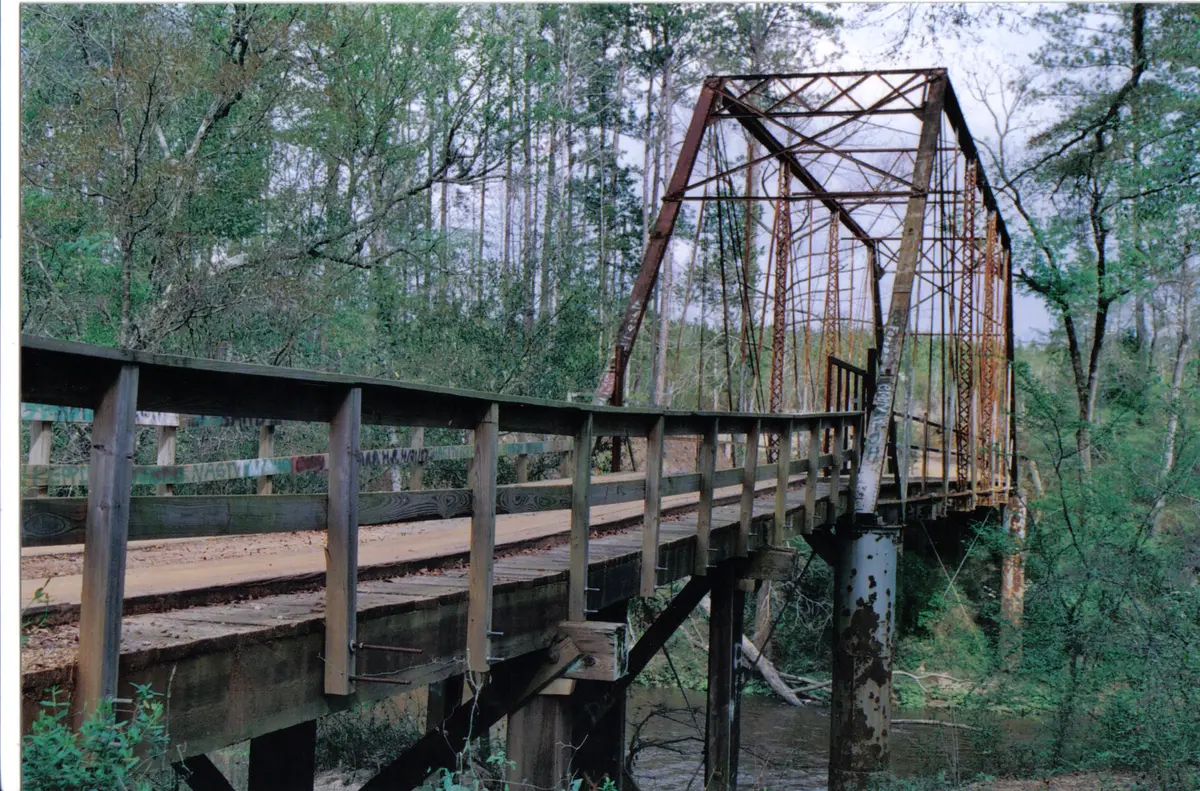
Stuckey's Bridge carries a gravel county road over the Chunky River in southern Lauderdale County, Mississippi, about six miles south of Meehan and a short drive south-west of Meridian. It is a pin-connected metal through truss with a timber approach trestle and a wooden deck: roughly 199 feet long overall, with a main span of about 110 feet and a driving surface barely twelve feet wide, carried on concrete-filled metal caissons sunk into the riverbed.
The state's own paperwork dates it precisely. When the Mississippi Department of Archives and History recorded the bridge, the historical archaeologist who filled in the form, Jack D. Elliott Jr., entered a date of construction of 1901 and a builder, the Virginia Bridge & Iron Company of Roanoke, Virginia. He also entered where each fact came from: the builder read off the plaque bolted to the bridge itself, the date taken from the bridge inventory kept by the Mississippi State Highway Department. Neither is an estimate. They are the two most ordinary and most reliable kinds of evidence a bridge can carry.
That date is not an outlier either. Elliott surveyed Mississippi's historic bridges intermittently between January and October 1986, working from the Highway Department's computerised inventory and visiting, describing, drawing and photographing every candidate structure. The thematic nomination that came out of the work tabulated 182 spans and stated the pattern plainly: the oldest surveyed bridge dated to 1895, and before the 1890s few metal truss bridges were built anywhere in Mississippi outside a handful of major river crossings such as Aberdeen and Columbus on the Tombigbee. Smaller streams like the Chunky, Elliott wrote, had until then "largely been forded or spanned by wooden bridges". Stuckey's Bridge belongs squarely to the wave of mass-produced, catalogue-ordered steel trusses that travelling company representatives sold to county governments after 1890.
Its protection came in stages. In November 1982, before any survey existed, the Permit Committee of the MDAH Board of Trustees declared every bridge on the Highway Department list a "State Archaeological Landmark" under the state Antiquities Act of 1970 — a holding action to stop counties demolishing bridges before anyone knew which ones mattered. Stuckey's Bridge was designated a Mississippi Landmark on 4 August 1984 under the number 075-MER-5804-NR-ML, entered in the county deed books on 29 October 1987, and listed on the National Register of Historic Places on 16 November 1988 as reference 88002415, within the "Historic Bridges of Mississippi" thematic nomination. It was listed under Criterion C, for engineering and transportation. Nothing in that file mentions a hanging, an outlaw, an inn or a ghost.
Even the engineering description has been revised since. Elliott wrote "Stearns (?) through truss", question mark included, added that the bridge "fits no known type", pointed to the influence of Fink and Stearns designs, and called it the only example of its kind in the state. In August 2011 the bridge historian Nathan Holth, working from a high-resolution photograph, argued that it was an ordinary Pratt truss with extra verticals and floorbeams added later, welded rather than pinned; a site visit by James Baughn in February 2015 confirmed it. The structure's identity has been corrected twice by people who went and looked. The legend attached to it has never been corrected at all.
That legend is best known through Alan Brown, a folklorist at the University of West Alabama who has published collections of Southern ghost lore with the University Press of Mississippi. His essay "Hanging at Stuckey's Bridge", printed in the 2010 anthology Weird Encounters, opens by calling it the oldest iron bridge in Lauderdale County and then lays out the story: an outlaw named Stuckey, "a member of the Dalton Gang", who ran an inn on the river's edge; eighteen people hanged from the bridge during the 1800s; Stuckey himself apprehended, tried and hanged there in the early 1850s. Brown reports the sightings as reports — the ghost of "Old Man Stuckey" walking the bank on moonlit nights, a lantern along the water, a heavy splash. And, to his credit, he records the difficulty in the same passage: other sources, he notes, maintain that Stuckey's Bridge was built in 1901 to replace an older wooden one.
Timeline: the documented record of Stuckey's Bridge
- October 1892 The Dalton Gang is wiped out attempting to rob two banks at once in Coffeyville, Kansas. Its whole career ran in Kansas, Oklahoma Territory, Indian Territory and California in the early 1890s — four decades after the hanging the legend describes, and most of a country from the Chunky River.
- 1901 The bridge is built by the Virginia Bridge & Iron Company of Roanoke, Virginia. The state survey form records the date from the Mississippi State Highway Department's bridge inventory and the builder from the plaque on the structure itself.
- November 1982 The Permit Committee of the MDAH Board of Trustees declares every bridge on the Highway Department inventory a "State Archaeological Landmark" under the Mississippi Antiquities Act of 1970, so that counties cannot demolish them before their significance is assessed.
- 4 August 1984 Stuckey's Bridge is designated a Mississippi Landmark under the number 075-MER-5804-NR-ML, described in the register simply as "over Chunky River, 6 mi S. of Meehan". The designation is entered in the county deed books on 29 October 1987.
- January–October 1986 Jack D. Elliott Jr., historical archaeologist with MDAH, carries out the statewide historic bridge survey, visiting and drawing each structure. His tabulation covers 182 spans; the oldest dates to 1895, and he concludes that before the 1890s Mississippi's smaller streams "had largely been forded or spanned by wooden bridges".
- 16 November 1988 The bridge is listed on the National Register of Historic Places as reference 88002415, within the "Historic Bridges of Mississippi" thematic nomination, under Criterion C for engineering and transportation. The file names no outlaw, no hanging and no ghost.
- 30 October 2004 The folklorist Alan Brown parks at the bridge at eleven at night with a companion, in his own words "waiting for Stuckey to appear". He later published the account as the centrepiece of his essay on the site.
- 2010 Brown's essay "Hanging at Stuckey's Bridge" appears in the anthology Weird Encounters. It gives the fullest published version — an outlaw Stuckey of the Dalton Gang, an inn on the riverbank, eighteen hangings during the 1800s, Stuckey himself hanged in the early 1850s — and notes in the same passage that other sources date the bridge to 1901.
- 24 August 2011 The bridge is physically closed and barricaded; the change is logged the following day. Eighteen months earlier a visitor had filmed a 1955 pickup being driven across the deck.
- 18 February 2015 A site visit by James Baughn confirms an identification first argued from photographs by Nathan Holth in 2011: the bridge was built as an ordinary Pratt through truss and later modified with added sub-panels, rather than the "Stearns (?)" type Elliott had tentatively recorded.
- September 2017 Inspection data rate the closed structure Poor overall, with the deck Poor (4 of 9), the substructure Serious (3 of 9) and a sufficiency rating of 11.7 out of 100.
Is there a rational explanation for Stuckey's Bridge?
The legend fails a test that needs no ghost hunting at all: the bridge is younger than the hanging.
No mob strung a man from Stuckey's Bridge in the early 1850s, because Stuckey's Bridge was built in 1901. The date is on the state's own survey form, which also records where each fact came from: the Mississippi State Highway Department's bridge inventory for the date, and the plaque on the structure for the builder, the Virginia Bridge & Iron Company of Roanoke. The structure fits the date: it is a pin-connected steel truss on concrete-filled metal caissons, of the mass-produced kind that, in the words of the statewide survey, replaced wooden bridges in Mississippi between about 1890 and 1940.
The gang does not survive the check either, because the Dalton Gang belongs to the early 1890s and to Kansas, Oklahoma Territory, Indian Territory and California; it was destroyed in a double bank raid at Coffeyville, Kansas, in October 1892. A Dalton man hanged in east-central Mississippi in the early 1850s would have had to be hanged four decades before his gang existed and most of a country away from where it rode. The Dalton name attaches a famous outlaw label to a local story.
Moving the hanging onto an earlier wooden bridge does not help. The English Wikipedia article on the bridge says that "Documents in the Lauderdale County Archives reveal the contract to construct a bridge in this location was written in 1847, and estimates place the bridge's construction date around 1850", and the citation it gives for that is a geocaching listing. The same claim appears a month earlier in an anonymous comment on Bridgehunter.com, dated 17 June 2009: "The County Archives show the contract was let in 1847. They do not have an exact date as for the completion, but 1850 is a fair estimate." Neither names a document, a volume or a page. The statewide survey, for its part, found that before the 1890s small Mississippi streams had "largely been forded or spanned by wooden bridges".
As for Stuckey himself, the survey form, the thematic nomination and the Mississippi Landmarks register use the name only as the name of the bridge. Bridgehunter.com places it on Stuckey Bridge Road, and the same 2009 commenter who gave the 1847 contract added that "there are several by the last name of Stuckey listed in the 1840 and 1850 census for that area". A family name is the plainest explanation on offer. Eighteen hangings at one county bridge would have left coroner's returns, court records and newspaper columns; the Wikipedia article sources the whole legend to a single folklore collection, Alan Brown's Shadows and Cypress (2000), and cites no record of any hanging.
What is left is a real place doing what dark places do. A narrow, unlit crossing in heavy pine woods; a rusted truss whose silhouette reads as a hanging shape against a pale sky; a river that throws splashes from turtles and falling limbs; headlights breaking through trees. Expectation does the rest of the work: Alan Brown's own celebrated night here began with him parked at the bridge at eleven o'clock on 30 October 2004, waiting for Stuckey to appear.
Can you visit Stuckey's Bridge?
Stuckey's Bridge has been closed to traffic since 2011. Bridgehunter.com, in the version of its record captured by the Wayback Machine in 2020, gives the status "Closed & Barricaded" and the note "Physically closed as of 08-24-2011", and an inspection report as of September 2017 that rates the overall condition Poor, the deck Poor (4 out of 9), the superstructure Fair (5 out of 9) and the substructure Serious (3 out of 9), with a sufficiency rating of 11.7 out of 100. The record's current address returned a 404 on 24 September 2026. Jack Elliott had recorded the condition as "fair" in the Mississippi Historic Bridge Survey form of the 1980s.
The bridge carries the county road over the Chunky River in Lauderdale County. The Mississippi Department of Archives and History's register of Mississippi Landmarks describes it as "over Chunky River, 6 mi S. of Meehan", Meridian vicinity, entry 075-MER-5804-NR-ML, designated on 4 August 1984. Bridgehunter's approximate coordinates, 32.25583 N, 88.85522 W, fall about 30 m from the pin on this file, which lies about 8 km (5 miles) south of Meehan and about 19 km (12 miles) south-west of the centre of Meridian in a straight line. The survey form records the owner as Lauderdale County and the nominated property as the bridge alone, less than an acre, spanning the river on the county road.
MDAH states that a Mississippi Landmark Permit is required before any project involving a designated landmark and that proposed alterations must be approved in advance by the Mississippi Landmark Review Committee of its Board of Trustees. In 2007 the botanist Lucas C. Majure published a floristic survey of about 34 km of the Chunky River, which records 805 taxa, describes the stretch as "recently set aside as a scenic stream of Mississippi" and names Stuckey's Bridge as "an important historical structure" within the survey area.
Sources consulted
- Jack D. Elliott, Jr., «Stuckey's Bridge — Mississippi Historic Bridge Survey, National Register of Historic Places Inventory–Nomination Form (ref. 88002415)» — Mississippi Department of Archives and History / National Park Service, 1987 archive
- Jack D. Elliott, Jr., «Historic Bridges of Mississippi (Thematic Resource) — National Register of Historic Places Inventory–Nomination Form (ref. 64000410)» — Mississippi Department of Archives and History / National Park Service, 1987 archive
- Mississippi Department of Archives and History, «Mississippi Landmarks (register of designated properties), entry 075-MER-5804-NR-ML» — Mississippi Department of Archives and History, 2008 report
- Alan Brown, «Hanging at Stuckey's Bridge, in Weird Encounters: True Tales of Haunted Places (ed. Joanne Austin)» — Sterling, New York, 2010 book
- Alan Brown, «Ghost Hunters of the South» — University Press of Mississippi, Jackson, 2006 book
- Paul Iselin Wellman, «A Dynasty of Western Outlaws» — Doubleday / University of Nebraska Press, 1961 book
- James Baughn (ed.), with Nathan Holth and Jared Rainer, «Stuckey's Bridge — bridge record, inspection data, update log and reader comments» — Bridgehunter.com, 2017 web
- Lucas C. Majure, «The vascular flora of the Chunky River (Mississippi)» — Journal of the Botanical Research Institute of Texas, vol. 1, no. 2, 2007 academic
- Mississippi Department of Archives and History, «Mississippi Landmarks (a Mississippi Landmark Permit is required before any project involving a designated landmark; alterations approved in advance by the Mississippi Landmark Review Committee)» — mdah.ms.gov, consulted 24 September 2026, 2026 web
- Wikipedia contributors, «Stuckey's Bridge — article claiming an 1847 contract and a bridge of about 1850, cited to a geocaching listing, and sourcing the legend to Alan Brown's Shadows and Cypress (2000)» — English Wikipedia, revision 1373303194 (5 September 2026); claim present since the first revision of 20 July 2009, 2009 web
Reviewed by V. Serrano on 2026-08-11 · How we verify our content
💬 Field testimonies (0)
No testimonies yet. Add the first.
Add your testimony
🔒 Log in to add a testimony