👻 HAUNTED PLACE · EXP. Nº9477
ACTIVE
Stull Cemetery, Kansas
Everything written about Stull traces back to one page: the front page of the University Daily Kansan of Tuesday 5 November 1974, five days after Halloween.
Where is Stull Cemetery, Kansas?
- Location
- Kansas, United States
- Type
- Cemetery
- Coordinates
- 38.971, -95.455
- Last updated
LOCATION
Why is Stull Cemetery, Kansas said to be haunted?
Read in facsimile, reporter Jain Penner's article makes a single claim about the graveyard of this unincorporated hamlet west of Lawrence — that it is "one of the two places on earth where the devil appears in person twice a year". No gate to hell, no number seven, no Halloween, no equinox: those arrived later, and in versions that contradict each other. The same article quotes the local Methodist pastor saying he had never heard the legend and suspected students had invented it. What followed was real enough for the people who live there: five decades of trespassers, broken and stolen headstones, and a sheriff's car parked at the gate every 31 October. The roofless stone church that drew them was bulldozed in March 2002 and no longer exists. The cemetery is private property and entering it is a crime.
What is the history of Stull Cemetery, Kansas?
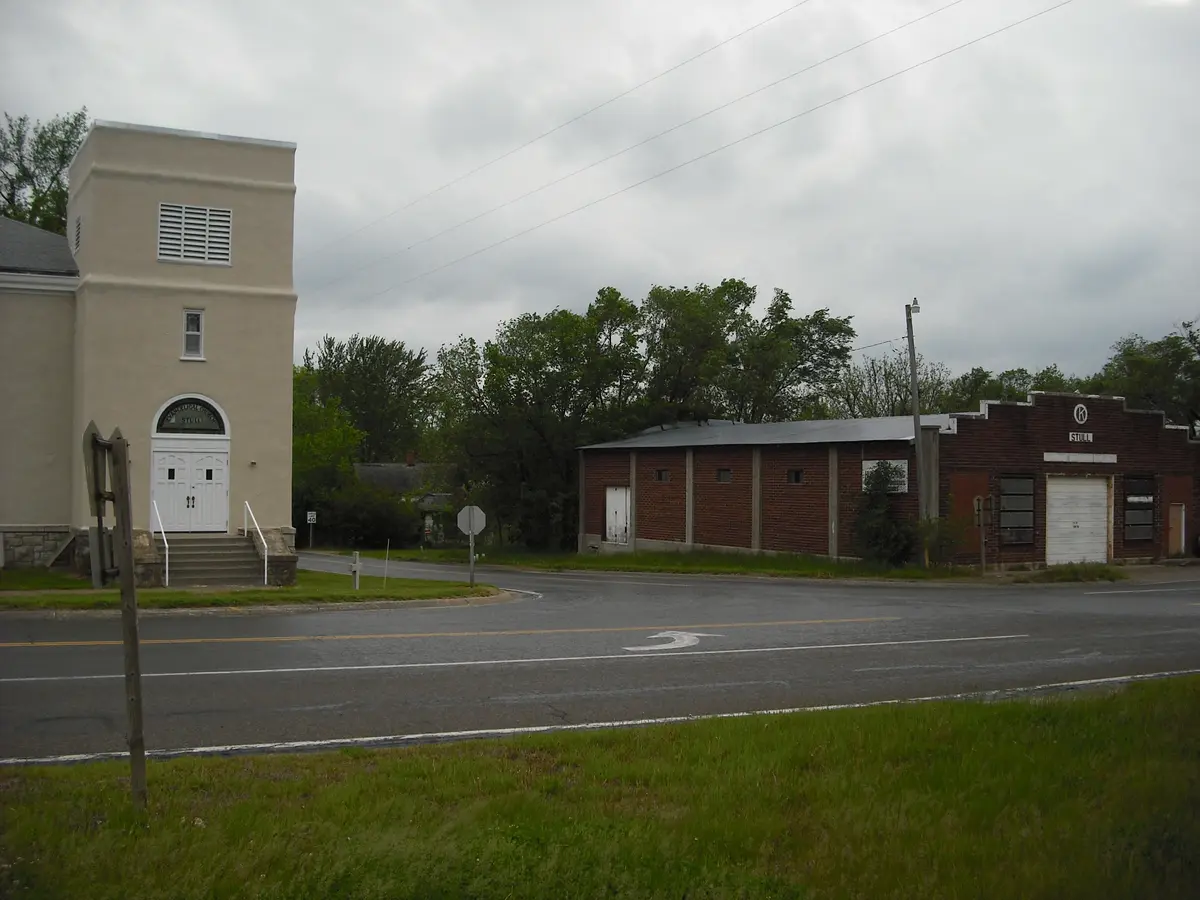
Stull is not a town and never has been. It was never incorporated, and the sentence the University Daily Kansan used to place it in 1974 still fits: "Stull covers about two blocks on one side of Douglas County Road 442 at the intersection of County Road 1025. On one side of the road are two churches, a garage and a few houses. On the other side, nearly as long as the town itself, is a graveyard." The same article admitted that "because the town has never been incorporated, its early history is hard to trace": in the 1860s it was a hamlet in Kanwaka township, Douglas County, with no post office and no railroad, dependent on its neighbours. The 1910 census counted 30 inhabitants; by 1974 the paper put the figure at about 20. Lawrence is some sixteen kilometres east, Topeka a similar distance west.
Before it was Stull it was Deer Creek, after the stream the 1974 reporter described as "the only body of water near Stull, which isn't even shown on most maps". The Kansan reported in 1998 that the community took its present name from Sylvester Stull, the postmaster, in 1899 — and that the stubborn rumour of an original name of "Skull" is false. Local histories compiled for the American bicentennial in 1976 date the first appearance of Deer Creek on territorial maps to 1857 and describe the first settlers as German speakers, some of them out of Pennsylvania Dutch country. I have not been able to read those volumes, so I pass them on as what they are — local tradition rather than something I have checked. One correction does not need them: "Pennsylvania Dutch" is Deutsch, German. There were no Dutch settlers at Deer Creek.
The congregation's stone church went up on the hill in 1867 as the Evangelical Emmanuel and Deer Creek Mission, with a cemetery chartered beside it. Steve Jansen, then director of the Elizabeth M. Watkins Community Museum in Lawrence, told the Kansan in 1994 that its sermons were preached in German until 1908. In the early 1920s — the sources say 1921 or 1922, and I cannot separate them — the congregation raised the money for a new frame church with a bell tower across the road, and left the stone one to the weather. There was no fire, no murder and no witch trial. The building, as the reporter who interviewed Jansen in 1994 put it, simply wore out its usefulness.
Then came Tuesday 5 November 1974. On the front page of volume 85, number 50 of the University Daily Kansan — election day in Douglas County, five days after Halloween — reporter Jain Penner published "Legend of devil haunts tiny town", alongside a photograph of the graveyard by Joyce Mendelsohn captioned "Silent Stull". The claim, in full, is one sentence: "According to legend, this graveyard is one of the two places on earth where the devil appears in person twice a year." That is all of it. The article names no gate, no number seven, no Halloween and no equinox. It also says, of the story it is printing, that it "has been told and retold, although it has probably never been recorded".
The witnesses in that first piece are worth reading, because everything since is a copy of a copy. Julie Day, a freshman from Bonner Springs, said her grandmother had told her the story and taken her there one October when she was ten or eleven; on the way she saw a house that "appeared to be all red, as if it were on fire" and looked ordinary again when they passed it. Rick Walker, an assistant instructor in western civilization, had heard of visitors suffering three-or-four-hour memory lapses. An anonymous junior described driving out with two fraternity brothers to "find some excitement", sudden rain that stopped as abruptly as it started, and a cold hand on his arm that turned out to belong to nobody: "I'll never forget how cold the fingers felt." Gary Mason, an associate professor of journalism, remembered a student turning in a photo story about a witches' coven at Stull.
What happened next did not happen to Stull; it happened to the people who live there. Carloads came from Lawrence, Topeka and the surrounding high schools. The hill was fenced and posted. On Halloween night 1994 a Kansan reporter, Carlos Tejada, staked out the entrance with the sheriff's deputies and filed a piece reporting that the devil had failed to appear. By 1998 the paper was quoting a student who had heard from friends "that it's one of the seven gateways to hell" — the first version of that formula I have been able to date. The Chicago band Urge Overkill had already put the ruined church and one of its headstones on the cover of its 1992 EP, titled simply Stull.
The ruin came down on Friday 29 March 2002. The Lawrence Journal-World reported the next morning that tracks showed heavy equipment had pushed the limestone walls inward, and that nobody would say who had ordered it: Major Weiss, of the Harvest Hills company that owned the ground, told reporter Mindie Paget "I didn't authorize it to be torn down", and added, drily, "Halloween will be really nice. You won't have to stay up late." A previous owner, Dennis McCarthy, was blunter: "It needed knocked down a long time ago. It's caused a lot of trouble and headaches. It's cost the county a lot of money, sending deputies to sit there every Halloween." Eighteen months later the Kansan had the answer from Lieutenant Don Crowe of the Douglas County Sheriff's Department: the owners had taken it down for safety. "The walls were leaning and we didn't want anybody to get hurt."
The surviving church across the road, the one the congregation built in the 1920s, is the building most photographs of Stull actually show. On the afternoon of Monday 25 July 2022 its bell tower caught fire; a neighbour called it in at about half past one and Consolidated Fire District No. 1 had the flames out by four. Chief Mike Baxter described "significant damage to the bell tower area" and concerns about structural instability; Brenna Wulfkuhle, a church trustee, said members reached the scene fast enough to hand firefighters the building's blueprints. Because the building was a church, the fire was referred to the federal Bureau of Alcohol, Tobacco, Firearms and Explosives. Fire officials pointed to a lightning strike recorded in the small hours as the likeliest cause. The tower and interior were restored and the congregation, now called Stull Community of Faith, is still meeting there.
Timeline: the documented record of Stull Cemetery, Kansas
- 1867 The Deer Creek congregation replaces its house meetings with a stone church on the hill, the Evangelical Emmanuel and Deer Creek Mission, and a cemetery is chartered beside it. Sermons are preached in German until 1908.
- 1899 The settlement, until then Deer Creek, takes the name of its postmaster, Sylvester Stull. The Kansan noted in 1998 that the popular claim of an earlier name of "Skull" is false.
- 1910 The census counts 30 inhabitants. The 1974 Kansan article, reporting that figure, put the current population at about 20.
- 1921–1922 The congregation builds a new frame church with a bell tower across the road and abandons the stone one, which is left to decay. Sources give 1921 or 1922 for the new building.
- 5 November 1974 Reporter Jain Penner publishes "Legend of devil haunts tiny town" on the front page of the University Daily Kansan (vol. 85, no. 50), with a photograph by Joyce Mendelsohn. Its only claim: the graveyard is "one of the two places on earth where the devil appears in person twice a year". It mentions no gate, no seven, no Halloween and no equinox — and quotes the pastor of the local Methodist churches saying he had never heard the legend.
- 1992 The Chicago band Urge Overkill releases the EP Stull, with the ruined church and one of the cemetery's headstones on the cover, carrying the name well beyond Kansas.
- 2 November 1994 Kansan reporter Carlos Tejada spends Halloween night at the cemetery gate and reports that nothing happened. Museum director Steve Jansen tells him no records of the legend exist and that he believes it began "as a sorority and fraternity thing". Deputy Jeff Nelson describes visitors who "park a mile away and crawl in on their elbows", and adds that the families with relatives buried there "have lost their sense of humor about this".
- 28 October 1998 The earliest datable appearance in print of the "seven gateways to hell" formula: the Kansan quotes a student, Jennifer Cooke, saying she has heard it from friends. By then the hill is fenced with no-trespassing signs and, according to undersheriff Kenny Massey, patrolled daily.
- 29 March 2002 The roofless stone church is bulldozed on a Friday. The Lawrence Journal-World reports the next morning that nobody will say who ordered it; the cemetery's caretaker tells the paper that vandals have knocked over four headstones in the previous week alone. In 2003 a sheriff's lieutenant confirms the owners took it down because the walls were leaning.
- 29 October 2010 The Kansan devotes its front page to dismantling the legend, quotes the 1974 sentence verbatim, and checks Time magazine's own archive for the story that the pope diverted his plane around Stull: there is no record of it.
- 29 October 2016 Paul Bahnmaier, president of the Lecompton Historical Society, tells the university radio station KJHK what the legend costs the living: "My grandparents are buried there, and we've had tombstones broken and stolen. All the stories about the cemetery are completely false."
- 25 July 2022 Fire guts the bell tower of the surviving church across the road, now Stull Community of Faith. Firefighters contain it in about two hours; officials point to a lightning strike recorded that morning. The tower and interior were later restored and the congregation still meets there.
Is there a rational explanation for Stull Cemetery, Kansas?
The useful question at Stull is not whether the devil turns up. It is when the story does, and that can be answered with a date.
The earliest printed appearance I have been able to fix is the University Daily Kansan of Tuesday 5 November 1974, read in facsimile. Everything the article claims is the single sentence quoted above: two places on earth, twice a year. There is no gate in it, no seven, no Halloween and no spring equinox. Those are later additions, and they arrive in versions that contradict each other: a student told the same paper in 1998 that Stull was "one of the seven gateways to hell"; the paper's own summary in 2010 was that retellings had made it "one of seven or eight portals to hell, with both solstices as well as Halloween inspiring visits from afar". Seven or eight; equinox or solstices. And in half a century nobody has ever named the other six gates — just as the 1974 article never named the other of its two places on earth. A figure that circulates in incompatible versions and cannot be itemised is not a tradition; it is a rumour with a number attached.
The first article also contains its own refutation, which is why it repays reading whole. Its reporter noted of the one witness who described something strange that "the power of suggestion may have had something to do with what she saw". And it quotes two residents against three students: the Rev. Paul Iwig, pastor of the Methodist churches in Stull and Big Springs, "said he had never heard of the legend" and thought "it might have been an invention of KU students" — he also mentioned that a university drama group had been rehearsing a play in the cemetery. Mrs Jerry Ice, who lived nearby, had not heard it either, though she was careful to say she had not lived in Stull all her life. The article's own line is blunt: "Although several KU students claim to have heard the legend, several people who live in Stull haven't."
Twenty years later the professional custodian of the county's memory said the same thing on the record. Steve Jansen, director of the Watkins Community Museum, told the Kansan in 1994 that no records of anything of the kind existed and that the countryside was not exactly rife with folk tales of Satan at Stull; as far as the locals were concerned, nothing unusual had happened there until students and out-of-towners started coming. His own guess he gave in his own words: "I personally think it got started as a sorority and fraternity thing. We haven't been able to find anything on it on our own." One datum points earlier: in 2010 Sgt. Steve Lewis of the Douglas County Sheriff's Office told the paper he had first heard the legend as a university freshman in 1967. That is an unverifiable recollection, forty-three years after the fact, and it is the only evidence I have found for anything before 1974 — worth recording, not enough to build on.
The papal story collapses without any help from folklore. In the version that circulates, John Paul II ordered his aircraft rerouted to avoid overflying Stull on a trip to Colorado, and Time magazine reported it. In 2010 the Kansan checked Time's own online archive, which then carried a section devoted to the pope, and found no record of any such report. The arithmetic finishes the job. That journey — Jamaica, Mexico and Denver, 8 to 16 August 1993, documented on the Vatican's own site, with the welcome ceremony at Denver airport on 12 August — reached Colorado from Mérida, in Yucatán. Stull lies roughly 600 km off the great-circle track from Mérida to Denver, and roughly 640 km off the return track from Denver to Rome. No leg of the trip goes near northeastern Kansas, so there was nothing to divert around. The 1999 date that has attached itself to this claim in some retellings, including an earlier version of this very file, matches no version of the rumour and no journey to Colorado.
Can you visit Stull Cemetery, Kansas?
Stull Cemetery lies on private property about 10 miles west of Lawrence, on County Road 442, as the Lawrence Journal-World described it in 2002. In October 2010 the University Daily Kansan reported "NO TRESPASSING" signs along its entrance and its fence, which had been put up in response to vandalism of the old church and the cemetery. On Halloween 2003 the Kansan quoted Lieutenant Don Crowe of the Douglas County Sheriff's Department: anyone who tried to walk up to the site would be issued a notice to appear in court for criminal trespassing, a class B misdemeanour that could bring a $1,000 fine and up to six months in jail, and anyone uncooperative would be arrested. The headline carried his summary, "Stay away unless you want to go to court".
Deputies at the cemetery on Halloween were already an old practice in 2002, when Dennis McCarthy, who until recently had owned the land, told the Journal-World that the church had "cost the county a lot of money, sending deputies to sit there every Halloween". In 2016 the KU student station KJHK reported that the locals kept a close eye on the cemetery with the backing of the sheriff's department, which could arrest people for trespassing there after hours.
The roofless limestone church at the centre of the legend was pushed over on Friday 29 March 2002. The Journal-World found its walls reduced to rubble piles, with the tracks of demolition equipment beside them, and one of the landowners, Major Weiss of Harvest Hills LLC, said he had not authorised it. KJHK described the site in 2016 as a pile of stone rubble where the church, built in 1867, had stood.
The frame church across the road is Stull Community of Faith, at 1596 East 250 Road, Lecompton, Kansas 66050. A fire on 25 July 2022 caused "significant damage to the bell tower area" and water damage at the main entry, according to the Lawrence Times; the contractor, Mar Lan Construction, describes on its portfolio page the restoration that followed, which included the stairs and railings of the tower. The congregation's website, last updated on 31 August 2026 and read on 24 September 2026, gives its worship time as 11am in the sanctuary and names Kyle Scheideman as pastor. It holds a Harvesters rural mobile food distribution on the fourth Thursday of each month from 10am to 11am, and a flyer on the site announces a Trunk or Treat for youth on Sunday 25 October from 4pm to 5pm.
Paul Bahnmaier, president of the Lecompton Historical Society, told KJHK in 2016 that his grandparents are buried in the cemetery and that tombstones there had been broken and stolen. The Kansan's back issues, including the front page of 5 November 1974 that first printed the legend, are digitised in the KU Libraries collection of student newspapers.
Sources consulted
- Penner, Jain, «Legend of devil haunts tiny town» — The University Daily Kansan, vol. 85, no. 50, pp. 1 and 8 (with the photograph "Silent Stull" by Joyce Mendelsohn), 1974 newspaper archive
- Tejada, Carlos, «The devil was a no show on Halloween night, but the legend still lives on» — The University Daily Kansan, 2 November 1994, 1994 newspaper archive
- O'Toole, Lori, «Home-grown fear: ten miles west of Lawrence, Stull captivates imaginations» — The University Daily Kansan, 28 October 1998, 1998 newspaper archive
- Paget, Mindie, «Building's demolition a mystery» — Lawrence Journal-World, 30 March 2002, 2002 newspaper archive
- Schmidt, Steve, «'Haunted' church leveled by owners; police fining curious trespassers» — The University Daily Kansan, 31 October 2003, 2003 newspaper archive
- Montemayor, Stephen, «Devil's door: dispelling the myth of Stull's famous 'portal to hell'» — The University Daily Kansan, 29 October 2010, pp. 1A and 3A, 2010 newspaper archive
- Winter, Jordan, «Douglas County's Gateway to Hell» — KJHK 90.7 FM, University of Kansas, 29 October 2016, 2016 newspaper archive
- Conde, Chris, «Stull Road reopens after church fire» — Lawrence Journal-World, 25 July 2022, 2022 newspaper archive
- Albright, Andrea, «Stull church fire causes no injuries, but damages bell tower and main entrance» — The Lawrence Times, 25 July 2022, 2022 newspaper archive
- Holy See, «Apostolic Journey to Jamaica, Mexico and Denver (Colorado), 8-16 August 1993» — vatican.va, official record of the journeys of John Paul II, 1993 archive
- Stull Community of Faith, «Stull Community of Faith (official site, consulted 13 August 2026)» — stullcoff.com, 2026 web
- Mar Lan Construction, «Stull Community of Faith Church Fire Remediation — the contractor's account of the restoration after the 2022 fire, including the tower stairs, balusters and railings» — marlanconstruction.com (contractor's portfolio), 2026 web
Reviewed by V. Serrano on 2026-08-13 · How we verify our content
💬 Field testimonies (0)
No testimonies yet. Add the first.
Add your testimony
🔒 Log in to add a testimony