👻 HAUNTED PLACE · EXP. Nº9477
ACTIVE
Sturdivant Hall
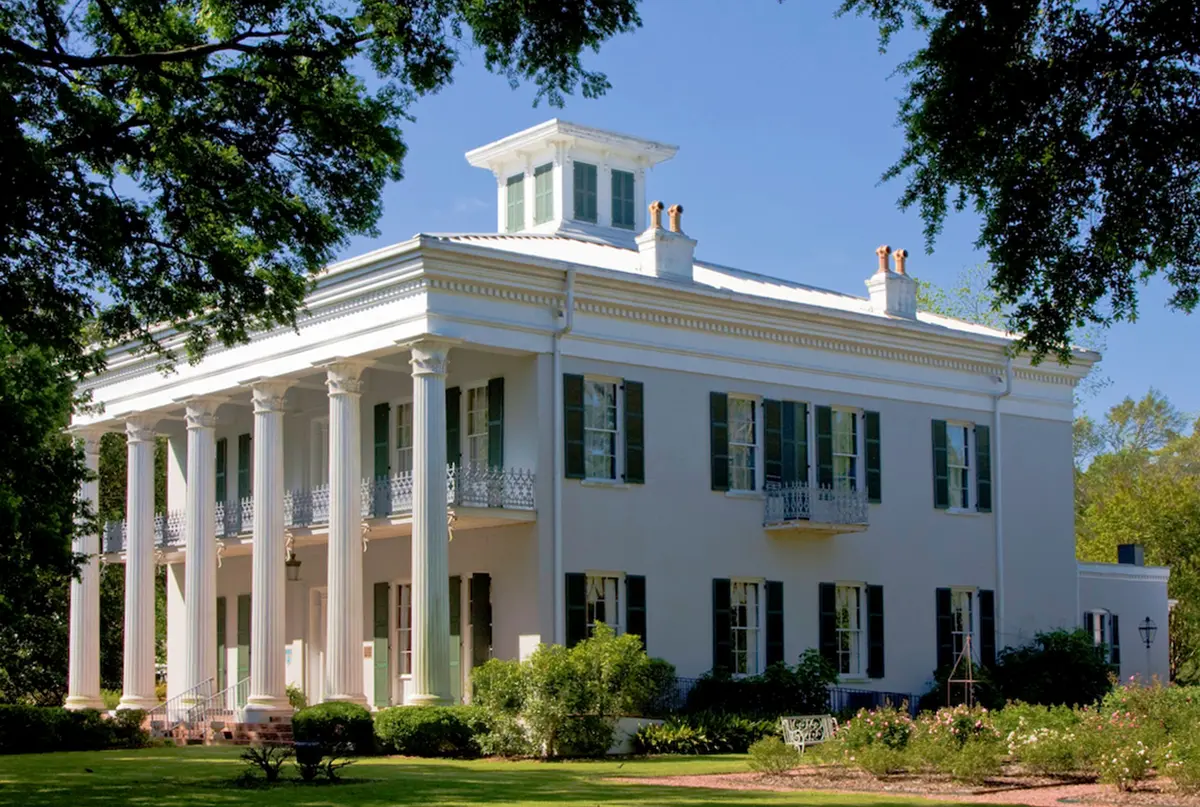
Sturdivant Hall was finished in 1856 for the cotton planter Edward T. Watts: six thirty-foot Corinthian columns with cast-iron capitals across a sixty-foot front, and no surviving document that names the enslaved people who built it.
Where is Sturdivant Hall?
- Location
- Alabama, United States
- Type
- Museum
- Coordinates
- 32.413, -87.029
- Last updated
LOCATION
Why is Sturdivant Hall said to be haunted?
Its ghost is said to be John McGee Parkman, who bought the house in 1864 and at twenty-eight was president of the First National Bank of Selma. When the bank lost government deposits in cotton speculation, General Wager Swayne seized it and arrested him. The story usually told — that he was shot as he ran home to Sturdivant Hall — cannot have happened: the jail was at Cahaba, almost thirteen kilometres away. What the Selma Times printed the next day is stranger. On 23 May 1867 he bolted from the jail hall, ran seventy-five yards to the Alabama River with the jailer firing, swam, reached the paddle wheel of the steamer Gertrude while passengers watched, and went under. The paper called it suicide; the wires called it drowning; when the body surfaced a week later, the wound was a gunshot. The earliest printed ghost story is from 1969.
What is the history of Sturdivant Hall?
The house came first and the ghost arrived a century later. Both are better documented than the version that circulates online, and neither says what that version says.
The lot, the builder, and the people the record leaves out
On 19 April 1852 Colonel Edward T. Watts, a cotton planter, bought a corner lot bounded by Mabry and Union streets and McLeod Avenue at a public sale for $1,830. What he wanted, according to the museum's own history page, was a house "in town" for entertaining guests. Work ran from 1853 to 1856 under Thomas Helm Lee of Selma, a cousin of Robert E. Lee, and cost around $69,000.
What Lee produced was a brick house rendered in stucco and scored to imitate ashlar stone. Six fluted Corinthian columns thirty feet high stand across a sixty-foot front, their capitals cast in iron rather than carved, behind a lace-work iron balcony that runs the whole length of the porch. Four windows to each floor have hinged panels below the sills so the sashes can be used as doors. The roof is hipped, with three chimneys and a small cupola windowed on every side. Inside, a T-shaped hall divides both floors; the drawing room measures twenty by thirty feet and its cornice carries large plaster rosettes spaced widely at the bottom and tiny ones crowded at the top; a straight-run stair serves the bedrooms and a spiral stair winds around a central post up to the cupola. The 1972 nomination that put the house on the National Register compared it to the Natchez mansions, and to Stanton Hall in particular. Artisans brought from Italy did the plaster and the marble.
Here is what the record does not say. The nomination form names Watts, names Lee, gives the price and the comparison, and stops. The Encyclopedia of Alabama adds the Italian plasterers. Neither names — nor even mentions — the enslaved people who built a Greek Revival mansion for a cotton planter in Dallas County in the middle of the 1850s. The same reference work says it of a comparable house. The Encyclopedia of Alabama's article on Lyon Hall in Demopolis, finished in 1853, states that it "was built with slave labor for its first resident, George Gaines Lyon". For Sturdivant Hall the nomination, the Encyclopedia's article and the museum's own history page of 2010 are all silent on who did the work, and this file supplies no names that those sources do not.
The banker
Watts moved to Texas and on 12 February 1864 sold the house for $65,000 to John McGee Parkman, born in Selma on 12 January 1838. Parkman had climbed from dry goods to clerk, bookkeeper, teller and cashier, and in 1866 — at twenty-eight — he was made president of the First National Bank of Selma, a newly organised institution with $100,000 of capital and large deposits of United States government money. The bank went into cotton speculation, which the museum's own account calls "a common error of the times", and lost.
What happened next is unusually well recorded, because the Selma Times printed a full account on 24 May 1867 that Northern papers reprinted within the week. On 15 April 1867 some $160,000 was said to have been stolen from the bank; the next day Parkman advertised a reward in the city papers for its recovery. On 17 April General Wager Swayne, the senior Federal officer in the state, took possession of the bank and its deposits on behalf of the government and placed the president under military arrest. The following morning Parkman escaped from his own residence, where he was being held under guard, and took the Cahaba road on horseback. Swayne offered $1,500 for him. He was captured in Wilcox County on the 19th, brought back to Selma, and lodged the next day in the county jail at Cahaba, 12.7 km (7.9 miles) south-west of the house he had bought three years earlier in a straight line, and 19 miles below Selma by river on the table of Alabama River landings in Saffold Berney's Handbook of Alabama (1878).
Twenty-three May 1867
At about sunset on 23 May the prisoners were assembled in the hall of the jail when the jailer opened the door. Parkman rushed out and made for the Alabama River, "about seventy five yards distant". The jailer fired at him as he ran and he was seen to fall; he got up, reached the water and struck out swimming. The steamer Gertrude lay some twenty yards below the point where he entered the river, and a party of ladies and gentlemen on board watched the whole thing. He went under once or twice as he was carried down towards the boat. Efforts were made to save him. He reached the paddle wheel, which was not turning, held on for a moment "stifled and exhausted", then sank beneath the boat and was not seen again. He left a widow, Sarah J. Norris, and two small daughters, Emily Norris Parkman and Maria Hunter Parkman. The Selma paper, which knew him, asked that "his errors in the closing scenes of his bank" be attributed "to his youth and ambition, and not to any mature fraudulent intentions".
The telegraph flattened all of that into one line that ran from Mobile on 24 May and was printed from Alexandria to Baton Rouge: Parkman "escaped yesterday, plunged into the river and drowned himself". The Selma Times had already run it under a blunter heading: "The Selma Bank Robbery — Suicide of the President, John M. Parkman".
Then the body came back. On 30 May 1867 the Selma Messenger reported that it had been recovered the previous day about fifteen miles below Cahaba and brought up to the city, and that a gentleman who saw it said the appearances "all indicated that he came to his death from a gun shot wound", the ball entering near the spine on the left side, in the lumbar region, and passing out just above the navel. Three weeks later a separate wire told a different story: the remains were found about a mile above White Bluff, Alabama, and the vultures had disfigured them. White Bluff was a landing on the Alabama River below Cahaba; Berney's table puts it 10 miles below Cahaba by water, so the wire's spot lies about nine river miles below the town and the Messenger's about fifteen. The two reports put the body on the same reach of river, some six miles apart, and differ on its state: a wound described by a witness in one, a corpse disfigured by vultures in the other.
Afterwards
Parkman's widow and daughters stayed on until January 1870, when the estate went at auction for $12,500 to Emile Gillman, a Selma merchant. The Gillman family kept it until the autumn of 1957, when the City of Selma bought it for $75,000: $50,000 came from the estate of Robert Daniel Sturdivant, whose will provided for a museum, and the city council and the Dallas County Board of Revenue put in $12,500 each. The house therefore carries the name of a man who never lived in it. It was documented by the Historic American Buildings Survey in 1934–35 and listed on the National Register on 18 January 1973, on a form signed by W. Warner Floyd of the Alabama Historical Commission.
The ghost is younger than the museum. The earliest printed telling among this file's sources is "The Return of the Ruined Banker", a chapter in 13 Alabama Ghosts and Jeffrey by Kathryn Tucker Windham and Margaret Gillis Figh, published in Huntsville in 1969 — a hundred and two years after the death, and twelve years after the house opened to visitors. It opens on a guided tour, with somebody insisting that "Parkman's ghost is right here in Sturdivant Hall!"
Timeline: the documented record of Sturdivant Hall
- 19 April 1852 Colonel Edward T. Watts, a cotton planter, buys the corner lot bounded by Mabry and Union streets and McLeod Avenue at a public sale for $1,830, wanting a house "in town" for entertaining.
- 1853-1856 The house is built under Thomas Helm Lee of Selma, a cousin of Robert E. Lee, at a cost of about $69,000; Italian artisans do the plaster and marble. Neither the 1972 nomination nor the Encyclopedia of Alabama names the enslaved people who built it.
- 12 February 1864 Watts, who is moving to Texas, sells the house for $65,000 to the banker John McGee Parkman, born in Selma on 12 January 1838.
- 1866 At twenty-eight, Parkman is made president of the First National Bank of Selma, a new institution with $100,000 of capital holding large deposits of United States government money.
- 15-16 April 1867 Some $160,000 is said to have been stolen from the bank; the next day Parkman advertises a reward in the Selma papers for its recovery.
- 17 April 1867 General Wager Swayne takes possession of the bank and its deposits on behalf of the government and places Parkman under military arrest. The charge concerns the bank and cotton speculation, not any railroad.
- 18-20 April 1867 Parkman escapes from his own guarded house and takes the Cahaba road on horseback; Swayne offers $1,500 for him; he is caught in Wilcox County on the 19th and jailed at Cahaba the following day.
- 23 May 1867, about sunset Parkman bolts from the jail hall and runs about seventy-five yards to the Alabama River. The jailer fires and he is seen to fall, then swims; the steamer Gertrude lies twenty yards downstream and passengers watch him sink beneath its paddle wheel.
- 24-25 May 1867 A telegraphic dispatch out of Mobile, printed from Alexandria to Baton Rouge, reduces the death to one line: Parkman "plunged into the river and drowned himself".
- 29-30 May 1867 The Selma Messenger reports the body recovered about fifteen miles below Cahaba; a witness says the appearances all indicated death from a gunshot wound entering near the spine on the left side and passing out above the navel.
- 20 June 1867 A second wire report: the remains of John M. Parkman were found about a mile above White Bluff, Alabama, disfigured by vultures. White Bluff lay 10 river miles below Cahaba, so the two reports place the body about six miles apart on the same reach.
- January 1870 Parkman's widow and daughters leave; the estate is auctioned for $12,500 to Emile Gillman, a Selma merchant, whose family keeps it for eighty-seven years.
- Autumn 1957 The City of Selma buys the house for $75,000 — $50,000 from the estate of Robert Daniel Sturdivant, who had left money for a museum, plus $12,500 each from the city council and the Dallas County Board of Revenue. The house takes the name of a man who never lived in it.
- 1969 Kathryn Tucker Windham and Margaret Gillis Figh publish "The Return of the Ruined Banker" in 13 Alabama Ghosts and Jeffrey. It is the earliest printed telling of the ghost among this file's sources: 102 years after the death.
- 18 January 1973 Sturdivant Hall is listed on the National Register of Historic Places (reference 73000340) on a form signed by W. Warner Floyd of the Alabama Historical Commission in June 1972. The nomination says nothing about a ghost.
- 1975 Selma holds its first Historic Selma Pilgrimage, with Sturdivant Hall as its centrepiece — the point at which the house becomes the town's antebellum showcase.
- 12 January 2023 An EF2 tornado crosses Selma's historic district. Sturdivant Hall loses windows to flying debris and most of its old live oaks; museum coordinator Mary Margret Mims says the museum will stay closed until further notice.
- 14 August 2026 The museum's former address, sturdivanthall.com, last shows the museum in an Internet Archive capture of 1 November 2018; by 8 June 2019 it carried an unrelated health-advertising site, from 2023 a domain-for-sale notice, and on 25 September 2026 it redirected to a gambling site. Any listing still linking to it is out of date.
Is there a rational explanation for Sturdivant Hall?
Start with the arithmetic, because it settles the story most often repeated about this house. Sturdivant Hall stands at 32.4131 N, 87.0289 W; the jail that held Parkman was at Cahaba, 12.7 km — 7.9 miles — away in a straight line. Nobody is shot "while fleeing towards the house he once called home" at that distance. According to the Selma Times, printed the day after, he ran about seventy-five yards, to the Alabama River. The romantic version turns a seventy-five-yard dash to the river into a flight of 12.7 km towards home.
The cause of death is genuinely unsettled, and that is what feeds the ghost. Three incompatible accounts were in print within a month. The Selma Times headline called it suicide. The telegraphic dispatch of 24 May said he "plunged into the river and drowned himself". The Selma Messenger of 30 May, reporting the recovery of the body, described a gunshot wound through the trunk. Windham's 1969 chapter records that the disagreement had by then hardened into folklore: "There was even disagreement about who fired at Parkman", she writes, and one version she reports has friends who had bribed the warden to arrange the escape shooting him themselves so that he "would never divulge information which would have linked them with the bank scandal". A death with three official versions is exactly the kind of death that grows a ghost.
Even the building he escaped from has drifted. Windham, the museum's own history page and the Selma Times-Journal all put him in Castle Morgan, the Confederate military prison at Cahaba, which is the more evocative address; the Selma Times of 24 May 1867 and the National Register nomination both say the county jail. Both stood in Cahaba, so nothing much turns on it — but it is a good measure of how a story firms up as it is retold, and this file follows the 1867 papers.
The story can be dated as well as the event. The death is 1867, and the earliest printed telling of the ghost among this file's sources is Windham's of 1969, a gap of one hundred and two years; its setting is a museum guided tour, and the house did not receive visitors until 1957. The National Register nomination signed three years later, in 1972, has no ghost in it. The museum's own website, in a page last updated in 2010, hedged carefully: "Some reports claim that the banker swore 'I was not guilty, so I will never leave my home.' Many believe that his spirit is still present at Sturdivant Hall." Some reports, unnamed, and many believe: with those two hedges the museum passed on a tradition and vouched for none of it.
One more claim circulates widely. The line that Edward Vason Jones, the architect who worked on the White House interiors, praised Sturdivant Hall as one of the finest Greek Revival houses in the Southeast is repeated by Wikipedia and by Alabama tourism sites. Wikipedia's footnote for it points at a single page of the museum's own website. The Internet Archive's copy of that page, captured on 6 December 2013, does not contain the sentence, and Jones's name does not appear in its text. His name appears in exactly one place in that file: inside the page's meta name="keywords" tag, in a comma-separated marketing list that reads "…Sturdivant Hall, The finest Greek revival neo-classic antebellum mansion in the Southeast, the late Edward Vason Jones, architect, the white house". The superlative itself was the museum's own strapline — it was the site's page title and its copyright line. Somebody read two adjacent items in a search-engine keyword list as an attributed judgement, and the sentence has been travelling ever since. The same wording appears in a 2000 travel guide, Sylvia Higginbotham's Marvelous Old Mansions. Neither Wikipedia's footnote nor the museum page it cites quotes anything written or said by Jones, so the judgement stands here only as what those two sources show it to be: a museum's claim about itself.
Can you visit Sturdivant Hall?
Sturdivant Hall is at 713 Mabry Street, Selma, Alabama 36701, in the Old Town Historic District. The telephone number given by guidebooks and by the regional tourism site Alabama's Front Porches is (334) 872-5626. On 11 May 2026 the Selma Times-Journal gave the hours for the house, its grounds and the gift shop as Tuesday to Friday from 10 a.m. to 4 p.m. and Saturday from 10 a.m. to 2 p.m. The Encyclopedia of Alabama, last revised in January 2024, still has Tuesday to Saturday from 10 a.m. to 4 p.m.; it describes public tours through the house, the detached kitchen that now holds the gift shop, and the garden, with admission fees and fundraisers paying for the upkeep.
The tornado of 12 January 2023 broke windows and uprooted or damaged many of the old live oaks on the lawn, and museum coordinator Mary Margret Mims told the Selma Times-Journal two days later that the museum was closed until further notice while the house was repaired and the grounds cleared. On 26 October of that year the museum held its Barbecue on the Green fundraiser on the grounds, with Mims, named in the report as museum director, greeting the guests. In March 2024 the house was the venue for the reception that opened the Historic Selma Tour of Homes, and in May 2026 board members were replanting its heritage rose garden, where 50 of the original 180 bushes had died after the tornado and the pandemic years.
The museum's former web address, sturdivanthall.com, no longer belongs to it: on 24 September 2026 the domain redirected to an Indonesian-language slot and lottery page.
Upstairs, according to the Encyclopedia of Alabama, a T-shaped hall leads to four bedrooms and cantilevered stairs rise to the attic, where a spiral stair winds round a central pole up to the cupola. Next door stands the White-Force Cottage, which the museum's own website described in 2013 as built in 1859 for Clement Billingslea White and his wife Martha, born Martha Todd, a half-sister of Mary Todd Lincoln. The place where Parkman was jailed and died is Old Cahawba Archaeological Park, the site of the vanished river town, about 13 km (8 miles) to the south-west. The house is let for weddings and private events, and the Encyclopedia calls it a prominent stop on the Historic Selma Pilgrimage.
Sources consulted
- Selma Times, «The Selma Bank Robbery — Suicide of the President, John M. Parkman (from the Selma Times of 24 May 1867)» — Daily National Intelligencer (Washington, D.C.), 30 May 1867, p. 1, 1867 newspaper archive
- Selma Messenger, «Parkman's Body Recovered (from the Selma Messenger of 30 May 1867)» — Baton Rouge Tri-Weekly Gazette & Comet, 13 June 1867, p. 2, 1867 newspaper archive
- Associated Press dispatch, «Telegraphic dispatch, Mobile, 24 May 1867: Parkman "plunged into the river and drowned himself"» — Alexandria Gazette, 25 May 1867, p. 2 (also New Orleans Tribune, Western Democrat, Baton Rouge Tri-Weekly Gazette & Comet, Danbury Times), 1867 newspaper archive
- Chicago Tribune, «The remains of John M. Parkman … were found about a mile above White Bluff, Alabama» — Chicago Tribune, 20 June 1867, p. 2 (also St. Cloud Journal, 27 June 1867), 1867 newspaper archive
- W. Warner Floyd, Alabama Historical Commission, «National Register of Historic Places Inventory — Nomination Form: Sturdivant Hall (Watts-Parkman-Gillman Home), reference 73000340» — United States Department of the Interior, National Park Service; signed 16 June 1972, listed 18 January 1973, 1972 archive
- Kathryn Tucker Windham and Margaret Gillis Figh, «13 Alabama Ghosts and Jeffrey — "The Return of the Ruined Banker"» — Strode Publishers, Huntsville, Alabama, 1969 book
- Caroline Greer, «Sturdivant Hall Museum» — Encyclopedia of Alabama (published 24 January 2020, last revised 3 January 2024), 2024 web
- Travis Gupton, «Sturdivant Hall not spared from tornado's destructive path» — The Selma Times-Journal, 14 January 2023, 2023 newspaper archive
- Sturdivant Museum Association, «Sturdivant Hall: History and Architecture (page last updated 27 August 2010; capture of 6 December 2013)» — sturdivanthall.com, via the Internet Archive Wayback Machine — the live domain no longer belongs to the museum, 2013 web
- Sylvia Higginbotham, «Marvelous Old Mansions and Other Southern Treasures» — John F. Blair, Winston-Salem, 2000 book
- Graham M. S. Dann and A. V. Seaton (eds.), «Slavery, Contested Heritage and Thanatourism — section "Selma and Sturdivant Hall"» — Haworth Hospitality Press, New York, 2001 academic
- Staff report, «Sturdivant Hall's Heritage Rose Garden in bloom again — 50 of 180 roses lost after COVID and the January 2023 tornado; museum open Tuesday-Friday 10-4 and Saturday 10-2» — The Selma Times-Journal, 11 May 2026, 2026 newspaper archive
- Amy Lewis, «Sturdivant Hall patrons experience Barbecue on the Green (26 October 2023, after the January tornado; museum director Mary Margaret Mims)» — The Selma Times-Journal, 31 October 2023, 2023 newspaper archive
- James Jones, «Selma Tour of Homes takes place this weekend (welcome reception at Sturdivant Hall Museum, March 2024)» — The Selma Times-Journal, 8 March 2024, 2024 newspaper archive
- Sturdivant Museum Association, «White-Force Cottage — next door to Sturdivant Hall, built in 1859 by Clement Billingslea White and his wife Martha, née Todd, half-sister of Mary Todd Lincoln (capture of 6 December 2013)» — sturdivanthall.com via the Internet Archive Wayback Machine — the live domain no longer belongs to the museum, 2013 web
- Saffold Berney, «Handbook of Alabama: a complete index to the state — table of Alabama River landings with distances (White Bluff 279, Cahaba 289, Selma 308)» — Mobile Register print, Mobile, 1878 book
- Grace London, «Lyon Hall — "Lyon Hall was built with slave labor for its first resident, George Gaines Lyon"» — Encyclopedia of Alabama (published 12 July 2018, last updated 5 June 2024), 2024 web
Reviewed by V. Serrano on 2026-08-14 · How we verify our content
💬 Field testimonies (0)
No testimonies yet. Add the first.
Add your testimony
🔒 Log in to add a testimony