👻 HAUNTED PLACE · EXP. Nº0482
ACTIVE
Terrence Building
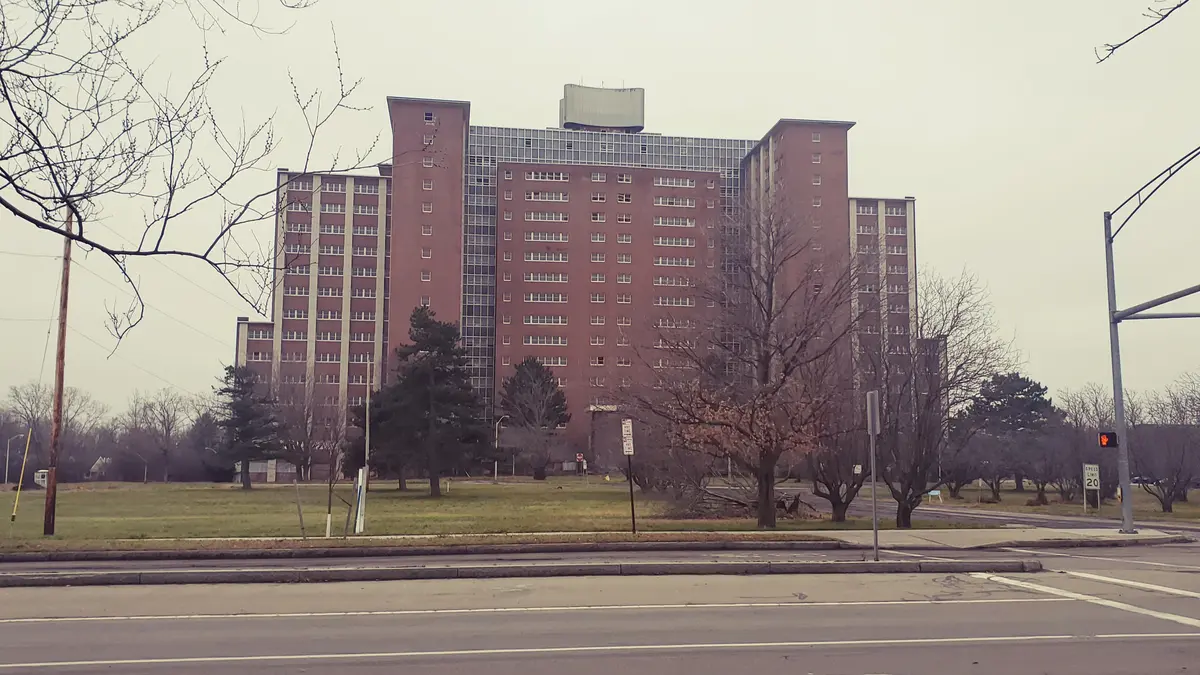
The Terrence Building is a psychiatric high-rise on Elmwood Avenue, on the southern edge of Rochester, New York.
Where is Terrence Building?
- Location
- New York, United States
- Type
- Hospital / asylum
- Coordinates
- 43.124, -77.606
- Last updated
LOCATION
Why is Terrence Building said to be haunted?
It opened in 1959 as the Medical-Surgical Building of the Rochester State Hospital, took the surname of the hospital's director, Dr Christopher F. Terrence, and closed in 1995, when its last patients moved to a new centre on the same campus. It has stood empty for three decades, and in June 2026 New York State set aside $20 million to demolish it and put nearly 500 homes on the site. It is in this atlas for one reason, and the reason is documented to the second: on 9 July 2024 a Wikipedia editor added one sentence, one link and one category in a single 356-byte edit with no explanation. Fifty revisions of that article had never used the words ghost, paranormal, spirit or apparition, and the page cited as proof never names this building at all. The photographers and reporters who have actually been inside describe no ghosts. The people who lived here are a different matter, and their file is real.
What is the history of Terrence Building?
The tower is the last chapter of an institution far older than itself. Monroe County opened its first poorhouse in 1824 and put under one roof everyone it did not know what to do with: the mentally ill, the destitute, orphaned children, people with disabilities, without any specialised care. Dorothea Dix inspected the Monroe County House at Rochester in the mid-1840s and reported well of it, which is why the county was allowed to keep its own patients instead of sending them to the state asylum at Utica. In 1857 a division was set aside for them and named the Monroe County Insane Asylum: a $40,000 addition for 48 people, with rug weaving, farm chores, indoor games, music and dancing. By the 1870s that regime had collapsed under overcrowding. New York passed the State Care Act in 1890 and offered to buy the county asylums; on 1 July 1891 Monroe County sold this one for $50,000 and it became the Rochester State Hospital. An expansion in 1902 cost a further $140,000 and took capacity from 300 to 500 beds. By 1916 the hospital held 1,505 patients in 1,268 beds. It ran its own school of nursing from 1890 to 1973.
The dead of those first decades have their own address, and it is not the tower. Between 1879 and 1886 the hospital buried many of the patients who died in its care in an unmarked ground known as Rosemont Cemetery, marking the graves with white wooden crosses that were lost or displaced. Kauthar Al-Khiqany, working from patient case records, superintendents' reports and newspapers, presented the site to the 2025 National Conference on Undergraduate Research and found that whether a patient was an immigrant or otherwise marginalised often decided how that patient was treated.
The tower was designed as the Medical-Surgical Building, and that is still the alternate name under which the Council on Tall Buildings and Urban Habitat registers it. The council's file gives 17 floors, 67.4 m (221 ft) and completion in 1958; the English Wikipedia infobox gives 16 floors, a 160 ft roof and completion in 1957; the local press in 2026 wrote 17 storeys and the urban-exploration site Opacity wrote 15. It opened in 1959. Each floor held a different department, with a general hospital across the 13th and 14th, a ward for patients committed as criminally insane on the 5th, and a laboratory and a morgue in the basement. Several floors were given to geriatric care. The hospital's director then was Dr Christopher F. Terrence, whose surname the building carries; he was still director in November 1962, when he took his turn in the Rochester Public Library's "Books Sandwiched In" lunchtime series. The folklore writer M. A. Kleen, quoting the Democrat and Chronicle of 1959, reports Terrence calling the new building a skyscraper proclaiming that a giant step had been taken against the ills that plague mankind, and puts the construction cost at $12 million and the attendance at the first open house at about 1,200.
The Community Mental Health Act of 1963 and the decades of deinstitutionalisation that followed made buildings of this size obsolete. The campus was renamed the Rochester Psychiatric Center after the mid-1970s. In 1995 a new centre opened elsewhere on the same grounds and the last patients were moved out of the tower, which has been empty ever since. What followed was thirty years of proposals: neighbours complaining to the Democrat and Chronicle in 2013 about a vacant, graffiti-covered structure; a mixed-use scheme announced by the developer Robert Morgan in 2015; a city council vote to demolish in 2017; a redevelopment estimate that climbed to $32 million; a lobby fire in July 2019 that the Democrat and Chronicle reported as arson, with several people escorted out of the building; and a 2023-24 proposal by Whitestone Development Partners that put demolition alone at $15-20 million. On 9 June 2026 Governor Kathy Hochul announced in Rochester that the state would put $20 million towards knocking the tower down, part of a $300 million Rochester-Monroe initiative in the state budget, to clear the site for nearly 500 affordable homes. No timeline was given. Mayor Malik Evans said that if the building did not come down, none of the plans meant anything.
Timeline: the documented record of Terrence Building
- 1824 Monroe County opens its first poorhouse in Rochester, housing the mentally ill, the destitute, orphaned children and people with disabilities together and without specialised care. It is the root of the institution that will become this hospital.
- 1857 A division of the county almshouse is set aside for the mentally ill and named the Monroe County Insane Asylum: a $40,000 addition for 48 people, with weaving, farm chores, music and dancing as its regime.
- 1 July 1891 Under the State Care Act of 1890, Monroe County sells the asylum to New York State for $50,000. It becomes the Rochester State Hospital.
- 1916 The hospital is caring for 1,505 patients with a capacity of 1,268 beds, a level of overcrowding that will shape the argument for building upwards forty years later.
- 1959 The tower opens, designed as the Medical-Surgical Building, with a department on each floor, a general hospital on the 13th and 14th, a ward for patients committed as criminally insane on the 5th, a laboratory and a morgue in the basement, and several floors of geriatric care. Its director, Dr Christopher F. Terrence, gives the building its name.
- 20 November 1962 Dr Christopher F. Terrence, still director of the Rochester State Hospital, speaks in the Rochester Public Library's lunchtime series Books Sandwiched In.
- 1995 A new centre opens elsewhere on the campus and the last patients leave the tower. The Rochester Psychiatric Center continues to operate; the building has been empty ever since.
- 8 July 2013 An anonymous explorer publishes on RochesterSubway.com the most widely read first-person account from inside the tower, and states plainly: "I'm not one for paranormal experiences, but in several places in this building I felt a comfortable connection."
- 2 May 2017 A reader signing James Doyle writes under a 2013 post about the tower that the real reason nobody has bought and rehabbed it is that they are afraid the place is haunted, and that he thinks so too. It predates the Wikipedia sentence by seven years.
- 7 July 2019 A fire in the lobby, later ruled arson, brings a three-alarm response and several people are escorted out of the building. It is the clearest measure of what three decades of trespassing have cost.
- 15 December 2023 The editor Wikiuser17 adds a paranormal sentence, a user-submission website and the category "Reportedly haunted locations in New York (state)" to the article on A.D. Oliver Middle School, in 336 bytes and with no edit summary. It is the rehearsal for what happens here seven months later.
- 9 July 2024 At 15:23 UTC, in a single 356-byte edit with no summary, Wikiuser17 makes the Terrence Building a haunted place: one sentence, one footnote to a 2017 listicle that never names the building, and the category through which this atlas found it.
- 9 June 2026 Governor Kathy Hochul announces $20 million towards demolishing the tower, within a $300 million initiative for Rochester and Monroe County, to clear the site for nearly 500 affordable homes. No timeline is given.
Is there a rational explanation for Terrence Building?
This entry exists because of a single edit, and the edit can be timed to the second.
On 9 July 2024 at 15:23 UTC an editor signing as Wikiuser17 added 356 bytes to the English Wikipedia article on the Terrence Building, with no edit summary: one sentence ("The Terrence Building is considered to be one of the most haunted places in Rochester, New York by Rochester locals"), one footnote pointing at a commercial ghost-listicle consulted that same day, and the category "Reportedly haunted locations in New York (state)". This atlas is compiled by walking that category and its subcategories, and the category is the only reason the building is in it.
On 1 October 2026 the article had 50 revisions, from its creation on 3 November 2021 to 11 June 2026. The word haunted appears in 10 of them, all from that edit onwards. Ghost, paranormal, spirit and apparition appear in none of the 50. As controls in the same sweep, hospital, patient and demolish each appear in all 50. The editor's contribution log is about western New York, the Buffalo Bills and military units.
The cited page, "Most Haunted Places in Rochester, NY", was published in 2017 under the byline "admin" and sells ghost-hunt gift cards. Downloaded in full on 1 October 2026 it runs to 238,611 bytes, and the string Terrence appears in it zero times. Controls in the same file: haunted 387, Eastman 20, ghost 16, Rochester Psychiatric 5, Valentown 5. The place the page actually names as the city's most haunted is the Rochester Psychiatric Center, the hospital that is still open beside the tower. The footnote does not support the sentence it is attached to.
The same editor had done the same thing seven months earlier to another building in this atlas, A.D. Oliver Middle School in Brockport: 15 December 2023, +336 bytes, no summary, one sentence about paranormal activity, one link to a site that publishes what visitors type into a box, and the same category. That one was deleted on 19 August 2026 by an editor whose summary read "remove user-generated source". This one is still standing.
And the people who have actually been inside report nothing. The anonymous explorer whose 2013 account for RochesterSubway.com is the most widely read first-person text from inside the tower wrote: "I'm not one for paranormal experiences, but in several places in this building I felt a comfortable connection, as if the story of life in this vertical world was to be told." The photographer behind Freaktography, whose gallery is Wikipedia's own source for the tower's floor plan, uses the words ghost and haunted only in his site's navigation menu, naming other galleries; in the body of the page he debunks his own picture, explaining that a shape over a bed was a curtain flapping in the wind, and describing that same room as "most likely 100% a staged room". Tom Kirsch's history of the hospital on Opacity runs to 765 words with haunted, ghost and paranormal at zero and Rochester at 12. The Campus Times reporter who wrote the harshest account of the place in 2019 mentions no ghosts either.
The belief itself is older than the edit. The comment thread under that same 2013 post runs for years, and on 2 May 2017 a commenter signing James Doyle wrote there: "I think the real reason that building has never been bought and rehabbed is because they're afraid that place is haunted, as do I." The 2024 edit moved that local feeling into an encyclopaedia, with a footnote that does not support it, and from there into gazetteers such as this one. The same thread also holds a first-hand memory of the building in use: on 4 July 2016 a commenter signing David wrote that his parents had put him there in 1969, that he left in 1973, that he had been on the children's ward, that everything was always locked, even the lifts, and that he would love to walk through it now.
The ghost material that circulates today, with cold spots, moving shadows and feelings near the basement morgue, surfaces in a folklore blog post by M. A. Kleen of September 2025, fourteen months after the Wikipedia sentence, and even that post concedes that "detailed ghost encounters are rare" and calls the claims "vague yet persistent".
Two smaller claims in circulation do not hold. The Wikipedia statement that the tower was "one of the largest mental health facilities built in the United States" carries no source and does not survive arithmetic: it held about 1,000 to 1,100 beds, while Pilgrim State Hospital, in the same state and the same decade, held 13,875 patients in 1954. And the published measurements disagree with one another: 15, 16 or 17 floors; 160, 204 or 221 feet; 1165 or 1201 Elmwood Avenue; completed in 1957 or 1958 and opened in 1959.
Kleen's post also names a 24-year-old patient found dead in a fourth-floor seclusion room on 3 January 1989, and cites for it a Democrat and Chronicle report of 6 January 1989 by Craig Gordon, "Possible suicide at psych center under review". The newspaper's 1989 issues are held by Newspapers.com, a subscription archive; the report was not read for this entry, and the patient's name is not repeated here. What the reporting that can be read does document is neglect. The Campus Times reporter wrote in 2019 that one blog's claims of torture and rape by security staff have "no credible record", and that the accounts available, including those of former patients, "speak only to the effects of their subpar, neglectful treatment".
Can you visit Terrence Building?
The Terrence Building is a vacant tower on the campus of the Rochester Psychiatric Center, which the New York State Office of Mental Health still runs at 1111 Elmwood Avenue, Rochester, NY 14620, with an Adult Services Unit and the Rochester Regional Forensic Unit among its inpatient services. The tower, which WXXI described in June 2026 as asbestos-laden, has been empty since 1995, when the last patients moved to a newer building on the same grounds. On 22 September 2026 News10NBC reported that it was still standing behind fencing and security cameras, its graffiti and damage visible from the street, and that the developer, Whitestone Development Partners, could give no date for demolition; the station was still trying to learn whether the $20 million the state announced on 9 June 2026 had been paid. A lobby fire in July 2019 that the Democrat and Chronicle reported as arson ended with several people escorted out of the building.
The tower can be seen from Elmwood Avenue, and that is where the photograph on this page was taken, on 30 December 2021, according to its record on Wikimedia Commons.
The hospital's early paperwork survives at the Edward G. Miner Library of the University of Rochester Medical Center, which holds the Rochester State Hospital record group: 67 bound folio volumes and 73 document boxes that occupy sixty-eight linear feet. The admission and discharge registers are complete from 1891 to the early 1950s; the rest includes patient case histories from 1891 to 1897, the single surviving volume of autopsy records (1891-1897), physicians' daily ward reports, the minutes of the Board of Managers, and the papers of the Training School for Nurses. The finding aid states that "the State of New York requires that these records be closed to the general public, including genealogists", and names the Clinical Director of the Rochester Psychiatric Center as the person to whom researchers apply. Tom Kirsch's photographs and history of the hospital campus are published on his site, Opacity.
Sources consulted
- English Wikipedia contributors, «Terrence Building: revision history (50 revisions, 3 November 2021 - 11 June 2026)» — Wikipedia, 2026 archive
- Wikiuser17, «Revision 1233529624: the edit that added the haunting, the source and the category» — Wikipedia, 2024 archive
- Edward G. Miner Library, «Rochester State Hospital record group, finding aid» — University of Rochester Medical Center, 2026 archive
- Kauthar Al-Khiqany, «The Forgotten Lives of Rochester State Hospital» — National Conference on Undergraduate Research, 2025 academic
- Friends and Foundation of the Rochester Public Library, «Books Sandwiched In 1956-2016: anthology of speakers and titles» — Rochester Public Library, 2018 report
- Corey Miller-Williams, «Terrence Tower, the remains of a dark past» — Campus Times (University of Rochester), 2019 newspaper archive
- Jeremy Moule, «Gov. Hochul announces $20M for Terrence Building demolition» — WXXI News, 2026 newspaper archive
- WHAM newsroom, «State budget includes $20 million for demolition of former Rochester Psychiatric Center» — 13WHAM, 2026 newspaper archive
- Office of State Senator Jeremy Cooney, «Senator Cooney comments on funding for tear down of the Terrence Building» — New York State Senate, 2026 report
- Tom Kirsch, «Rochester State Hospital» — Opacity.us (snapshot of 19 April 2022), 2022 web
- Freaktography, «Terrence Tower at Abandoned Rochester Psychiatric Hospital» — freaktography.com (snapshot of 3 November 2021), 2021 web
- Anonymous reader, «Inside Rochester's Terrence Tower» — RochesterSubway.com, 2013 web
- admin, «Most Haunted Places in Rochester, NY» — HauntedRooms.com, 2017 web
- Johnny Joo, «The Dark History Behind the Walls of a Massive New York Asylum» — Architectural Afterlife, 2019 web
- M. A. Kleen, «Rochester's Most Haunted High-Rise? Inside the Terrence Building's Past» — michaelkleen.com, 2025 web
- Council on Tall Buildings and Urban Habitat, «Terrence Tower: building data file» — The Skyscraper Center, 2026 web
Reviewed by V. Serrano on 2026-08-21 · How we verify our content
📎 Source: Wikipedia (CC BY-SA)
💬 Field testimonies (0)
No testimonies yet. Add the first.
Add your testimony
🔒 Log in to add a testimony