👻 HAUNTED PLACE · EXP. Nº9477
ACTIVE
The Mount (Lenox, Massachusetts)
Edith Wharton did not test her design theories at The Mount — she had already published them.
Where is The Mount (Lenox, Massachusetts)?
- Location
- Massachusetts, United States
- Type
- House / mansion
- Coordinates
- 42.331, -73.282
- Last updated
LOCATION
Why is The Mount (Lenox, Massachusetts) said to be haunted?
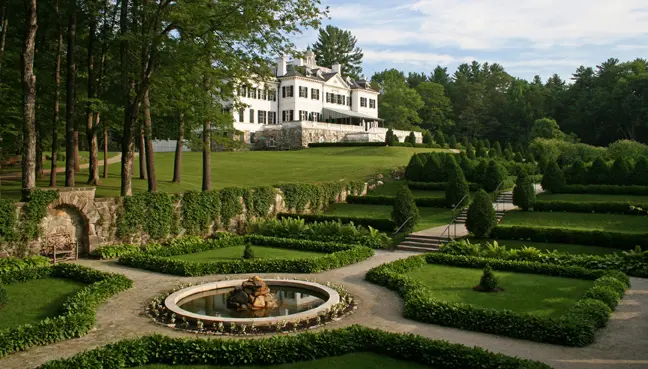
"The Decoration of Houses", written with the Boston architect Ogden Codman Jr., appeared in 1897, five years before the Lenox house was finished in the autumn of 1902; the estate is the book applied at full scale, not the laboratory that produced it. Wharton designed it with Codman, the architect Francis L. V. Hoppin, the builder R. W. Curry and her niece, the landscape architect Beatrix Farrand. She leased it out in 1909, sold it in 1911, and blamed her husband's failing health rather than the divorce that came in 1913. In her memoir she called it "my first real home". Later it was a girls' school dormitory, then the base of the Shakespeare & Company theatre troupe, whose members reported apparitions, footsteps and voices. The house has been a National Historic Landmark since 1971 — designated for the novelist who worked there, not for the architecture — and has sold ghost tours since 2009, the year after it came close to foreclosure.
What is the history of The Mount (Lenox, Massachusetts)?
The story usually told about The Mount has the order of events backwards, and the correct order is the more interesting one.
"The Decoration of Houses" was published by Charles Scribner's Sons in 1897 — the Scribner printing still carries the line "Copyright, 1897" and the authorship "By Edith Wharton and Ogden Codman Jr." on its title page. Wharton wrote it at Land's End, the ugly wooden house on the Newport cliffs she and Teddy Wharton had bought years earlier. In "A Backward Glance" she describes how it began: she and Codman, "a clever young Boston architect" hired to redecorate Land's End, found they shared a dislike of Victorian clutter, and "finding that we had the same views we drifted, I hardly know how, toward the notion of putting them into a book." Macmillan rejected the manuscript outright — their reader, she recalled, "had received it with cries of derision." Scribner's took it, printed a small tentative edition, and it sold out at once.
The Mount came afterwards. According to the estate's own published construction record, the house was built between July 1901 and the autumn of 1902 on 113 acres bought from Georgiana Sargent for $40,600; the main house cost $57,619, the stable $20,354 and the gatehouse $5,356. So the house is not the laboratory that produced the book. It is the book applied — four years later, at full scale, by an author who by then had a bestselling manual to live up to.
And she did not build it alone. The estate lists the house design as Wharton's own, but names two architects — Ogden Codman Jr. and Francis L. V. Hoppin of Hoppin & Koen — plus the builder R. W. Curry, and a second landscape architect, Beatrix Farrand, who was Wharton's niece and one of the most accomplished garden designers in America. The main house was modelled on Belton House in Lincolnshire. Wharton herself is partly responsible for the erasure: the name Hoppin does not appear once in "A Backward Glance", in a text where Codman is named ten times, Lenox eight and the word architect thirty-two.
Even the name is borrowed. Wharton explains that the house took "the name of my great-grandfather's place, the Mount" — a Long Island estate originally called Mount Buonaparte, which her republican great-grandfather indignantly renamed when his hero dropped the u from his name and made himself Emperor.
What she wrote about the place is the one quoted line that survives verification intact. On page 125 of the 1934 first edition: "The Mount was my first real home, and though it is nearly twenty years since I last saw it (for I was too happy there ever to want to revisit it as a stranger) its blessed influence still lives in me."
She gave her own reason for leaving, and it was not the divorce: she would have ended her days there, she wrote, "had not a grave change in my husband's health made the burden of the property too heavy." The Whartons leased The Mount to Albert R. Shattuck in 1909 and sold it to him outright in 1911; the divorce came two years later, in 1913. The federal nomination form that made The Mount a National Historic Landmark got this wrong — it dates the sale to 1913 and admits, in writing, "It is not known who bought the property."
That form is worth reading for what it is. Prepared on 17 June 1971 by two National Park Service historians, Edmund Preston and Christopher Redburn, it was filed under the theme "Literature, Drama, Music" and its statement of significance is entirely about Wharton the novelist. It never mentions "The Decoration of Houses", never names Codman, Hoppin or Farrand, and describes the interiors in the flat language of a surveyor. The building was protected because a great writer worked in it, not because she designed it.
By then the house had long since stopped being a home. Aileen M. Farrell bought it in 1942 for $18,000 for her Foxhollow School for Girls and used the main house as dormitories until the school closed in 1976; in 1971 the owner of record on the nomination form is the school's headmistress, Mrs. Thomas Mumford. Shakespeare & Company bought the property in 1978 and ran its operations from it until 2001, by which time the fabric was in poor condition. Edith Wharton Restoration was formed in 1980 and now owns the house and 49.5 acres. The restoration nearly destroyed it financially: the organisation carried $8.5 million in loans by 2008 and came to the edge of foreclosure, and did not clear the debt until September 2015.
Timeline: the documented record of The Mount (Lenox, Massachusetts)
- 1897 Scribner's publishes "The Decoration of Houses" by Edith Wharton and Ogden Codman Jr., written at Land's End in Newport and previously rejected by Macmillan. It appears five years before The Mount exists.
- July 1901 Construction begins on 113 acres above Laurel Lake bought from Georgiana Sargent for $40,600. The estate credits the house design to Wharton and the architecture to Ogden Codman Jr. and Francis L. V. Hoppin, with builder R. W. Curry and landscape architect Beatrix Farrand, Wharton's niece.
- Autumn 1902 The house is finished, modelled on Belton House in Lincolnshire and named after Mount Buonaparte, her great-grandfather's Long Island place, renamed "The Mount" when Napoleon crowned himself Emperor.
- 1909 The Whartons lease The Mount to Albert R. Shattuck. Wharton later writes that she would have died there had a grave change in her husband's health not made the property too heavy a burden.
- 1911 Shattuck buys the estate outright. "Ethan Frome", set in country much like the hills around Lenox, is published the same year. The divorce follows in 1913 — two years after the sale, not the cause of it.
- 1942 Aileen M. Farrell buys the house for $18,000 for her Foxhollow School for Girls and turns the main block into dormitories. The school closes in 1976.
- 17 June 1971 NPS historians Edmund Preston and Christopher Redburn file the nomination that makes The Mount a National Historic Landmark, under the theme "Literature, Drama, Music". It never mentions "The Decoration of Houses", names none of the architects, dates the sale wrongly to 1913 and states "It is not known who bought the property." The owner of record is the Foxhollow headmistress, Mrs. Thomas Mumford.
- 1978 Shakespeare & Company buys the property and runs its operations from the mansion until 2001, living and rehearsing in a building whose fabric is steadily deteriorating. Edith Wharton Restoration is formed in 1980.
- Early 1980s Kevin Coleman, Shakespeare & Company's director of education, later dates the troupe's first encounter to a visiting English psychic who backed out of a third-floor office saying "Don't anybody go in this room." The room, he says, was where a servant girl had lived.
- 2001 During a production of "A Midsummer Night's Dream", Jeremy Goodwin relates, publicity director Elizabeth Aspenlieder saw backstage "an old-fashioned gentleman standing there in a tuxedo with a pocket watch staring at her." It is the most detailed account on record, and it reaches print second-hand, eight years later.
- 2008 Edith Wharton Restoration is $8.5 million in debt after the house and garden restoration and the purchase of Wharton's library from a British collector, and comes to the brink of foreclosure. Susan Wissler moves up from deputy to executive director.
- 17 March 2009 The Berkshire Eagle reports the SyFy "Ghost Hunters" investigation and the ghost tours planned for later that year. Executive director Susan Wissler is quoted: "This is, I confess, new territory for us. But we see it as an opportunity to diversify for a younger audience."
- September 2015 A campaign led by trustee chair Lila Berle raises about $3.3 million and clears the debt entirely, saving $215,000 a year in principal and interest. The ghost tours have by then run for six seasons.
- 2026 season The museum advertises ghost tours from July to 31 October — not October alone — at $30-$35 for adults, describing the phenomena on its own page as "Tricks of the imagination in an old house once inhabited by a skilled writer of ghost stories …"
Is there a rational explanation for The Mount (Lenox, Massachusetts)?
The most useful sceptic here is the institution that sells the ghost tour. The Mount's own tour page opens by calling the phenomena "Tricks of the imagination in an old house once inhabited by a skilled writer of ghost stories …", lists "Creaking floors. Slamming doors. Fading footsteps in empty halls", and then asks the visitor to "decide for yourself". Its guides, the page says, share "tales of eerie encounters reported over the years" — reported, not established. A museum that wanted you to believe would not write it that way.
The commercial chronology is documented and tight. The Edith Wharton Restoration was $8.5 million in debt and facing foreclosure in 2008. The SyFy series "Ghost Hunters" filmed at the estate and the episode aired in the spring of 2009. Ghost tours were announced for later that same year, and the executive director, Susan Wissler, told the Berkshire Eagle on 17 March 2009: "This is, I confess, new territory for us. But we see it as an opportunity to diversify for a younger audience." That is an unusually frank statement of motive, made on the record, by the person in charge. The debt was cleared in September 2015. The haunting and the revenue stream grew up together, and the museum has never pretended otherwise.
The doors have a mechanical answer, and it comes from Wharton's own book. "The Decoration of Houses" lays down two rules that its authors then built into this house: "Under ordinary circumstances, doors should always be kept shut", and "Doors should always swing into a room. This facilitates entrance and gives the hospitable impression that everything is made easy to those who are coming in." A 16,850-square-foot house whose doors are all hung to swing inward, with a tall stair hall, a service wing, a lift shaft and a terrace of French windows along the east front, is a house engineered for pressure differentials. Open a window on the garden side of such a building and inward-swinging doors upstairs will move on their own. The single most-cited piece of the haunting is a direct consequence of its design.
The named testimony is worth reading carefully, because almost all of it is second-hand. Kevin Coleman of Shakespeare & Company told the Eagle in 2009 "I've heard from a few people that they've seen Edith Wharton there reading" — he is reporting others. The most detailed account, an "old-fashioned gentleman standing there in a tuxedo with a pocket watch", was relayed by Jeremy Goodwin about a colleague, Elizabeth Aspenlieder, during a 2001 production of "A Midsummer Night's Dream". The witnesses were theatre professionals working late in a decaying building they also lived in; Shakespeare & Company occupied the mansion from 1978 until 2001, the period in which the fabric deteriorated most. The recurring "woman with sunken eyes" seen in a bathroom window carries no name and no date in any account traced here.
One detail circulating about this house appears to have no source at all. As of August 2026 I could find no published account attributing anything at The Mount to a dog — no phantom barking, no claws on a floor. The word does not appear in the 2009 Berkshire Eagle report, on the museum's ghost-tour page, on its estate page, or in the Berkshire Style feature, in corpora where "ghost" returns 16, 3 and 8 hits and "footstep" returns 1, 6 and 1. A single recent aggregator mentions "soft barking near the graves" of the pet cemetery. Wharton's love of her dogs is real and documented — six of them are buried on a hillside visible from her library — which is precisely what makes the invention plausible enough to spread. A haunting deduced from a biographical fact is not a haunting.
And there is the priming. Wharton wrote ghost stories all her life; "Tales of Men and Ghosts" appeared in 1910, while she still owned this house. Visitors arrive at the home of a professional ghost-story writer, in the dark, having paid for the experience, and the building obliges.
Can you visit The Mount (Lenox, Massachusetts)?
The Mount is at 2 Plunkett Street, at the corner of Route 7, in Lenox, Massachusetts 01240 (413-551-5111). It is roughly two hours from Boston and two and a half from New York City. Parking is free on site: the main lot is about a quarter of a mile from the mansion, and there is accessible parking directly in front of the house for vehicles with placards. A golf cart between the car park and the buildings can be requested at the ticket booth.
The grounds and gardens are free and open year-round, dawn to dusk. The mansion is not: it opens daily from May to October, typically 10:00 to 17:00, then weekends only in November and December, 10:00 to 15:00, and closes entirely from January to April. The museum warns that it occasionally closes early for private events, especially on Saturdays — worth a phone call before driving out. Admission is $22 for adults, $20 for over-65s, $13 for students with ID, $10 for teachers and military with ID, and free for anyone 18 or under; it covers a guided or self-guided mansion tour and all on-site exhibits. The Terrace Café and the bookstore can be visited without paying admission.
Ghost tours are not an October-only affair, whatever the internet says: as advertised for the 2026 season they run from July to 31 October, last about two hours, involve roughly half a mile of walking, require a reservation, and cost $30-$35 for adults and $25 for ages 12 to 18. The museum states the tour contains adult content and does not recommend it for under-12s; a separate, lighter kids' ghost tour runs on selected evenings in September and October at 18:00, for ages 6 to 12, at $15 per person and about 75 minutes.
Accessibility is unusually well handled for a 1902 house. All three public floors of the mansion are reached by a modern lift in the historic service wing, with a wheelchair lift on the third floor. Manual indoor wheelchairs are free on a first-come basis, and an all-terrain GRIT Freedom Chair can be reserved for the gardens and grounds. Gender-neutral accessible toilets are in the stable and on the first and second floors of the mansion. ADA service animals are welcome on tours and programmes, leashed. The estate is rolling meadow, hill, woodland, paved and gravel path and mown lawn, so ask staff which route suits your device — not every path suits every wheel.
Sources consulted
- Edith Wharton, «A Backward Glance» — Charles Scribner's Sons, 1934 book
- Edith Wharton and Ogden Codman Jr., «The Decoration of Houses» — Charles Scribner's Sons, 1897 book
- Edmund Preston and Christopher Redburn, «"The Mount" (Edith Wharton Estate) — National Register of Historic Places Inventory–Nomination Form, ref. 71000900» — National Park Service, Office of Archeology and Historic Preservation, 1971 report
- David Pepose, «The Mount's haunted halls» — The Berkshire Eagle, 2009 newspaper archive
- Clarence Fanto, «The Mount, once on brink of foreclosure, clears all debts» — The Berkshire Eagle, 2015 newspaper archive
- Edith Wharton Restoration, «The Estate — Facts About the Original Estate» — The Mount, 2026 web
- Edith Wharton Restoration, «Ghost Tours» — The Mount, 2026 web
- Edith Wharton Restoration, «Hours & Admission, Directions & Parking, Accessibility» — The Mount, 2026 web
- National Park Service, «The Mount» — NPS.gov, 2026 web
- Rachel Louchen, «Ghosts at the Mount» — Berkshire Style, 2015 web
- American Aristocracy, «The Mount — ownership and transaction history» — americanaristocracy.com, 2026 web
Reviewed by V. Serrano on 2026-08-14 · How we verify our content
💬 Field testimonies (0)
No testimonies yet. Add the first.
Add your testimony
🔒 Log in to add a testimony