👻 HAUNTED PLACE · EXP. Nº9478
ACTIVE
The Octagon House
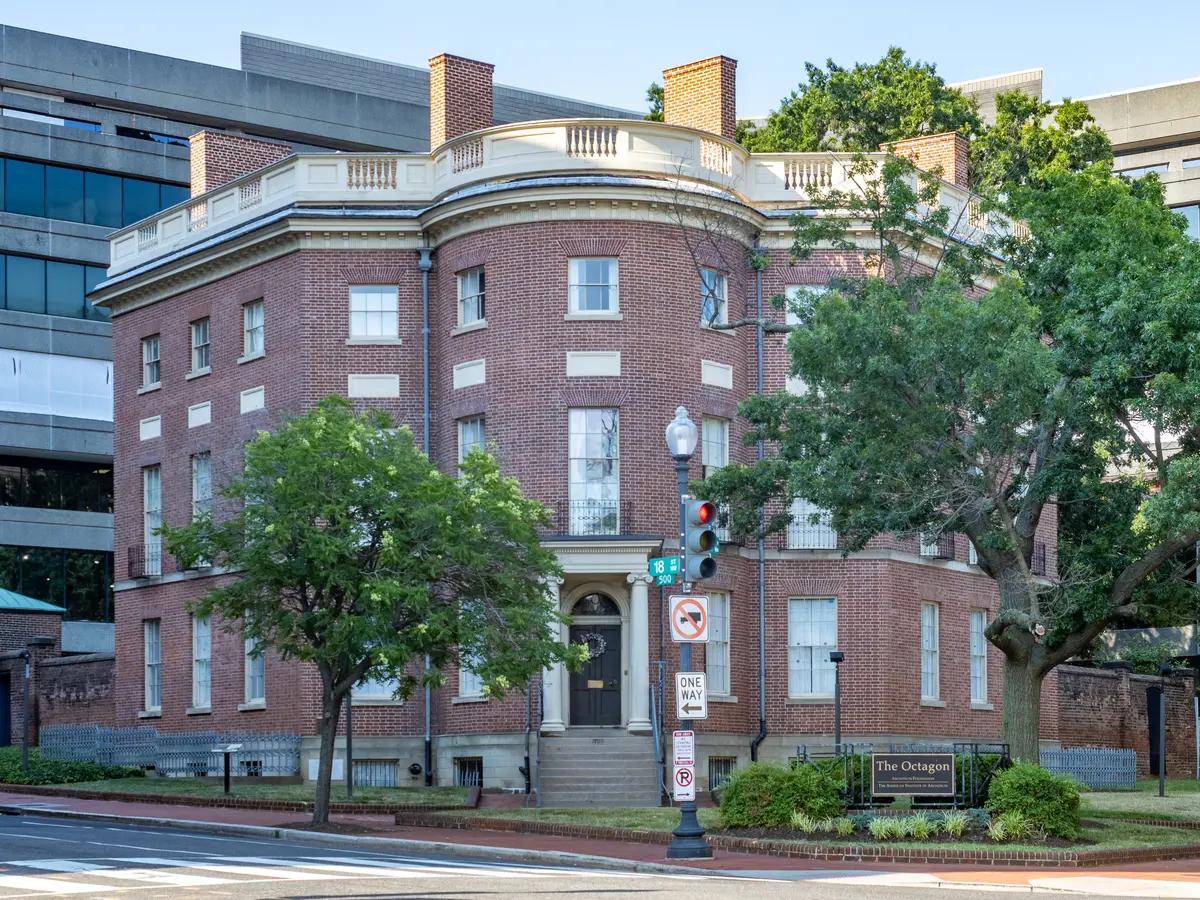
It is called The Octagon and it has six sides. The federal landmark file says so outright: "Not an octagon at all, the house is an irregular hexagon."
Where is The Octagon House?
- Location
- District of Columbia, United States
- Type
- House / mansion
- Coordinates
- 38.896, -77.042
- Last updated
LOCATION
Why is The Octagon House said to be haunted?
William Thornton, architect of the Capitol, shaped it in 1799-1800 to fit an awkward Washington corner for John Tayloe III, a Virginia planter whose fortune rested on enslaved labour — a fact the 1971 federal nomination never mentions, though the house's owner today does. After the British burned the White House in August 1814, the Madisons rented the place for $800 for six months, and in its circular second-floor room, on 17 February 1815, the Treaty of Ghent was ratified and the ratifications exchanged. The treaty itself had been signed in Belgium two months earlier, without Madison. The ghost stories in print are older than the one now told, and different. In the Evening Star of 1907 the Octagon's ghosts have nothing to do with Tayloe daughters falling down the stairs: the paper records that Black neighbours attributed the shrieks and clanking chains to the ghosts of Tayloe's enslaved people. The museum itself asks of its resident spirit: "A ghostly presence, or total nonsense?"
What is the history of The Octagon House?
Start with the name, because the name is a lie that everyone repeats. The federal nomination that put the house on the National Register says so in one flat sentence: "Not an octagon at all, the house is an irregular hexagon with a projecting semicircular bay containing the circular entrance hall on the main floor and the 'Treaty Room' on the second floor." The Historic American Buildings Survey data form agrees, describing an "irregular hexagonal shape with projecting semi-circular entrance bay". The nomination adds that "The Octagon" was what the Tayloe family themselves called it.
The shape was not a whim. In April 1797 Colonel John Tayloe III paid Gustavus W. Scott a thousand dollars for Lot 8, Square 170, at the acute angle where New York Avenue crosses 18th Street — a corner nobody knew what to do with. Tayloe had wanted to build in Philadelphia; George Washington talked him out of it and steered him to the new Federal City, within sight of the unfinished President's House. He hired Dr William Thornton (1759-1828), the amateur whose design had won the competition for the United States Capitol. Thornton solved the awkward lot by refusing to fight it: he composed the plan, as the nomination puts it, out of "a circle, two rectangles and a triangle", and let the odd angle become the front door. Work began early in 1799 and was finished late in 1800; the family moved in the following year. Sources differ on the exact span — HABS records 1798-1800, the National Register 1799-1800, the White House Historical Association 1800-01, the museum itself 1799-1801.
Tayloe was a Virginia planter of Mount Airy in Richmond County, a horse breeder, an ironmaster and, in the nomination's careful phrasing, a man whose "energies went into managing his extensive agricultural and financial holdings". Those holdings were people. The house was built and served by enslaved African Americans, and the wealth that paid for the Coade stone mantels came from their labour. Neither the 1971 National Register nomination nor the HABS documentation mentions them once: search both federal files for "slave", "enslaved" or "servant" and the count is zero, while "Tayloe" appears fourteen times and "architect" eighteen. The house's own owner said what the federal record would not. On 12 June 2020 the Architects Foundation board wrote: "We recognize The Octagon symbolizes wealth generated at the expense of enslaved African Americans." In December 2021 the museum opened "I Was Here", the first piece of a multi-year project called Parallel Histories Hidden in Plain Sight, described by the Foundation as research "to commemorate the enslaved people who built and worked at The Octagon, their descendants and the role of enslaved people in the national architectural canon".
The famous year began with a fire. In August 1814 British troops burned the White House and the Capitol. The Tayloes had left for Virginia, leaving the house in the hands of the French minister Serrurier — a flag over the door was as good as a fireguard — and it came through untouched. On 8 September 1814 President James Madison and Dolley Madison moved in. This was not a gift: the White House Historical Association records "an agreement was made for a rental fee of $800 for six months". Madison set up his office in the circular study on the second floor, and the receptions resumed almost at once; the first Wednesday levee at the Octagon was held on 21 September.
Among the household that moved with them was Paul Jennings, born into slavery at Montpelier in 1799 and taken to the White House as a footman at ten. In 1865 he published A Colored Man's Reminiscences of James Madison, the first memoir of life inside the White House by someone who had lived there. He is exact about the address: "We moved into the house of Colonel John B. Taylor, corner of 18th street and New York Avenue, where we lived till the news of peace arrived."
The peace is the second thing everybody gets wrong. The Treaty of Peace and Amity was signed at Ghent on 24 December 1814 by eight plenipotentiaries — Gambier, Goulburn and William Adams for Britain; John Quincy Adams, Bayard, Clay, Russell and Gallatin for the United States. Madison was not among them and was not in Belgium. What happened at the Octagon happened eight weeks later and was a different constitutional act. Madison's own proclamation, printed in the Daily National Intelligencer of 18 February 1815, sets out the sequence: the treaty "was signed at Ghent, on the twenty-fourth day of December, one thousand eight hundred and fourteen, by Plenipotentiaries respectively appointed for that purpose; and the said treaty having been, by and with the advice and consent of the Senate of the United States, duly accepted, ratified, and confirmed, on the seventeenth day of February, one thousand eight hundred and fifteen; and ratified copies thereof having been exchanged". The war ended not at Ghent but in that circular room, when the ratifications were exchanged. The same issue notes that Anthony St John Baker, carrying the Prince Regent's ratification, "arrived in this city about 8 o'clock last evening", and that a general illumination was recommended by the mayor for that night — which is where the candles in the Octagon's windows come from.
Jennings was in the house when the news broke, and wrote: "When the news of peace arrived, we were crazy with joy. Miss Sally Coles, a cousin of Mrs. Madison, and afterwards wife of Andrew Stevenson, since minister to England, came to the head of the stairs, crying out, 'Peace! peace!' and told John Freeman (the butler) to serve out wine liberally to the servants and others. I played the President's March on the violin, John Susé and some others were drunk for two days, and such another joyful time was never seen in Washington." The Madisons left in March 1815. On the fifth of that month Dolley wrote to Hannah Gallatin: "Still our house is crowded with company. [I]n truth ever since the peace my brain has been turn'd with noise & bustle. Such over flowing rooms I never saw before—I sigh for repose."
The Tayloes returned and stayed until Ann Ogle Tayloe died in 1855; the children then sold up. What followed was a long decline — a girls' school run by religious sisters, government offices, a studio, and finally tenement rooms. On 11 February 1898 the board of the American Institute of Architects voted to lease the wreck for five years at $360 a year; the AIA moved in on 1 January 1899 and bought the property in 1902 for $30,000, one of the earliest restoration campaigns in the country. Major restorations followed in 1949-50 and 1967-70. The Octagon was declared a National Historic Landmark in 1960 under the theme of Political and Military Affairs, with architectural recognition added in 1972. Since 2009 it has belonged to the Architects Foundation, the AIA's philanthropic partner.
Timeline: the documented record of The Octagon House
- 19 April 1797 Colonel John Tayloe III pays Gustavus W. Scott one thousand dollars for Lot 8, Square 170, at the corner of New York Avenue and 18th Street. According to the National Register nomination he had meant to build in Philadelphia until George Washington talked him into the new Federal City.
- 1799-1800 William Thornton, architect of the Capitol, builds the house on an acute street corner. The federal record is blunt about the result: "Not an octagon at all, the house is an irregular hexagon with a projecting semicircular bay." It was the Tayloes who called it The Octagon.
- 8 September 1814 Three weeks after the British burn the White House, the Madisons move into the Octagon. It was a commercial arrangement: the White House Historical Association records a rental fee of $800 for six months. Madison takes the circular second-floor study as his office.
- 24 December 1814 The Treaty of Peace and Amity is signed at Ghent by eight plenipotentiaries — Gambier, Goulburn and William Adams for Britain, John Quincy Adams, Bayard, Clay, Russell and Gallatin for the United States. Madison is not a signatory and is not in Belgium.
- 17 February 1815 In the circular room over the entrance hall, the treaty is "duly accepted, ratified, and confirmed" with the Senate's advice and consent, and the ratified copies are exchanged — the act that actually ended the war. Anthony St John Baker, carrying the Prince Regent's ratification, had reached the city about eight the previous evening.
- 17-18 February 1815 Paul Jennings, enslaved by Madison and present in the house, later writes: "When the news of peace arrived, we were crazy with joy. Miss Sally Coles… came to the head of the stairs, crying out, 'Peace! peace!'… I played the President's March on the violin." The mayor recommends a general illumination of Washington that night — the origin of the candles in the Octagon's windows.
- 5 March 1815 Days before leaving, Dolley Madison writes to Hannah Gallatin from the Octagon: "Still our house is crowded with company… Such over flowing rooms I never saw before—I sigh for repose." The Madisons move out that month.
- 1855 Ann Ogle Tayloe dies and her children sell the house. It descends through a girls' school run by religious sisters, government offices and a studio to tenement rooms.
- 28 June 1902 The Evening Star prints an Octagon ghost account, under the subhead "Ghosts in the Octagon House": "The Octagon House at that time was haunted. Of course It was." The speaker is recalling the 1830s and mentions no daughters and no staircase.
- 1898-1902 The American Institute of Architects leases the decayed house for $360 a year, moves in on 1 January 1899 and buys it in 1902 for $30,000 — one of the earliest restoration campaigns in the United States.
- 1 September 1907 The Evening Star calls the Octagon "probably the best known" haunted house in Washington and reports that Black neighbours attributed its noises to "the ghosts of Col. Tayloe's slaves". The same article blames the bells that emptied the girls' school on "rats in the walls".
- 1960 The Octagon is declared a National Historic Landmark under the theme of Political and Military Affairs; architectural recognition is added in 1972. Neither the landmark file nor the HABS documentation mentions enslaved people once.
- 12 June 2020 The Architects Foundation board, owner of the house since 2009, publishes a statement: "We recognize The Octagon symbolizes wealth generated at the expense of enslaved African Americans."
- December 2021 The museum opens "I Was Here", first instalment of Parallel Histories Hidden in Plain Sight, a multi-year project to research and commemorate the enslaved people who built and worked at the Octagon and their descendants.
Is there a rational explanation for The Octagon House?
The Octagon's ghost story, as it circulates today, is about two Tayloe daughters who fell to their deaths down the curving stair, one after a quarrel over a forbidden suitor. Two Octagon ghost accounts printed in the Evening Star, in 1902 and 1907, tell something else.
The first is a reminiscence column in the Evening Star of 28 June 1902, under the subhead "Ghosts in the Octagon House": "The Octagon House at that time was haunted. Of course It was." The speaker, an old Washingtonian recalling the 1830s and 40s, then adds that a turner's shop on D Street was haunted too, and that "there are ghosts, and ghosts everywhere, as every old man knows, but unimaginative people cannot see them." There are no daughters in it and no staircase.
The second is far more specific, and it is the one the modern legend has displaced. On 1 September 1907 the same paper ran "Old Washington Houses that are Haunted" and called the Octagon "probably the best known of these reputed haunted houses". Its ghosts are the enslaved: "Old negroes living in the vicinity insist that its particular 'harnts' are the shrieks and groans and clanking of chains, supposed to be caused by the ghosts of Col. Tayloe's slaves, whom he imprisoned in the cellars and secret passages." The account comes from Black neighbours, and its subject is the people whom the 1971 federal nomination never mentions. The same article supplies its own rational explanation for the bells that emptied the girls' school: they "might have been caused by rats in the walls".
A phrase search of Chronicling America, the Library of Congress's collection of digitised American newspapers, run on 11 August 2026, returned exactly one hit for "ghost of the Octagon" — the 1902 column above — and none apiece for "haunted the Octagon", "daughter of Colonel Tayloe", "Colonel Tayloe's slaves" and "down the staircase of the Octagon". The controls in the same corpus were large: "Octagon House" returned 1,715 hits, "Tayloe" 37,442 and "Octagon" 92,766.
The owner of the house writes about its ghost openly. On the scent of lilac perfume that visitors — Jacqueline Kennedy among them — have reported in the drawing room, said to be Dolley Madison's favourite, the Architects Foundation's own research blog ends: "A ghostly presence, or total nonsense? You can decide for yourself during The Octagon's annual Poltergeists and Pints tour each October." In the Foundation's telling, Dolley Madison's ghost is a smell in the drawing room.
One detail has a mundane origin that is better than the legend. The lights in the windows are real and dated: on the night of 17 February 1815, with the ratifications exchanged, the mayor of Washington recommended a general illumination of the city, and candles duly burned in the Octagon's windows. And the staircase does have a documented moment — it is where Sally Coles stood to shout "Peace! peace!" down to the household, as Paul Jennings recorded it. The falls appear neither in Jennings nor in the two Evening Star accounts.
Can you visit The Octagon House?
The Octagon is at 1799 New York Avenue NW, Washington, DC 20006. The Architects Foundation runs it as a house museum. William Thornton designed it for John Tayloe III in 1799. It was declared a National Historic Landmark on 19 December 1960 and entered the National Register of Historic Places on 15 October 1966 under reference 66000863.
The Foundation's own visitor page gave the opening on 9 September 2026 as Fridays and Saturdays from 11:00 to 16:00, with last admission at 15:00. Guided tours are offered at 11:00 and at 14:00 and last approximately 45 to 50 minutes. Admission is $10 for adults, while the $5 rate covers seniors; D.C. residents; college and graduate students; teachers; AIA members; military personnel. Children and teens under 18 enter free of charge. Groups of ten or more and private tours are arranged at least two weeks in advance through [email protected], and the telephone number is (202) 626-7439.
The same page states that "The Octagon is not currently ADA accessible" and offers a full online tour in its place, together with a free Bloomberg Connects digital guide that opens on site by scanning a QR code. This is a 1799 house with a curving stair rising through three storeys over a raised basement, and it has no lift. Street parking is described as limited, with nearby garages available. Farragut West and Farragut North are the closest Metro stations.
The Foundation also hires the building out for private events, advertised on its own pages as a National Historic Landmark venue, which can move the public hours. The ghost material has a product of its own: a research post published by the Foundation on 12 March 2024 refers to "The Octagon's annual Poltergeists and Pints tour each October", and that post is also where the Foundation repeats the story of the lilac scent in the drawing room.
Sources consulted
- W. Brown Morton III, «National Register of Historic Places Inventory–Nomination Form: The Octagon (Colonel John Tayloe House)» — National Park Service, Office of Archeology and Historic Preservation, 1971 report
- Alison K. Hoagland, ed. Druscilla J. Null, «Octagon House (Col. John Tayloe House; American Institute of Architects Headquarters), HABS DC-25: Architectural Data Form and written historical data» — Historic American Buildings Survey, Library of Congress, 1983 archive
- James Madison, «By the President of the United States of America. A Proclamation [of the Treaty of Peace and Amity]» — Daily National Intelligencer (Washington City), 1815 newspaper archive
- Paul Jennings, «A Colored Man's Reminiscences of James Madison» — George C. Beadle, Brooklyn; digitised by Documenting the American South, University of North Carolina, 1865 book
- Evening Star, «Ghosts in the Octagon House (reminiscence column)» — Evening Star (Washington, D.C.), 28 June 1902, p. 18, 1902 newspaper archive
- White House Historical Association, «The Octagon» — whitehousehistory.org, 2024 web
- Hunter Miller (ed.), «Treaty of Ghent, 1814 (Treaty of Peace and Amity between His Britannic Majesty and the United States of America)» — Treaties and Other International Acts of the United States of America, vol. 2, Government Printing Office; Avalon Project, Yale Law School, 1931 book
- Evening Star, «Old Washington Houses that are Haunted» — Evening Star (Washington, D.C.), 1 September 1907, p. 22, 1907 newspaper archive
- Architects Foundation Board of Directors, «Architects Foundation Board statement on The Octagon» — architectsfoundation.org, 2020 web
- Architects Foundation, «Recap: The Octagon reopens ("I Was Here" and Parallel Histories Hidden in Plain Sight)» — architectsfoundation.org, 2022 web
- Architects Foundation staff, research by Kayla Laws, «Octagon Intern Research Blog: The Women of The Octagon» — architectsfoundation.org, 2024 web
- Architects Foundation, «Plan Your Visit — The Octagon» — architectsfoundation.org, 2026 web
Reviewed by V. Serrano on 2026-08-11 · How we verify our content
💬 Field testimonies (0)
No testimonies yet. Add the first.
Add your testimony
🔒 Log in to add a testimony