👻 HAUNTED PLACE · EXP. Nº9478
ACTIVE
The Palmer House Hotel
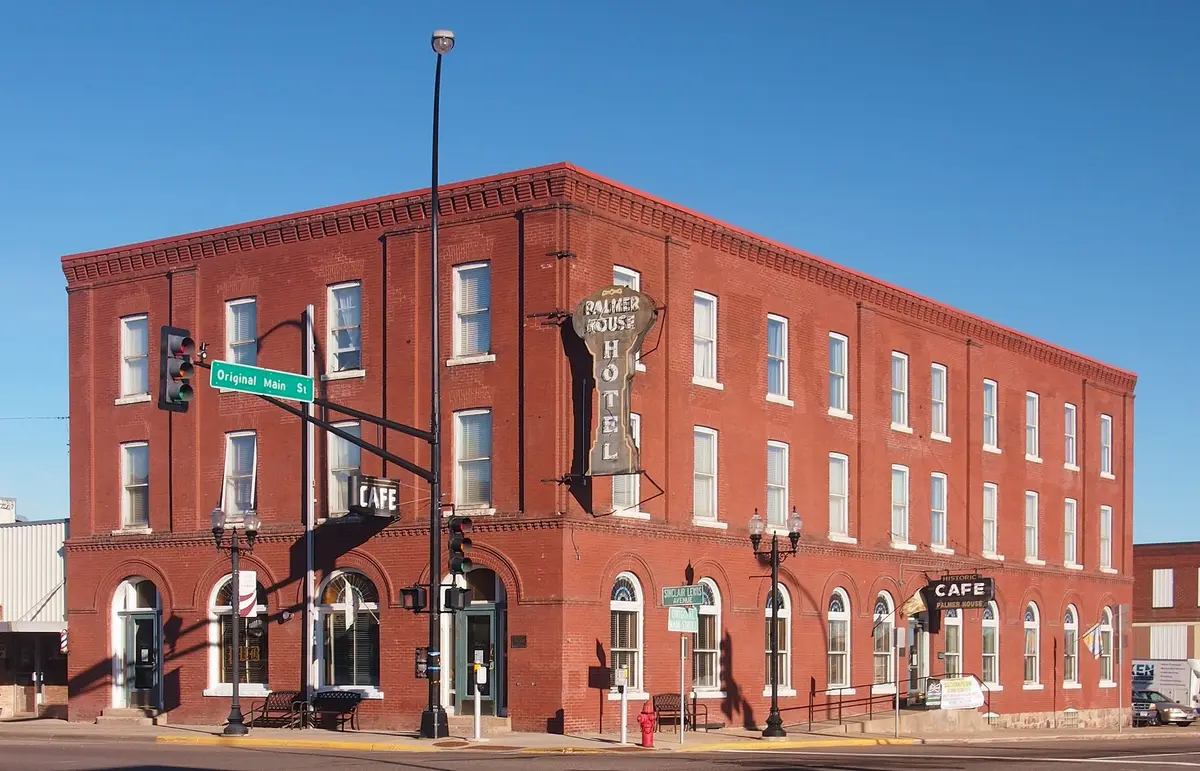
The Palmer House opened in 1901 on the corner of Main Street and what is now Sinclair Lewis Avenue, in the Minnesota town that Sinclair Lewis would turn into Gopher Prairie.
Where is The Palmer House Hotel?
- Location
- Minnesota, United States
- Type
- Hotel / inn
- Coordinates
- 45.738, -94.952
- Last updated
LOCATION
Why is The Palmer House Hotel said to be haunted?
It replaced the Sauk Centre House, the town's first hotel, which had burned to the ground the previous summer. In 1902 Lewis himself — seventeen, still a schoolboy, three decades from the Nobel Prize — worked the night desk here.
The ghosts arrived much later, and they have an author. Al Tingley, who bought the hotel in 1974 and whose name appears as owner on its 1982 National Register nomination, published Corner on Main Street in 1984 through his own imprint; it is the first place the hotel's hauntings are written down. Later owners built on it: a guest log of reported encounters, a paranormal conference in 2008, a Ghost Adventures lockdown in 2012, and tours that end in the basement. Room 17, the most requested, is now a jacuzzi suite.
In December 2025 the hotel was bought by Dave Schrader — the paranormal broadcaster who had fronted that 2008 conference.
What is the history of The Palmer House Hotel?
Sauk Centre's first hotel stood on the corner where Main Street met the road down to the railway depot. It was called the Sauk Centre House, and it burned to the ground on 26 June 1900, leaving a prairie town on a busy rail line with nowhere decent to put a travelling salesman.
R. L. Palmer built the replacement the following year. (The National Register nomination expands the initials to Richard L. Palmer; the hotel's own history page calls him Ralph L. Palmer in one paragraph and Richard Palmer three paragraphs later. The initials are the only part every source agrees on.) What went up in 1901 was a three-storey brick block with round-arched window and door openings along the two street facades, raised decorative brickwork marking the arches and the sill line of the second-floor windows, and brick pilasters separating the bays above. The lobby and ground-floor restaurant were lined with what the state's architectural historians called the building's main decorative asset: arched stained-glass windows imported from Vienna. It had twenty-four rooms, and it was the first building in Sauk Centre wired for electricity.
What the place was for matters more than what it looked like. The 1980 nomination is unsentimental about it: the Palmer House is significant "as an example of the once-common salesmen's hotel", standing "just over a bl[o]ck from the railroad depot, through which passed most of the hotel's early lodgers". A second owner added twenty more rooms at the rear in 1916, to a design by the St. Cloud architect Roland C. Buckley that replicated the original. The resulting forty-four rooms had been reorganised into thirty-seven by 1980, and into nineteen today.
And in 1902, the year after it opened, the night desk was worked by a seventeen-year-old local boy called Harry Sinclair Lewis. Al Tingley, a later owner who went through the hotel's records, wrote that Lewis had been "employed as a night clerk at the Palmer House from six in the evening" onward; the National Register nomination says only that "Lewis worked as a desk clerk for two summers". Eighteen years later Lewis published Main Street. Sauk Centre became Gopher Prairie, Gopher Prairie's hotel became the Minniemashie House, and in 1930 Lewis became the first American awarded the Nobel Prize in Literature.
The hotel has claimed that connection ever since, and Minnesota's State Historic Preservation Office endorsed it in writing in 1980: "The hotel was the model for Sinclair Lewis' Minnemashie Hotel, as Sauk Centre was the model for Gopher Prairie." It is worth reading what Lewis actually wrote. Seen through Carol Kennicott's eyes on her first afternoon in town, the Minniemashie House is "a tall lean shabby structure, three stories of yellow-streaked wood, the corners covered with sanded pine slabs purporting to symbolize stone", with "a stretch of bare unclean floor" in the office and a dining room that is "a jungle of stained table-cloths and catsup bottles". The Palmer House is brick, and it was the newest and proudest building on the street when Lewis clerked in it. Whichever hotel he had in his head, he was not describing this one from life.
Timeline: the documented record of The Palmer House Hotel
- 26 June 1900 The Sauk Centre House, the town's first hotel and the previous occupant of the corner, burns to the ground. The date is the one given by the hotel's own history page and repeated by every later account.
- 1901 R. L. Palmer builds the Palmer House on the empty corner: three storeys of brick, twenty-four rooms, arched stained-glass windows imported from Vienna, and the first electrical wiring in Sauk Centre.
- 1902 Harry Sinclair Lewis, seventeen years old and still a schoolboy in Sauk Centre, works the night desk at the year-old hotel. Al Tingley's history of the building records him on duty "from six in the evening" onward.
- 1916 The second owner adds twenty rooms at the rear, to a design by the St. Cloud architect Roland C. Buckley that replicates the 1901 building. The hotel reaches forty-four rooms.
- 1920 Sinclair Lewis publishes Main Street. Sauk Centre appears as Gopher Prairie and its hotel as the Minniemashie House — described, unflatteringly, as a shabby three-storey wooden building, which the brick Palmer House is not.
- 1974 Al Tingley and his partner Dick Schwartz buy the ageing hotel and begin restoring it. Later accounts date the start of the ghost stories to this ownership.
- 11 February 1982 The Palmer House Hotel is listed on the National Register of Historic Places (ref. 82003047), on a nomination drafted by the Minnesota State Historic Preservation Office in 1980. It argues commerce and social history, and says nothing about ghosts.
- 1984 Al Tingley, the owner named on the National Register form, publishes Corner on Main Street through his own St. Cloud imprint, Dauntless. It is the earliest written source located for the hotel's hauntings.
- 1985 Interviewed by the journalist Peg Meier, Tingley refuses the most attractive version of his own legend — that the ghost is Sinclair Lewis: "If Lewis comes to town, he comes in a whirlwind."
- 18-20 January 2008 The hotel hosts its first paranormal conference, organised by the radio programme Darkness on the Edge of Town and fronted by its host Dave Schrader with the television investigators Chris Fleming and Patrick Burns.
- 12 September 2009 A guest, Becky Ballard, writes in the hotel's log that in room 17 she repeatedly heard her name called while alone: "The voice was a woman's and was in the room with me." It is the best-attributed report attached to that room.
- 5 October 2012 Travel Channel broadcasts "The Palmer House", the fourth episode of the eighth season of Ghost Adventures and the crew's first investigation in Minnesota. This, not an unnamed 2011 vigil, is the televised night the hotel is known for.
- 15 December 2025 Dave and Winnie Schrader become the hotel's owners — the same Dave Schrader who had fronted the 2008 paranormal conference in the building seventeen years earlier.
Is there a rational explanation for The Palmer House Hotel?
The Palmer House is unusual among haunted hotels in that you can date the haunting, and name the man who first wrote it down.
Nothing supernatural appears in the National Register file. The nomination was prepared by the Minnesota State Historic Preservation Office in September 1980, photographed for the record by Thomas Harvey of the Minnesota Historical Society, and listed on 11 February 1982 under reference 82003047. It argues the building's importance under "commerce" and "social/humanitarian" — a salesmen's hotel by a depot — and mentions no ghost, no cold room and no unexplained noise. The owner named on that form is Al Tingley, of Dauntless Inc., who with his partner Dick Schwartz had bought the hotel in 1974 and was restoring it.
Two years after the listing, in 1984, Tingley published Corner on Main Street through Dauntless and Creative Concepts of St. Cloud — the same Dauntless that appears as his company on the nomination. That book is the earliest written source for the hotel's hauntings this file could find: a ghost said to go back to the 1950s, a suicide upstairs, a man hanged in the bar. The legend's first documented author, in other words, is the proprietor, self-published, during the decade he was restoring and promoting the building.
And Tingley himself would not sign the best version of it. Asked by the Minneapolis journalist Peg Meier, for The Pie Lady of Winthrop (1985), about the story that the resident ghost is Lewis, he refused it. "Some people speculate that Lewis's ghost clunks around the hotel where he once clerked," Meier wrote. "Co-owner Al Tingley says no. 'If Lewis comes to town, he comes in a whirlwind.'"
Everything after that is accumulation, and it is commercial accumulation. Under Kelley Freese, who ran the hotel through the 2000s and 2010s, guest reports were collected and published on the hotel's own website; a paranormal conference was booked in for January 2008; a Ghost Adventures lockdown aired in October 2012; the counter sold the ghost-hunting books written by the hotel's own visitors. The phenomena reported are the standard repertoire of a big old building — knocks, footsteps, doors, rooms that will not hold a temperature, and electrical faults in a structure the hotel's own page notes had just been "rewired and gutted for electrical inspection".
The ordinary explanations are the ordinary ones. Guests arrive having booked precisely because the hotel is famous for ghosts, and several of the published testimonies say so in their first sentence. A 1901 brick block with individually controlled heating and air conditioning will produce cold rooms and hot rooms. And the accounts contradict each other on plain facts: a 2006 investigators' report posted by the hotel says it was told nobody died in the 1900 fire, while the Travel Channel's synopsis of its own episode has that fire killing several people.
Can you visit The Palmer House Hotel?
The Palmer House Hotel is a working hotel at 500 Sinclair Lewis Avenue, Sauk Centre, Minnesota, on what its National Register nomination of 1980 calls "the principal intersection of Sauk Centre". The hotel describes its three-storey building as holding a restaurant and a pub, with a café, as well as the guest rooms. Reservations are taken by telephone only, on 320-351-9100. The hotel's pages, read on 24 September 2026, ask in capitals not to email for reservations or availability, and the contact page states that reservations are "not available online at this time". The same page announces that Dave and Winnie Schrader became the owners on 15 December 2025.
According to the hotel's history page, the building originally had 38 small rooms whose guests shared a common "necessary room" down the hall; since a renovation in 1993 there have been 19 rooms, each with its own bathroom. The rates page gives new rates effective from 15 July 2025, before tax, and prices a night from $130 for the three economy rooms to $210 for the double jacuzzi suite, room 1. In between come the six standard rooms at $145, room 11 among them, the two standard plus rooms at $165 and the economy suite, room 3, at $166. The three suites cost $175 and the three jacuzzi suites $195; room 17 is one of these, numbered 17K. The hotel's page of paranormal findings says that room 11 "has been said to always stay cool" and that guests in room 17 have come back to find the furniture moved. Check-in is at 3pm and check-out at 11am. The hotel has a 48-hour cancellation policy and gives no refunds. Guests must be 21 or over to reserve or check in, and debit cards carry a $250 pre-authorisation hold. The terms add: "Paranormal Investigations without prior approval are not allowed."
The restaurant serves lunch every day from 11am to 2pm, and on Monday and Tuesday it is closed for evening dinner. The kitchen is open on Wednesday from 5pm to 9pm and from Thursday to Saturday from 9am to 9pm; on Sunday it opens from 8am to 3pm. Happy hour in the pub runs daily from 3pm to 6pm.
Historical and paranormal tours are sold through the hotel's event calendar, which listed the next one for Saturday 26 September 2026 at 3pm, led by the hotel's guide, Sherry. The listing gives the price as $50 plus tax per person, non-refundable "under any circumstances", and the length as about two to three hours; the history page says about two hours. The tour ends in the basement, which the hotel says is closed to the public except on tours; the lights are turned off there for what the hotel calls "a mini investigation". The minimum age is 12, anyone aged 12 to 17 must be accompanied by a parent or guardian, and every participant signs a waiver of liability.
Sources consulted
- Minnesota State Historic Preservation Office, «Palmer House Hotel — National Register of Historic Places Inventory–Nomination Form (ref. 82003047)» — U.S. Department of the Interior / National Park Service, 1980 report
- Sinclair Lewis, «Main Street» — Harcourt, Brace and Howe (public-domain text via Project Gutenberg), 1920 book
- Al Tingley, «Corner on Main Street» — Dauntless and Creative Concepts, St. Cloud, Minnesota, 1984 book
- Peg Meier, «The Pie Lady of Winthrop, and Other Minnesota Tales» — Neighbors Publishing, Minneapolis, 1985 book
- The Palmer House Hotel, «The Historic Palmer House — the hotel's official history» — thepalmerhousehotel.com, 2026 web
- The Palmer House Hotel, «Guest Experiences — the hotel's own log of reported encounters» — thepalmerhousehotel.com, 2015 web
- The Palmer House Hotel, «Contact — announcement of the change of ownership on 15 December 2025» — thepalmerhousehotel.com, 2026 web
- The Palmer House Hotel, «Hotel rooms, rates and house rules» — thepalmerhousehotel.com, 2026 web
- Zak Bagans, Nick Groff and Aaron Goodwin, «Ghost Adventures, season 8, episode 4: "The Palmer House" (first broadcast 5 October 2012)» — Travel Channel, 2012 web
- The Palmer House Hotel, «Paranormal Findings — investigators' reports and the January 2008 conference, as published by the hotel» — thepalmerhousehotel.com, 2016 web
- The Palmer House Hotel, «Event Calendar (Historical/Paranormal Tour: $50 plus tax, 2-3 hours, minimum age 12, waiver)» — thepalmerhousehotel.com, 2026 web
- The Palmer House Hotel, «Restaurant & Pub (kitchen hours and happy hour)» — thepalmerhousehotel.com, 2026 web
Reviewed by V. Serrano on 2026-08-11 · How we verify our content
💬 Field testimonies (0)
No testimonies yet. Add the first.
Add your testimony
🔒 Log in to add a testimony