👻 HAUNTED PLACE · EXP. Nº9477
ACTIVE
The Witch House
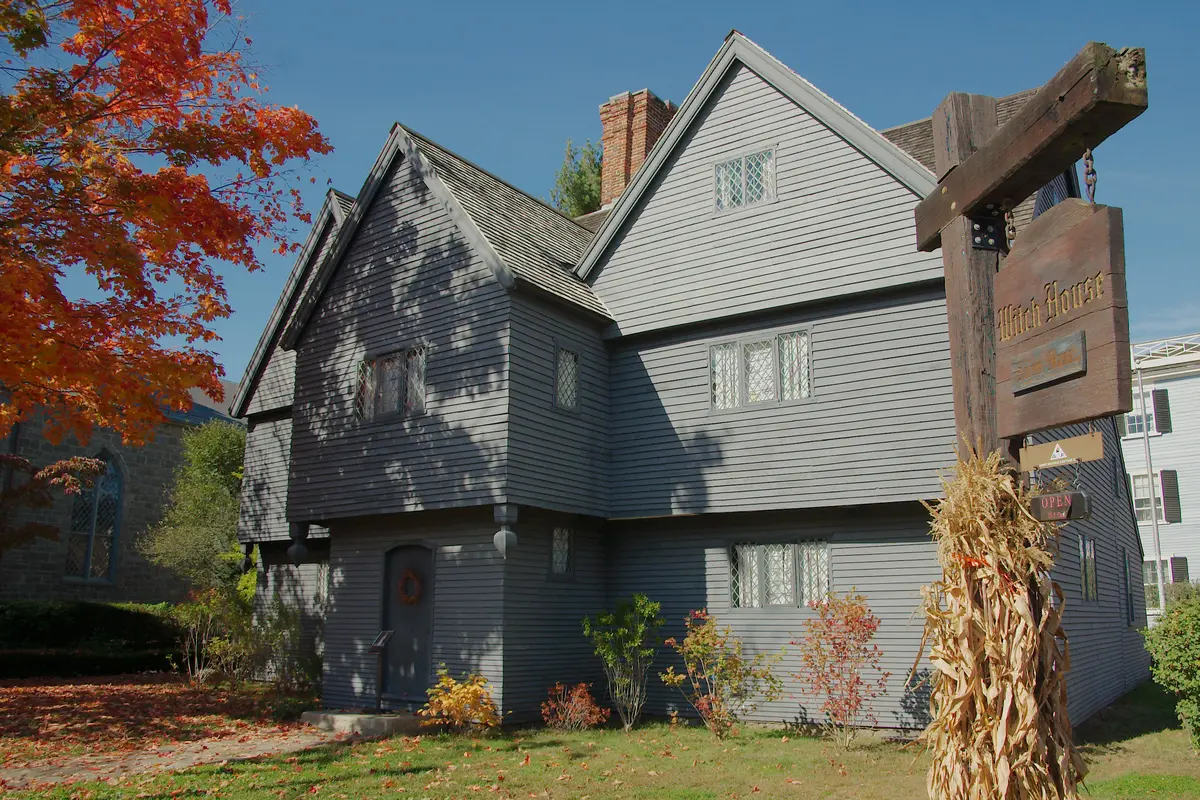
Built around 1675 for Judge Jonathan Corwin, who lived there for more than forty years, the Jonathan Corwin House in Salem, Massachusetts is the only structure still standing in the city with a direct physical connection to the Salem witch trials of 1692.
Where is The Witch House?
- Location
- Massachusetts, United States
- Type
- House / mansion
- Coordinates
- 42.522, -70.899
- Last updated
LOCATION
Why is The Witch House said to be haunted?
Corwin, one of the magistrates who conducted preliminary examinations of the accused, is believed to have questioned some of the trials' earliest suspects inside the house itself, giving the building its enduring local nickname, "The Witch House." Visitors and staff over the years have reported cold spots on the staircase and a heaviness in the upstairs rooms said to echo the fear of 1692, when twenty people were ultimately executed on charges of witchcraft. Now a city-run museum, the house draws crowds every October.
What is the history of The Witch House?
The Witch House is described by the City of Salem, which owns it, as one of the very few structures left standing in Salem with a direct tie to the witch trials of 1692 — and it is the only one most visitors will ever be shown. That is the honest version of its claim to fame, and it is already a great deal. It is not a courthouse. Nobody was tried here. What it is, is the home of one of the men who did the questioning.
Jonathan Corwin (1640-1718) came from one of the wealthiest Puritan merchant families in New England. In 1675 he bought a large, still-unfinished house on Essex Street from Captain Nathaniel Davenport, finished it, and lived in it for more than forty years; it stayed in the family until the middle of the nineteenth century. The bricklayer who worked on that house, Daniel Andrew, was a prominent Salem Village selectman — and in May 1692 he too was named as a witch and fled before the constable could serve the warrant. That detail is a fair measure of how indiscriminate the panic became: the man who built the judge's chimneys ran for his life.
By then Corwin was one of the engines of the crisis. From 1 March 1692 he sat alongside his brother-in-law John Hathorne taking the first examinations of the accused — not in his parlour, but at Lieutenant Nathaniel Ingersoll's house in Salem Village. The transcripts survive. Asked what evil spirit she had familiarity with, Sarah Good answered "none"; told she was hurting the children, she said "I doe not hurt them. I scorn it." She was hanged on 19 July. Corwin later joined the special Court of Oyer and Terminer created by Governor William Phips, taking the seat left by Nathaniel Saltonstall, who had resigned from it.
What followed is not the story Salem sells in October. Nobody was burned. Under English law witchcraft was a felony, and felons hanged; burning was reserved for other crimes entirely. At least 155 people were arrested and jailed between late February 1692 and May 1693. Nineteen were hanged at Proctor's Ledge, on the lower slope below Gallows Hill, on four days: Bridget Bishop alone on 10 June, five on 19 July, five on 19 August and eight on 22 September. Giles Corey refused to plead and was crushed under stones; Judge Samuel Sewall wrote in his diary, "Monday; Sept-19th 1692. Abt noon, at Salem, Giles Corey was pressed to death for standing mute." At least five more died in prison, among them Sarah Osborne and the newborn daughter of Sarah Good, born in a cell.
The machine stopped because the evidence collapsed. The court had relied on spectral evidence — the claim that the shape of a witch could be seen tormenting a victim. Increase Mather and other ministers argued that the Devil could take the shape of an innocent person, and Phips agreed. Writing to London on 12 October 1692, he reported that "the Devill had taken upon him the name and shape of severall persons who were doubtless inocent"; in a second letter of 21 February 1692/3 he described "at least fifty persons in prison in great misery by reason of the extream cold and their poverty, most of them having only spectre evidence against them", and stated flatly, "I put an end to the Court and stopped the proceedings, which I did because I saw many innocent persons might otherwise perish."
Then came the retractions, and they took three centuries. In 1697 Massachusetts held a day of fasting, and Sewall stood in his Boston meeting-house while his confession of "blame and shame" was read aloud. In 1706 Ann Putnam Jr., one of the most active accusers, stood in her pew at Salem Village while the minister read her admission that she had been deluded. On 17 October 1711 the colony reversed the attainders of twenty-two of the condemned and awarded £578 12s in restitution to survivors and heirs. Names kept trickling in: further resolves in 1957 and 2001, and finally, on 28 July 2022, Elizabeth Johnson Jr. — cleared 329 years late, after a middle-school civics class in North Andover took up her case.
Timeline: the documented record of The Witch House
- 1675 Jonathan Corwin buys the unfinished house on Essex Street from Captain Nathaniel Davenport, completes it and moves in. He will live there more than forty years and the house will stay in his family until the mid-nineteenth century.
- 1 March 1692 Corwin and his brother-in-law John Hathorne take the first examinations of the accused — at Lieutenant Nathaniel Ingersoll's house in Salem Village, not at Corwin's own home. Sarah Good tells them: "I doe not hurt them. I scorn it."
- 14 May 1692 A complaint is filed against Daniel Andrew, the Salem Village selectman and bricklayer who had worked on Corwin's house. He flees before the constable can serve the warrant.
- 10 June 1692 Bridget Bishop is hanged, the first of nineteen executions. Five more follow on 19 July, five on 19 August and eight on 22 September, all at Proctor's Ledge. Nobody is burned: under English law witchcraft was a felony, and felons hanged.
- 19 September 1692 Giles Corey, who refuses to plead, is crushed under stones. Judge Samuel Sewall records it in his diary: "Monday; Sept-19th 1692. Abt noon, at Salem, Giles Corey was pressed to death for standing mute."
- 12 October 1692 Governor William Phips writes to London that "the Devill had taken upon him the name and shape of severall persons who were doubtless inocent". The Court of Oyer and Terminer is dissolved later that month.
- 21 February 1692/3 In a second letter Phips describes "at least fifty persons in prison in great misery" held mostly on spectral evidence, and writes: "I put an end to the Court and stopped the proceedings, which I did because I saw many innocent persons might otherwise perish."
- 17 October 1711 Massachusetts reverses the attainders of twenty-two of the condemned, declaring the convictions "null and void to all Intents", and awards £578 12s in restitution to survivors and heirs.
- c. 1856 George Farrington buys the house, grafts an apothecary shop onto the front and sells medicines in bottles bearing a flying-witch insignia. The nickname "Witch House" — until then it was widely called the Roger Williams House — takes hold commercially.
- Winter 1945 Saved from demolition for the widening of North Street, the house is moved about thirty-five feet back on its lot. The Victorian shopfront is cut away, the gables are rebuilt and a new pitched roof recreates the presumed original. Historic Salem Inc. raised the $42,500; Gordon Robb directed the work.
- 1948 The restored house opens to the public as a furnished historic site. It is now run by the City of Salem.
- January 2016 The Gallows Hill Project — Emerson Baker, Benjamin Ray, Marilynne Roach, Peter Sablock and Tom Phillips — confirms Proctor's Ledge as the execution site, combining trial records, Rebecca Eames's 1692 testimony, GIS viewshed mapping and ground-penetrating radar.
- 19 July 2017 A memorial is dedicated at Proctor's Ledge on the 325th anniversary of the hangings of 19 July 1692, with the nineteen names carved along an arc of granite.
- 28 July 2022 Massachusetts exonerates Elizabeth Johnson Jr., the last convicted person still unpardoned, 329 years after her conviction, after a North Andover middle-school civics class took up her case.
Is there a rational explanation for The Witch House?
Almost everything a visitor assumes about this house is nineteenth- and twentieth-century work.
Start with the name. For much of the 1800s the building was known not as the Witch House but as the Roger Williams House, on the strength of a tradition that the dissenting minister had lodged there. It became the "Witch House" commercially: George Farrington acquired it around 1856, bolted an apothecary shop onto the front and sold his medicines in bottles bearing a flying-witch insignia. The Salem State University archives are blunt about the underlying claim — "there is no documentation that Judge Corwin used his own home to interrogate those accused". The surviving examination records place Corwin and Hathorne at Ingersoll's tavern and the Salem Village meeting house, not in his parlour.
The building itself is partly an interpretation. In 1944 the widening of North Street condemned it; Historic Salem Inc. was founded around the rescue and raised $42,500. In the winter of 1945 the house was moved some thirty-five feet back on its lot, the Victorian shopfront was cut away, the gables were rebuilt and a new pitched roof was put on to recreate what was believed to have been the original. The work was directed by the Boston architect Gordon Robb in consultation with Frank C. Brown, and the museum opened in 1948. The seventeenth-century face Salem photographs today is, in significant part, a 1940s reconstruction of a seventeenth century that the restorers inferred.
As for the ghosts — cold spots on the stairs, a child's voice, a weight in the upper chamber — they circulate almost entirely on commercial ghost-tour sites. The museum makes no such claim, and neither does the City of Salem, which runs it. The house's own rules make the point unintentionally: photography, video and electronics of any kind are forbidden inside, so the equipment readings that ghost-hunting depends on cannot be produced there at all. When the Witch House does programme ghosts, it does it openly as literature — its "Ghost Stories in the Witch House" evenings are the historian and storyteller Rory O'Brien reading classic ghost fiction at sunset.
And the biggest myth of all is not paranormal but forensic. Nobody was burned in Salem, and nobody was executed in this house or in any building. The scale of the audience that comes to be told otherwise is measurable: Destination Salem counted 1.1 million unique visitors downtown in October 2025 and 96,600 on Halloween day alone. The building outlived the panic it commemorates, and then outlived a century of merchandising of that panic. Both facts are true at once.
Can you visit The Witch House?
The Witch House stands at the corner of Essex and North streets, at 310½ Essex Street in Salem (Massachusetts 01970). The City of Salem lists it among its municipal facilities. It was the house of Judge Jonathan Corwin, who according to the city's page bought it in 1675 at the age of 24; it stayed in the Corwin family until the mid-1800s. Tickets are sold for the same day through the house's own website.
The house's "Plan Your Visit" page, read on 24 September 2026, gives daily opening from 15 April to 15 November, from 10:00 to 17:00 with last entry at 16:30, and Thursday to Sunday from 16 November to 14 April, from 12:00 to 16:00 with last entry at 15:45. It closes on Thanksgiving and on federal holidays; over Christmas and New Year it closes on both the eve and the day. Admission is a single price of $17, with children under 4 free; on the same day the City of Salem's facility page still showed an older scale of $12 for adults, $10 for seniors and $8 for youth. School groups pay $5 per student with one free chaperone per ten, and the house takes no group bookings in October. The city's page gives 978-744-8815 as the telephone number.
October has its own rules, set out on the house's "Visiting in October" page. Tickets are sold online only from 15 August and are released at 8:00 each morning for that day. They are non-refundable and late arrivals are not admitted; everyone aged 4 and over needs one. Visitors wait outside until their slot. The page also warns that traffic and parking are difficult at that time of year. Destination Salem counted 1.1 million unique visitors downtown in October 2025.
The October page also sets out the rules inside the house. Nothing may be touched. Photographs, video and electronic devices are not permitted inside, where food and drink are also barred; strollers are parked outside and large backpacks and luggage are refused, and only service animals are admitted. There are no public restrooms, and only the first floor is ADA compliant. Photographs of the exterior are allowed as long as the front door, which is the exit, is kept clear.
The executions took place at another site in the town. The Gallows Hill Project identified Proctor's Ledge in 2016, and the city dedicated a memorial below it on 19 July 2017, the 325th anniversary of the first mass hanging. Smithsonian's report on the memorial describes the lot as tucked between houses on Pope Street and owned by the city since 1936. Neighbours told the magazine that they had learned only that winter that they lived beside the hanging site, and one recalled strangers holding a loud séance in a back yard.
Sources consulted
- Benjamin C. Ray (dir.), «Salem Witch Trials Documentary Archive and Transcription Project» — University of Virginia, 2018 archive
- William Phips, «SWP No. 163: Two Letters of Gov. William Phips (1692-1693)» — Salem Witch Trials Documentary Archive, University of Virginia, 1693 archive
- Court of Oyer and Terminer records, «SWP No. 063: Sarah Good, Executed July 19, 1692» — Salem Witch Trials Documentary Archive, University of Virginia, 1692 archive
- General Court of Massachusetts, «SWP No. 173: Reversal of Attainder and Restitution (1710-1750)» — Salem Witch Trials Documentary Archive, University of Virginia, 1711 archive
- Samuel Sewall / Massachusetts Historical Society, «Giles Corey, pressed to death (diary of Samuel Sewall, 19 September 1692)» — The Beehive, Massachusetts Historical Society, 2021 archive
- Susan Edwards (Archives and Special Collections), «The Witch House» — Salem State University, 2021 archive
- Emerson W. Baker, Benjamin Ray, Marilynne K. Roach, Peter Sablock and Tom Phillips, «The Gallows Hill Project» — University of Virginia, 2016 report
- City of Salem, «The Witch House (facility page)» — salemma.gov, 2026 web
- The Witch House / Corwin House, «Plan Your Visit — hours, $17 admission, children under 4 free, school groups $5 per student» — thewitchhouse.org, 2026 web
- Donna Seger, «Which Witch House?» — Streets of Salem, 2012 web
- Boston Public Library, «Salem Witch Trials research guide: Accusers and Accused» — guides.bpl.org, 2025 web
- Smithsonian Magazine, «The Site of the Salem Witch Trial Hangings Finally Has a Memorial» — Smithsonian, 2017 newspaper archive
- Salem Witch Museum, «Sarah and Daniel Andrews Home, Site of (citing Boyer and Nissenbaum, Salem Possessed, 1974)» — salemwitchmuseum.com, 2024 web
- Smithsonian Magazine, «Last convicted Salem witch is finally cleared» — Smithsonian, 2022 newspaper archive
- Destination Salem, «Halloween Day Visitors Up 7.2% as Salem Sustains Record October Tourism Levels» — Press release, 5 November 2025, 2025 report
- The Witch House / Corwin House, «Visiting in October — tickets online only from 15 August, released at 8:00 for that day; non-refundable; no late entries; every visitor aged 4 and over needs a ticket; house rules» — thewitchhouse.org, 2026 web
Reviewed by V. Serrano on 2026-07-29 · How we verify our content
💬 Field testimonies (0)
No testimonies yet. Add the first.
Add your testimony
🔒 Log in to add a testimony