👻 HAUNTED PLACE · EXP. Nº9046
ACTIVE
Theorosa's Bridge
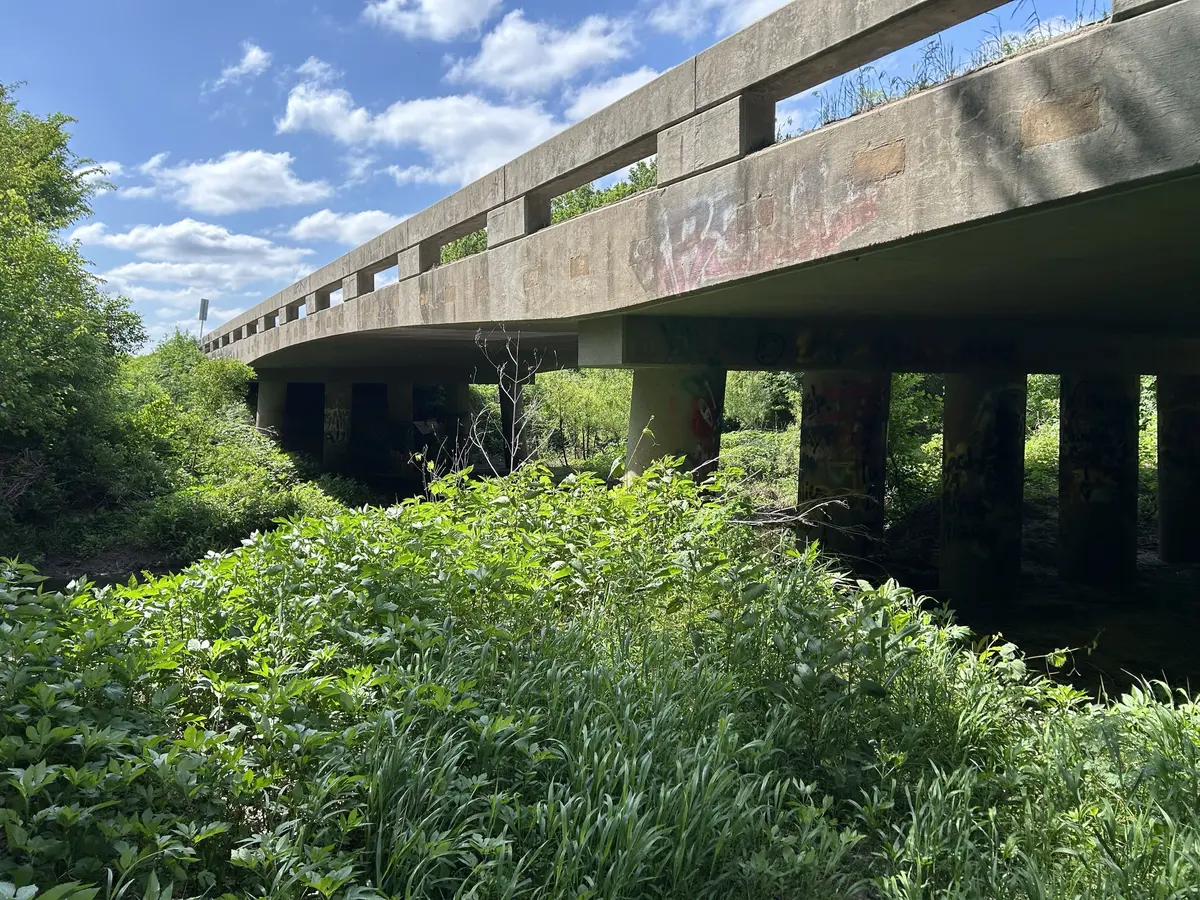
Theorosa's Bridge is a three-span concrete slab carrying 109th Street North over Jester Creek in Sedgwick County, Kansas, a few hundred metres west of Meridian Avenue.
Where is Theorosa's Bridge?
- Location
- Kansas, United States
- Type
- Road / bridge
- Coordinates
- 37.883, -97.374
- Last updated
LOCATION
Why is Theorosa's Bridge said to be haunted?
The federal bridge inventory dates the present structure to 1991 and counts about thirty vehicles a day; the road itself was petitioned into existence by twenty-nine local men in July 1883. The legend attached to it has no single plot. In the oldest setting the folklorist Lisa Hefner Heitz recorded, a settler baby named Theorosa is carried off from a wagon train in the late 1800s and her mother searches the creek for her; in others Theorosa is the mother, a Native American woman or a farm wife who loses or drowns her own child. What holds the versions together is a procedure: callers who say "Theorosa, I have your baby" three times are said to be attacked by her, and she is also blamed for riding horses to death. The historian Jay Price checked the census and the local papers in 2017 and found no Theorosa in nineteenth-century Kansas.
What is the history of Theorosa's Bridge?
The crossing came first, and it can be dated. On 7 July 1883 a petition signed by B. J. Allen and twenty-eight others reached the Board of County Commissioners of Sedgwick County asking for a road to be laid out along the section line "to Jester creek"; the county appointed J. T. Carpenter, O. G. Jacobs and N. L. Palmer as viewers and printed the notice in the Wichita Eagle of 2 and 9 August 1883. The following year the same paper carried another petition, for the session opening 6 October 1884, asking the commissioners for an appropriation of $430 "to aid in building a bridge across Jester Creek" where the stream crosses a section line in township twenty-five south, range one west. In the decade in which the legend places its settlers, then, this stretch of Jester Creek was still being argued over in legal notices at a few hundred dollars a span.
What stands there now is neither old nor mysterious. The Federal Highway Administration's National Bridge Inventory lists structure 000870815905920, carrying "109th LOCAL RD." over Jester Creek at 37.883125 N, 97.374092 W: three spans, 49.7 metres long, 9.1 metres wide, owned and maintained by the county, built in 1991 and never reconstructed since. Its traffic count is thirty vehicles a day. Lisa Hefner Heitz, who went there for Haunted Kansas (University Press of Kansas, 1997), put the naming plainly: the bridge "is officially known as the 109th Street Bridge, but around Valley Center" it is Theorosa's.
The legend has no single version, and Heitz did not pretend otherwise. "The oldest setting for the story is the Kansas plains in the late 1800s when white settlers were traveling through the Jester Creek area," she wrote — a wagon train attacked, a baby called Theorosa carried off, her mother left behind to search the creek. In others Theorosa is the mother rather than the child: a Native American woman with a baby by a white settler, a farm wife with a baby by a hired hand. One of Heitz's tellers ended a version flatly: she "drowned it and the Indians saw her and killed her, so now she haunts the bridge."
What binds the versions together is a procedure: the caller goes at night, calls out, and she is said to come. Heitz recorded the formula from a teller: say "Theorosa, I have your baby" three times "and there will be a ghost that comes screaming and running at you." She noted that the ghost herself is unusual for Kansas — "an unusually active ghost, and besides haunting, wandering, searching, moaning, screaming, running, attacking, scratching" — and that Theorosa is also said to ride horses to death for sport, a motif Heitz called "quite unusual in Kansas folklore". A local farmer's horse, pastured near the bridge and found dead one morning in apparent good health, was explained that way.
The written trail is short, and it starts in the years when the old bridge was burning: Troy Taylor wrote in 1998 that the original wood and iron bridge "burned down in 1974, was rebuilt, and then burned again two years later". The earliest source Heitz lists is a 1974 collection made at Valley Center High School. Her notes then cite the Ark Valley News of 18 June 1975 under the headline "Theorosa Lost Her Home but Legend of Ghost Continues", the Wichita Eagle-Beacon of 12 December 1980 under "Psychic Claims Theorosa's Bridge Is 'Haunted'", and the Ark Valley News of 18 July 1991 under "Theorosa's Bridge Undergoing Repair" — a headline that lands in the same year the federal inventory gives for the concrete span that is there today.
Timeline: the documented record of Theorosa's Bridge
- 7 July 1883 B. J. Allen and twenty-eight other petitioners ask the Sedgwick County commissioners to lay out a road running west along a section line 'to Jester creek'. The county appoints J. T. Carpenter, O. G. Jacobs and N. L. Palmer as viewers and publishes the notice in the Wichita Eagle on 2 and 9 August.
- 19 September 1884 The Wichita Eagle prints a petition to the county commissioners, for the session opening 6 October, seeking $430 'to aid in building a bridge across Jester Creek' in township twenty-five south, range one west. The crossings the legend needs are still being funded a few hundred dollars at a time.
- 1974 The earliest source Lisa Hefner Heitz lists for the legend is a collection made that year at Valley Center High School.
- 18 June 1975 The Ark Valley News runs 'Theorosa Lost Her Home but Legend of Ghost Continues', cited in Heitz's notes. The wooden-and-iron bridge is gone by this date and the road stays shut for years.
- 12 December 1980 The Wichita Eagle-Beacon publishes 'Psychic Claims Theorosa's Bridge Is Haunted', also cited by Heitz: the earliest appearance of the site in the metropolitan press that can be dated from her notes.
- 1991 The county builds the concrete bridge that stands today; the Federal Highway Administration records 1991 as the year built for structure 000870815905920, with no later reconstruction. The Ark Valley News of 18 July that year runs 'Theorosa's Bridge Undergoing Repair'.
- 1997 Heitz publishes Haunted Kansas. She records the summoning formula from a teller, notes the horse-riding motif as unusual in Kansas, links the story to La Llorona, and quotes Sergeant Alan Sherry and Investigator Ron Farthing to the effect that police had spent twenty-five years breaking up parties at the site.
- 1998 Troy Taylor publishes the Ghosts of the Prairie page on the bridge, archived on 21 February 1999. It reuses Heitz's sentences almost verbatim, drops the word 'white' from 'white settlers', and rewrites the ritual so that visitors declare they are Theorosa's child. Nearly every later web version descends from this page.
- 31 October 2017 Historian Jay Price reports on KMUW that the census and the local papers contain no Theorosa in nineteenth-century Kansas, and suggests instead that the motif may have arrived with Mexican American families in the 1910s and 1920s, labelling that explicitly as an untested hypothesis.
- 12 June 2022 A Wikipedia administrator cuts the article by 3,534 bytes, removing all five versions of the legend as 'chatter based on unreliable sourcing'. The stub left behind is the text from which most later summaries of the bridge, including an earlier version of this file, were written.
Is there a rational explanation for Theorosa's Bridge?
The search for a historical Theorosa has come back empty.
Lisa Hefner Heitz collected the versions in 1997 and read the bridge as a folklorist. The creek, she wrote, "figuratively bridges the time gap between the supposed date of the story's events and the time of the telling"; it "serves as an anchor for a wandering ghost and an excellent and appropriately eerie landmark". She also named the family the story belongs to: it is "highly reminiscent of the Mexican legend of La Llorona, the 'weeping one'". Twenty years later Jay Price, the historian who writes the Past & Present commentaries for KMUW in Wichita, tried to find the woman herself and reported the result in one sentence on 31 October 2017: "Local papers and the census make no mention of a Theorosa, either as a mother or as a child, in Kansas during the 1800s." Price offered a dating hypothesis instead of a person — that the motif may have travelled with the Mexican American families who arrived in the area in the 1910s and 1920s — and he was careful to label it: "it is only a hypothesis that needs more testing".
An independent check in the Library of Congress newspaper corpus points the same way. Searching Chronicling America on 20 August 2026 for "Theorosa" returned four pages in the whole digitised run — from New Haven, New York, Sacramento and Richmond — and not one from a Kansas paper. Controls run the same day in the same corpus: "Jester Creek" returned pages of genuine hits from the Wichita Eagle of 1875, 1883, 1884, 1887 and 1899, and a deliberately meaningless query returned nothing at all. In that digitised run the name does not appear in a single Kansas paper.
The transmission, by contrast, can be traced in detail, and it explains most of what is repeated online. In 1998 Troy Taylor published a page on Theorosa's Bridge on his site Ghosts of the Prairie — archived by the Wayback Machine on 21 February 1999 — one year after Heitz's book, reusing her sentences almost word for word, including "the bridge is officially known as the 109th Street Bridge" and "the oldest setting for the story", from which he quietly dropped the word "white". He also changed the ritual: where Heitz's teller says "Theorosa, I have your baby", Taylor writes that visitors "speak aloud that they are Theorosa's child". Wikipedia's article, created in 2006, took its five versions from Taylor and from Kathy Alexander's Legends of America page, and carried Taylor's altered formula for sixteen years, until an administrator cut the article by 3,534 bytes on 12 June 2022 with the note: "chatter based on unreliable sourcing--websites, one of which dead. the Haunted Kansas book is a more acceptable source, perhaps."
One label circulates as a local name without being one. Taylor introduced the phrase as his own genre tag — this is, he wrote, "a story that we often refer to as a 'Crybaby Bridge'" — and later ghost-travel sites printed "Crybaby Bridge" as an alternative name for the place. Heitz, who asked in Valley Center, records only the official name (the 109th Street Bridge) and the local one (Theorosa's).
Finally, the earthly explanation was already on the record. Heitz interviewed Sergeant Alan Sherry and Investigator Ron Farthing, and reported that police had patrolled the area over the previous twenty-five years "to control partying as well as some individuals whose imaginations were in overdrive", and that by 1997 "activity near the old bridge site is nearly nonexistent these days".
Can you visit Theorosa's Bridge?
Theorosa's Bridge is the bridge that carries 109th Street North over Jester Creek in Sedgwick County, Kansas. Jay Price, on KMUW in October 2017, placed it "north of Valley Center where 109th Street crosses Jester Creek". Troy Taylor's page of 1998 called it "a plain and forgettable concrete bridge", officially known as the 109th Street Bridge. The 2024 National Bridge Inventory file for Kansas records it as structure 000870815905920 at 37.883125 N, 97.374092 W, with the location "109thN 0.9 E of 39thW". Measured from those coordinates, it is about 6 km (3.7 miles) north of the Census Bureau's reference point for Valley Center.
The same record describes the present structure. It was built in 1991, belongs to the county highway agency and carries a two-lane road classed as rural local. It is a continuous concrete slab of three spans, 49.7 m long, with a longest span of 21.3 m and 8.5 m of roadway between the kerbs. The file gives the average daily traffic as 30 vehicles, from a count made in 2022. At the inspection of August 2023 the deck and the superstructure were rated 7 and the substructure 8, which places the bridge in the inventory's "good" condition class. Lisa Hefner Heitz's notes to Haunted Kansas (1997) list newspaper coverage of the legend from the 1970s, including an Ark Valley News article of 18 June 1975 and another headed "Theorosa's Bridge Undergoing Repair", so the slab standing today is later than the first accounts.
The documentary record is mostly free to read. The inventory file can be downloaded from the Federal Highway Administration, and Price's commentary is on the KMUW website. The Wichita Eagle printed Sedgwick County's notice of a road petition by B. J. Allen and twenty-eight others on 2 August 1883, and on 19 September 1884 a notice of a petition for a $430 appropriation towards a bridge across Jester Creek; both pages are held in the Library of Congress's Chronicling America. Haunted Kansas was published by the University Press of Kansas, and the Internet Archive holds a digitised copy whose access is restricted to people with print disabilities.
Sources consulted
- Lisa Hefner Heitz, «Haunted Kansas: Ghost Stories and Other Eerie Tales» — University Press of Kansas, 1997 book
- Jay Price, «Past & Present: Theorosa's Bridge» — KMUW (Wichita Public Radio), 2017 newspaper archive
- Federal Highway Administration, «National Bridge Inventory, Kansas - structure 000870815905920, 109th Local Rd over Jester Creek, Sedgwick County» — U.S. Department of Transportation, 2024 report
- Board of County Commissioners of Sedgwick County, «Notice: road petition of B. J. Allen and twenty-eight others, Sedgwick County, 7 July 1883» — Wichita Eagle, 2 August 1883, p. 3, 1883 newspaper archive
- Board of County Commissioners of Sedgwick County, «Notice: petition for a $430 appropriation to aid in building a bridge across Jester Creek» — Wichita Eagle, 19 September 1884, p. 2, 1884 newspaper archive
- Troy Taylor, «Theorosa's Bridge (Ghosts of the Prairie), archived 21 February 1999» — Internet Archive Wayback Machine, 1998 archive
- Wikipedia contributors, «Theorosa's Bridge: revision history and the cut of 12 June 2022» — English Wikipedia, 2022 archive
- Kathy Alexander, «Ghostly Theorosa Bridge» — Legends of America, 2025 web
Reviewed by V. Serrano on 2026-08-20 · How we verify our content
💬 Field testimonies (0)
No testimonies yet. Add the first.
Add your testimony
🔒 Log in to add a testimony