👻 HAUNTED PLACE · EXP. Nº1189
ACTIVE
University Heights Center
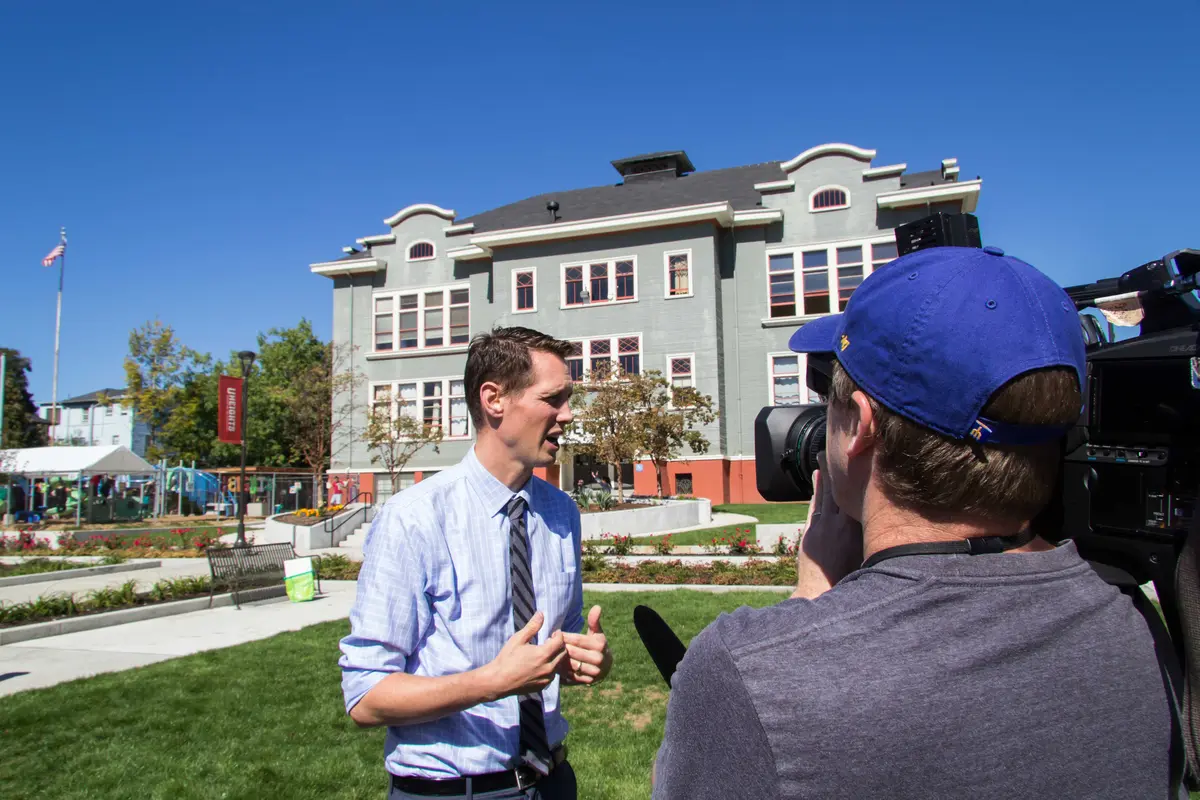
University Heights Center occupies the Mission Revival schoolhouse that Bebb & Mendel finished at University Way and NE 50th Street in December 1902 and that opened as University Heights Elementary School the following September.
Where is University Heights Center?
- Location
- Seattle, Washington, United States
- Type
- School / university
- Coordinates
- 47.666, -122.314
- Last updated
LOCATION
Why is University Heights Center said to be haunted?
Its National Register nomination calls it the third-oldest surviving school building in the city; Seattle had already made it a landmark in 1978, and the Register listed it in December 2010. Its real story is a thirty-year fight: the district tried to close it in 1974, 1975 and 1985, the neighbourhood sued and won a court-ordered reopening in 1976, and when a judge finally authorised closure in January 1989 the parents who had chanted "Be cool, save our school" formed the association that has run the building as a community centre ever since, and that bought it outright in 2009. The haunting is thinner. Wikipedia states in six words that the building is alleged to be haunted; behind them stand one ghost-hunting blog and one city listings piece, and the story they carry, a boy called Brian locked in a classroom closet by his teacher and forgotten over a weekend, has no trace in any record of the school. The blog that first told it now calls it an urban legend.
What is the history of University Heights Center?
The north shore of Portage Bay was a scattered settlement called Brooklyn, and its children walked to Latona School. The University of Washington's move to a 600-acre campus nearby changed that. By 1900 Seattle School District No. 1 accepted that the neighbourhood needed a school of its own, bought a full city block for $30,650 and hired Bebb & Mendel, one of the city's leading firms. Charles Bebb, an English-born engineer who had reached Seattle in 1890, and Louis Mendel, who had arrived from Mayen by way of Cleveland and San Diego, drew a twenty-room building to be raised in phases and chose Mission Revival, a style then barely used in the Pacific Northwest. Permit no. 15335, signed by city engineer R. H. Thomson, allowed 120 days and $21,000 for the first eight rooms. They were finished in December 1902, and the school opened the following September with grades one to eight.
Enrolment did the rest. A thirteen-room wing followed in 1907-08 — usually credited to district architect James Stephen, although the detailed elevations on file are Bebb & Mendel's and are dated January 1902 — and the roll still outgrew it, reaching 1,056 pupils with seven portables on the block. Charles W. Metsker was principal from the autumn of 1905 until he died in office on 12 January 1930, having governed 525 teachers and 19,056 children; the sixth-grade teacher Julia M. Bruce ran the school for the rest of that year. Moving seventh and eighth grades to John Marshall Junior High relieved the crowding in 1927. The war years brought numbers down to about 320 and put two nursery schools for the children of working parents into the building. A programme for hearing-impaired pupils began in 1951. The school was ready to take transfers when Seattle's Voluntary Racial Transfer Program started in 1965, and built its own multi-ethnic curriculum. Alternative School II opened in 1974, and that same year a film crew used the school for a chase sequence in 99 and 44/100% Dead, blowing the building up on screen with Richard Harris in the cast.
Off screen the demolition took thirty years and never happened. A 1970 facilities study marked University Heights as one of seven schools to close in 1974; citizens stopped it. The 1975 levy failed and the district tried again; the neighbourhood sued in 1976, and the court ordered an environmental impact statement and the school's reopening. Another plan came in 1984-85. In January 1989 a judge, in closed chambers, finally authorised the closure, and the building shut as a school on 20 June 1989, while parents marched around it chanting "Be cool, save our school". The protesters incorporated as the University Heights Center for the Community Association in 1990, leased the building from the district, raised more than $100,000 to replace the roof and began restoring the wooden windows. When the district decided to sell in 2007 they raised the purchase money instead: the centre and Seattle Parks and Recreation closed on their respective purchases in the summer of 2009. The city's Landmarks Preservation Board had issued its controls for the building in February 1978; the National Register listed it on 7 December 2010.
Timeline: the documented record of University Heights Center
- December 1902 The first eight rooms are completed on a city block the school district had bought for $30,650, under permit no. 15335 signed by city engineer R. H. Thomson, which allowed 120 days and $21,000. The architects are Bebb & Mendel and the style is Mission Revival, then almost unknown in Seattle.
- September 1903 University Heights Elementary School opens with grades one to eight. Priscilla Long's HistoryLink essay of 2001, the source Wikipedia cites for the opening, dates it to this month.
- 12 January 1930 Charles W. Metsker, principal since the autumn of 1905, dies in office after a short illness. The nomination file credits him with 525 teachers and 19,056 pupils; the sixth-grade teacher Julia M. Bruce finishes the year as acting principal.
- 1974 A 1970 district study had listed University Heights among seven schools to close this year; public opposition halts it. The same year a film crew shoots a chase for 99 and 44/100% Dead in the school and blows the building up on screen.
- 1976 After the 1975 levy fails and the district orders the school closed, the neighbourhood sues. The court sides with the residents and requires an environmental impact statement and the school's reopening.
- 20 June 1989 The building closes as a school, five months after a judge authorised the closure in closed chambers. Seattle Parks records the school as having served the district's children from 1902 to 1989.
- 1991 The University Heights P-Patch is laid out in a corner of the old playground: 31 plots on 5,000 square feet, later rebuilt in 1995, 2002 and 2013, with a rainwater system the gardeners built with University of Washington students.
- November 2002 The Seattle Sun, a North Seattle monthly, runs "Boo! Ghosts: Sightings abound in North Seattle" in its Out & About section. This is the oldest datable published trace of the building's reputation that could be located; the article page is no longer served and has no Wayback copy, so only its headline and date are confirmed here.
- 7 December 2010 The National Register of Historic Places lists the building as University Heights School, reference no. 10000995, on the strength of a nomination prepared by the community association and edited by the state historic preservation office.
- 10 May 2011 Historic Seattle gives the centre its Best Preservation Practice Award for the restoration of the building's historic windows, calling it a model for the treatment of historic properties.
- 20 August 2016 Two investigators join a Spooked in Seattle ghost hunt in the building and publish their instrument readings nine days later. They report no voice recording in two of the four rooms, attribute a three-degree rise to six people in a small space, and conclude that the electromagnetic spikes are "likely man-made and not paranormal".
- Between 27 March and 28 November 2023 The same blog post silently gains a paragraph disowning its own story: "The story of Brian is an urban legend. No child had died at the center, but a janitor did fall to his death." The dates are the two Wayback Machine captures that bracket the change.
- 16 December 2023 The centre advertises on its own events calendar a two-hour Spooked in Seattle ghost hunt through the building, from 10 pm, limited to twenty guests and restricted to over-13s. The operator's price is $50 a head plus 15.35 % tax.
Is there a rational explanation for University Heights Center?
Everything paranormal in the earlier version of this file descended from six words in Wikipedia — "The building is alleged to be haunted" — and two footnotes. Follow them. The first is a 2017 Curbed Seattle listicle which says, with no source, that a young boy "may still roam the hallways" and that children's laughter is heard when no children are present. The second is a ghost-hunting blog, Ghostly Activities, whose post of 29 August 2016 supplies the only story there is: a teacher locked a misbehaving boy named Brian in a closet, forgot him over a weekend and found him dead. No surname, no year, no document. Our own text kept none of that and wrote instead that "generations of neighborhood residents and staff" reported "footsteps and unexplained sounds". Those phrases are in no source and appear nowhere else in this catalogue; they were ours, and they have been removed.
The story is not merely unsourced, it is disowned by the page that carries it. Comparing captures in the Wayback Machine, the same Ghostly Activities post gained a paragraph between 27 March and 28 November 2023 which reads: "The story of Brian is an urban legend. No child had died at the center, but a janitor did fall to his death." That second death has no source either. Meanwhile the national ghost-tour chain US Ghost Adventures, writing as Seattle Terrors, has expanded Brian into a Friday, a Monday morning, three days without water and a body curled in a corner — while getting the building itself wrong, claiming it "remained vacant for nearly two decades" when the community association had run it since 1989.
The documentary record is silent in a way that can be measured. The 2010 National Register nomination runs to roughly 7,170 words, uses "school" 126 times and "Bebb" 15 times, and contains "ghost", "haunt", "spirit", "apparition", "janitor" and "closet" zero times; the owner's own 977-word history page scores zero on the same terms. That silence is not disinterested, though. The centre rents its corridors to Spooked in Seattle, which sells a two-hour University Heights ghost hunt at $50 per person plus 15.35 % city and state tax, and which the centre advertised on its own events calendar for 16 December 2023. The best sceptic available is that operator's own customer: the 2016 report records no EVP in the stage room, debunks a three-degree temperature rise as six people in a small room, and quotes the building's coordinator saying that the electromagnetic spikes along a classroom wall happen often — "likely man-made and not paranormal", the investigators concluded. Their entire haul was one disputed audio clip and no photograph.
Dating the story is the remaining problem. The oldest published trace located is the November 2002 issue of the Seattle Sun, a North Seattle monthly, whose archived contents page lists "Boo! Ghosts: Sightings abound in North Seattle" under Out & About; the article itself is no longer served by the site and has no copy in the Wayback Machine, so only its headline and date can be confirmed here. Contemporary Seattle newspapers could not be searched at all on the day of writing: Chronicling America, Washington Digital Newspapers and Elephind refused the requests, and Google Books returned a quota error to the query and to its control alike. Whether a child ever died in this building is therefore unchecked rather than disproved — but in a quarter of a century nobody telling the story has produced a date, a surname or a paper.
Can you visit University Heights Center?
The centre is at 5031 University Way NE, on the corner of NE 50th Street in Seattle's University District, and it is a working building rather than an attraction: no admission charge, no tour, no gift shop. Posted building hours are Monday to Friday 8 am to 10 pm, Saturday 9 am to 4 pm and Sunday 10 am to 6 pm; the telephone is (206) 527-4278. About a dozen resident organisations use the classrooms, among them several schools and after-school programmes, so much of the interior is occupied during the working day. An elevator installed in 2023, after five years of effort, replaced an older wheelchair lift and made the whole building step-free. Rooms can be hired: Room 209 costs $45 an hour for commercial bookings and $40 for registered non-profits on weekday daytimes, rising to $80 and $60 in the evenings and at weekends, with the renovated auditorium, its stage, lighting rig and sound system quoted separately. Outside, University Heights Plaza (5001 University Way NE) is a free city park open from 4 am to 11.30 pm, with rain gardens, a basketball hoop and paving panels meant for chalk drawings, and the University Heights P-Patch — 31 plots on 5,000 square feet, established in 1991 and rebuilt in 1995, 2002 and 2013 — is worked by neighbours who sign up through the city. The nearest light rail is U District station, 4300 Brooklyn Ave NE, seven blocks south. The ghost hunt is a separate commercial event run by an outside operator; at the time of writing it lists no scheduled date.
Sources consulted
- University Heights Center for the Community Association, edited by the Washington Department of Archaeology and Historic Preservation, «National Register of Historic Places Registration Form: University Heights School (reference no. 10000995)» — National Park Service, 2010 report
- Priscilla Long, «University Heights Elementary School opens in the University District in September 1903» — HistoryLink, essay 3381, 2001 web
- University Heights Center, «Our History and Preservation» — uheightscenter.org, 2026 web
- Historic Seattle, «2011 Awards: University Heights Center Window Restoration, Best Preservation Practice Award» — historicseattle.org (archived copy), 2011 web
- Jacob Rice, «Ghost Hunt: University Heights Center in Seattle» — Ghostly Activities, 2016 web
- Seattle Department of Neighborhoods, «P-Patch Community Gardening: University Heights» — seattle.gov, 2026 web
- Seattle Sun, «Boo! Ghosts: Sightings abound in North Seattle (contents page of vol. 6, no. 11)» — Seattle Sun, November 2002 (archived contents page; the article itself is no longer served and has no Wayback copy), 2002 newspaper archive
- University Heights Center, «Spooked in Seattle, 16 December 2023» — uheightscenter.org events calendar, 2023 web
- Sarah Anne Lloyd and Sean Keeley, «16 haunted Seattle places for Friday the 13th» — Curbed Seattle (archived copy), 2018 web
- Spooked in Seattle Tours, «University Heights Ghost Hunt» — spookedinseattle.com, 2026 web
- Seattle Parks and Recreation, «University Heights Plaza» — seattle.gov, 2026 web
- Seattle Terrors (US Ghost Adventures), «University Heights Center» — seattleterrors.com (archived copy, 27 September 2021), 2021 web
Reviewed by V. Serrano on 2026-08-21 · How we verify our content
💬 Field testimonies (0)
No testimonies yet. Add the first.
Add your testimony
🔒 Log in to add a testimony