🛸 UFO CASE · EXP. Nº7519
ACTIVE
Apollo 17: the crew's sightings and the Taurus-Littrow photograph
Apollo 17, the last crewed Moon landing, left Florida on 7 December 1972.
Apollo 17: the crew's sightings and the Taurus-Littrow photograph: where and when did it happen?
- Location
- Mission Control, Houston, United States
- Date of the event
- What was reported
- Sighting
- What the evidence says
- Not yet assessed
- Coordinates
- 29.558, -95.088
- Last updated
LOCATION
What is known about Apollo 17: the crew's sightings and the Taurus-Littrow photograph?
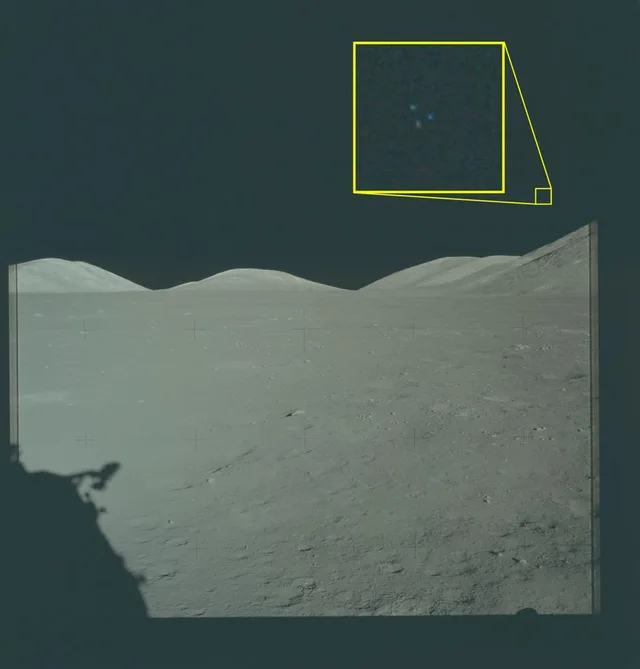
Fifty-three years later the U.S. Department of War put four of its records into PURSUE, its public archive of unidentified phenomena: an excerpt of the air-to-ground transcript, an audio clip, a page of the crew debriefing and a photograph. In the transcript the crew describe bright tumbling fragments after leaving Earth orbit, a distant object flashing in rhythm that Gene Cernan called "something physical in the distance", and a flash on the lunar surface seen by Harrison Schmitt. On each occasion the astronauts proposed an explanation themselves: the spent third stage, panels shed by the rocket, a small meteorite impact. The photograph is the part that remains open. It was taken from inside the lunar module at Taurus-Littrow, and on 8 May 2026 the Department of War said it had "opened a case to investigate" three dots in its sky. Its caption cites preliminary government analysis pointing to "a physical object in the scene". A full analysis was promised. By 1 November 2026 it had not been published.
What is the history of Apollo 17: the crew's sightings and the Taurus-Littrow photograph?
Apollo 17 lifted off from Launch Complex 39 at Kennedy Space Center at 05:33 GMT on 7 December 1972, "12:33:00 a.m. e.s.t.", with Eugene Cernan as commander, Ronald Evans as command module pilot and the geologist Harrison Schmitt as lunar module pilot. A failure in the automatic countdown sequencer had caused "a launch delay of 2 hours and 40 minutes", according to the mission report. That delay matters for reading the documents: to keep the planned lighting at the landing site the crew flew a faster trip, and at 65 hours Mission Control and the spacecraft moved their clocks forward. The public affairs officer explained it on the loop: "This clock update is occasioned by the fact that we lifted off 2 hours, 40 minutes late from Cape Kennedy." The 1972 transcript excerpt released in 2026 keeps the elapsed time from lift-off; the Apollo Flight Journal prints the updated clock, 2 hours 40 minutes ahead.
The first episode came during separation from the S-IVB, the Saturn V third stage, about three and a half hours after launch. A crewman reported "very bright particles or fragments or something that go drifting by as we maneuver", and then: "It looks like the Fourth of July out of Ron's window." The fragments were "very jagged, angular fragments that are tumbling"; asked whether they looked like fluid, the answer was "Not to me. They look like pieces of something." The same voice offered a cause, "off the side of the S-IVB. And that's a wild guess", and then "ice chunks, possibly. Or maybe there's paint coming off of it." The capcom, Robert Overmyer, remembered seeing paint on the rocket the week before: "Looked like it was peeling. Maybe that's what you've got." Cernan added that they were "flat, flake-like particles. Some may be 6 inches across."
The second episode fell on the third day, about 66 hours 48 minutes after lift-off: the evening of 9 December by Houston clocks, 10 December in GMT. It followed the ALFMED light-flash experiment, in which Evans wore a blindfolded detector. Cernan first described the flash he had seen falling asleep, "like a very bright headlight - like a train coming at you, only with a flash". Then he turned to an object Schmitt had pointed out: "it's definitely not a particle that's nearby", "It's something physical in the distance." It flashed in rhythm, "a very bright flash; and then you get a dull flash". Schmitt had an answer ready: "That's the side and - of the S-IVB - and then the engine bell, Gene." Cernan did not accept it: "He couldn't see the engine bell if he had 10 monoculars." Two hours later Cernan reported "two of those flashers out there. They could be SLA panels. I don't know." The SLA was the adapter whose four panels fell away when the spacecraft separated from the third stage.
The third episode came in lunar orbit, at 87 hours 38 minutes in the 1972 transcript (about 21:11 GMT on 10 December by the mission report's lift-off time). Schmitt was describing the western maria when he broke off: "Hey, I just saw a flash on the lunar surface!" It was "just out there north of Grimaldi", and he asked Houston to check the seismometers, "although a small impact probably would give a fair amount of visible light." Capcom Gordon Fullerton answered "Okay. We'll check." The Flight Journal page that covers that pass carries no reply about it.
The photograph followed the landing. The lunar module touched down at Taurus-Littrow at 110:21:58 elapsed time on 11 December, and before the first moonwalk each man photographed the valley through his window. The Lunar Surface Journal records that "The photographs taken out Jack's window are AS17-147-22469 to 22478", and its image library describes frame 22470 as a "Pre-EVA-1 LM window pan. (West) Family Mountain (left), (Old) Family Mountain (center), Scarp." That is the frame the Department of War published as NASA-UAP-VM006, matching the scan of the same frame held by the March to the Moon project; the war.gov caption does not give the frame number.
After splashdown on 19 December the crew were debriefed. The technical debriefing of 4 January 1973 (MSC-07631) was stamped Confidential, with a note that it "will automatically become declassified 90 days from the published date". On page 24-4 Schmitt said: "We had light flashes just about continuously during the whole flight when we were dark adapted. I had one which I thought was a flash on the lunar surface." Cernan's only "unusual sighting" at recovery was Evans looking out at the aircraft carrier and saying "Oh, we've got a tin can with us."
On 8 May 2026 the Department of War released D002, D006 and the photograph in the first PURSUE batch; the audio of the first episode, D009, followed on 22 May. All of it can be read or heard free: the files on war.gov, the audio on DVIDS, the full corrected transcripts in the Apollo Flight Journal and the Lunar Surface Journal, and the mission report on NASA's Technical Reports Server.
Timeline: the documented record of Apollo 17: the crew's sightings and the Taurus-Littrow photograph
- 7 December 1972, 05:33 GMT Apollo 17 lifts off from Kennedy Space Center 2 hours 40 minutes late, after a failure in the automatic countdown sequencer, according to the mission report.
- 7 December 1972, 003:34-003:39 elapsed During separation from the S-IVB the crew report bright, tumbling, angular fragments, "like the Fourth of July", and guess at ice or paint from the stage. The 1972 transcript and the Flight Journal's corrected version disagree over which crewman said which line.
- 9 December 1972 (Houston), 066:47 elapsed After the ALFMED light-flash session Cernan reports a rhythmically flashing object, "something physical in the distance". Schmitt identifies it as the S-IVB; two hours later Cernan sees two flashers and suggests SLA panels.
- 10 December 1972, 087:38 elapsed In lunar orbit Schmitt reports "a flash on the lunar surface" north of Grimaldi and suggests a small impact; Houston says it will check the seismometers.
- 11 December 1972 After the landing at Taurus-Littrow and before the first moonwalk, Schmitt photographs the valley through his window; frame AS17-147-22470 is part of that pan.
- 4 January 1973 In the technical crew debriefing (MSC-07631, marked Confidential) Schmitt says the crew had light flashes "just about continuously" when dark-adapted, and mentions his flash on the lunar surface.
- 1975 Osborne, Pinsky and Bailey publish NASA's account of the Apollo light-flash studies, concluding that the flashes are probably all caused by cosmic-ray particles crossing the retina.
- 8 May 2026 The Department of War publishes the transcript excerpt, the debriefing page and the photograph in the first PURSUE release, and says it has opened a case on the three dots in NASA-UAP-VM006.
- 8 October 2026 A pseudonymous post on LessWrong identifies VM006 as AS17-147-22470 and argues that the dots are scratches on the film.
- 1 November 2026 The PURSUE catalogue, as captured by the Wayback Machine, still carries the May caption for VM006: the full NASA and Department of War analysis "will be released when completed".
Is there a rational explanation for Apollo 17: the crew's sightings and the Taurus-Littrow photograph?
None of the three episodes in the transcript was left without an explanation by the people who saw it, and the Department of War's own captions repeat those explanations. What remains open in the file is the photograph.
The fragments of the first day are the least mysterious item. They appeared as the S-IVB manoeuvred and the spacecraft prepared to separate, and the crew's candidates were ice and peeling paint from the stage, with the capcom adding that he had seen paint peeling on the rocket during a trip up the launch tower elevator the week before. There is one discrepancy worth knowing about, because it changes who said what: the 1972 transcription released in D002 gives the "Fourth of July" line to the lunar module pilot and the "jagged, angular fragments" and "wild guess" lines to the command module pilot, Evans, and the war.gov caption follows it. The Flight Journal, whose editors corrected the transcript against the audio, gives the bright particles, the fragments and the guess to Schmitt and the remark about "a whole bunce of big ones on my window" to Evans. The audio clip D009 lets anyone check. The Flight Journal also notes that "The film record has seven frames that show particles against the black of space": AS17-148-22672 to 22678.
The rhythmic flasher of the third day was, in Schmitt's view at the time, the S-IVB tumbling, bright side and dull engine bell in turn; Cernan doubted he could make out the bell, though he had himself called the object something physical. The stage was still flying: the mission report puts its impact on the Moon "approximately 87 hours into the mission", some twenty hours after the sighting. The four SLA panels, Cernan's own candidate for the second flasher, had also been released into space at separation. Neither identification was confirmed by tracking in the documents released, so this part remains the crew's explanation on the spot, without independent confirmation in the file.
The flashes that Cernan saw with his eyes closed, and the ones Schmitt had "just about continuously", are a known effect. Osborne, Pinsky and Bailey, writing in NASA's Biomedical Results of Apollo in 1975, state: "It is believed that these light flashes result from high energy, heavy cosmic rays penetrating the Command Module structure and the crewmembers' eyes", and conclude that "since the flux of these particles is sufficient to explain the entire phenomenon, it is likely that all of the flashes originate in this manner." The Department of War's caption for the crew's medical debriefing (D028, released in July 2026) calls it "a then novel, now well-documented biological effect". Schmitt himself, in January 1973, put his lunar-surface flash in the same paragraph as these eye flashes. A real impact remains possible, and no seismometer answer appears in the documents.
The photograph is where the Department of War's position differs from the others. Its caption says the case is open, that "there is no consensus about the nature of the anomaly" and that "New preliminary US government analysis suggests the image feature is potentially the result of a physical object in the scene." It gives no method, no author and no figures for that analysis. The catalogue places the camera inside the cabin, shooting through Schmitt's window, so the glass is in the optical path as well as the lens and the film. The March to the Moon project, which scans the original film at Johnson Space Center, warns that the cleaning before scanning "only removes debris that is loosely adhered to the film stock (e.g. dust and lint) but any strongly adhered debris are simply left on the film". The same project states that "the original film is not allowed to leave the building", while the war.gov caption says the government "has obtained the original film"; the two can both be true if the analysis is done at Johnson, but the caption does not say. The five Apollo 12 images in the same release carry a warning that each "has been modified from its original state to assist viewers"; VM006 has the same yellow magnification box and no such warning, and its sky is dark blue-grey where the March to the Moon scan of the frame shows black.
The only published argument against the dots that I have found is a pseudonymous post on LessWrong of 8 October 2026, which compares the war.gov file with the March to the Moon scan and calls the marks "very clear blue scratch artifacts" on Ektachrome film, adding: "It’s unclear to me what possible analysis could indicate this artifact is the result of a “physical object”". The same author concedes, about the Apollo 12 frames, that "a scratch could not produce a red artifact by removing dye alone", which matters here because one of the three dots in VM006 is orange. Its author is unnamed and worked from digital copies; the post reports no examination of the film itself. As of the archive's catalogue captured on 1 November 2026, the NASA and Department of War results had not been released.
Sources consulted
- NASA Manned Spacecraft Center, «NASA-UAP-D002, Apollo 17 Transcript, 1972 — 16-page excerpt of the Apollo 17 Technical Air-to-Ground Voice Transcription with three highlighted passages (tapes 5, 46-47 and 59-60)» — U.S. Department of War, PURSUE UAP archive (war.gov/UFO), release 1, 8 May 2026, 1972 archive
- NASA Manned Spacecraft Center, Training Office, Crew Training and Simulation Division, «NASA-UAP-D006, Apollo 17 Technical Crew Debriefing (MSC-07631, 4 January 1973) — cover and page 24-4» — U.S. Department of War, PURSUE UAP archive (war.gov/UFO), release 1, 8 May 2026, 1973 archive
- NASA, «NASA-UAP-D009, Apollo 17 Audio Excerpt, December 7, 1972 — air-to-ground audio of the debris particles after S-IVB separation» — U.S. Department of War, PURSUE UAP archive, via DVIDS (video 1007872), released 22 May 2026, 1972 archive
- U.S. Department of War (caption); NASA (photograph), «NASA-UAP-VM006, Apollo 17, 1972 — NASA photograph with a yellow magnification box, and the Department of War's caption announcing an open case» — U.S. Department of War, PURSUE UAP archive (war.gov/UFO), release 1, 8 May 2026, 2026 archive
- U.S. Department of War, «PURSUE catalogue data file (uap-data.csv) — captions of NASA-UAP-D002, D006, D009, D028 and VM001-VM006 as served on 1 November 2026 (Wayback Machine capture)» — war.gov/UFO, archived by the Internet Archive, 2026 archive
- W. David Woods; Ben Feist, «Apollo 17 Flight Journal, Day 1: Transposition, Docking and Extraction — corrected transcript and commentary, with the debris frames AS17-148-22672 to 22678» — Apollo Flight Journal (apollojournals.org), 2026 web
- W. David Woods; Ben Feist, «Apollo 17 Flight Journal, Day 4, part 2: Light flash experiment — corrected transcript of the ALFMED session and of the flashing object (069:22-071:37 GET)» — Apollo Flight Journal (apollojournals.org), 2025 web
- W. David Woods; Ben Feist, «Apollo 17 Flight Journal, Day 5, part 2: Lunar Orbit Insertion — corrected transcript of the first near-side passes, including Schmitt's flash north of Grimaldi (090:18 GET)» — Apollo Flight Journal (apollojournals.org), 2025 web
- W. David Woods; Ben Feist, «Apollo 17 Flight Journal, Day 4, part 1: Clock update — the public affairs explanation of the 2 h 40 min advance of the mission clock» — Apollo Flight Journal (apollojournals.org), 2025 web
- Eric M. Jones, «Apollo 17 Lunar Surface Journal: Post-landing Activities — corrected transcript and commentary; identifies AS17-147-22469 to 22478 as the photographs taken out Schmitt's window» — Apollo Lunar Surface Journal (apollojournals.org), 2026 web
- Eric M. Jones (ed.), «Apollo 17 Image Library — magazine 147/A (colour), entry AS17-147-22470: "Pre-EVA-1 LM window pan"» — Apollo Lunar Surface Journal (apollojournals.org), 2025 web
- NASA Lyndon B. Johnson Space Center, «Apollo 17 Mission Report (JSC-07904) — launch time, sequence of events, S-IVB lunar impact and section 6.3, Visual Light Flash Phenomenon» — NASA Technical Reports Server (19730015117), 1973 report
- W. Zachary Osborne; Lawrence S. Pinsky; J. Vernon Bailey, «Apollo Light Flash Investigations — chapter 2 of section VI of Biomedical Results of Apollo (NASA SP-368)» — NASA (NASA Technical Reports Server, 19760005597), 1975 academic
- Arizona State University; NASA Johnson Space Center, «March to the Moon: About the Film Scans — storage, cleaning and scanning of the original Apollo flight film at Johnson Space Center; gallery entry for AS17-147-22470» — March to the Moon (tothemoon.im-ldi.com), 2026 web
- jonathanbreitg (pseudonym), «Apollo "UAP"s explained — argues that the dots in the PURSUE Apollo images, AS17-147-22470 included, are film-scratch artefacts» — LessWrong (linkpost of a Medium article), 2026 web
Reviewed by V. Serrano on 2026-11-20 · How we verify our content


💬 Field testimonies (0)
No testimonies yet. Add the first.
Add your testimony
🔒 Log in to add a testimony