🛸 UFO CASE · EXP. Nº7521
ACTIVE
The Gemini 4 object (James McDivitt, 1965)
On 4 June 1965, the second day of the Gemini 4 flight, command pilot James McDivitt saw something outside his window while Ed White slept and the spacecraft drifted with its thrusters off.
The Gemini 4 object (James McDivitt, 1965): where and when did it happen?
- Location
- Mission Control, Houston, United States
- Date of the event
- What was reported
- Sighting
- What the evidence says
- Probable explanation According to: The Gemini 4 UFO
- Coordinates
- 29.558, -95.088
- Last updated
LOCATION
What is known about the Gemini 4 object (James McDivitt, 1965)?
At 29 hours 52 minutes of elapsed time he told the ground: “I just saw something else up here with me”. Five minutes later he added that “It had big arms sticking out of it”, and that he had taken pictures with a movie camera and a Hasselblad before the Sun hit the dirty window and he lost it. NORAD's list of nearby satellites offered nothing within his guess of ten miles; the best candidate, Pegasus B, was about 2,000 km away. In 1969 the Condon Report kept the sighting among three astronaut observations “not adequately explained”. The photograph NASA released as McDivitt's object was not his: he later said it showed reflections of bolts in the window panes. The writer James Oberg has argued since 1976 that McDivitt saw the spent second stage of his own Titan II rocket, which McDivitt rejected; in 1999 he said it was probably ice or Mylar from his own spacecraft.
What is the history of the Gemini 4 object (James McDivitt, 1965)?
Gemini 4 lifted off from Launch Complex 19 at Cape Kennedy at “10:15:59 a.m. EST (15:15:59.562 UT)” on 3 June 1965, according to NASA's space science archive, with James McDivitt as command pilot and Edward White as pilot. Two days before the launch, a memorandum to the NASA Administrator, Mission Operation Report M-913-65-04 of 1 June, added three activities to the flight. One was a “Demonstration of rendezvous with the booster second stage”, and the memo explained that “Flashing lights identical to those designed for the Gemini/Agena Vehicle have been installed on the booster second stage for this test.” The rendezvous failed: NASA's summary says the exercise “was cancelled early in the second revolution after depletion of 42% of the fuel”; White then made the first American spacewalk, and afterwards “Drifting flight was maintained for the next 30 hours to conserve propellant.”
The sighting came during that drift, and the composite voice transcript that NASA's Manned Spacecraft Center compiled in August 1965 shows the spacecraft in touch with the Hawaii tracking station at about 29 hours 40 minutes of elapsed time. At 29:52:17, when the Guaymas station in Mexico called, McDivitt answered: “Fine. I just saw something else up here with me, but just as I was getting close enough to it to take a good picture, the sun got in the way and I lost it.” Asked at 29:57:09 whether he was still looking at “that thing up there”, he replied: “No, I've lost it. It had big arms sticking out of it, it looked like. I only had it for just a minute. I got a couple of pictures with a movie camera and one with the Hasselblad; but I was in free drift, and before I could get the control back I drifted and lost it.” Counting from the launch, 29:52 of elapsed time falls at 21:08 GMT on 4 June, which is 15:08 Central Standard Time, the clock of the Houston releases. White was asleep; in the NASA oral history of 1999 McDivitt described the spacecraft as “just tumbling through space, end over end and sideways and all over”, and said: “Ed was asleep. We were taking turns sleeping.”
The public-affairs commentary from Houston put the report out at 30 hours 9 minutes: McDivitt had sighted “another object in space” that “appeared to have big arms sticking out”. A little later the commentator added: “Here at Mission Control Center at Houston, we are checking with SPADETS here - Space Detection and Tracking System - concerning the object”. The answer was issued as Gemini News Center Release No. 17 of 4 June. Ten catalogued objects, among them fragments, a tank, a “YO-YO De-Spin Weight” and “10 x 20 Foot Debris of Pegasus”, had passed between 427 and 979 km from GT-4 between 2:56 and 3:18 CST, and “Pegasus B at 3:06 (CST) was about 2000 km in the proper direction to be observed by the astronauts.” The next day, over Cape Kennedy at 48:58, the capsule communicator told McDivitt that “the only satellite it could be would be Pegasus”, and he replied: “That's what I thought it might be, too.” Two minutes later Houston asked how far away it had been, and he said: “It looked like quite a large object, and it looked like I was closing on it rather rapidly. Distance is rather hard to judge. I'd say 10 miles or so.” The ground answered that “Pegasus was about 1200 miles away”. At 49 hours 45 minutes the commentary reported that, after talking to the Goddard Space Flight Center and to NORAD, Houston still thought the object had probably been Pegasus.
On 9 June, aboard the recovery carrier USS Wasp, the crew were debriefed. In the transcript, classified confidential and declassified on 20 November 1973, McDivitt placed the object over the Pacific: “This satellite that I saw over around Hawaii--I saw the thing and we were closing on it. We might have had a better rendezvous with it than with our own booster.” He had checked where the a.c. power switch was in case he had to manoeuvre, and then “The sun came across the window and I lost it just like that.” On the distance he hedged: “It might have been 5 miles out.” And then: “It might have been 50 miles out, but I had the impression in the 30 or 40 seconds I saw it that it was quite close because I could make out the shape of it.” White added that “our windows had a white film of material on the outside”. The second part of the debriefing, which holds the formal “Visual Sightings” section, does not go back to the object; near the end McDivitt said: “I did observe three satellites, but I think that these were covered in detail earlier”. What that section does record is a different thing: twice at night, “near Australia, each time, but I'm not really sure”, McDivitt saw “parallel running lines of lights radiating from the earth up toward us” that looked “a lot like the Aurora Borealis, except that they were down below us”, and White told him: “I saw it too, so you weren't seeing things.”
The Condon committee, the University of Colorado study paid for by the Air Force, took the case up. Its astronomer, Franklin Roach, talked to McDivitt on 3 October 1967 and summarised: “McDivitt saw a cylindrical-shaped object with an antenna-like extension. The appearance was something like the second phase of a Titan”. Roach recorded that McDivitt thought the object “was probably some unmanned satellite” and questioned the Pegasus identification. He then did the sum himself: Pegasus B, 29.3 metres across with its panels open, would have subtended “1/20 minute of arc at a distance of 2000 km”, far too small for arms to be seen. The report, published in 1969, put the sighting first among three astronaut observations “which, in the judgment of the writer, have not been adequately explained”.
Timeline: the documented record of the Gemini 4 object (James McDivitt, 1965)
- 1 June 1965 Mission Operation Report M-913-65-04 adds a rendezvous with the Titan II second stage to the Gemini 4 flight plan, with “Flashing lights” fitted to the stage for the test.
- 3 June 1965 Gemini 4 is launched at 15:15:59 UT. The station-keeping with the second stage is cancelled early in the second revolution after 42 % of the fuel is spent, and the spacecraft is left in drifting flight for the next 30 hours.
- 4 June 1965, 29:52 elapsed time After a pass over the Hawaii station, McDivitt tells the Guaymas station: “I just saw something else up here with me”. At 29:57 he adds that “It had big arms sticking out of it” and that he took movie and Hasselblad pictures.
- 4 June 1965 Gemini News Center Release No. 17 publishes the NORAD list of ten objects within 1,000 km of GT-4 and places Pegasus B about 2,000 km away at 3:06 CST.
- 5 June 1965, 49:01 elapsed time McDivitt guesses the object was “10 miles or so” away; Houston answers that “Pegasus was about 1200 miles away”.
- 9 June 1965 In the crew debriefing aboard USS Wasp, McDivitt places the object “over around Hawaii” and says he saw it for “30 or 40 seconds”.
- 3 October 1967 Franklin Roach of the Condon committee interviews McDivitt, who thinks the object “was probably some unmanned satellite”.
- 1969 The Condon Report lists the Gemini 4 cylindrical object first among three astronaut sightings that “have not been adequately explained”.
- 20 November 1973 Part I of the Gemini 4 crew debriefing is changed from confidential to unclassified.
- Fall 1981 James Oberg publishes “The Gemini 4 UFO”, arguing that McDivitt most probably saw his own Titan II second stage, missing from the NORAD list.
- 29 June 1999 In the NASA oral history, McDivitt says the object “probably was a piece of ice that had fallen off the spacecraft” and that the released photo showed reflections of window bolts.
- 12 June 2026 The Department of War's PURSUE archive publishes the two parts of the Gemini 4 crew debriefing and the experiment debriefing among its NASA files.
Is there a rational explanation for the Gemini 4 object (James McDivitt, 1965)?
The picture that circulates as McDivitt's UFO is not what he saw, and on that point the sources agree. Roach wrote in 1969 that “The NASA photo interpreter had released three or four pictures but McDivitt says that the pictures released were definitely not of the object he had seen.” According to Oberg, NASA's first caption, numbered 65-H-1013, presented the frame as “the satellite McDivitt observed on the 20th revolution”, and a later one as a “sun flare through the spacecraft window”. In 1999 McDivitt said the frame showed “disc-shaped things with a tail” and gave the cause: “really what it was, was a reflection of the bolts in the windows.” The windows had several panes, and “when the Sun shined on them right, they’d multiply the images off the different panes.”
The sources disagree about the film McDivitt himself shot: Roach wrote that McDivitt's later inspection of it showed the object only “hazily” but that “he feels that a positive identification had been made”. McDivitt said the opposite in 1999: “Nothing ever showed up on the photographs. I reviewed them all.” Oberg called Roach's sentence “some sort of error”, and none of the documents read for this file, up to November 2026, reproduces a frame of the object.
The NORAD list had a gap, and it is the heart of the explanation that James Oberg, a writer on spaceflight, has defended since 1976. The list covered objects already in orbit; the spent Titan II second stage that had put Gemini 4 into orbit was not on it, although NASA had planned the rendezvous with it and the crew had chased it on the first revolution. Oberg wrote in 1981 that the stage “did not decay for at least 50 hours” and was “well within the 1,000 mile range specified by NORAD, yet it was not on the list of nearby satellites”. The viewing conditions fit a misjudged shape, and at 32:42 of elapsed time McDivitt explained to the ground: “My small end was up above the horizon so I couldn't see the horizon. As it came around toward the sun I saw the --this other satellite, but then as the sun came in through the window I lost it because the sun was so bright.” Asked “You were looking into the sun then, when you saw it?”, he said “That's affirmative.” The stage was not a still target either: in the debriefing McDivitt said its tumbling rates rose to “40 to 50 degrees/second” and that “When we last saw it over Mexico or over southern United States it was still tumbling”. His eyes were also sore: at 72:43 he told the flight surgeon he had had “a lot of trouble with my eyes at the end of the first day” and that “it was really bad between about 18 and 36 hours”; the sighting fell at 29 hours 52 minutes. According to Oberg, NASA answered a congressman that “We believe it to be a rocket tank or spent second stage of a rocket”, and in 1975 a retired NORAD officer showed the journalist Philip Klass the NASA photograph of the Titan stage as “a photo of McDivitt's UFO”.
McDivitt rejected the booster explanation; replying to Oberg's identification, in the letter Oberg quotes, he wrote that he had spent “approximately one-and-a-half to two hours looking at this upper stage from various angles and distances” and that the object “definitely was not that upper stage.” His own explanation moved over the years: during the flight and in 1967 he spoke of a satellite, and in 1999 he told NASA's oral history: “I’m sure it was in the—in our orbit and it probably was a piece of ice that had fallen off the spacecraft someplace. Or maybe a piece of Mylar that had come out from behind the thing and come up in front.” He also said it “could’ve been the size of the Empire State Building for all I knew way out there”, because he had no way of telling its size from its distance.
Roach himself, Oberg writes, answered him in 1977 that the analyst he had had in mind “would probably come up with a very natural explanation”; that letter is known only through Oberg's article. James Harder and Brad Sparks of the Aerial Phenomena Research Organization argued in 1977 that the case stayed unexplained, but by Oberg's account their argument rested on the frame NASA had released, which McDivitt said was not his object. This file therefore marks the case as “probable”. Three readings compete, Pegasus, the Titan II stage and debris from Gemini 4 itself, and no photograph or tracking record confirms any of them; Roach's own arithmetic rules out the first at 2,000 km. What the other two have in common is that the witness, the space agency and the analyst who argued it longest all took the object for something made on Earth. The publication of the debriefings in the Department of War's PURSUE archive in 2026 adds no new identification.
Can you visit the Gemini 4 object (James McDivitt, 1965)?
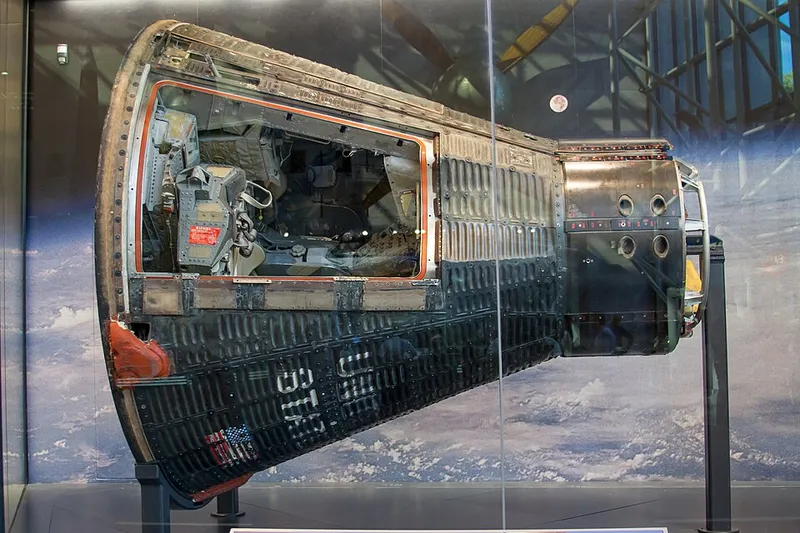
The object was never found, but the spacecraft from whose window McDivitt saw it survives. The Smithsonian's National Air and Space Museum says that “In 1967 NASA transferred the spacecraft to the Smithsonian” and that the capsule “is on display in Boeing Milestones of Flight Hall at the National Air and Space Museum in Washington, DC”, at 650 Jefferson Drive SW. The museum page, consulted on 20 November 2026, gives the hours as “Open daily 10:00 am – 5:30 pm” and says “Admission is always free”, with “Free Timed-Entry Passes Required” for the building in Washington. The museum catalogues the capsule under object number A19670209000.
The records of the case can be read online without charge. NASA publishes the composite voice transcript and the public-affairs commentary of the mission in its collection of Mercury, Gemini and Apollo transcripts; the sighting is on pages 156 to 158 of the voice transcript. The two parts of the crew debriefing and the experiment debriefing are among the NASA files of the Department of War's PURSUE archive at war.gov/UFO, released on 12 June 2026, and Roach's chapter of the Condon Report is online at ncas.org.
Sources consulted
- James Oberg, «The Gemini 4 UFO — Oberg's case that McDivitt's object was most probably the Titan II second stage, with McDivitt's replies of 1976 and to Philip Klass, the NASA letter calling it a spent stage, and Franklin Roach's 1977 letter» — UFO Report (Fall 1981), republished on jamesoberg.com (archived 16 January 2025), 1981 web
- NASA Manned Spacecraft Center, Flight Crew Support Division, «NASA-UAP-D016, Preliminary GT-4 Flight Crew Debriefing Transcript, Part I — debriefing aboard USS Wasp on 9 June 1965, prepared 16 June 1965; McDivitt's account of the object on p. 75; declassified 20 November 1973» — U.S. Department of War, PURSUE archive (war.gov/UFO), release 3, 1965 archive
- NASA Manned Spacecraft Center, Flight Crew Support Division, «NASA-UAP-D017, Preliminary GT-4 Flight Crew Debriefing Transcript, Part II — prepared 18 June 1965; section 10.0 "Visual Sightings", including the lights seen twice at night» — U.S. Department of War, PURSUE archive (war.gov/UFO), release 3, 1965 archive
- NASA Manned Spacecraft Center, «Composite Air-to-Ground and Onboard Voice Tape Transcription of the GT-4 Mission — NASA Program Gemini Working Paper No. 5035; the sighting at 29:52:17 and 29:57:12 elapsed time (pp. 156-158) and the Pegasus exchange at 48:58-49:02 (p. 228)» — NASA History Office, Mission Transcripts: Mercury, Gemini and Apollo, 1965 archive
- NASA Manned Spacecraft Center, Public Affairs Office, «Gemini 4 Mission Commentary Transcript — the public-affairs commentary from Houston, including Gemini News Center Release No. 17 of 4 June 1965 with the NORAD list of satellites near GT-4» — NASA History Office, Mission Transcripts: Mercury, Gemini and Apollo, 1965 archive
- Franklin E. Roach, «Visual Observations Made by U. S. Astronauts — Section III, Chapter 6 of the Condon Report; section 8 lists the Gemini 4 cylindrical object among three sightings "not adequately explained"» — Scientific Study of Unidentified Flying Objects (University of Colorado), online text at NCAS, 1969 report
- James A. McDivitt; Doug Ward, «James A. McDivitt, interviewed by Doug Ward, Elk Lake, Michigan, 29 June 1999 — NASA Johnson Space Center Oral History Project (archived 25 May 2025)» — NASA Johnson Space Center Oral History Project, 1999 interview
- NASA, «NASA-UAP-D018, Gemini 4 Experiment Debriefing — opens with Mission Operation Report M-913-65-04 of 1 June 1965, which added the rendezvous with the booster second stage, and includes the crew's remarks on particles around the spacecraft» — U.S. Department of War, PURSUE archive (war.gov/UFO), release 3, 1967 archive
- NASA Space Science Data Coordinated Archive, «Gemini 4 (NSSDCA/COSPAR ID 1965-043A) — launch time, orbit, the abandoned station-keeping with the second stage and the 30 hours of drifting flight» — NASA Goddard Space Flight Center, 2026 web
- Smithsonian National Air and Space Museum, «Capsule, Gemini IV — collection object A19670209000, on display in the Boeing Milestones of Flight Hall» — airandspace.si.edu, 2026 web
Reviewed by V. Serrano on 2026-11-20 · How we verify our content



💬 Field testimonies (0)
No testimonies yet. Add the first.
Add your testimony
🔒 Log in to add a testimony