🛸 UFO CASE · EXP. Nº5670
ACTIVE
Roswell incident (1947)
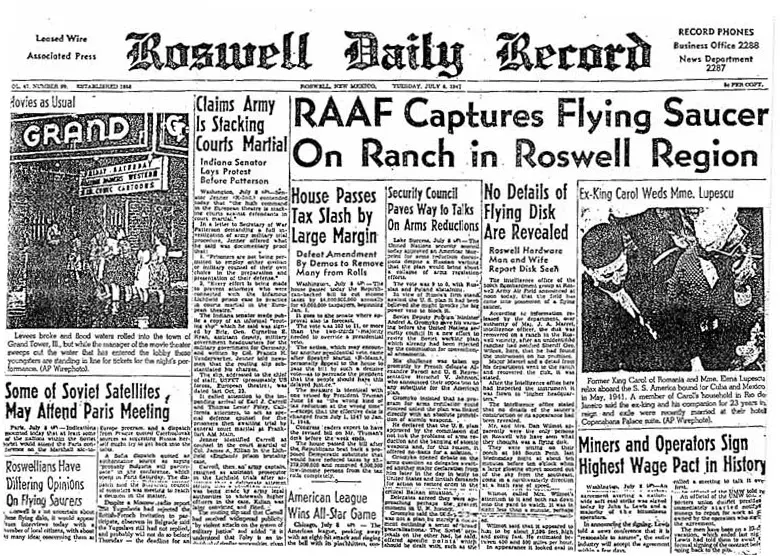
On 8 July 1947 the Roswell Daily Record reported that the intelligence office of the 509th Bomb Group had "announced at noon today, that the field has come into possession of a flying saucer."
Roswell incident (1947): where and when did it happen?
- Location
- New Mexico, United States
- Date of the event
- What was reported
- Crash and recovery claim
- What the evidence says
- Probable explanation According to: The Roswell Report: Fact vs. Fiction in the New Mexico Desert
- Coordinates
- 33.302, -104.531
- Last updated
LOCATION
What is known about Roswell incident (1947)?
The material came from a ranch north-west of Roswell, New Mexico, where the rancher W. W. Brazel had found it and reported it to the county sheriff. The next day the Eighth Air Force in Fort Worth identified it as a balloon with a radar target, and Brazel told the paper he had come upon "rubber strips, tinfoil, a rather tough paper and sticks." Nobody returned to the story for three decades. In 1978 the former intelligence officer Jesse Marcel said the debris had been something else, and books written over the following years turned it into a crashed craft with alien bodies. In 1994 the US Air Force concluded that the wreckage most likely came from Project Mogul, a then top-secret balloon programme meant to detect Soviet nuclear tests, and in 1997 it traced the bodies to test dummies and accidents of the 1950s. The General Accounting Office found in 1995 that part of the base's records had been destroyed.
What is the history of Roswell incident (1947)?
The Roswell Daily Record of Tuesday 8 July 1947 led its front page with the headline "RAAF Captures Flying Saucer On Ranch in Roswell Region". Underneath a second headline, "No Details of Flying Disk Are Revealed", the paper reported that the intelligence office of the 509th Bombardment Group at Roswell Army Air Field had "announced at noon today, that the field has come into possession of a flying saucer." The information had been released "over authority of Maj. J. A. Marcel, intelligence officer": an unidentified rancher had notified Sheriff George Wilcox, Marcel and a detail had gone out and recovered the object, and once inspected it had been flown to "higher headquarters." The same column carried the only local sighting the paper could find. Dan Wilmot and his wife, sitting on their porch at 105 South Penn. "last Wednesday night", which was 2 July, had watched "a large glowing object" cross the sky from the southeast "at a high rate of speed."
The timing explains a good deal. The Air Force report of 1994 places Roswell inside what it calls "the UFO Wave of 1947", which "began with 16 alleged sightings that occurred between May 17 and July 12, 1947", and it adds that some researchers count as many as 800. The unit history of the 509th for July 1947, which the General Accounting Office located and quoted in 1995, records that the base information office "was kept quite busy . . . answering inquiries on the 'flying disc,' which was reported to be in [the] possession of the 509th Bomb Group. The object turned out to be a radar tracking balloon."
The rancher spoke the next day. "W. W. Brazel, 48, Lincoln county rancher living 30 miles south east of Corona", was brought to town by W. E. Whitmore of radio station KGFL and interviewed by the Record and by Jason Kellahin of the Associated Press bureau in Albuquerque. He said that "on June 14 he and an 8-year old son, Vernon" were seven or eight miles from the ranch house of the J. B. Foster ranch, which he operated, "when they came upon a large area of bright wreckage made up on rubber strips, tinfoil, a rather tough paper and sticks." He was in a hurry and paid it little attention. On 4 July he went back with his wife, Vernon and his daughter Betty, aged 14, and gathered up a good part of it; the following day he first heard about the flying disks. On Monday 7 July, in town to sell wool, he "whispered kinda confidential like" to Sheriff Wilcox that he might have found one. Wilcox called the airfield, and Marcel and "a man in plain clothes" drove back with him to collect the rest. Brazel estimated that the whole lot "would have weighed maybe five pounds", noted "Considerable scotch tape and some tape with flowers printed upon it", and said that he had found two weather observation balloons on the ranch before and that this did not resemble either. His closing words were a complaint about the attention: "if I find anything else besides a bomb they are going to have a hard time getting me to say anything about it."
In Fort Worth, Brigadier General Roger Ramey, commander of the Eighth Air Force, had the material laid out in his office. The 1994 report summarises the press coverage of 9 July as describing "a bundle of tinfoil, broken wood beams, and rubber remnants of a balloon". Irving Newton, the weather officer on duty that day, signed a statement for the Air Force in 1994: "I walked into the General's office where this supposed flying saucer was lying all over the floor. As soon as I saw it, I giggled and asked if that was the flying saucer". He also recalled Marcel "trying to convince me that some notations on the sticks were alien writings." On 8 July itself the FBI office in Dallas sent a teletype to headquarters which, in the GAO's summary, reported that the object "resembled a high-altitude weather balloon with a radar reflector."
There the matter rested. The 1994 report states that Ramey's press conference and Brazel's statement "effectively ended this as a UFO-related matter until 1978", and that Roswell is not mentioned in Project Blue Book. In 1978 the tabloid National Enquirer published Marcel's claim that he had recovered UFO debris, and in the same year the researcher Stanton Friedman met him. In 1980 William L. Moore and Charles Berlitz published The Roswell Incident, built on interviews with people who described themselves as first-hand or second-hand witnesses, and in the 1990s Kevin Randle and Donald Schmitt added more. By 1994, in the Air Force's words, the debris had grown "from a minimal amount of debris recovered from a small area to airplane loads of debris from multiple huge 'debris fields'", and most versions now included a second site with alien bodies.
The official inquiries began with a Washington Post article of 14 January 1994 announcing that Congressman Steven Schiff of New Mexico had asked the General Accounting Office to look for the records. The Air Force's search, written by Colonel Richard L. Weaver with an attachment on Project Mogul by First Lieutenant James McAndrew, was sent to the Secretary of the Air Force on 27 July 1994 and printed in 1995 as The Roswell Report: Fact vs. Fiction in the New Mexico Desert. The GAO's own report to Schiff, dated 28 July 1995, found only two records from 1947, the 509th history and the FBI teletype, and established that RAAF administrative records from March 1945 to December 1949 and outgoing messages from October 1946 to December 1949 had been destroyed. A second Air Force volume, The Roswell Report: Case Closed, written by McAndrew, followed in 1997 and dealt with the bodies.
Timeline: the documented record of Roswell incident (1947)
- 4 June 1947 At Alamogordo, Albert P. Crary of the Watson Laboratories writes in his journal that there were no balloon flights because of clouds, and that the team "Flew regular sono buoy up in cluster of balloons". The Air Force later identified this as NYU Flight 4.
- 14 June 1947 The date W. W. Brazel gave the Roswell Daily Record for finding, with his son Vernon, "a large area of bright wreckage" on the J. B. Foster ranch. Later accounts move the find to early July; this is the only contemporaneous date.
- 7 July 1947 In Roswell to sell wool, Brazel tells Sheriff George Wilcox that he may have found a flying disk. Wilcox calls the airfield, and Major Jesse Marcel and a man in plain clothes go back with Brazel to collect the debris.
- 8 July 1947 The 509th Bomb Group announces at noon that Roswell Army Air Field "has come into possession of a flying saucer"; the Roswell Daily Record prints it on its front page that afternoon.
- 8 July 1947 The FBI office in Dallas sends a teletype reporting, on the word of an Eighth Air Force official, that the object resembled a high-altitude weather balloon with a radar reflector and was being sent to Wright Field.
- 1978 The National Enquirer publishes Jesse Marcel's claim that he recovered UFO debris near Roswell, and the researcher Stanton Friedman meets him. The Air Force later dates the revival of the case to these years.
- 1980 William L. Moore and Charles Berlitz publish The Roswell Incident, based on interviews with people presented as first-hand or second-hand witnesses.
- 1989 According to the 1997 Air Force report, the mortician Glenn Dennis first tells his account of bodies at the Roswell base hospital, more than 42 years after the events.
- 1992 Walter Haut, Glenn Dennis and Max Littell open the International UFO Museum and Research Center in Roswell, according to the museum's own history.
- 27 July 1994 After an audit requested by Congressman Steven Schiff, the Air Force delivers its report: the material was "most likely" from a Project Mogul balloon train, and no records of alien bodies were found.
- 28 July 1995 The GAO reports to Schiff: two records from 1947 survive, the 509th history and the FBI teletype, while RAAF administrative files from 1945 to 1949 and outgoing messages from 1946 to 1949 were destroyed.
- 1997 The Air Force publishes The Roswell Report: Case Closed, which attributes the "aliens" to test dummies dropped from balloons between 1954 and 1959 and the hospital stories to accidents of 1956 and 1959.
Is there a rational explanation for Roswell incident (1947)?
The Air Force explanation rests on Project Mogul, which the 1997 report describes as "an experimental attempt to acoustically detect suspected Soviet nuclear weapon explosions and ballistic missile launches", carried out with sensors and radar targets hung from "a train of weather balloons over 600 feet long." A New York University team flew the balloons from Alamogordo Army Air Field and arrived there on 1 June 1947. The 1994 report concludes that Brazel's debris was "most probably" NYU Flight 4, a "service flight" left out of the published technical reports, launched on 4 June and never recovered by the team. Its strongest physical argument is the tape. Albert Trakowski, formerly the project's Top Secret control officer, told the Air Force that the early radar targets were made by "toy or novelty companies using a purplish-pink tape with flower and heart symbols on it", and in July 1947 Brazel had described "tape with flowers printed upon it" without knowing any of this. The blueprint of the ML-307 radar target, found at the Army Signal Corps Museum, specifies the "foil material, tape, wood, eyelets, and string"; Brazel's interview mentions foil, tape, sticks and eyelets, and says that "No strings or wire were to be found".
The weak link is Flight 4 itself, and the Air Force printed the evidence against it. The only record of the launch is the personal journal of Albert P. Crary, of the Watson Laboratories group working with NYU, handed over by his widow, and its entry for Wednesday 4 June reads: "No balloon flights again on account of clouds. Flew regular sono buoy up in cluster of balloons and had good luck on receiver on ground but poor on plane." The report treats the second sentence as Flight 4 and does not discuss the first. Nor was the flight followed to the ranch: the project engineer Charles B. Moore told the investigators in 1994 that the early-June service flights "were to be tracked by radar, and the radar was unsuccessful." The identification therefore rests on Moore's reading of the descriptions 47 years later. The report also says it "did not find documented evidence that Gen. Ramey was directed to espouse a weather balloon", and leaves open whether Ramey was deflecting attention from Mogul or simply believed his weather officer. That is why this file says "probable" and not "explained": the Air Force itself calls Mogul "the most likely source of the wreckage".
The witnesses do not agree with each other either. Sheridan Cavitt, the counter-intelligence agent who went to the ranch with Marcel, described in his 1994 statement an area of debris "about 20 feet square"; Brazel, in 1947, had the rubber scattered over "an area about 200 yards in diameter." Brazel's insistence that it was "not any weather observation balloon" fits the Mogul reading better than it seems, since the 1994 report contrasts the Flight 4 equipment with "typical weather radiosondes which were made of cardboard", which is the kind of balloon a rancher would have found before.
The bodies are a separate layer, and they are late. The 1997 report notes that "The first claim of 'bodies' appeared in the late 1970s", and that the account of the mortician Glenn Dennis, the main source for bodies at the base hospital, was "reportedly first related in 1989, over 42 years after" the events. Its conclusion is that "Air Force activities which occurred over a period of many years have been consolidated and are now represented to have occurred in two or three days in July 1947": 67 anthropomorphic dummies dropped from 43 balloon flights over New Mexico between June 1954 and February 1959, a KC-97 crash in 1956 in which 11 airmen died, and a balloon accident in 1959 that injured two pilots.
The Air Force was investigating itself, and its covering memorandum of 1994 already expected that "pro-UFO groups will strongly object to the attached report". The GAO, which is independent of it, found no record of a crash beyond the two documents of 1947, but it also found the destroyed files, on a disposal form that "does not indicate what organization or person destroyed the records and when or under what authority". The National Personnel Records Center's chief archivist told the GAO that many Air Force records of that period had been destroyed without citing the authority, so the gap is not specific to Roswell. The researcher Karl Pflock, in a 1994 study the Air Force summarised, accepted Mogul for Brazel's debris and argued for a simultaneous crash of an alien craft "not far away"; the Air Force found nothing to corroborate it.
Can you visit Roswell incident (1947)?
Nothing marks the spot where Brazel found the debris. The 1947 interview places it seven or eight miles from the ranch house of the J. B. Foster ranch, in Lincoln County, which is ranch land and not a public site. What can be visited is in Roswell itself. The 1997 Air Force report already noted that the town "boasts competing 'museums' focusing on the Roswell Incident", and printed a photograph of the best known, the International UFO Museum and Research Center, at 114 N. Main Street.
The museum's own page says it was opened "in 1992 by Walter Haut, Glenn Dennis, and Max Littell". Haut was the base's information officer in 1947 (Colonel Weaver called him "The public affairs guy at the time" when interviewing Cavitt in 1994), and Dennis is the mortician whose account of bodies the 1997 report examines. The museum describes itself as a non-profit "organized to inform the public about what has come to be known as 'The Roswell Incident'", funded through "donations, admissions, memberships and gift shop sales." Its stated aim is to "preserve the history of the Roswell Incident" and to "encourage thoughtful exploration of UFO-related reports and research"; the Air Force reports are not part of that description.
On 20 November 2026 its admissions page listed the museum as open daily from 9 am to 5 pm, with extended hours until 7 pm from 21 to 30 November, "CLOSED THANKSGIVING DAY, CHRISTMAS DAY, AND NEW YEAR'S DAY", and closing at 2 pm on the day before each of those holidays. Admission was $7.00 for adults aged 16 to 64, $5.00 for seniors and for military and first responders, $4.00 for children aged 5 to 15, and free for children aged 4 and under. Parking "is available on the south side of the museum and in the gated lot directly across Main Street."
The documents themselves are free to read online. The two Air Force reports are on the Internet Archive as DTIC scans, and the 1995 volume reproduces Brazel's interview of 9 July 1947, Cavitt's statement and Crary's journal in facsimile. The GAO report is on the GAO's website under the number GAO/NSIAD-95-187.
Sources consulted
- Roswell Daily Record, «RAAF Captures Flying Saucer On Ranch in Roswell Region — front page of 8 July 1947, with the base's announcement and the Wilmot sighting» — Roswell Daily Record (scan on Wikimedia Commons), 1947 newspaper archive
- Roswell Daily Record, «Harassed Rancher Who Located 'Saucer' Sorry He Told About It — interview with W. W. Brazel, 9 July 1947, read in the facsimile reproduced in the 1995 Air Force report» — Roswell Daily Record, 1947 newspaper archive
- Richard L. Weaver and James McAndrew, «The Roswell Report: Fact vs. Fiction in the New Mexico Desert — the July 1994 report of Air Force research, with its attachments» — Headquarters United States Air Force, 1995 report
- Albert P. Crary, «Personal journal, entries for May and June 1947 — reproduced in The Roswell Report: Fact vs. Fiction in the New Mexico Desert» — Headquarters United States Air Force (facsimile), 1947 archive
- United States General Accounting Office, «Government Records: Results of a Search for Records Concerning the 1947 Crash Near Roswell, New Mexico (GAO/NSIAD-95-187)» — Report to the Honorable Steven H. Schiff, House of Representatives, 1995 report
- James McAndrew, «The Roswell Report: Case Closed» — Headquarters United States Air Force, 1997 report
- International UFO Museum & Research Center, «Admissions — hours, prices and location of the museum» — roswellufomuseum.com, 2026 web
- International UFO Museum & Research Center, «About Us — the museum's account of its founding and purpose» — roswellufomuseum.com, 2026 web
Reviewed by V. Serrano on 2026-11-20 · How we verify our content
💬 Field testimonies (0)
No testimonies yet. Add the first.
Add your testimony
🔒 Log in to add a testimony