🛸 UFO CASE · EXP. Nº7526
ACTIVE
The STS-80 tumbling object (Columbia, 1996)
At some point between 19 November and 7 December 1996, during mission STS-80 of the space shuttle Columbia, the crew photographed a small, bright, elongated object outside the orbiter three times.
The STS-80 tumbling object (Columbia, 1996): where and when did it happen?
- Location
- Mission Control, Houston, United States
- Date of the event
- What was reported
- Photographs or video
- What the evidence says
- Not yet assessed
- Coordinates
- 29.558, -95.088
- Last updated
LOCATION
What is known about the STS-80 tumbling object (Columbia, 1996)?
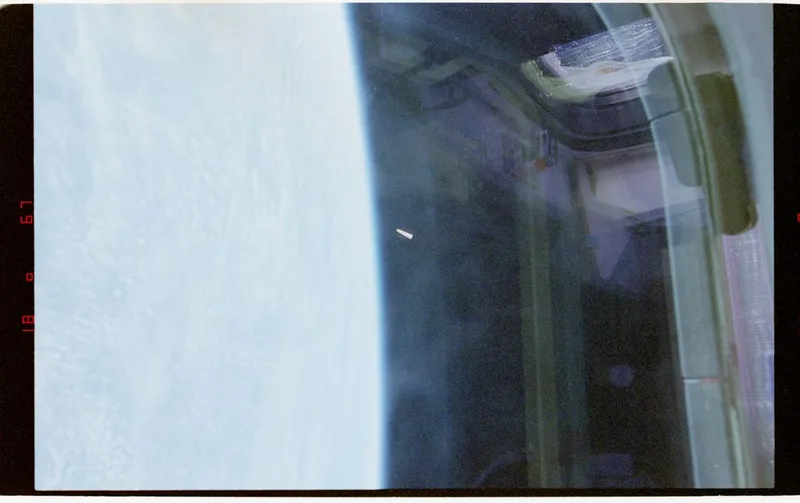
The frames were published on 10 July 2026 by the U.S. Department of War as records NASA-UAP-D030 to D032, in the fourth release of PURSUE, its online archive of unresolved UAP cases. The catalogue gives no day, time, window or photographer. It describes an object in low Earth orbit that, between the first and second frames, “appears to have rotated or tumbled about its major axis, which is consistent with the behavior of a free-floating object”, and that in the third frame crosses in front of the Earth. In the first photograph it is a white rod beside the curve of the planet; in the second it is a short wedge, with reflections of the cabin in the window glass. No source identifies it. NASA's own mission report of February 1997 does not mention it, and the former Mission Control engineer James Oberg had argued since 1999 that most objects drifting past the shuttle were its own ice and debris.
What is the history of the STS-80 tumbling object (Columbia, 1996)?
Columbia lifted off from pad 39B at the Kennedy Space Center on 19 November 1996, at "2:55:47 p.m. EST" according to NASA's mission page. On board were Kenneth D. Cockrell, the commander, the pilot Kent V. Rominger and three mission specialists: Tamara E. Jernigan, Story Musgrave and Thomas D. Jones. The mission report that the Johnson Space Center issued in February 1997 (NSTS-37411) records that the orbiter was "inserted into an orbit of 190 by 188 nmi", some 350 km above the Earth, at an inclination of 28.45 degrees.
The flight was built around two free-flying research satellites. The robot arm released the ORFEUS-SPAS II ultraviolet telescope at 04:10 GMT on 20 November, and the Wake Shield Facility, which NASA describes as a "12-foot diameter, free-flying stainless steel disk" for growing semiconductor films, at 01:37 GMT on 23 November; both were later retrieved. The two spacewalks never happened. At about 02:30 GMT on 29 November, the report says, "the crew reported that the outer hatch of the airlock could not be unlatched and opened". After the landing, NASA found that "a small screw had become loose from an internal assembly and lodged in an actuator". Bad weather on 5 December and fog on the 6th at the Florida runway kept Columbia in orbit for two extra days, and it touched down on 7 December after a flight of "17 days 15 hours 53 minutes and 19 seconds".
The photographs reached the public almost thirty years later. On 10 July 2026 the Department of War announced that it had "just released the fourth tranche of records under PURSUE", the archive opened on 8 May 2026 after a presidential statement of 19 February. Among them were three images filed as NASA-UAP-D030, D031 and D032. Their catalogue entries share one sentence: "During STS-80, between November 19 and December 7, 1996, astronauts aboard Space Shuttle Columbia captured a series of three images of an unidentified object in low-Earth orbit." The incident date is given only as "1996" and the location as "Low-Earth Orbit".
In the first frame, according to the catalogue, "the object is visible near the center of the frame, to the right of the limb of the Earth". At full resolution it is a bright white bar, slightly thicker at one end, against black sky a short distance from the blue edge of the atmosphere. Superimposed on the right half of the picture are reflections of the cabin: panels, a window frame and a bright rectangle. In the second frame the same object has become a short white wedge, and the catalogue adds that "It appears to have rotated or tumbled about its major axis, which is consistent with the behavior of a free-floating object." In the third the camera has turned and the Earth fills the top of the frame; the object, now a tiny dark mark against the clouds, "appears to have continued along a trajectory passing between Columbia and the Earth".
The three scans carry red figures printed along the edge of the film, which the catalogue does not decode, and no entry names the photographer, the window, the camera or the lens. One detail of the records shows how quickly the batch was assembled: the third image lists as its companion files "NASA-UAP-D029 | NASA-UAP-D031", and D029 in the same catalogue is the second half of an audio recording of the Apollo 17 crew's medical debriefing of 1972.
Timeline: the documented record of the STS-80 tumbling object (Columbia, 1996)
- 19 November 1996 Columbia lifts off from pad 39B at the Kennedy Space Center on mission STS-80, with five astronauts on board.
- 20 November 1996, 04:10 GMT The robot arm releases the ORFEUS-SPAS II ultraviolet telescope, the first of the two satellites that fly free near the shuttle.
- 23 November 1996, 01:37 GMT The Wake Shield Facility, a steel disk for growing semiconductor films, is released for three days of free flight.
- 29 November 1996 The crew cannot open the airlock's outer hatch; the two planned spacewalks are later cancelled.
- 7 December 1996 Columbia lands at the Kennedy Space Center after 17 days, 15 hours and 53 minutes, two days later than planned because of the weather. The three photographs were taken at some point between launch and landing.
- February 1997 The Johnson Space Center issues the STS-80 mission report, which records the water dumps and some out-of-focus debris near the orbiter but no unidentified object.
- 13 December 1999 James Oberg writes on SPACE.com that the famous STS-80 television sequence shows nearby particles drifting out of the shuttle's shadow.
- 1 December 2000 In a reply to a critic, Oberg lists the debris a shuttle sheds: ice from the dump nozzles and thrusters, payload-bay junk, insulation and tile gap filler.
- 8 May 2026 The Department of War opens the PURSUE archive of unresolved UAP records with its first release.
- 10 July 2026 The fourth PURSUE release includes the three STS-80 frames as NASA-UAP-D030 to D032, described as an unidentified object in low Earth orbit.
Is there a rational explanation for the STS-80 tumbling object (Columbia, 1996)?
The archive itself sets the limits of the case. Its front page explains that "The materials archived here are unresolved cases, meaning the government is unable to make a definitive determination on the nature of the observed phenomena", which "can occur for a variety of reasons, including a lack of sufficient data". The catalogue offers no analysis beyond its own reading that the object behaves like something "free-floating", and it does not say that NASA ever studied the frames.
What the three photographs cannot give is distance. A single frame through a window does not separate a small object a few metres away from a larger one a few kilometres away, and the catalogue gives no time between exposures that would allow a speed to be worked out. The phrase "passing between Columbia and the Earth" adds nothing on that point: anything that appears in front of the Earth's disc in a downward view lies between the camera and the ground.
The flight did not lack candidates. Two satellites flew free near Columbia for days, although the Wake Shield Facility, a steel disk 3.7 metres across, and the ORFEUS-SPAS platform look nothing like the white bar in the first frame. The orbiter also dumped water throughout: the mission report lists three dumps through the flash evaporator "with a total duration of 25 hours 19 minutes", "Five additional supply water dumps" through the overboard nozzle and five waste water dumps. The same report already noted loose material on the first day, in hand-held video of the external tank: "Some debris was noted; however, the debris was out of focus and appeared to be near the Orbiter." It mentions no unidentified object; a search of its text gives no hits for "unidentif" or "UFO", against ten for "debris".
The general explanation comes from James Oberg, who worked at NASA's Johnson Space Center from 1975 to 1997. Writing for SPACE.com on 13 December 1999 about the "notorious STS 48 and STS 80 videos", he noted that "Some particles that happen to be closer to the camera drift away and pass out of the shuttle's shadow, making them suddenly visible", and that "Even bigger pieces of 'space junk' can appear mysterious". In a reply posted on 1 December 2000 he listed the usual sources: "small nearby sunlit shuttle-generated debris, usually ice (off the water dump nozzles or any of 100 valves in the thrusters, or even the flash evaporator ...), sometimes junk from inside the payload bay, or fragments of insulation blankets, or strips of tile gap filler that are manually inserted during pre-flight processing". The STS-80 material he wrote about is a television sequence of moving dots; the 2026 records are still photographs. His argument fits a rigid, tumbling piece better than it fits ice, but nobody has matched the object to a part of Columbia.
Oberg also set out how such a case is checked: interview the crew, find "which camera or window was involved", and compare the time of the picture with the timeline, because "telemetry records reveal thruster firings and other debris-generating shuttle activities". None of that has been published for these frames. Until the roll, the frame numbers and the time are known, the object stays where the archive left it: unidentified, and most likely small and close.
Sources consulted
- NASA, «NASA-UAP-D030, STS-80 Unidentified Object Image 1, 1996 — scan of the first frame: an elongated white object beside the Earth's limb, with cabin reflections in the window» — U.S. Department of War, PURSUE archive (war.gov/UFO), release 04, 1996 archive
- NASA, «NASA-UAP-D031, STS-80 Unidentified Object Image 2, 1996 — scan of the second frame: the same object seen as a short wedge» — U.S. Department of War, PURSUE archive (war.gov/UFO), release 04, 1996 archive
- NASA, «NASA-UAP-D032, STS-80 Unidentified Object Image 3, 1996 — scan of the third frame: the object against the clouds» — U.S. Department of War, PURSUE archive (war.gov/UFO), release 04, 1996 archive
- U.S. Department of War, «PURSUE records database (uap-data.csv) — catalogue entries for NASA-UAP-D030, D031 and D032: release date 10 July 2026, incident date 1996, location low-Earth orbit, descriptions and related files» — war.gov, 2026 archive
- U.S. Department of War, «Presidential Unsealing and Reporting System for UAP Encounters (PURSUE) — Release 04 announcement, the 19 February 2026 presidential statement and the directive defining the archived cases as unresolved (capture of 10 July 2026)» — war.gov, 2026 web
- NASA, «STS-80 — mission facts (launch and landing times, orbit, crew) and highlights, including the hatch failure and its cause» — nasa.gov, 2025 web
- NASA Lyndon B. Johnson Space Center, «STS-80 Space Shuttle Mission Report (NSTS-37411) — payload operations, the airlock hatch problem, water dumps and photographic analysis» — NASA Technical Reports Server, 1997 report
- James Oberg, «Strange Shuttle Sights: Unearthly and Mundane — on the STS-48 and STS-80 videos and debris near the shuttle (SPACE.com article of 13 December 1999, copy on the author's site)» — SPACE.com (jamesoberg.com copy), 1999 web
- James Oberg, «Reply to Mike Bara on the STS-48 video (1 December 2000) — the sunrise pattern of the STS-48, STS-75 and STS-80 videos and the sources of shuttle-generated debris» — jamesoberg.com, 2000 web
Reviewed by V. Serrano on 2026-11-20 · How we verify our content


💬 Field testimonies (0)
No testimonies yet. Add the first.
Add your testimony
🔒 Log in to add a testimony