👻 HAUNTED PLACE · EXP. Nº1189
ACTIVE
Ashmore Estates
Ashmore Estates is a location reputed to be haunted in Ashmore, Illinois, US. Its reputation comes from reported apparitions, unexplained phenomena and eyewitness accounts gathered over time.
Where is Ashmore Estates?
- Location
- Ashmore, Illinois, US
- Type
- Hospital / asylum
- Coordinates
- 39.529, -88.05
- Testimonies
- 0
- Last updated
LOCATION
Why is Ashmore Estates said to be haunted?
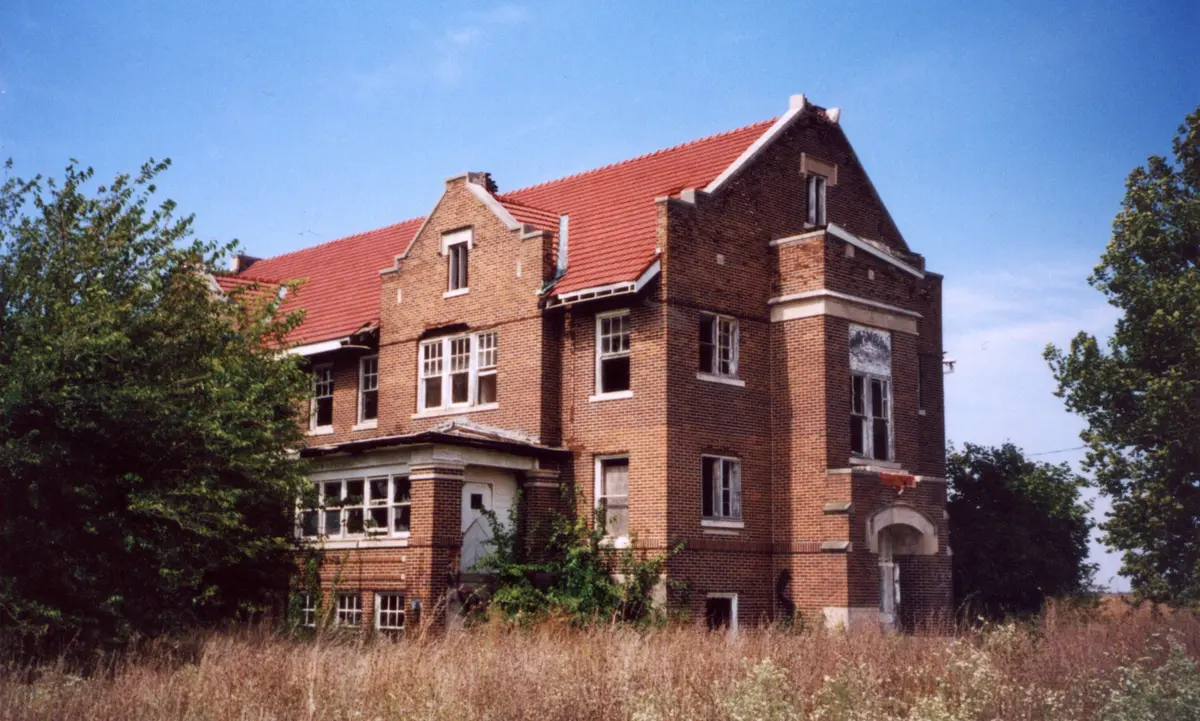
Ashmore Estates is a brick building in the Coles County countryside, eight miles east of Charleston, Illinois. It was raised in 1916 as the almshouse of the county poor farm, replacing an older house that a state inspector had called "unfit to decently house animals". The county kept its paupers there for forty-three years; from 1959 it was a private psychiatric hospital and then a shelter-care home, and after it closed in the late 1980s it stood empty and was broken into for nearly twenty years. The haunted reputation arrives late and can be dated: it begins as a satirical Halloween piece in the Eastern Illinois University student paper about a building whose past nobody knew, and it becomes a business on 13 October 2006, when a commercial haunted house opened there. The archive holds what the ghost tours leave out. A superintendent's letter of 1879 counts thirty-two deaths and names the oldest of the dead, and a state inspection of 1910 records a woman beaten by the other residents.
What is the history of Ashmore Estates?
Coles County first relieved its poor through township overseers, an arrangement that William Henry Perrin's county history of 1879 says cost as much as $12,000 in a single year. The county bought a tract in Pleasant Grove Township during the Civil War, sold it in 1865, worked forty acres in La Fayette Township, and in 1870 bought 258 acres in Ashmore Township on the Indianapolis & St. Louis Railroad, eight miles east of Charleston. Twenty-seven paupers were moved from the old house west of Charleston to the new farm on 25 October 1870. Perrin printed in full a letter from the superintendent, Joshua Ricketts, who counted thirty-three residents in a brick building thirty-eight by fifty-eight feet: "twenty-one females and twelve males. Four of the inmates are over eighty years of age; two of them are white and two black." Of those two Black women, one was "supposed to be at least 100 years old", and both, Ricketts wrote, "were slaves until freed by the emancipation proclamation of President Lincoln". He named another resident outright: "Old John Golliday, well known to many of the citizens of the county", who had owned four hundred acres in Morgan Township "but by not doing right, he lost it all". Ricketts closed his accounting with the death toll of the first nine years — "There have been thirty-two deaths at the house, out of some two hundred and fifty persons who have been received and cared for" — and with the name of the oldest of them, "Mrs. Anna Higgenbotham, a cousin to Gen. Winfield Scott". The attending physician was A. T. Robertson of Ashmore, who two decades later sat on the county's auxiliary board of charities.
The state inspected the place twice in the years that decided its fate. The Seventeenth Biennial Report of the Board of State Commissioners of Public Charities, presented to the governor on 1 October 1902, called the sanitary condition fair and then set down, on page 72, the sentences that matter most: "There is no special provision for the insane. One inmate who is insane has not been so adjudged by the court. None are locked up or in restraint. There is one inmate who never has outdoor exercise." Eight years later the tone had changed entirely. The Illinois State Charities Commission inspected on 5 October 1910, under superintendent Martin Carnes of Ashmore, and opened its entry with a judgement: "The Coles county almshouse is unfit to decently house animals." Men and women lived "without any attempt at classification" in rooms off a central hall; "It is impossible to keep bed bugs out of the cracked walls. Rats and mice overrun the place"; food left from one meal stayed on the men's dining table until the next, where "Flies swarm in this food making it rather unpalatable for the succeeding meal." The inspector then watched a quarrel start between "an incurable, insane woman and a 'fussy' old man", and recorded that the woman "is a good worker and wants to stay at the farm but she is undoubtedly misused by many of the men; they beat her and she is in terror of them."
Bids for a fireproof replacement were taken in January 1915. The contract went to J. W. Montgomery in March 1916 for $20,389, the architect was L. F. W. Stuebe, and the cornerstone of the building that still stands was laid on 17 May 1916. Coles County sold it to Ashmore Estates, Inc. in February 1959, and the corporation opened it as a private psychiatric hospital under that name; it closed in October 1964 over debt and reopened in 1965 taking patients discharged from state institutions. In May 1979 the Illinois Department of Public Health ordered the building closed after finding twenty-two safety code violations, and a judge allowed it to stay open until November on the strength of repairs under way. Through the early 1980s it housed mentally and developmentally disabled adults, a period Michael Kleen says the Times-Courier reported as a pleasant and caring environment. Kleen dates the final closure to 1987; the present operators date it to the end of April 1986. Either way the building then stood empty, stripped and repeatedly broken into, until Scott and Tanya Kelley bought it in July 2006 and began charging for entry.
Timeline: the documented record of Ashmore Estates
- 25 October 1870 Twenty-seven paupers are moved from the old county house west of Charleston to a newly bought 258-acre farm in Ashmore Township, on the Indianapolis & St. Louis Railroad.
- 1879 Superintendent Joshua Ricketts writes to Perrin's county history: thirty-three residents, four of them over eighty, two of those Black women freed by the Emancipation Proclamation; thirty-two deaths out of some two hundred and fifty people received, the oldest being Mrs. Anna Higgenbotham.
- 1 October 1902 The Seventeenth Biennial Report of the state charities board records that the almshouse has no special provision for the insane and that one inmate held there as insane has not been so adjudged by any court.
- 5 October 1910 The Illinois State Charities Commission inspects under superintendent Martin Carnes and opens its report with the sentence that the Coles county almshouse is unfit to decently house animals; it also records a woman beaten by other inmates.
- 17 May 1916 Cornerstone laid for the fireproof replacement almshouse, designed by architect L. F. W. Stuebe and contracted to J. W. Montgomery in March for $20,389. This is the building that stands today.
- February 1959 Coles County sells the almshouse to Ashmore Estates, Inc., which opens it as a private psychiatric hospital under the same name.
- May 1979 The Illinois Department of Public Health orders the building closed after finding twenty-two safety code violations; a judge lets it stay open until November because repairs are progressing.
- 1987 Ashmore Estates closes for good, in Michael Kleen's dating; the present operators date the closure to the end of April 1986. The building then stands empty for nearly twenty years.
- Halloween, late 1990s Two students writing as the "Men of Adventure" publish a satirical Halloween piece in the Verge supplement of the Daily Eastern News proposing the abandoned building as an illegal night out; they state that nobody is sure what it once housed. This is the earliest printed circulation of the legend that Kleen traces.
- 13 October 2006 Scott and Tanya Kelley open a commercial haunted house in the building, having financed the work with flashlight tours at five dollars a head; weeks earlier Scott Kelley told the Daily Eastern News that he remained a skeptic.
- 23 September 2011 Ashmore Estates appears on the season premiere of Ghost Adventures. Michael Kleen, interviewed for the programme, later writes that he disagreed with the crew's demon framing and that haunted-house actors played the almshouse inmates in the reenactments.
- 26 April 2013 Three months after a storm tore off the roof, the building is auctioned for $12,700 to a four-member partnership from central Illinois; it reopens for paranormal investigations that July.
- January 2025 Robbin Terry sells Ashmore Estates to Ashley Yvonne Burgoon, who becomes sole owner; the operator's own history page records the change and dates the switch to a conventional mortgage to August 2026.
Is there a rational explanation for Ashmore Estates?
The ghost story at Ashmore Estates is younger than the empty building, and its earliest printed circulation can be pointed at. Michael Kleen, who arrived at Eastern Illinois University in 2000 and was taken out to the site in January 2001, traces the campus legend to a satirical Halloween piece in the Verge supplement of the student newspaper, written by two undergraduates who called themselves the "Men of Adventure". Kleen quotes them: "No one is really sure what this building once housed. But there are stories. These tales revolve around pagan rituals and dismembered bodies. We aren't sure if any of them are true or not, but they sure do make for three floors... of unadulterated fun." The stories came first and the history came afterwards, from Kleen himself reading Perrin's 1879 county history in the summer of 2003.
That is why the word asylum sticks to a poor farm. Reporting for the Daily Eastern News in September 2006, Kevin Kenealy wrote that by the early 1980s the building "reopened as Ashmore Estates, which was an insane asylum, according to the myth, but it truth it was a home for the mentally and developmentally disabled". The same article records what the ruined interior actually came from, in the words of Tanya Kelley: "They (remodelers) stripped out the wiring; the air conditioner, they pulled out; they threw the toilets out the windows; the controls for the elevator are ripped out." Kenealy also documented a scare on one of the first paid flashlight tours and its cause in the same sentence: "Ten girls' screams echoes in the building's boiler room/crematorium as a chimney sweep flutters overhead, resembling a bat."
The number of dead grows with the ticket price. Ricketts recorded thirty-two deaths in the farm's first nine years; Kleen's estimate for the whole 89-year life of the farm is that "over 100 inmates died on the farm", most of them elderly on arrival. The Eventbrite page selling the public investigation of 19 September 2026 raises that to a round claim: "With over 200 reported deaths at Ashmore Estates we know some have never left the property." A second slippage runs the same way. The best-known ghost is a child, Elva L. Skinner; the 2006 article says "Local mortuary records show that Skinner was burned to death in the first building of Ashmore in Feb. 1880", which is the 1870 almshouse, demolished long before the 1916 building that visitors walk through. Her age is given as seven in that account and as five and four in later retellings.
Two of the people closest to the site have said so in print. Scott Kelley, a month before opening his haunted house on 13 October 2006 and with the International Society of Paranormal Investigators having just declared the building haunted, told the Daily Eastern News: "I'm still a skeptic okay." Kleen, who supplied much of the site's documented history and took the photograph used on this page, wrote of the Ghost Adventures season premiere of 23 September 2011: "Although I disagreed with the way the Ghost Adventures crew claimed Ashmore Estates was infested by demons, I did appreciate the opportunity. The film crew used actors from the Kelley's haunted house to reenact scenes from Ashmore Estates' days as the Coles County Poor Farm almshouse." The almshouse inmates seen by a national television audience were haunted-house staff in costume.
Can you visit Ashmore Estates?
Ashmore Estates is a working attraction and is entered only by booking. The operator gives the address as 22645 East Co Road 1050 North, Ashmore, IL 61912, the telephone as 217-899-9978 and the address for enquiries as [email protected], under the heading "Hours - By appointment only" (site consulted on 7 September 2026). It sits on a rural county road with no public transport; arrival is by car. The telephone number 217-512-9499 and the domain hauntedashmoreestates.net, which circulate widely, date from the Kelley ownership of 2006 and no longer reach anyone.
The calendar page sets out the four bands in which the building is let, in the operator's own words: "PRIVATE - Date is booked from 7pm-10am and is not available except for a DAYTIME investigation. AE PUBLIC - Tickets are available for investigation from 7pm-2am or 7pm-10am. DAYTIME is available. DAYTIME - Date is booked from 11am-6pm. A PRIVATE is available from 7pm-10am. TOUR - Private tour for 2 hours and do not start later than 4:30pm." The same page carries the line "WE DO NOT OFFER REFUNDS!!!", and the ticket listings repeat it as "Refund Policy: No refunds". Alcohol and drugs are barred: "We do not allow the use of alcohol or any type of narcotic while visiting Ashmore Estates."
Pricing runs through Eventbrite. The public investigation advertised for the night of 19-20 September 2026 is capped at twelve people, runs from 7 pm to 2 am, and adds a bunkhouse ticket good until 10 am for a party of four; on 7 September 2026 the listing carried a price band of $55.20 to $81.88 including fees. Private tours last two hours and cannot begin after 4:30 pm.
The building has lost its roof twice since the attraction opened, in the storm of 29 January 2013 and again on 7 June 2015, when Robbin Terry put the repair bill at "over $10,000". Terry sold in January 2025 to Ashley Yvonne Burgoon, who according to the operator's history page converted a contract for deed into a conventional mortgage in August 2026. The county's second pauper cemetery is not on the property: the same page places it south of Route 16 and says it "now contains the graves of between sixty to one hundred persons".
Sources consulted
- William Henry Perrin, «The History of Coles County, Illinois — "The County Farm", pp. 268-270» — Wm. Le Baron, Jr. & Co., Chicago, 1879 book
- Board of State Commissioners of Public Charities of the State of Illinois, «Seventeenth Biennial Report — Coles County almshouse inspection, p. 72» — Presented to the Governor, 1 October 1902, Springfield, 1902 report
- Illinois State Charities Commission, «Annual Report — "Coles County Almshouse — October 5, 1910", p. 464» — State Charities Commission of Illinois, Springfield, 1911 report
- Kevin Kenealy, «Haunted house history revealed» — The Daily Eastern News (Charleston, Illinois), 2006 newspaper archive
- Michael Kleen, «The Weird and Wild Side of Coles County, Parts 1 and 2» — michaelkleen.com, 2014 web
- Michael Kleen, «A Quick and Dirty Guide to Ashmore Estates» — michaelkleen.com, 2018 web
- Michael Kleen, «"From Poor House to Haunted House" in Historic Illinois (and The Weird and Wild Side of Coles County, Part 3)» — michaelkleen.com, 2011 web
- Ashmore Estates, «History of the Coles County Poor Farm and Ashmore Estates (operator's own history page, consulted 7 September 2026)» — ashmoreestates.net, 2026 web
- Ashmore Estates, «Ashmore Estates Public Investigation, 19-20 September 2026 (ticket listing, consulted 7 September 2026)» — Eventbrite, 2026 web
Reviewed by V. Serrano on 2026-09-07 · How we verify our content
💬 Field testimonies (0)
No testimonies yet. Add the first.
Add your testimony
🔒 Log in to add a testimony