👻 HAUNTED PLACE · EXP. Nº9478
ACTIVE
Belcourt of Newport
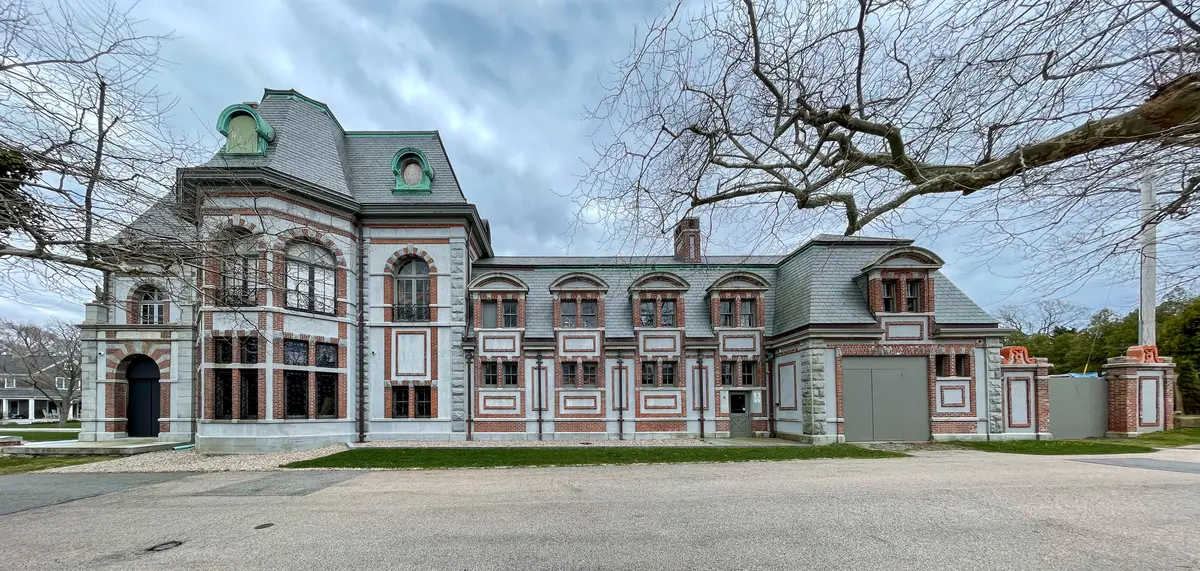
Richard Morris Hunt built Belcourt between 1891 and 1894 for Oliver Hazard Perry Belmont, banker's son, one-term congressman and obsessive horseman, and put the stables and carriage rooms on the ground floor of the house itself.
Where is Belcourt of Newport?
- Location
- Rhode Island, United States
- Type
- House / mansion
- Coordinates
- 41.458, -71.306
- Last updated
LOCATION
Why is Belcourt of Newport said to be haunted?
A 1904 architectural survey repeated the joke already going round Newport: a palatial stable with an incidental apartment and an incidental ballroom. The same survey records what the Gothic hall upstairs was for. It was built, its author wrote, to display one of the finest collections of old armour in the country, mounted on manikins and set on caparisoned horses. That armour was Belmont's. His widow Alva, who married him in January 1896, did the opposite of filling the house: she had the horses taken out of the living quarters, rebuilt the Grand Hall over the old coach passage, and went on to co-found the National Woman's Party. The screaming suit of armour belongs to a third chapter. The Tinney family bought the ruined house in 1956 for 25,000 dollars, opened it to visitors in 1957 and sold ghost tours for decades. They left, with their collection, in 2012.
What is the history of Belcourt of Newport?
Belcourt is the only one of the great Bellevue Avenue houses whose ground floor was designed for horses.
Richard Morris Hunt drew it between 1891 and 1894 for Oliver Hazard Perry Belmont, the youngest son of August Belmont, the banker who had come to America in 1837 as the Rothschilds' agent. Oliver was thirty-two when work began. He had been named for his mother's uncle, the Commodore Oliver Hazard Perry who won the Battle of Lake Erie; he would later serve a single term in Congress as a Democrat from New York, from 1901 to 1903. What he is remembered for is his stable. Hunt put the carriage rooms and the stalls on the first floor of the house itself, with two carriage entrances cut into the north front, and the family rooms above them.
The architectural critic Barr Ferree, surveying American country houses in 1904, recorded the joke that was already circulating about it: Belcourt, he wrote, had been "somewhat flippantly described as the home of a bachelor with a taste for hospitality and for horses, or, in other words, 'a palatial stable with an incidental apartment and an incidental ballroom'."
Ferree also recorded, in a sentence that settles a question the ghost tours have blurred for decades, what the great Gothic room upstairs was for. "This great baronial hall," he wrote, "was built with the view of producing a properly appointed space in which to display one of the finest collections of old armor to be seen in this country. Many of the suits of mail have been mounted on manikins and placed upon horses, which have been draped and fully caparisoned, showing how the knights would appear when arrayed for a tourney." The photograph facing that page, copyright 1897 by the Newport photographer Frank H. Child, is captioned "Belcourt — Baronial Hall, containing organ loft and collection of rare armor". The armour was Oliver Belmont's, and the room was built around it.
On 11 January 1896 Belmont married his neighbour Alva Vanderbilt, who ten months earlier had divorced his friend William Kissam Vanderbilt in one of the most public scandals of the Gilded Age. She moved into Belcourt and immediately began undoing it: she added a library and a bedroom of her own, had the horses taken out of the living quarters, and between 1910 and 1914 had the architect John Russell Pope push the Grand Hall thirty feet east into what had been the passage for Belmont's coaches.
On 7 September 1899 she organised, on the lawn in front of the house, what the wire report called "a novelty in the way of an automobile parade, the first held in this country" — with an obstacle course laid out in flags and dummy nursemaids pushing prams, over which Belmont's own coachmen held the reins.
Oliver died of appendicitis in June 1908, at forty-nine. Alva left for Europe, came back in 1909 and became one of the most consequential figures in American suffrage: she paid to move the National American Woman Suffrage Association's headquarters to New York, founded the Political Equality Association, funded a Black branch of it in 1910 with the Brooklyn clubwoman Sarah J. S. Garnet and others, co-founded the National Woman's Party in 1916, organised the first picketing of the White House in January 1917 and was the party's president until she died in 1933. In 2016 the Belmont-Paul Women's Equality National Monument in Washington was named for her and for Alice Paul. One correction is worth making, because the Bellevue Avenue houses are constantly confused: her Newport suffrage rallies were held at Marble House, the mansion she had kept from the Vanderbilt settlement, not at Belcourt.
After Alva, Belcourt fell fast. It went to her brother-in-law Perry Belmont; in 1940 it was sold for $1,000 to an entrepreneur who wanted an antique car museum and was refused by the zoning board; it passed to Edward Dunn, who never lived in it and rented the stables to the military; and in 1954 to Louis and Elaine Lorillard, who tried to make it the home of the Newport Jazz Festival until the neighbours objected.
In November 1956 Harold and Ruth Tinney, of Cumberland, Rhode Island, bought the derelict house for $25,000, renamed it Belcourt Castle and moved in with their son Donald. They brought their own collection with them — seventeen van-loads of furniture, stained glass, religious objects and armour, much of it salvaged from other Newport houses then being demolished. They opened it to visitors in 1957, and ran it as a house museum, a wedding venue and, eventually, a ghost attraction for fifty-six years. In November 2012 Harle Tinney, Donald's widow and by then the last of the family, sold the building to Carolyn Rafaelian, the founder of the jewellery company Alex and Ani, for $3.6 million. The collection was not part of the sale.
Timeline: the documented record of Belcourt of Newport
- 1891-1894 Richard Morris Hunt builds Belcourt for Oliver Hazard Perry Belmont, with the carriage rooms and stalls on the ground floor of the house itself. The National Register inventory of the Bellevue Avenue district, which dates the work to 1892, catalogues it as a "large residence and stable complex in Louis XIII chateau style".
- 11 January 1896 Belmont marries his neighbour Alva Vanderbilt, who had divorced William Kissam Vanderbilt ten months earlier. She moves into Belcourt, adds a library and her own bedroom, and has the horses removed from the main living areas.
- 1897 The Newport photographer Frank H. Child copyrights a photograph of the baronial hall captioned "containing organ loft and collection of rare armor". Published by Barr Ferree in 1904, it is the earliest dated record I have found of the armour that the ghost stories are attached to, and it places the collection with Oliver Belmont.
- 7 September 1899 Alva Belmont organises on the lawn of Belcourt what a contemporary wire report calls "an automobile parade, the first held in this country", with an obstacle course of dummy nursemaids and prams driven by Belmont's own coachmen.
- June 1908 Oliver Belmont dies of an infection following appendicitis, aged forty-nine. Alva leaves for Europe while the estate is settled and returns in 1909 to take up the suffrage cause.
- 1910-1914 Alva Belmont has John Russell Pope move the Grand Hall partition some thirty feet east, over what had been the passageway for Belmont's coaches, and adds the English library. She gives away the 1894 Aeolian organ before moving to France.
- 1940 Perry Belmont disposes of the house. An entrepreneur buys it for $1,000 intending an antique car museum, and is refused by the zoning board.
- November 1956 Harold and Ruth Tinney buy the derelict mansion for $25,000 and rename it Belcourt Castle. They bring in their own collection, described in Harle Tinney's memoir as seventeen van-loads of furnishings, much of it salvaged from Newport houses then being demolished.
- 1957 The Tinneys open the house to visitors. The date is confirmed by their own press release of 15 October 2002, which bills Belcourt Castle as "celebrating this year, 45 years of Living History 1957-2002" and is signed by Harle Tinney as executive director of the Royal Arts Foundation.
- 11 July 2001 The earliest ghost material I can date at Belcourt: an archived page of the house's own website advertising "Virginia's Ghost Tours" with guide Virginia Smith at $15 per person. By 2007 the same page listed $18.
- 2006 Harle Tinney publishes The Ghosts of Belcourt Castle through the self-publishing house iUniverse, with a foreword by Virginia L. Smith, the guide who led the paid ghost tours. One of its chapters is titled "Belcourt Is Not Haunted". A revised edition follows in 2012.
- 12 November 2012 Harle Tinney sells the house to Carolyn Rafaelian, founder of Alex and Ani, for $3.6 million.
- September 2013 Penelope Green reports for The New York Times that the ghost and murder-mystery placards are gone. The contractor Joe Triangelo says they found treasures "but no ghosts" and that "Carolyn is trying to distance herself from all that fodder"; Rafaelian says she brought in a shaman for "a major cleansing, energy-wise".
- 2026 Belcourt of Newport opens Fridays to Sundays year-round and sells a candlelit night ghost tour, describing the house as one that "was once known as the most haunted house in Newport" and asking visitors: "Are they still here? You be the judge!" The museum inside shows relics of the Statue of Liberty and photographs of Armenia.
Is there a rational explanation for Belcourt of Newport?
Everyone who has ever told the ghost story of Belcourt has charged for it.
The oldest ghost material I have been able to date is a page on the Tinneys' own website, archived on 11 July 2001, advertising "Virginia's Ghost Tours" with the guide Virginia Smith at $15 a head; by 2007 the same page listed $18, and the Royal Arts Foundation, the Tinney family's non-profit, was selling an evening candlelight tour at the same price. That is forty-four years after the house first opened to visitors in 1957, and more than a century after it was built. The stories were fixed in print in 2006, when Harle Tinney published The Ghosts of Belcourt Castle through the self-publishing house iUniverse — with a foreword by Virginia Smith, the guide who led the paid tours. Owner, author, guide and box office are the same operation. That does not make the accounts false; it does mean there is no independent witness anywhere in the chain.
The screaming suit of armour, the best-known of the stories, has a mundane setting that the house's own guides described for years. The French Gothic ballroom is seventy feet long, thirty-five wide and thirty-five high — proportions the Tinney-era guide notes advertised as "the perfect acoustic formula" — and it was designed, as Ferree recorded in 1904, to hold articulated steel mounted on manikins and on horse-shaped frames. A tall stone-and-plaster vault built for resonance, filled with jointed metal on wooden armatures that expand, contract and settle with temperature, is a room that will make noises at night whether or not anyone is dead in it.
The strongest sceptical evidence, though, comes from the current owner's own side. When Penelope Green visited for The New York Times in 2013, the first thing she noted was that the sidewalk placards for the ghost and murder-mystery tours were gone. The contractor running the restoration, Joe Triangelo, told her they had found all sorts of intriguing treasures in the house, "but no ghosts", and added that "Carolyn is trying to distance herself from all that fodder". Rafaelian herself did not claim hauntings either; she said there had been "energies and entities, some not pleasant", that she had brought in a shaman, and that "now the house has a different vibration". Newport's own coverage in 2024 summarised the outcome bluntly: right after the sale, the spirits were reported to have been banished.
And the house that sells the ghost tour today is careful with its tenses. Its website says Belcourt "was once known as the most haunted house in Newport", offers "a candlelit (fake candles, but still!) guided tour" and promises "spooky tales of the spirits that once roamed this great house", before ending on the only honest position available: "Are they still here? You be the judge!" Meanwhile the museum inside Belcourt in 2026 displays structural relics of the Statue of Liberty and photographs of Armenia.
Can you visit Belcourt of Newport?
Belcourt stands at 657 Bellevue Avenue, Newport, Rhode Island 02840. It is run by Belcourt of Newport, which describes the house as a nonprofit museum, and it belongs to Carolyn Rafaelian; the Newport mansions of the Preservation Society of Newport County are a separate organisation. Belcourt's website, read on 24 September 2026, gives its current opening days as Fridays, Saturdays and Sundays, when it runs a live guided tour "usually Friday through Sunday, year-round". The tour lasts approximately sixty minutes and covers the history of the house and its restoration. Tickets are sold on the 3Common platform (3common.com/Belcourt) or at the door during regular tour hours; on that date the website itself published no prices. The nighttime ghost tour is a separate guided walk of sixty minutes by candlelight, "fake candles, but still!" in the estate's own words. Enquiries go to [email protected].
The website states that access to the museum's exhibits is included with a guided tour ticket. From 4 July 2026 the museum has shown "Bones of the Statue of Liberty", structural relics removed from the statue during its restoration of 1984-1986. According to the same page, Carolyn Rafaelian took over their stewardship in 2016 and chose the 250th anniversary of the United States to put them on show. An exhibition of photographs of Armenia by Anastasiya Sergienya was listed as returning in August 2026.
The house is a contributing property of the Bellevue Avenue Historic District, listed on the National Register of Historic Places on 8 December 1972 under reference 72000023 and designated a National Historic Landmark district on 11 May 1976. The district inventory, prepared by the architectural historian Carolyn Pitts of the National Park Service and dated 5 February 1976, enters it as item 58: "Belcourt, by Richard M. Hunt, 1892. Large residence and stable complex in Louis XIII chateau style".
The New York Times reported in September 2013 that Belcourt, zoned as a museum, operated under grandfathered rights that allowed 12 events a year, each of which had to be approved by the City Council. The same article printed a photograph of the ballroom showing suits of armour beneath the organ, taken nearly a year after Carolyn Rafaelian bought the house from the Tinney family.
Sources consulted
- Barr Ferree, «American Estates and Gardens (Belcourt, the House of O. H. P. Belmont, Esq., pp. 80-84)» — Munn & Co., New York, 1904 book
- Wire report, dateline Newport, R.I., 7 September 1899, «Automobile Parade. Newport Society Had a Dizzy Time at Belcourt (p. 6)» — The Butler Weekly Times (Butler, Missouri), 14 September 1899, 1899 newspaper archive
- Carolyn Pitts, «National Register of Historic Places Inventory-Nomination: Bellevue Avenue Historic District (ref. 72000023; Belcourt is item 58)» — National Park Service, 1976 report
- Harle Tinney, executive director, The Royal Arts Foundation at Belcourt Castle, «Press release: Ghost and Vampire Legends of Rhode Island preview at Belcourt Castle, 15 October 2002» — belcourtcastle.com, archived by the Internet Archive, 2002 archive
- Belcourt Castle, «Calendar of Events: Virginia's Ghost Tours at Belcourt Castle (archived 11 July 2001)» — belcourtcastle.com, archived by the Internet Archive, 2001 archive
- Penelope Green, «Ghosts Be Gone» — The New York Times, 2013 newspaper archive
- Belcourt of Newport, «Belcourt of Newport: Tours, History, Museum and Restoration (official site, consulted 11 August 2026)» — belcourt.com, 2026 web
- Harle H. Tinney, «The Ghosts of Belcourt Castle» — iUniverse, Bloomington (first edition 2006; revised 2012), 2006 book
- Terrance Zepke, «A Ghost Hunter's Guide to the Most Haunted Places in America (Belcourt Castle chapter)» — Safari Publishing, Greensboro, NC, 2012 book
- Lucie-Anne Dionne-Thomas, «Firsthand Account of Belcourt Castle (review of the new edition of Harle Tinney's The Ghosts of Belcourt Castle; the seventeen van-loads)» — Newport This Week, 2021 newspaper archive
- The Preservation Society of Newport County, «Marble House (Chinese Tea House built 1914 for Alva Belmont, used for suffrage rallies)» — newportmansions.org, 2026 web
- What's Up Newp, «Harle Tinney will return to Belcourt Castle to discuss spirits» — whatsupnewp.com, 2024 newspaper archive
- Belcourt Castle, «Architecture of Belcourt Castle: Grand Hall, French Gothic Ballroom and Foyer (archived guide notes, 2007)» — belcourtcastle.com, archived by the Internet Archive, 2007 archive
- Belcourt of Newport, «The Museum at Belcourt: Bones of the Statue of Liberty (from 4 July 2026) and Armenia (returning August 2026)» — belcourt.com, 2026 web
Reviewed by V. Serrano on 2026-08-11 · How we verify our content
💬 Field testimonies (0)
No testimonies yet. Add the first.
Add your testimony
🔒 Log in to add a testimony