👻 HAUNTED PLACE · EXP. Nº9478
ACTIVE
Big Thicket
Big Thicket names a region, not a boundary: the National Park Service says the original Big Thicket covered two to three million acres of southeast Texas, and the 113,114-acre national preserve inside it was only created by Congress on 11 October 1974, with twelve units whose stated acreages add up to exactly 84,550.
Where is Big Thicket?
- Location
- Texas, United States
- Type
- Forest / nature
- Coordinates
- 30.548, -94.34
- Last updated
LOCATION
Why is Big Thicket said to be haunted?
UNESCO made it a biosphere reserve in 1981. The region's ghost story belongs to Bragg Road, in Hardin County: seven miles of dead-straight dirt on the bed of a Santa Fe branch line whose rails were laid in 1901 and pulled in 1934. It runs through the heart of the Big Thicket but outside the preserve boundary, which almost every retelling gets wrong. The folklorist Francis E. Abernethy recorded that the light was seen while the tracks were still in place, and that crowds arrived only after Archer Fullingim, editor of the Kountze News, ran front-page stories in the summer of 1960. Abernethy collected six rival explanations, among them a decapitated railwayman and a crew of Mexican track workers killed by a foreman who kept their wages.
What is the history of Big Thicket?
The name is older and much larger than the boundary. The National Park Service says the original Big Thicket of Texas covered between two and three million acres of what is now mapped as the Piney Woods and Coastal Marsh ecoregions, and the encyclopaedic descriptions still call it "a somewhat imprecise region". Everything in this entry happens inside that region. Only some of it happens inside the federal preserve that shares its name.
The Civil War left the Thicket its first legend. Local men who refused to fight for the Confederacy hid in the dense woods and were called Jayhawkers, and in what is remembered as the Kaiser Burnout, Confederate soldiers set fire to part of the Thicket to flush them out. Francis Edward Abernethy, the folklorist who collected the area's oral traditions, describes it in exactly those terms. The episode was already being staged before the Second World War: Larry Jene Fisher, the photographer of Big Thicket folkways, wrote and produced a play called The Keyser Burnout about the Jayhawkers who hid in the woods to evade Confederate conscription, and cast descendants of the people it depicted, some of whom walked six miles to rehearsals.
Then came the railroad, and with it the road that carries the ghost story. Abernethy records that Bragg Road was originally a seven-mile bed for a Santa Fe branch line running from Bragg Station, on what is now Farm Road 1293, south to Saratoga. The rails were laid in 1901 and pulled in 1934. Bragg itself was a railroad junction town named after the Confederate general Braxton Bragg; its post office closed in 1914 and it is a ghost town today. When the oil booms and the virgin pine gave out, the rails came up, the county bought the right-of-way, and the tram road became a county road. The bed stayed, dead straight, under a closed canopy, through some of the densest woods in the Big Thicket.
The light on it was reported while the tracks were still in place — Abernethy is explicit about that, and it matters, because most versions in circulation date the sightings to the 1940s. What can be dated precisely is the fame. In the summer of 1960 Archer Fullingim, editor and publisher of the Kountze News, began running front-page stories speculating on the nature of the light. They were picked up by metropolitan newspapers in Texas and beyond, and light-seers arrived by the hundreds.
Fullingim is the hinge of the whole story, and he was not a ghost writer. Born near Decatur in 1902, he printed the first issue of the Kountze News on 14 September 1950 and ran a front-page column called "The Printer Fires Both Barrels" that gave a weekly of 2,000 copies an influence far beyond its circulation. He mailed issues to Kennedy and Johnson, is credited with first calling Richard Nixon "Tricky Dicky", attacked the John Birch Society and the Ku Klux Klan, and led a long fight to save the Big Thicket from the timber industry in a county where most jobs depended on the harvest. He sold the paper in 1974 and died in Silsbee on 26 November 1984. He authorised the inscription on his own tombstone: "His favorite Kountze news story for twenty-five years was the Big Thicket." The man who made the ghost light famous is the same man who campaigned to save the forest it runs through.
That campaign won. A new Big Thicket Association was founded in 1964 by the self-taught naturalist Lance Rosier; Senator Ralph Yarborough introduced a national park bill in 1966; and Public Law 93-439, approved on 11 October 1974, established Big Thicket National Preserve to "assure the preservation, conservation, and protection of the natural, scenic, and recreational values of a significant portion of the Big Thicket area in the State of Texas". The Act lists twelve units by name and county, and their stated acreages add up to exactly 84,550 — the largest being the Lance Rosier Unit in Hardin County, at roughly 25,024 acres. It was one of the first national preserves in the United States, authorised the same day as Big Cypress in Florida. The preserve now manages 113,114 acres in nine land units and six water units across seven counties, and UNESCO added it to its biosphere reserve network in 1981.
Bragg Road is not in it. The road runs through the heart of the Big Thicket, as Abernethy puts it, but outside the boundary of the preserve — a distinction almost every retelling gets wrong.
Timeline: the documented record of Big Thicket
- Spring 1865 Confederate soldiers fire part of the Big Thicket to flush out Jayhawkers, local men who refused to fight for the South. Abernethy records the episode, remembered as the Kaiser Burnout, as one of the sources later offered for the light: either a fire never extinguished, or the ghost of a man shot during it.
- 1901 The rails are laid for a seven-mile Santa Fe branch line running from Bragg Station, on what is now Farm Road 1293, south to Saratoga. The Saratoga train carries people, cattle, oil and logs down to Beaumont.
- 1934 With the oil booms and the virgin pine exhausted, crews pull up the rails. The county buys the right-of-way and the tram road becomes a county road: dead straight, unpaved, under a closed canopy. Abernethy states that the light had already been reported while the tracks were still in place.
- 14 September 1950 Archer Fullingim prints the first issue of the Kountze News. His front-page column, “The Printer Fires Both Barrels”, gives a weekly of 2,000 copies an influence far beyond its circulation.
- Summer 1960 Fullingim begins running front-page stories speculating on the nature of the light. Metropolitan newspapers in Texas and beyond pick them up, and light-seers visit Bragg Road by the hundreds, describing it inconsistently but agreeing that a ghostly light of some sort frequented the road. This is the earliest precisely datable event in the story.
- 1966 Abernethy edits Tales from the Big Thicket (University of Texas Press), the collection of the region's oral traditions that his later encyclopaedia entry on the light cites as its own source, alongside the vertical files of the Briscoe Center for American History.
- 11 October 1974 Public Law 93-439 establishes Big Thicket National Preserve, one of the first national preserves in the United States, authorised the same day as Big Cypress in Florida. The Act names twelve units with their counties; their stated acreages add up to exactly 84,550, the largest being the Lance Rosier Unit in Hardin County at roughly 25,024 acres. Bragg Road is not among them.
- 1981 UNESCO adds Big Thicket to its World Network of Biosphere Reserves, citing an area called both “an American ark” and “the biological crossroads of North America”.
- 26 November 1984 Fullingim dies in Silsbee, ten years after selling the paper. He had authorised the inscription on his own tombstone: “His favorite Kountze news story for twenty-five years was the Big Thicket.”
- 2001 A book catalogued as Rob Riggs, In the Big Thicket: On the Trail of the Wild Man, is published by Paraview Press in 188 pages. It is the only source for a Big Thicket wild man that this review could identify by author and date; Riggs went on to co-write the mass-market Weird Texas in 2005.
- 14 and 24 January 2005 On 14 January an editor writes the “Ghost Road” section of the encyclopaedia article on the Big Thicket, working from a regional tourism page archived ten days later. The page had said that tales “gathered steam in the 1940's, '50s and '60s as more people traveled to the road”; the new section states that “in the 1940s, stories began to circulate”. It has not changed since, and it is the origin of the sighting date most often repeated online.
- 28 October 2010 Michigan Tech reports that Jeremy Bos and students from its SPIE chapter have identified the Paulding Light — another ghost light explained locally by a decapitated railwayman — as headlights on US-45 about four and a half miles away, matching every appearance to a passing car and then reproducing it by driving the road themselves.
Is there a rational explanation for Big Thicket?
The prosaic explanations are not a modern correction. They are as old as the fame, and it was the folklorist who printed them. Abernethy lists what people offered at the time: reflections of car lights going in to Saratoga, patches of low-grade gas, a reflection of foxfire or swamp fire, "or the figment of hysterical imaginations". The romantic explanations he collected alongside them are six, not one, and they are worth naming in full, because most retellings — including earlier versions of this entry — carry only two or three of them: buried conquistador gold, a fire never extinguished after the Kaiser Burnout, the ghost of a man shot during that burnout, a railroad man decapitated in a wreck whose body still walks the right-of-way looking for its head, a night hunter lost in the Thicket carrying a spectral fire pan, and — the one with the sharpest edge — the story Abernethy calls the Mexican cemetery: a crew of Mexican labourers hired to cut the right-of-way and lay the track whose foreman, rather than hand over a large sum of accumulated wages, killed them and kept the money, burying them in the woods beside the line. A sixth tells of a man who sold his farm to work on the railroad, became a brakeman on the Saratoga, lost his job when the Santa Fe cut its runs, died soon after, and still walks the bed with his brakeman's lantern.
The decapitated railroad man is not local. The same explanation — a railway worker beheaded in a wreck whose lantern still searches for his head — is attached to the Paulding Light in Michigan's Upper Peninsula and to the Maco light in North Carolina. That matters because one of those lights has been tested with instruments. On 28 October 2010 Michigan Tech reported that Jeremy Bos, a doctoral candidate in electrical engineering, and students from the university's SPIE chapter had taken a telescope to the Paulding viewing site and seen car headlights on US-45, about four and a half miles away. One team member stationed himself on the highway logging vehicle passages while the others logged appearances of the light: "every time the Paulding Light appeared, a car drove by the spot." They then reproduced it by driving the highway themselves, and when the driver switched on his hazard lights the watchers saw flashing yellow ones.
Bragg Road is close to a purpose-built instrument for that effect. It is seven to eight miles of dead-straight former rail grade under a closed canopy: a long, narrow, level sight-line aimed through dense woods, which is exactly the geometry that lets a distant, moving light source appear as a single hovering point with no visible origin. One counter-argument circulates — that the light is usually seen looking north while the road traffic can only be seen looking south — but it travels without a source attached to it, and no published measurement of that geometry has been located.
The dates are the part where the record has actually been damaged, and the damage is traceable. Abernethy says the light was reported while the tracks were still down, that is, before 1934. Almost everything else says the sightings began in the 1940s. That figure has a birthplace: a regional tourism page, "Bragg Road – The Ghost Road of Hardin County", archived on 24 January 2005, which paraphrases Abernethy's list of legends in his own order but writes that tales "gathered steam in the 1940's, '50s and '60s as more people traveled to the road" — a statement about crowds, not about first sightings. Ten days earlier, on 14 January 2005, an editor had written the "Ghost Road" section of the Wikipedia article on the Big Thicket from that page, and hardened the sentence into "In the 1940s, stories began to circulate about a mysterious light." That section has not changed since. On the way through, the chain also dropped Fullingim and the 1960 newspaper campaign that actually caused the crowds, dropped the Mexican railway crew and the laid-off brakeman, added a murdered bride at the Bragg Hotel that Abernethy does not have, and turned a roadbed whose rails came up in 1934 into a road "constructed in 1934". Retellings downstream of that chain, this entry's own earlier version among them, inherited the losses without the additions.
The Big Thicket wild man is a separate claim and a weaker one. It is absent from Abernethy's 1994 inventory of the road's lore — zero occurrences of "wild man", "wildman", "Bigfoot", "Sasquatch", "creature" or "hairy" in its 1,521 words, against 19 for "light", 15 for "Thicket" and 4 for "Bragg" in the same text and the same reading. In the 11,325-word encyclopaedia article on the region the phrase occurs exactly once, and not in the body: it is a bibliography line for a book catalogued as Rob Riggs, In the Big Thicket: On the Trail of the Wild Man (Paraview Press, 2001, 188 pages). Riggs went on to co-write Weird Texas (2005), a mass-market series. So the figure has a nameable recent author and a date, which is a far more useful fact than the vague "popular Texas folklore books" it is usually credited to. Whether it appears in the county's earlier newspapers remains an open question: the digitised Hardin County press is held by the Portal to Texas History, which could not be consulted for this entry, so the point is unresolved rather than settled in the negative.
Finally, there is no ticket here, which removes the usual argument. Bragg Road is a signposted Hardin County park and the preserve charges no entrance fee at all, so nobody in either place is selling the light. Nor is there any published instrumental investigation of the Bragg Road light itself on record. What can be said with a document in hand is that the phenomenon has a well-tested mechanism available to it, that the road's shape suits that mechanism unusually well, and that the sighting dates most often repeated are younger than the source they claim to come from.
Can you visit Big Thicket?
This entry covers two places that are often confused: Big Thicket National Preserve, run by the National Park Service, and Bragg Road, the Hardin County road where the light is reported, which lies outside the preserve.
The preserve protects 113,114 acres of land and water in seven counties of south-east Texas, managed as nine land units and six water units, and the Park Service notes that few roads lead into it. The Big Thicket Visitor Center is at 6102 FM 420, Kountze, Texas (mailing address 6044 FM 420, Kountze, TX 77625; telephone 409-951-6700). The Service gives its coordinates as 30.458251, -94.387285, which puts it about 12 km (7.5 miles) in a straight line north-west of the centre of Kountze. On the Service's pages as read on 23 September 2026, the visitor center opens from 09:00 to 17:00 central time every day except Thanksgiving, 25 December and 1 January, and the preserve itself is open 24 hours. Entry is free and no entrance pass is required. There are over 30 miles of hiking trails, and backcountry camping and hunting need a free permit from the visitor center. The Beaumont Unit page gives the seasons as March to September for backcountry camping and October to February for hunting, so parts of the preserve are hunted in winter.
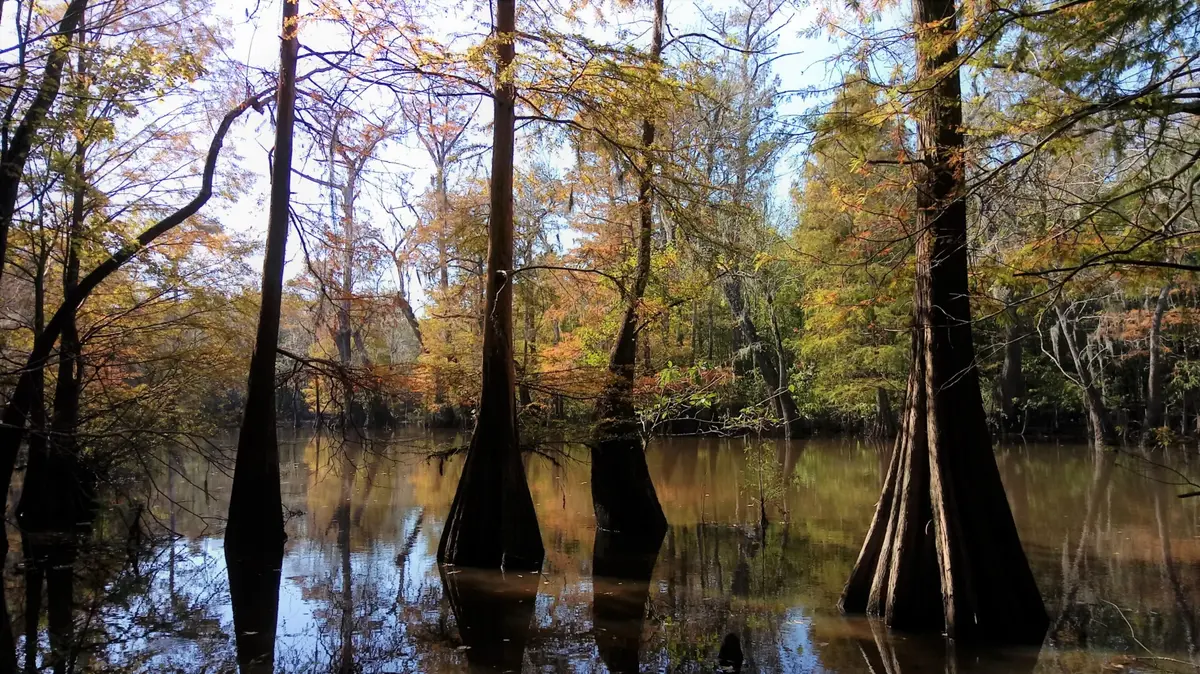
The photograph on this page is a Park Service image of bald cypresses in the Beaumont Unit, which the Service places north-east of the city of Beaumont along the Neches River corridor, over 14,344 acres of Hardin, Jefferson and Orange counties. The unit has no maintained hiking trails, although walking off-trail is allowed, and the Service describes its plant communities as floodplain and cypress slough. Its two marked routes are for canoes and kayaks: a 4.8-mile loop from Cooks Lake to Scatterman and a 7-mile round trip from Collier's Ferry to Lake Bayou.
Bragg Road follows the bed of a Santa Fe branch line that the Handbook of Texas gives as seven miles long, from Bragg Station, on what is now Farm Road 1293, to Saratoga. A 2007 account on Texas Escapes describes it as a dirt road "8 miles long by 2 cars wide" and allows 30 minutes to drive it safely in daylight. Its southern end is at a bend on Farm-to-Market Road 787, 1.7 miles north of the FM 787–770 intersection near Saratoga, according to a Big Thicket directory page archived in January 2005, which also records that the Hardin County Commissioners Court designated it the Ghost Road Scenic Drive County Park on 28 July 1997. The 2007 account found electric power lines and a couple of mobile homes along the last mile or so of the northern end, so the road passes people's houses. In 2022 Texas Co-op Power described it as about 8 miles of very straight road, the line left when the rails and ties were taken up in the 1930s.
Sources consulted
- Francis Edward Abernethy, «Big Thicket Light» — Handbook of Texas Online, Texas State Historical Association, 1994 academic
- 93rd United States Congress, «An Act to authorize the establishment of the Big Thicket National Preserve (Public Law 93-439, 88 Stat. 1254)» — United States Statutes at Large, via govinfo, 1974 archive
- James McEnteer, «Fullingim, Archer Jesse» — Handbook of Texas Online, Texas State Historical Association, 1995 academic
- National Park Service, «Big Thicket National Preserve: The Biological Crossroads of North America; Basic Information; Operating Hours & Seasons; Fees & Passes; Directions» — nps.gov/bith, 2025 report
- Marcia Goodrich, «Just in Time for Halloween: Michigan Tech Students Solve the Mystery of the Paulding Light» — Michigan Tech News, 2010 newspaper archive
- bigthicketdirectory.com (unsigned), «Bragg Road - The Ghost Road of Hardin County» — Internet Archive snapshot of 24 January 2005, 2005 archive
- Handbook of Texas Online, Texas State Historical Association, «Larry Jene Fisher» — tshaonline.org, 2020 academic
- UNESCO Man and the Biosphere Programme, «Big Thicket Biosphere Reserve» — unesco.org, 1981 report
- Chet Garner, «Creeping Along» — Texas Co-op Power, 2022 newspaper archive
- Wikipedia contributors, «Big Thicket (article and revision history; revision 9911348 of 14 January 2005)» — en.wikipedia.org, 2026 web
- Ken and Yvonne Rudine, «Saratoga Ghost Road, Bragg Road Ghost Light» — Texas Escapes, 2007 web
- National Park Service, «Beaumont Unit, Big Thicket National Preserve» — nps.gov/bith, 2025 report
Reviewed by V. Serrano on 2026-08-17 · How we verify our content
💬 Field testimonies (0)
No testimonies yet. Add the first.
Add your testimony
🔒 Log in to add a testimony