👻 HAUNTED PLACE · EXP. Nº9478
ACTIVE
Cutts–Madison House
The Cutts-Madison House stands on the north-east corner of Lafayette Square, and it is where Dolley Madison died on 12 July 1849, poor enough that a man she had once enslaved sent her food.
Where is Cutts–Madison House?
- Location
- Washington, D.C., United States
- Type
- House / mansion
- Coordinates
- 38.9, -77.035
- Last updated
LOCATION
Why is Cutts–Madison House said to be haunted?
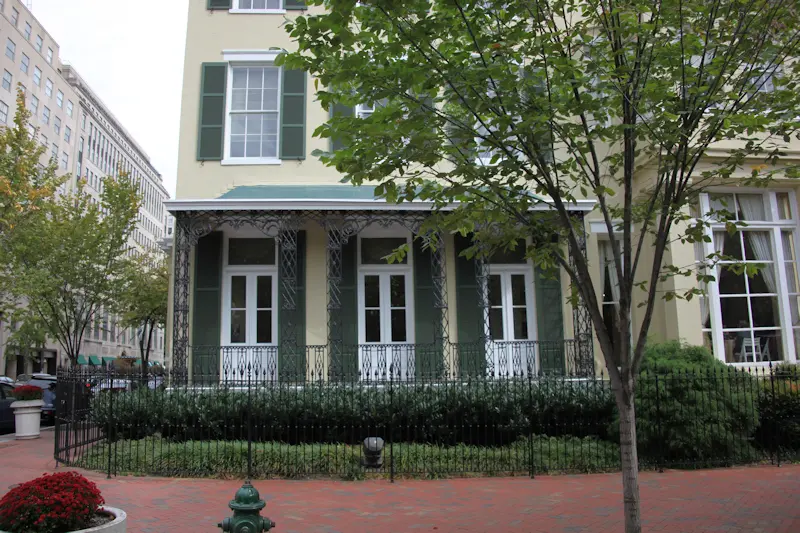
The legend says she is still there, rocking in a chair on the side porch, smiling at passers-by. The Cosmos Club, which owned the house from 1886 and published a documentary history of it in 1904, recorded that in her day the front entrance was reached by plain wooden steps, and that the cast-iron balcony now on that elevation was put up by Rear Admiral Charles Wilkes after he bought the house in 1851 - at least twenty-one months after her death. The same 67,763-word history mentions no ghost at all. What the story leaves out is better documented than what it contains: Paul Jennings, sold from this address in 1846, and Mary Ellen Stewart, sent to the pump in Lafayette Park in December 1847 so that a slave trader could seize her, who escaped and sailed on the Pearl four months later.
What is the history of Cutts–Madison House?
Square 221, on the north-east corner of what is now Lafayette Square, was sold by the federal commissioners to Samuel Davidson on 31 March 1793. His heirs sold lots 12 to 15 to Richard Cutts, a congressman from the Massachusetts district of Maine, on 3 October 1818, and Cutts built the house there in 1818-19 for himself and his wife Anna Payne Cutts, Dolley Madison's sister.
What Cutts built is not the building you photograph today. The Cosmos Club's documentary history of 1904 preserves a description given by Jane and Eliza Wilkes, daughters of a later owner: a small two-storey-and-attic house with a gable roof sloping east and west, dormer windows and no back building, its front turned towards Lafayette Square, and its principal entrance "reached by plain wooden steps". The garden ran south as far as the Tayloe mansion and east to the middle of the block.
Cutts, who was Second Comptroller of the Treasury, could not manage his own debts. On 22 August 1828 the bank holding his mortgage sold the property to ex-President James Madison for $5,750. Madison died at Montpelier on 28 June 1836 and willed it to his wife. Dolley Madison moved in during November 1837 to cut her costs, went back to Montpelier in 1839 to try to save the estate and rented the Washington house out, returned in 1843 and sold Montpelier in 1844. The White House Historical Association puts it exactly: she lived there "off and on". In 1844 or 1845 someone pushed lit matches into the shutters at the rear and she was woken and carried out by a servant.
The household in this house is the part the ghost story leaves out. Dolley Madison brought only part of the household to Washington - most of the people the Madisons had enslaved stayed at Montpelier - and she sold or hired out many of them over the following years to cover her son Payne Todd's debts. Among those who came with her were Paul Jennings, Madison's valet since the White House years, and a young woman named Mary Ellen Stewart with her mother Sukey. Ellen's brother Ben had already been sold to Georgia. In December 1847, according to the White House Historical Association's research, she arranged for a slave trader to call, then sent Ellen to the public pump in Lafayette Park to be seized there; Ellen suspected the visitor, fled and hid. A letter signed "Hampden", written in Washington on 8 March 1848 and printed in the Albany Patriot, tells the same episode from the street: "The girl, Helen, she agreed to send to the street-pump at dusk. Two traders were actually there to seize her, but they happened not to recognize her, and she passed them and made tracks down street." The same letter records that Jennings, sold through the intermediary Pollard Webb, had advanced Mrs Madison $200 of his own money to fix his price before she could sell him to the traders; the bill of sale from D. P. Madison to Pollard Webb was recorded on 4 March 1847, and Senator Daniel Webster, her neighbour on the square, then bought him and let him work off the debt at $8 a month.
About four months after the pump, on 15 April 1848, Ellen Stewart went aboard the schooner Pearl with seventy-six others: thirty-eight men, twenty-six women and thirteen children. The Pearl was overtaken at Point Lookout. The trader Hope Slatter bought fifty of the recaptured, Ellen among them; her freedom was later purchased with money raised by William Chaplin and Dr Joseph Evans, and she went to Boston, married Thomas White and came back to Washington with her daughter Gertrude. Jennings, whose part in the escape was never discovered, published A Colored Man's Reminiscences of James Madison in 1865 and wrote of these same years: "In the last days of her life ... she was in a state of absolute poverty ... he often sent me to her with a market-basket full of provisions."
Dolley Madison died in the house on 12 July 1849 and was buried from St John's Church opposite. Her son John Payne Todd sold the property to Rear Admiral Charles Wilkes on 3 April 1851. Wilkes moved the entrance round to H Street, turned the old Lafayette Square doorway into a window, cut the front windows down to the floor, put a balcony across that front, replaced the gable roof with a flat one and added a bay window on the south. General George B. McClellan used the house as headquarters from 26 July 1861 until late October. The Cosmos Club bought it in 1886 for $40,000 and enlarged it in 1886 and 1893, Hornblower & Marshall's addition being finished in January 1894. The federal government bought the house in 1940 for $1 million and leased it back to the club until 1952; it then became the first Washington headquarters of NASA, and it was in its ballroom, on 9 April 1959, that the seven Mercury astronauts were introduced to the press. Slated for demolition under the McMillan Plan, the house was saved after Jacqueline Kennedy intervened in February 1962 and John Carl Warnecke redesigned the scheme around it. It is now part of the Howard T. Markey National Courts Building.
Timeline: the documented record of Cutts–Madison House
- 3 October 1818 Richard Cutts, a congressman and Dolley Madison's brother-in-law, buys lots 12 to 15 of square 221 and builds a two-storey house whose front faces Lafayette Square and whose main entrance is reached by plain wooden steps.
- 22 August 1828 With Cutts unable to pay, the bank holding the mortgage sells the property to ex-President James Madison for $5,750.
- November 1837 Widowed and short of money, Dolley Madison moves in. She will leave again for Montpelier in 1839, rent the house out, and return in 1843.
- December 1847 Mary Ellen Stewart, enslaved in the house, is sent to the public pump in Lafayette Park so that a slave trader can seize her. She suspects the visitor, escapes and goes into hiding.
- 8 March 1848 A letter signed 'Hampden' in the Albany Patriot recounts the trap at the pump and reports that Paul Jennings had advanced Mrs Madison $200 of his own money to fix the price of his own sale.
- 15 April 1848 Ellen Stewart boards the schooner Pearl with seventy-six others. The vessel is overtaken; she is sold to the trader Hope Slatter, and her freedom is bought later with funds raised in New York and Massachusetts.
- 12 July 1849 Dolley Madison dies in the house. Her funeral is held at St John's Church, on the opposite corner of the square.
- 3 April 1851 John Payne Todd sells the house to Rear Admiral Charles Wilkes, who moves the entrance to H Street, turns the old Lafayette Square doorway into a window and places a balcony across that front. This is the ironwork the ghost is said to sit on.
- 1865 Paul Jennings publishes A Colored Man's Reminiscences of James Madison, describing the household's last years and the market baskets Daniel Webster sent to the impoverished widow.
- 1904 The Cosmos Club, resident in the house since 1886, publishes a 67,763-word documentary history of it. It records the wooden steps and Wilkes's balcony, and mentions no ghost of any kind.
- 9 April 1959 Now NASA's first Washington headquarters, the house hosts in its ballroom the press conference at which the seven Mercury astronauts are introduced to the world.
- 29 August 1970 The Lafayette Square Historic District is listed and designated a National Historic Landmark District; the nomination describes the house as 'a simple Federal residence occupied by Dolly Madison in her later years'.
- 1998 John Alexander's Ghosts: Washington Revisited gives the oldest wording of the legend that can be pinned to a page: men leaving the nearby Washington Club saw her 'gently rocking in her favorite chair'. No nineteenth-century source is produced for it.
Is there a rational explanation for Cutts–Madison House?
The story has a fixed image: Dolley Madison rocking on the porch, seen from the pavement, smiling at passers-by. The porch is the problem, and the document that settles it is not a ghost book but the Cosmos Club's own history of the house, published in 1904 and based on a description given by Admiral Wilkes's daughters, Jane and Eliza. In Dolley Madison's day the principal entrance was on the Lafayette Square front and was reached "by plain wooden steps". It was Wilkes, after buying the house on 3 April 1851, who "changed the entrance to the H street side, the old entrance on Lafayette Square being converted into a window, the front windows cut down to the floor, and a balcony placed on that front". That is the ironwork in the photograph. Dolley Madison had been dead more than twenty months when it went up, and WETA's Boundary Stones makes the same point in plain words: the ghost is reported on a porch "despite its nonexistence during her tenure".
Two things follow. First, our own previous text was worse than the ghost-tour version it was drawn from: the commercial listings and the Wikipedia article both say the figure is seen where the porch used to be, and we turned that into a woman sitting on an existing side porch. Second, the whole account can be tested against the people who actually lived in the building. The Cosmos Club occupied the house from 1886 to 1952 and published a 67,763-word documentary history of it in 1904, in the middle of the period the legend claims. In that text, ghost, haunt, apparition, spectre, phantom, supernatural and rocking return zero apiece; the controls in the same file are Wilkes 86, Madison 50, Dolly 11 and Cutts 4, and the scan is not truncated: its running headers and page numbers carry through to page 351. Porch is also zero, but that one is a false zero of vocabulary, not of substance: the club calls it a balcony.
Dating the story is harder than it should be. The oldest wording I could put a page number to is John Alexander's Ghosts: Washington Revisited (1998), p. 25 - men leaving the nearby Washington Club at night saw her "gently rocking in her favorite chair in shadows highlighted by the glow of the moon" - and I read it as transcribed by Joe Nickell, who also offers the ordinary explanations: wind in an empty chair, shadows read as motion, a club member walking home after a long evening. The oldest source Wikipedia cites for the haunting is a Reuters wire story of 24 October 2000. "Since the mid-nineteenth century" is an assertion made by twentieth- and twenty-first-century ghost writers, none of whom produces a nineteenth-century document. I could not test the digitised American press: on 17 August 2026 Chronicling America returned a 5,837-byte security interstitial to every request, so that check remains open rather than answered.
Two ornaments in the version we are replacing belong somewhere else. The scent of lilacs is an Octagon motif - the Architects Foundation, which owns that house, attaches it to visitors in its drawing room, Jacqueline Kennedy among them - and the Montpelier Foundation's own research on the Madisons' flowers points the other way: an old friend wrote to Dolley in 1846 that a great-granddaughter was named Daisy, "and I love her the better as that used to be your favorite flower", while the plant she was sentimental about was the Cape jessamine. The only lilacs in her own words are a note from Montpelier in January 1819 about a mild winter. The workmen who fled are a White House story, attached to a rose garden that Ellen Wilson had planted in 1913, sixty-four years after Dolley Madison died; even the ghost-tour operator keeps that one at the White House.
One last trap worth naming: in nineteenth-century Washington she is spelled Dolly. The 1904 club history has Dolley zero times and Dolly eleven, and the 1970 National Register nomination for the district still writes "Dolly Madison". Anyone searching the old press for the modern spelling will collect a clean, meaningless zero.
Can you visit Cutts–Madison House?
The house has not been a private home since 1851, and its interior is closed to visitors. It is one of three historic buildings absorbed into the Howard T. Markey National Courts Building, whose public entrance is at 717 Madison Place NW, Washington DC 20439. The house itself stands at 1520 H Street NW and holds chambers and offices of the United States Court of Appeals for the Federal Circuit and of the United States Court of Federal Claims. The General Services Administration dates the structure to 1820 and records it within the Lafayette Square National Historic Landmark District.
What is open is the courthouse, on courthouse terms: the Federal Circuit states that the building is open to the public from 8 a.m. to 5 p.m. on weekdays excluding federal and court holidays, and the Clerk's Office from 8.30 a.m. to 4.30 p.m. Everyone entering passes a magnetometer staffed by court security officers and has their belongings screened by X-ray machine; after screening, a government-issued photo identification is required and a visitor's badge is issued. The court's published list of refused items covers weapons and self-defence items of any type, knives and anything with a cutting or sharp edge, aerosol containers, tools, chemicals, and flammable or explosive materials.
The accessible entrance and exit is off H Street, between Vermont Avenue and 15th Street NW, through a brick breezeway. Seating in courtrooms 201 and 203 requires no stairs; courtroom 402 does, and an access lift is available to the public; trained service animals are admitted. The nearest Metro station is McPherson Square, on the Orange, Blue and Silver lines, with Farragut North and Metro Center, on the Red line, a short walk away. These details were checked on 22 September 2026.
The outside needs no appointment. Lafayette Park, opposite, is National Park Service land and free to enter. The Madison Place pavement faces the yellow stucco elevation and the cast-iron balcony that the legend calls Dolley Madison's porch. Rear Admiral Charles Wilkes bought the house on 3 April 1851, two years after she died in it; it was Wilkes who put a balcony across that front. St John's Church, where her funeral was held, stands on the opposite side of the square. Access to Lafayette Park is occasionally restricted at short notice for security reasons around the White House.
Sources consulted
- Cosmos Club (Washington, D.C.); description of the house by Jane and Eliza Wilkes, «The Twenty-Fifth Anniversary of the Founding of the Cosmos Club of Washington, D.C.: With a Documentary History of the Club from its Organization to November 16, 1903 (footnote 'The Dolly Madison house, or Wilkes house', pp. 114-116)» — Cosmos Club, Washington, D.C.; digitised by the Internet Archive, 1904 book
- Paul Jennings, «A Colored Man's Reminiscences of James Madison» — George C. Beadle, Brooklyn; digitised by Documenting the American South, University of North Carolina, 1865 book
- 'Hampden', «Mrs. Madison's Slaves Again (letter signed 'Hampden', Washington, 8 March 1848)» — Albany Patriot; transcription published by the White House Historical Association, 1848 newspaper archive
- White House Historical Association, «Dolley Madison's House: Former Slave Shows Charity Toward an Impoverished First Lady» — Slavery in the President's Neighborhood, whitehousehistory.org, 2024 web
- Mia Owens, «'Running from the Temple of Liberty': The Pearl Incident» — David M. Rubenstein National Center for White House History, White House Historical Association, 2021 academic
- Joel D. Treese, «The Dolley Madison House on Lafayette Square» — Rubenstein Center Scholarship, White House Historical Association, published 25 May 2016, 2016 web
- Joe Nickell, «Those Haunted Rocking Chairs (quoting John Alexander, Ghosts: Washington Revisited, 1998, p. 25)» — Center for Inquiry, 14 August 2015, 2015 web
- Emily Robinson, «Dolley Madison and The Mercury 7» — Boundary Stones, WETA, published 22 October 2019, 2019 web
- National Park Service, «National Register of Historic Places Inventory-Nomination Form: Lafayette Square Historic District (ref. 70000833)» — U.S. Department of the Interior, 1970 report
- The Montpelier Foundation, «A Paradise of Roses: Flowers at Montpelier» — montpelier.org, 2023 web
- United States Court of Appeals for the Federal Circuit, «Visiting the Court» — cafc.uscourts.gov, 2026 web
- U.S. General Services Administration, «Dolley Madison House, Washington, DC (historic federal building record)» — gsa.gov, 2026 web
Reviewed by V. Serrano on 2026-08-17 · How we verify our content
💬 Field testimonies (0)
No testimonies yet. Add the first.
Add your testimony
🔒 Log in to add a testimony