👻 HAUNTED PLACE · EXP. Nº9477
ACTIVE
El Adobe de Capistrano
El Adobe de Capistrano is two adobes stuck together, and only the southern one has a story.
Where is El Adobe de Capistrano?
- Location
- California, United States
- Type
- House / mansion
- Coordinates
- 33.5, -117.663
- Last updated
LOCATION
Why is El Adobe de Capistrano said to be haunted?
It held San Juan Capistrano's juzgado — the justice court, with two cells dug in below it — and those cells are still there, with their original iron bars and carved graffiti, holding the restaurant's wine. When the two adobes were built is genuinely disputed: 1797 and 1812 are printed almost everywhere, but the cultural-resources assessment the City commissioned in 2011 dates both to circa 1830. Two claims are sold on the premises and neither survives checking. A sign by the cellar named Joaquín Murrieta as a prisoner here; he was shot and beheaded 390 km north of here in 1853, not hanged nearby. The tunnel to Judge Egan's house is, in the City's own words, oral history. The restaurant's website mentions no ghost at all, and the headless friar everyone repeats traces to a single page of a 2004 paperback and to a Wikipedia sentence added, unsourced, twenty-one minutes after the article was created. What is documented is Richard Nixon: his daily diary logs the dinner.
What is the history of El Adobe de Capistrano?
El Adobe de Capistrano is not one building. It is two adobes shoved together, and only one of them ever had anything to do with jails, judges or ghosts.
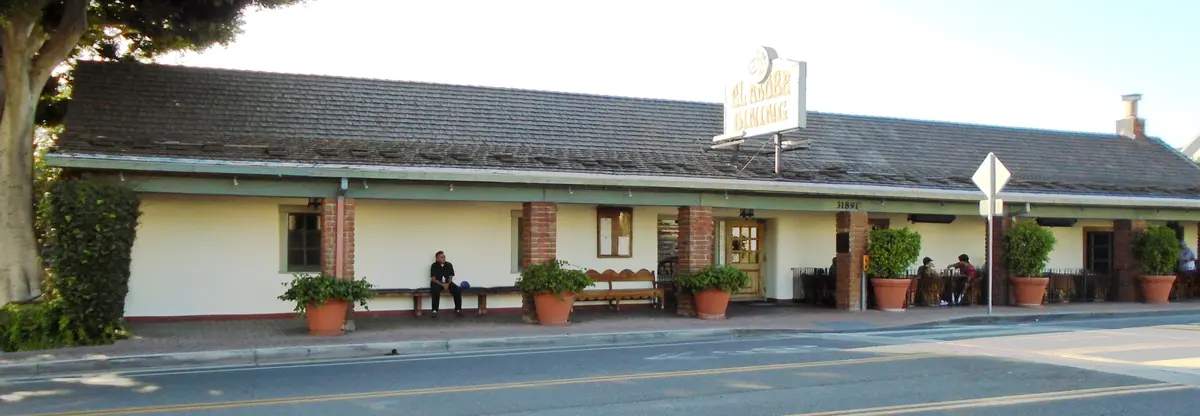
The northern adobe was a family house: the Yorbas'. The southern one held the town's juzgado — the justice court on the floor at street level, and the cells dug in underneath it. Between the two ran an open gap wide enough for a stagecoach. That gap is the restaurant's lobby today.
The first thing that goes wrong here is the date. Wikipedia, the restaurant's own website and most of the local press give 1797 for the north adobe and 1812 for the south, a pair of figures they trace to Hoover and Kyle's "Historic Spots in California". The evaluation the City of San Juan Capistrano itself commissioned says something else. Cogstone Resource Management, which surveyed the buildings on 25 July 2011 with two members of the local historical society present, wrote that "originally this building was two separate adobes built circa 1830", and its inventory table dates the pair "1841+". The San Juan Capistrano Historical Society, writing around 2000, refused to date the south adobe at all — "it is not known when it was built but it appears to have been erected early in the 1800s" — and said of the north one only that Miguel Yorba was living there in 1841. A 1970s travel guide printed 1778. Chris Jepsen of the Orange County Archives gave 1797 and "around 1810". Six dates, four sources, no agreement: whichever one you use, use it with a name attached.
What the building did is much better documented than when it was built. Cogstone records the juzgado as a "jail stop" for prisoners moving between Los Angeles and San Diego, and notes that "the two jail cells are still extant (in the wine cellar of El Adobe) with original iron bars and carved historic graffiti" — two cells, not one. Judge Richard Egan, who built his house across the street in 1883, held court in the room above them. The Seeley and Wright stage line from Los Angeles to San Diego drove through the gap between the adobes and laid over here in the 1850s, a habit that ended when the Santa Fe railway reached the town in 1888.
In 1910 Harry and Georgia Mott Vander-Leck bought both properties and joined them, roofing the stagecoach passage to make a dining room. Georgia Vander-Leck sold in 1946 to Clarence Brown, a farmer from Rancho Mission Viejo, who opened El Adobe de Capistrano on Thursday 8 July 1948 with the wedding reception of Camp Pendleton's first commanding general, Maj. Gen. Joseph C. Fegan. The Fred Harvey Company bought the restaurant in 1955. In 1957 a fire gutted the kitchen and the roof; the kitchen was rebuilt and enlarged in 1961, and in 1991 the adobe was given a seismic retrofit, termite repair and a new cedar-shingle roof.
The menu was continental until a president wanted something else. Richard Nixon's Western White House was at La Casa Pacífica in San Clemente, fifteen minutes down the coast, and the visits are not anecdote: they are logged. The President's Daily Diary for Friday 3 July 1970 has the party motoring from the San Clemente residence to "the El Adobe Resturant in San Juan Capistrano" at 6:30 p.m. with the First Lady, his daughter Patricia and Charles G. Rebozo, dining there, motoring back at 8:17 and reaching the residence at 8:32. Afterwards they watched a film. The restaurant says his requests are what turned its kitchen Mexican, and a combination plate associated with him — chile relleno, chicken enchilada and taco — is still sold.
Timeline: the documented record of El Adobe de Capistrano
- 8 December 1812 An earthquake brings down the Great Stone Church at the mission two blocks north. Chris Jepsen of the Orange County Archives writes that the northern adobe sheltered victims of the collapse — a claim that only works if the adobe was already standing, which the City's own 2011 assessment doubts.
- circa 1830 Cogstone Resource Management, evaluating the property for the City of San Juan Capistrano, dates both adobes to "circa 1830" and its inventory table to "1841+" — against the 1797 and 1812 printed almost everywhere else.
- 25 July 1853 Joaquín Murrieta is killed at Arroyo de Cantúa, 390 km north, by state rangers under Captain Harry Love. The site is registered in 1939 as California Historical Landmark No. 344. The restaurant nevertheless names him as an inmate of its cellar.
- 1883 Judge Richard Egan builds his house across the street from the juzgado. Every version of the tunnel legend links the cells to that house, so none of them can be older than this date.
- 1888 The Santa Fe railway reaches San Juan Capistrano and the Seeley and Wright stagecoaches stop laying over. The passage they used between the two adobes later becomes the restaurant's lobby.
- 1910 Harry and Georgia Mott Vander-Leck buy both adobes and join them, roofing the stagecoach gap to make a dining room, and use the result as their home and store.
- 8 July 1948 Clarence Brown opens El Adobe de Capistrano with the wedding reception of Camp Pendleton's first commanding general, Maj. Gen. Joseph C. Fegan. The kitchen is continental.
- 1957 A fire rips through the building, gutting the kitchen and the roof and badly damaging the rear. It is rebuilt with a larger kitchen; the City's 2011 assessment dates the kitchen addition to 1961.
- 3 July 1970 The President's Daily Diary logs Richard Nixon motoring from San Clemente at 6:30 p.m. with the First Lady, his daughter Patricia and Charles G. Rebozo, dining at El Adobe, and returning at 8:32 p.m. It is the visit in the archive, not in the anecdote.
- 1993 Richard Senate's "The Haunted Southland" walks a ghost tour of San Juan Capistrano into the restaurant — the earliest printed ghost-hunting account naming El Adobe that I have been able to date.
- 24 July 2007 Twenty-one minutes after the English Wikipedia article is created, an editor adds the sentence about the wine cellar being "rumored to harbor a ghost", with no source. A source is attached only in 2010, forty-eight minutes after another editor challenges the article's notability.
- 27 October 2008 Chris Jepsen of the Orange County Archives publishes his transcription of the cellar sign attributing the dungeon to Joaquín Murrieta and calls it "pure bunk", noting that this is nevertheless the part of the adobe that generates the most ghost stories.
- 25 July 2011 Cogstone surveys the buildings with two members of the San Juan Capistrano Historical Society present, records two extant cells with original iron bars and carved graffiti, and files the tunnel where it belongs: "oral histories indicate tunnels connected the Egan Residence with the jail".
Is there a rational explanation for El Adobe de Capistrano?
The most useful thing about El Adobe's ghost is that the people who could profit from it do not sell it.
On 20 August 2026 the restaurant's own website returned zero hits for "ghost", "haunted", "spirit", "apparition" and "friar" across its home, about and private-dining pages — with "Nixon", "jail", "Murrieta", "1797" and "1812" all present in the same fetch as controls. What it does sell is the cell itself: "El Carcel", a private dining room for eight guests, booked by phone off the regular menu. And it sells an outlaw. Its page says the jail "was used to house some of California's most infamous criminals such as Joaquin Murrieta".
That claim is checkable and it is wrong. Joaquín Murrieta was killed on Monday 25 July 1853 at Arroyo de Cantúa, in what is now Fresno County, by state rangers under Captain Harry Love; the site is California Historical Landmark No. 344, registered in 1939, and its plaque says so. It is 390 km north of San Juan Capistrano, and he was shot and beheaded, not hanged: the sign is wrong about the manner of his death and about the place. Chris Jepsen of the Orange County Archives, who ate here in October 2008 and transcribed the sign then standing by the cellar — "Joaquin Murrietta, the famous California outlaw, who was [hanged] not far from here, was said to have once been a prisoner in this dungeon" — wrote flatly: "The part about Murrietta is pure bunk, but naturally, this is the part of the adobe that generates the most ghost stories." That is as close to a documented origin as this file gets: the haunting is anchored to a false line of signage in a wine cellar.
The tunnel is the same shape. The restaurant advertises the cell's "original old iron bars and entryway to the underground tunnel that led to Judge Richard Egan's house across the street", adding that it "has since been blocked off for safety reasons". The historical society, around 2000, wrote that Egan "was said to be able to" use such a tunnel and that "the tunnel, if it ever existed" was destroyed when Camino Capistrano was lowered and paved. Cogstone, for the City in 2011, put it in the only honest register available: "oral histories indicate tunnels connected the Egan Residence with the jail". Note the arithmetic, too — Egan's house was built in 1883, so no version of this tunnel can be older than that.
The apparitions themselves are late and thin. The earliest printed account I can date that even walks a ghost tour into this building is Richard Senate's "The Haunted Southland" (1993): "The group next walked to the El Adobe Restaurant on El Camino Capistrano. Formerly two adobes, the Mexican restaurant has been a favorite of movie stars and presidents." The Wlodarskis gave it an entry in "California Hauntspitality" in 2002; Saul Rubin's roadside-oddities paperback of 2004 is the single source behind the two claims everyone repeats; Charles Stansfield's "Haunted Southern California" (2009) has "a monk, who materializes regularly outside the restaurant". That is forty-five years after the restaurant opened and, by the earliest construction date anyone claims, nearly two centuries after the building.
Where the two famous claims actually come from can be dated to the minute. The sentence "the Juzgado's jail cell now serves as the restaurant's wine cellar and is rumored to harbor a ghost" was added to the English Wikipedia article on 24 July 2007, twenty-one minutes after the article was created, with no source. No source was attached for three years. On 28 July 2010 another editor tagged the article as failing notability; forty-eight minutes later the author added the headless friar and hung Rubin's page 130 on both sentences. The category that puts this building in gazetteers of haunted places was added by a third editor on 19 November 2011 in a 63-byte edit with no summary and no source at all.
Measurements, with their controls, made on 20 August 2026. Calisphere, the University of California's image and archive portal: "El Adobe de Capistrano" returns 0 items, while "Yorba Adobe" Capistrano returns 7 and "Mission San Juan Capistrano" returns 603 in the same session. Open Library's full-text book search: "headless friar" together with Capistrano returns nothing; "headless friar" alone returns exactly two books, one on Nicaraguan murals and one volume of selected writings, neither Californian; the control "El Adobe de Capistrano" returns 91. In other words, outside Rubin's page and the pages copied from Wikipedia, the headless friar of San Juan Capistrano is not in the book record at all. A robed figure is — but it belongs to the mission two blocks north, whose own apparition can be traced in print back to village talk collected there in 1930.
One last thing worth saying plainly, because versions of it circulate: accounts that put activity in upstairs rooms are describing a building that is not there. El Adobe is single-storeyed, as its own street frontage shows, and the cells are below the floor.
Can you visit El Adobe de Capistrano?
El Adobe de Capistrano is a working Mexican restaurant. There is no admission, no ghost tour and no paranormal programme; the way in is a table in the dining room or a seat at the bar.
It stands at 31891 Camino Capistrano, San Juan Capistrano, California 92675, two blocks south of Mission San Juan Capistrano and a short walk from the Santa Fe depot, which is still served by Amtrak's Pacific Surfliner and by Metrolink. Re-checked on 22 September 2026, the published hours are the same as in August: 11:00 to 21:00 Monday to Saturday and 10:00 to 21:00 on Sunday. The telephone is +1 949 493 1163 and the address given for private events is [email protected].
The part visitors come for is the old jail. The cells sit below the floor of what was the courtroom and now hold the wine cellar; Chris Jepsen recorded in 2008 that the cellar was open to visitors, and the restaurant today rents it as a private dining room called El Carcel. Its own page, read on 22 September 2026, gives the capacity as "Seats up to 8" around an antique round table under low ceilings and old iron chandeliers, and says the room keeps the original iron bars of the 1812 jail together with the mouth of the tunnel that ran to Judge Richard Egan's house across the street, "blocked off for safety reasons". The room above is the Portola Room, "Seats up to 34", which the restaurant identifies as the old Justice Court and names after the Portola Riders who carried the Mission bell in 1963. The bar and cocktail lounge occupy the northern adobe, the older half, whose walls the restaurant traces to the Miguel Yorba Adobe; the lobby between the two halves stands over the passage used by Seeley & Wright stagecoaches until the Santa Fe railway arrived in 1888. The 1991 seismic retrofit and the 2003 remodel account for much of the present fabric, while the iron bars and the carved graffiti in the cells were recorded as original by the City's consultants in 2011.
The building is single-storeyed, but the cellar is reached by stairs and has low headroom, and the accessibility statement the restaurant publishes covers its website alone, with nothing about the premises. The telephone above is the only channel it offers for that question.
There is no state plaque to look for. The restaurant's own site calls the building "a California State Historical Landmark", and El Adobe appears nowhere in the California Office of Historic Preservation's roll of listed resources for Orange County, checked on 22 September 2026: the eleven San Juan Capistrano entries run from Mission San Juan Capistrano, landmark 200 since 1935, to the Roger Y. Williams House, listed in 2007. The designation El Adobe does hold is municipal, on the City of San Juan Capistrano's Inventory of Historic and Cultural Landmarks.
Sources consulted
- White House Office of Presidential Papers, «President Richard Nixon's Daily Diary, 1-15 July 1970» — Richard Nixon Presidential Library and Museum (NARA), 1970 archive
- Cogstone Resource Management / Templeton Planning Group, «Historic Town Center Master Plan Draft EIR, Section 5.5 Cultural Resources (based on Cogstone Resource Management, Cultural Resource Assessment for the San Juan Capistrano Historic Town Center Master Plan Area, August 2011)» — City of San Juan Capistrano, 2011 report
- California Office of Historic Preservation, «Listed California Historical Resources: Orange County and Fresno County (National Register, State Landmarks, California Register, Points of Historical Interest)» — California Department of Parks and Recreation, 2026 report
- San Juan Capistrano Historical Society, «El Adobe de Capistrano Restaurant» — sjchistoricalsociety.com, archived by the Wayback Machine on 28 September 2007, 2000 web
- Chris Jepsen, «El Adobe and the elusive ghosts of Capistrano» — O.C. History Roundup, 2008 web
- Richard L. Senate, «The Haunted Southland: Ghosts of Southern California» — Charon Press, 1993 book
- Charles A. Stansfield Jr., «Haunted Southern California: Ghosts and Strange Phenomena of the Golden State» — Stackpole Books, 2009 book
- Rhonda deHaan, «Then & Now: History of El Adobe de Capistrano» — The Capistrano Dispatch, 2018 newspaper archive
- El Adobe de Capistrano, «About us; Carcel Room; Portola Room (official site, consulted 20 August 2026)» — eladobedecapistrano.com, 2026 web
- Mary Ellen Tryon, «A Guide to Historic San Juan Capistrano: Established in 1776» — The Paragon Agency, 2002 book
- Robert Wlodarski and Anne Wlodarski, «California Hauntspitality: A Ghostly Guide to Haunted Inns, Hotels and Restaurants» — Whitechapel Productions Press, 2002 book
- English Wikipedia contributors, «Revision history of the article "El Adobe de Capistrano", 2007-2026 (93 revisions, consulted 20 August 2026)» — Wikipedia, 2026 web
Reviewed by V. Serrano on 2026-08-20 · How we verify our content
💬 Field testimonies (0)
No testimonies yet. Add the first.
Add your testimony
🔒 Log in to add a testimony