👻 HAUNTED PLACE · EXP. Nº1190
ACTIVE
Harvard Exit Theatre
Harvard Exit Theatre is a location reputed to be haunted in Seattle, Washington, US. Its reputation comes from reported apparitions, unexplained phenomena and eyewitness accounts gathered over time.
Where is Harvard Exit Theatre?
- Location
- Seattle, Washington, US
- Type
- Theater
- Coordinates
- 47.625, -122.322
- Testimonies
- 0
- Last updated
LOCATION
Why is Harvard Exit Theatre said to be haunted?
807 East Roy Street on Seattle's Capitol Hill has housed the Consulate of Mexico since the summer of 2018. Before that it was the Harvard Exit, an art-house cinema whose last screenings ran on 8 January 2015, and before that it was the clubhouse of the Woman's Century Club, built in 1925 for a suffrage-era organisation founded in 1891 by Carrie Chapman Catt and nine other Seattle women. The ghost story belongs to the cinema years. Janet Wainwright, who managed the theatre through much of the 1970s, reported a woman in old-fashioned clothing by the lobby fireplace, and mornings when she opened up to find the fire already lit and the chairs drawn into a semicircle. Her successor Alan Blangy, who ran the place from 1982 to 1988, was told by earlier staff that the fire and the chairs had been a prank played on her. The apparition was later identified with Bertha Knight Landes, the club president who became mayor of Seattle in 1926, on the strength of Blangy's own theory and a newspaper columnist's stated assumption. Landes died in Ann Arbor, Michigan, in 1943.
What is the history of Harvard Exit Theatre?
The Woman's Century Club was founded in Seattle in July 1891 by ten women who named it for the nineteenth century, which suffragists called the Woman's Century "because during that century women had made such great strides". The founding president was Carrie Chapman Catt, later president of the National American Woman Suffrage Association and founder of the League of Women Voters. Mildred Andrews lists the charter members in HistoryLink essay 408: among them Sarah Kendall, M.D., one of Seattle's first women physicians; Julia E. Kennedy, superintendent of Seattle schools from 1887 to 1890; Harriet E. Parkhurst, president of the Seattle WCTU in 1888-1889; and Elizabeth Mackintosh, an enrolling and engrossing clerk in the Washington Territorial Legislature from 1868, "the first woman in the country to hold such a position". Andrews's list runs to eleven names and the club's own runs to ten; the difference is Marmora DeVoe Moody, M.D., whom Andrews calls "another early physician".
The club paid the salary of the city's first librarian, "led the fight to raise the age of consent from 12 to 18", and in 1907 got the city council to prohibit spitting in public. It brought Susan B. Anthony to Seattle in 1896 for two days of workshops and lectures.
Ground was broken on the clubhouse at 807 East Roy Street on 26 May 1925, and the club's own history records that "the clubhouse opened less than five months later, on October 13". Pierce A. Horrocks was the architect and the total cost came to "just under $60,000". Membership peaked at 350 in the mid-1920s. One of those members, Bertha Knight Landes, "served as the club's president from 1918 to 1920" and in March 1926 was elected mayor of Seattle. In 1933 the clubhouse held a reception for Amelia Earhart, who lectured twice at the Civic Auditorium under the club's auspices.
Sean Nelson, writing in The Stranger, quoted the club's stated purpose: for "quality women of good will" to promote "intellectual culture, original research, and the solution of the altruistic problems of the day". By the mid-1960s the rentals that had paid for the building were going to newer halls with better parking and membership had fallen to about a hundred. In 1968 the club sold to the film exhibitors James O'Steen and Arthur Bernstein for $75,000, "on one condition: That the Woman's Century Club be allowed to meet there twice a month".
The cinema's "grand-opening preview" ran on 20 May 1969 and regular screenings began the next day with Billy Liar. Janet Wainwright, who managed the Harvard Exit for much of the 1970s, told the Seattle Times what the Bernstein and O'Steen years felt like: "It was like Camelot there. It was magic." Landmark Theatres took over operations in 1979, and in the early 1980s the top floor, until then a Cornish College classroom, became a second auditorium called Top of the Exit.
On 16 December 2014 Sanjay Bhatt reported in the Seattle Times that Scott Shapiro's Harvard Exit LLC was buying the 17,000-square-foot building from O'Steen LLC: "We're excited to be the steward of this historical building, improve upon it and have it be a contributing member of the community." The screens went dark three weeks later, after the club had met in that lobby for ninety years. The renovation finished in July 2018, and the building's own history page states the result plainly: "Its main tenant is the Consulate of Mexico."
Timeline: the documented record of Harvard Exit Theatre
- July 1891 Ten Seattle women found the Woman's Century Club, with Carrie Chapman Catt as its first president. Its early campaigns include paying the salary of the city's first librarian and raising the age of consent from 12 to 18.
- 13 October 1925 The clubhouse at 807 East Roy Street opens, five months after ground was broken. Pierce A. Horrocks was the architect; the club's history puts the cost at just under $60,000.
- March 1926 Bertha Knight Landes, club president from 1918 to 1920, is elected mayor of Seattle and becomes the first woman to lead a major American city. She serves one term, 1926-1928.
- 1933 The clubhouse hosts a reception for Amelia Earhart, in Seattle under the club's auspices to give two public lectures at the Civic Auditorium.
- 1968 The club sells the building to James O'Steen and Arthur Bernstein for $75,000, on the condition that it be allowed to keep meeting in the parlour twice a month.
- 20-21 May 1969 The Harvard Exit holds its grand-opening preview on 20 May and begins regular screenings the next day with Billy Liar.
- Early 1970s Manager Janet Wainwright reports an apparition of a woman in turn-of-the-century clothing that vanishes as she approaches, and mornings when she arrives to find the lobby fire lit and chairs set in a semicircle.
- 1979 Landmark Theatres takes over operation of the cinema. In the early 1980s the top floor, previously a Cornish College classroom, becomes a second auditorium called Top of the Exit.
- 1982 Alan Blangy replaces Wainwright and manages the theatre until 1988. Early staff tell him the fire and the semicircle of chairs had been pranks played on her after she reported the apparition.
- 1987 The independent filmmaker Karl Krogstad moves his goods into rental quarters in the theatre and reports his stacks of boxes falling over repeatedly for several days. The reported phenomena had otherwise ceased in the mid-1980s.
- 28 October 2001 Greg Palmer prints the Landes identification in The Seattle Times and flags it as a guess in the same sentence, adding that after years of ghost-hunting he had never seen one.
- 30 October 2008 The Seattle Times follows the Capitol Hill Ghost Tour run from the Seattle Museum of the Mysteries next door, which presents the theatre as the most haunted place in the city.
- 16 December 2014 Scott Shapiro's Harvard Exit LLC agrees to buy the 17,000-square-foot building from O'Steen LLC for conversion to offices and a restaurant.
- 8 January 2015 The Harvard Exit screens its last films, three days earlier than announced. The Woman's Century Club, which had met in the lobby for ninety years, moves to Dearborn House on First Hill.
- July 2018 The renovated building reopens as offices with the Consulate of Mexico as its main tenant.
- 5 September 2018 The Seattle Landmarks Preservation Board takes up the building, listed on its agenda as Harvard Exit/ Women's Century Club, 807 E Roy St, under Special Tax Valuation.
Is there a rational explanation for Harvard Exit Theatre?
The fullest account of the haunting is the entry in Rosemary Ellen Guiley's Encyclopedia of Ghosts and Spirits (third edition, 2007, pp. 224-225), and it gives the case away in its first three lines. The cinema is "said to be haunted during the early 1970s through the mid-1980s. Some of the phenomena remain unexplained, but some are confessed practical jokes."
The confession has a name on it. Guiley's informant is Alan Blangy, who managed the theatre from 1982, when Janet Wainwright left, until 1988. "Blangy was told by early staffers that some of the phenomena were outright jokes on Wainwright. After Wainwright reported seeing an apparition, other staff members played pranks of lighting the fire prior to her morning arrival and setting up the chairs in the semicircle." The fire already burning and the chairs drawn into a circle are precisely the two details that travelled furthest: Atlas Obscura was still printing them in December 2014 as an unexplained occurrence, the chairs arranged "as if some of the club's earliest members had returned for one last meeting". Guiley disposes of the running projector in the same paragraph, noting that staff screened films during the day, "so it is possible that someone left the projector running prior to the arrival of the projectionist for the public showings".
The identification with Bertha Knight Landes has a shorter chain than the repetition suggests. Guiley attributes it to a theory: "Blangy theorized that the theater may have been haunted by the ghost of Seattle's first and only woman mayor, Bertha K. Landes." When Greg Palmer put it in the Seattle Times in 2001, he marked it as guesswork inside the sentence: "We assume that's why she's haunting the place, waiting patiently for all the latte-sipping cineastes to disperse so the meeting can begin." Palmer, who had been visiting haunted places around the Northwest for years, answered the obvious question about his own sightings: "our answer is still no." Landes died on 29 November 1943 at her son's home in Ann Arbor, Michigan, and her ashes were interred at Evergreen Washelli in Seattle. The phrase that carries her name through every retelling, Seattle's only woman mayor, expired in November 2017, when Jenny Durkan was sworn in as the second.
Money had been attached to the story since about 2003. Connie McDougall reported for the Seattle Times in 2008 that Charlotte LeFevre and Philip Lipson had set up the Seattle Museum of the Mysteries "about five years ago" in the basement of the Deluxe Building, sharing a wall with the old clubhouse, and ran the Capitol Hill Ghost Tour out of it. On the tour McDougall joined, the group walked "to what is said to be the most haunted place in Seattle, currently known as the Harvard Exit Theater". Sarah Galvin, who worked at the cinema for seven years, recorded the same tour from the other side of the ticket desk: it "stopped at the Harvard Exit weekly, and the tour guide always asked if we'd 'seen any activity'". The museum gave up its Broadway storefront on 30 June 2010.
The people with the most hours inside the building reported the least. Galvin's own verdict after seven years was that "I never saw a ghost there, though I had some funny experiences with electronic devices and I never liked the upstairs lounge". Art Bernstein lived upstairs at the Exit for much of the 1970s and his three sons were in and out of it constantly, sleeping over at weekends; asked by the Seattle Times in 2015 whether they had ever seen the ghost, the brothers said no.
Can you visit Harvard Exit Theatre?
The cinema is gone. Its last screenings were on Thursday 8 January 2015: the Capitol Hill Seattle Blog had announced a final day of Sunday 11 January and then updated the post, "A sign posted at the theater now says the Exit's last screenings will be on Thursday night, January 8th." Films came back once, from 14 May to 7 June 2015, when the Seattle International Film Festival used the building as a venue and its artistic director Carl Spence described the plan as a chance to "properly say goodbye to this important cinematic institution by throwing a 24-day celebratory wake".
807 East Roy Street, Seattle, WA 98102 is now the Consulate of Mexico. The Washington State Commission on Hispanic Affairs lists it as "Mexican General Consulate in Seattle, 807 E Roy St., Seattle, WA 98102", telephone (+1) 206-448-3526. It is a working consulate: its own site lists the Mexican passport, the matricula consular and consular protection among its services, and routes appointments through Mexitel. Nothing of the cinema is open to the public, no tour of the building exists, and the lobby where the Woman's Century Club met is now consular floor space. The renovation was completed in July 2018 with the stated aim of "maintaining historical character while creating modern office space".
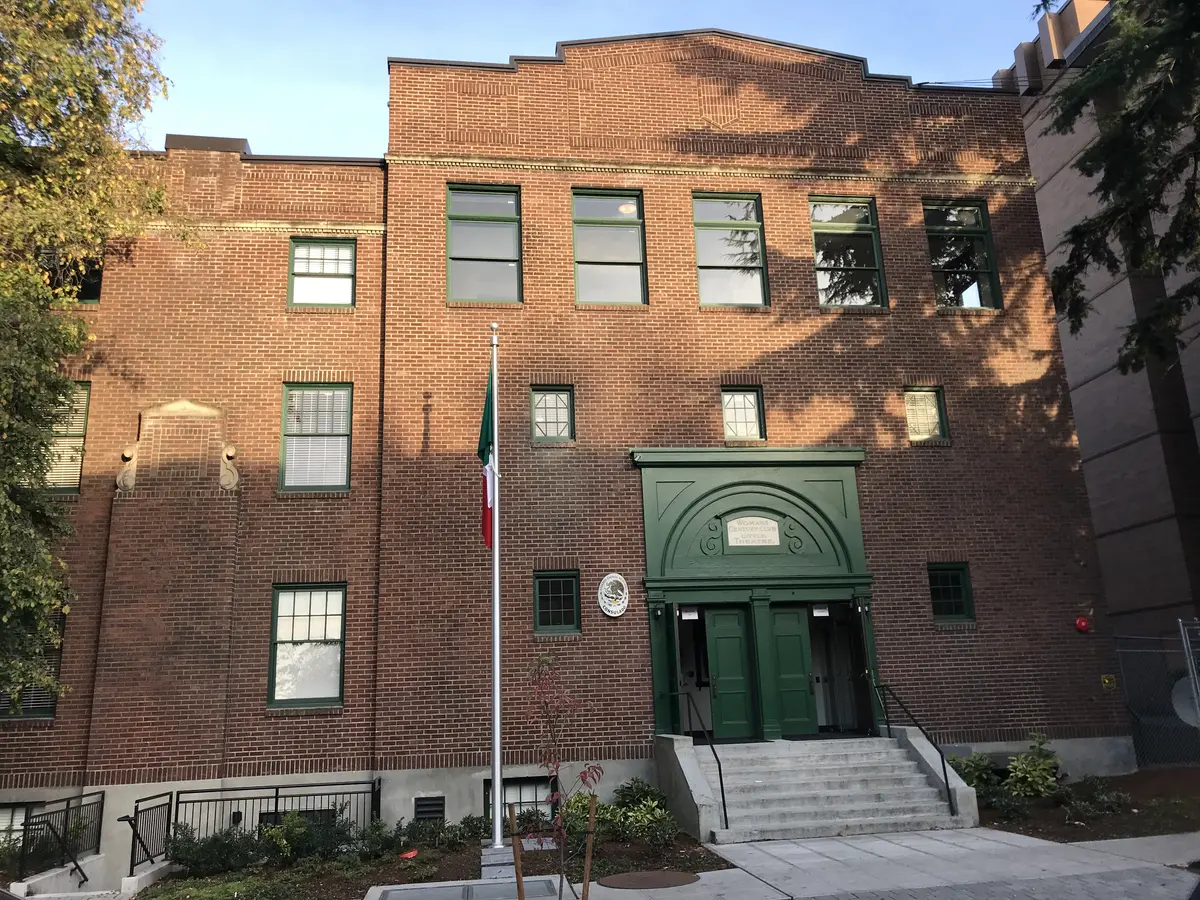
What remains visible is the outside, and it still carries the club's name. Atlas Obscura noted in 2014 that the members' name is "preserved above the doors on the building's red brick and emerald-green exterior". That is what the ghost-tour guide used to aim her flashlight at: "People don't look up enough," Charlotte LeFevre told the Seattle Times party in 2008, before the beam picked out "a crest and its sign, The Woman's Century Club". The photograph on this page, taken after the refit, shows the same green doorway with the Mexican coat of arms beside it and a flagpole in front. Across the street at 800 East Roy stands the NSDAR Rainier Chapter House, which was under construction when the clubhouse went up in 1925.
The building has no landmark designation of its own; the Capitol Hill Seattle Blog checked in December 2014 and reported that the 1925 masonry structure was "not currently protected by the Seattle Landmarks Preservation Board". It sits inside the Harvard-Belmont Landmark District, approved for designation in 1980, where "A Certificate of Approval issued by the Seattle Landmarks Preservation Board is required prior to the issuance of any building, demolition, street use, or other permits for proposed work within the district that is visible from a public right-of-way." The board took up "Harvard Exit/ Women's Century Club, 807 E Roy St" under Special Tax Valuation at its meeting of 5 September 2018.
The club itself is still meeting, on First Hill: "Our in-person meetings are usually held at Dearborn House, 1117 Minor Avenue, Seattle," the headquarters of Historic Seattle. Most of the file on this building is free to read online: Mildred Andrews's HistoryLink essay 408, Greg Palmer's 2001 column and Moira Macdonald's 2015 farewell in the Seattle Times archive, and Sarah Galvin's account in The Stranger.
Sources consulted
- Rosemary Ellen Guiley, «Harvard Exit Theater» — The Encyclopedia of Ghosts and Spirits, Third Edition (Facts On File), pp. 224-225, 2007 book
- Mildred Andrews, «Woman's Century Club (Seattle), HistoryLink.org Essay 408 (posted 2 December 1998, updated 17 December 2020)» — HistoryLink.org, 1998 web
- Moira Macdonald, «Harvard Exit memories: Movies, marriages and at least one ghost» — The Seattle Times, 10 January 2015, 2015 newspaper archive
- Sarah Galvin, «I Quit My Job at the Harvard Exit Three Weeks Ago After Working There for Seven Years. I Just Learned It's Closing. I Will Miss It.» — The Stranger, 3 December 2014, 2014 newspaper archive
- Sean Nelson, «Quality Women of Good Will: A Brief History of the Proto-Feminists Who Built the Harvard Exit (edited excerpt from 'Tea at the Ladies' Club', 22 January 1998)» — The Stranger, 3 December 2014, 2014 newspaper archive
- Sanjay Bhatt, «Harvard Exit building will house restaurant, offices» — The Seattle Times, 16 December 2014, 2014 newspaper archive
- Greg Palmer, «Hunting for haunted places around the Northwest» — The Seattle Times, 28 October 2001, 2001 newspaper archive
- Connie McDougall, «Boo! Ghost tours and more at Seattle's Museum of the Mysteries» — The Seattle Times, 30 October 2008, 2008 newspaper archive
- Capitol Hill Seattle Blog, «January 8th, 2015: Harvard Exit's last day as a cinema» — capitolhillseattle.com, 30 December 2014, 2014 web
- Seattle Landmarks Preservation Board, «Agenda LPB 484/18, Landmarks Preservation Board meeting of 5 September 2018 (item 090518.21, Special Tax Valuation: Harvard Exit/ Women's Century Club, 807 E Roy St)» — Seattle Department of Neighborhoods, 2018 report
- Bess Lovejoy, «One of Seattle's Most Beautiful and Ghostliest Theatres Goes Dark» — Atlas Obscura, 12 December 2014, 2014 web
- Woman's Century Club, «Illustrated History» — womanscenturyclub.org, 2021 web
- Harvard Exit building, «History - EST. 1925 (807 E. Roy St.)» — harvardexit.com, 2018 web
- Washington State Commission on Hispanic Affairs, «Consulates / Consulados» — cha.wa.gov, 2026 web
- Seattle Department of Neighborhoods, «Harvard-Belmont Landmark District» — seattle.gov, 1980 web
- Capitol Hill Seattle Blog, «Capitol Hill's Harvard Exit Theatre to close» — capitolhillseattle.com, 2 December 2014, 2014 web
Reviewed by V. Serrano on 2026-09-07 · How we verify our content
💬 Field testimonies (0)
No testimonies yet. Add the first.
Add your testimony
🔒 Log in to add a testimony