👻 HAUNTED PLACE · EXP. Nº0482
ACTIVE
Mount Nebo Cemetery
Mount Nebo Cemetery is a location reputed to be haunted in Alabama, US. Its reputation comes from reported apparitions, unexplained phenomena and eyewitness accounts gathered over time.
Where is Mount Nebo Cemetery?
- Location
- Alabama, US
- Type
- Cemetery
- Coordinates
- 31.347, -87.869
- Testimonies
- 0
- Last updated
LOCATION
Why is Mount Nebo Cemetery said to be haunted?
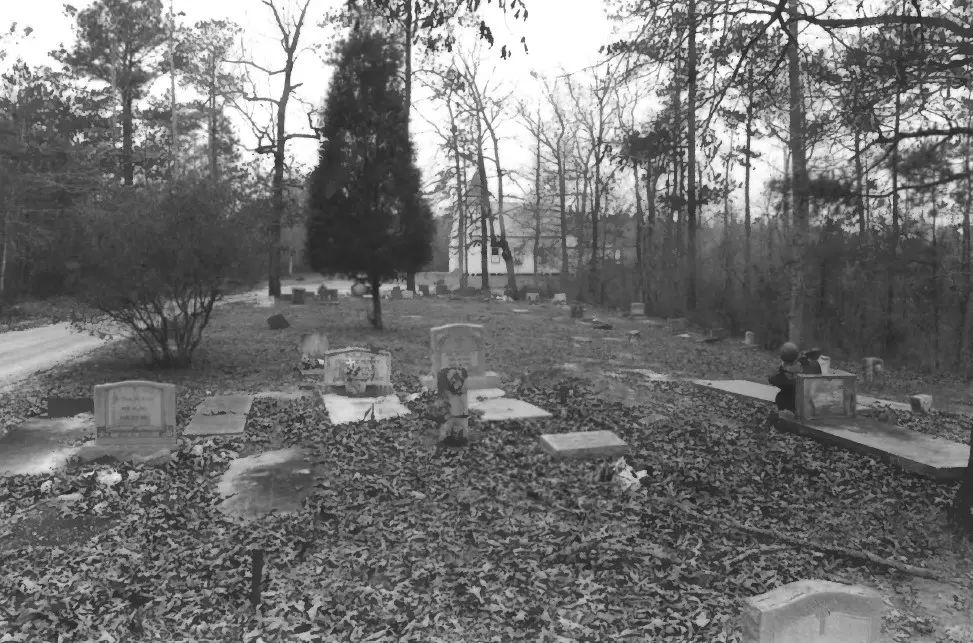
Mount Nebo Cemetery is the burial ground of a Black Baptist congregation in the pine woods of southern Clarke County, Alabama, near the fork where the Alabama and Tombigbee rivers meet. Four of its concrete markers were made by Isaac "Ike" Nettles Sr. (1885-1957), a farmer and inventor from nearby Nettles' Quarters, and they carry human faces. They are always called death masks, and the name is wrong: Nettles had his subjects press their faces into a box of sand while they were alive, then cast the mould in concrete. The stone everyone photographs, raised over his wife Korean in 1933, carries the faces of their three daughters, who were not dead and are not buried there; the inscription reads only "mother". The Alabama Historical Commission had the four objects listed on the National Register of Historic Places on 24 February 2000, reference number 00000141. The cemetery reaches lists of haunted places on the strength of four anonymous comments and one line added to Wikipedia in 2023. Nothing in the documentary record mentions a ghost. The faces are stranger than the story told about them.
What is the history of Mount Nebo Cemetery?
The cemetery sits at the southern tip of Clarke County, Alabama, near the fork where the Alabama and the Tombigbee meet, down a dirt road in commercial pine plantation. The crossroads community beside it, Carlton, was first called Hal's Lake, after a runaway slave who built a stockade by the water and eluded his captors in the canebrake for years; the Alabama Historical Commission took that from T. H. Ball's 1882 county history when it wrote up the site. The Mt. Nebo Baptist congregation, traditionally African American, formed in the last third of the nineteenth century, after the Civil War. The present white frame church went up shortly after 1900. Burials began with the church, but the earliest graves were unmarked or marked with materials that have not survived, and most of what stands today is concrete and dates from the 1950s on.
Four of those concrete markers were made by one man. Isaac "Ike" Nettles Sr. was born in 1885 on eighty-five acres near Carlton known as Nettles' Quarters. He studied at Tuskegee Institute and, according to his family, could not finish a divinity degree for lack of money. He worked at the Mobile Pulley Works during the First World War and came home to farm, but kept building machines: a great-nephew called him a "brilliant recluse" and an inventor in the Mobile Register in 1997, and relatives at a 2016 gathering remembered a corn sheller rigged out of a bicycle, a car driven by weights that he built for his children, and a design for a rifle. One of them, Gaines Pezent of nearby Rockville, said Nettles warned him he would sue if he copied one of his contraptions, because it was patented. Doshia Dean, a relative from Jackson, remembered a tall building he would climb into, where he said he received his ideas. "I thought he was crazy," she told the room, laughing.
The faces are almost always called death masks, and almost every source that calls them that also explains why the name is wrong. Nettles had his subjects press their faces into a box of sand while they were alive, and cast the mould in concrete; a relative told the writer Ed Williams, for a 1985 article the nomination leans on, that the mix included paper and wire. The 2016 historical marker at the edge of the cemetery puts it plainly: he "used concrete to make images of living people's faces for their tombstones."
Three of the four are family. The largest was his mother, a life-size figure from the hips up; locals told the surveyors it originally held her own hair, and a later account says birds picked it out. Her name is spelled Selena in the nomination and Celina on a hand-lettered slab added at the foot of the ruin and dated 22 January 1983, which reads "Celina Nettles, Born in 1800s, Died January 1940." The nomination's own narrative section instead gives 1933, the year it says Nettles lost his mother and his wife within weeks of each other, and the 2016 marker follows 1933. The date is genuinely unsettled and the only object on the ground says 1940.
The best-known stone is the one raised over Korean Nettles, sometimes written Cora, his wife, buried on 6 July 1933. It is a narrow headstone carrying three faces arranged off-centre, with pieces of clear glass set into the concrete around the top. The faces are not hers. They are their three daughters, Pauline, Marie and Clara, who were living when the moulds were taken, and the inscription simply says "mother." A fourth stone belongs to Angel Ezella Nettles, a relative — the University of South Alabama's outreach collection calls her his aunt, and the county paper spells her Estella — with her face, her name and her nickname "Sis Dollie" in raised letters. The last is the only one outside the family: Manul Burell, a local man who died in 1946 and who, having seen the others, asked Nettles for one of his own. His mask sits above a drawn shirt with a collar and buttons, and across the shirt front is written "He is at rest." The stone spells his surname with one r; the 2016 marker doubles it.
Nettles left Clarke County for Cleveland and then Detroit, where he worked for the Ford Motor Company. He died in 1957. His family cannot agree where: Carlton, Detroit or Mobile, depending on who is asked. His son told the surveyors in 1999 that the man who made the only portrait gravestones in the county lies in an unmarked grave in this cemetery.
The stones were put on a list of Clarke County's most endangered historic places in 1996. Blythe Semmer and Trina Binkley of the Alabama Historical Commission prepared the nomination, dated 24 August 1999, with photographs taken by Johnathan Farris on 3 February that year, and the four objects were entered on the National Register of Historic Places on 24 February 2000 as "Nettles, Isaac, Gravestones," reference number 00000141, under the county's multiple property submission. The nominated area is less than an acre: a triangle inside the cemetery, measured out from the southeast corner of the church.
Timeline: the documented record of Mount Nebo Cemetery
- 1885 Isaac "Ike" Nettles Sr. is born on eighty-five acres near Carlton known as Nettles' Quarters, according to the account his family gave the Alabama Historical Commission in 1999.
- 6 July 1933 Korean (Cora) Nettles, Isaac's wife, is buried. Her marker carries three faces cast from their living daughters, Pauline, Marie and Clara, and is inscribed "mother" rather than her name.
- January 1940, per a slab added in 1983 The hand-lettered concrete slab at the foot of his mother's broken statue, dated 22 January 1983, records "Celina Nettles, Born in 1800s, Died January 1940." The nomination's narrative section gives 1933 instead, and the 2016 marker follows 1933.
- 1946 Manul Burell, the only one of the four not related to Nettles, is buried under a marker he had asked for after seeing the others; "He is at rest" is written across the drawn shirt front. The nomination dates his death 9 August in one section and September in another.
- 1957 Nettles dies after years in Cleveland and Detroit, where he worked for Ford. His relatives disagree on whether he died in Carlton, Detroit or Mobile; his son told the surveyors he lies in an unmarked grave at Mt. Nebo.
- 1979 Hurricane Frederic topples the life-size torso of his mother, the largest of the four. By the 1999 survey it lay on the ground in three large pieces.
- Autumn 1985 The earliest printed account of the stones traced for this file: Ed Williams, "Cemetery Art," EnviroSouth 9, pages 16-17 and 25, cited in the nomination as its source for the concrete, paper and wire mix and for Burell's request.
- 1996 The gravestones are placed on a list of Clarke County's most endangered historic places.
- 24 February 2000 The four objects are listed on the National Register of Historic Places as "Nettles, Isaac, Gravestones," reference number 00000141, under Criterion A for African American ethnic heritage and Criterion C for art, on an area of less than one acre.
- 11 September 2012 Kerry Reid, director of the Clarke County Historical Museum, tells al.com that the preservationist the museum consulted judged the markers temporary and unrepairable without loss: "Fortunately, we have lots of photos. She told us to document, document, document."
- 2016 The Clarke County Historical Society dedicates a two-sided marker at the edge of the cemetery; the Clarke County Democrat reported on 1 December that more than seventy-five people attended and that Kerry Dunaway of the county museum gave the talk. The marker's own text avoids the misnomer, describing images of living people's faces.
- 1 February 2020 The fullest paranormal account traceable anywhere: an anonymous commenter on a haunted-places aggregator writes that the masks seem to watch you as you drive up to the church, and passes on a dare about the property's single street light.
- 18 February 2023 Why this cemetery is filed as a haunted place at all: the English Wikipedia article is created that morning and at 06:19 UTC its author adds the sentence "It is considered a haunted site by some people," sourced to one page of a 2019 popular book; at 06:50 the same author files it under Reportedly haunted locations in Alabama.
Is there a rational explanation for Mount Nebo Cemetery?
There is no ghost story here to weigh, and that is the finding rather than an evasion. Six independent bodies of text about this cemetery — the 1999 National Register nomination, both faces of the 2016 marker, the Clarke County Democrat's report on its dedication, al.com's "Strange Alabama" column of 2012, the University of South Alabama's outreach page and the RuralSWAlabama entry, some 7,600 words in all — contain the words ghost, haunt, spirit, apparition, paranormal, supernatural, eerie and creepy exactly zero times. The same sweep returns "Nettles" 124 times and "mask" 82, so the search is working. Even the column filed under Strange Alabama never reaches for the vocabulary.
What the label rests on can be dated to the minute. The English Wikipedia article on this cemetery was created on the morning of 18 February 2023; at 06:19 UTC its author added the sentence "It is considered a haunted site by some people," sourced to a single page of Alan Brown's popular collection Eerie Alabama (2019), and at 06:50 the same author filed the article under Reportedly haunted locations in Alabama. Enigma Atlas took the cemetery from that category. Brown's page could not be read for this file: Google Books returned quota-exhausted errors all day, so what he actually writes on page 121 is an open question, not a settled one.
The only first-hand accounts traceable anywhere are four user comments on a haunted-places aggregator whose own headline for the site reads "This place doesn't even need to be haunted, it's just freaking eerie," and which disclaims that any of its stories are factually accurate. One, signed Jessica on 11 March 2014, describes lights near a parked jeep and a dark shape seen only to the waist. Another, anonymous, on 1 February 2020, says the masks "seem to watch you as you drive up to the church" and passes on a local dare about the single street light on the property: park under it, and if it goes out your car will not start. One of the remaining two is a bare link to the 2012 al.com article; the fourth is a question.
The watching is the point, and it has a plain explanation that the record supplies. Visitors are told these are death masks and reasonably assume each face is the face of the person beneath it. On the stone most people photograph, that is false three times over: the faces are the sculptor's three daughters, taken from life, and al.com reported in 2012 that the daughters are not buried at Mt. Nebo. A portrait that does not belong to the grave it stands on is disorienting whether or not anyone believes in ghosts.
Nobody sells the strangeness. There is no tour, no ticket and no operator; the church put up a gate to keep vehicles out after repeated vandalism, and the county museum asks to be phoned before visits. The commercial incentive that usually explains a haunted reputation is simply absent here.
The non-paranormal literature, meanwhile, is the part that has drifted. Henry Chase's heritage guide In Their Footsteps has Nettles casting iron masks "in the 1800s" — wrong material, wrong century — in a passage read here only as a full-text snippet through Open Library's search inside, not in the book itself. al.com in 2012 gives two daughters instead of three and adds a plaster-of-Paris intermediate cast that no other source mentions. The Clarke County Democrat reported in December 2016 that Korean Nettles's stone was "completely gone," yet Mark Hilton photographed it standing on 25 February 2017; the stone reduced to a base is his mother's, and the likeliest reading is a mix-up, but the contradiction is on the record and is left standing here rather than tidied away.
Can you visit Mount Nebo Cemetery?
The National Register nomination filed by the Alabama Historical Commission in 1999 places the site on the "E side Mt. Nebo Rd. (Co. 867), 0.5 mi S of Co. 19", in the vicinity of Carlton, Clarke County, Alabama, zip code 36545, with a UTM reference of zone 16, easting 417440, northing 3468140. The narrative description sets the cemetery "just west of the crossroads community of Carlton on County Road 19", reached down "a dirt road off the road to Hal's Lake", with the graves "east of the church building along the north side of Mt. Nebo Road", over a nominated area of less than one acre.
Ownership is entered on the form as private, and the listed owner is the Mount Nebo Baptist Church, care of the Reverend King David Jackson at PO Box 24, Gainestown, Alabama 36540. The current function is recorded as "graves/burials", which is to say a congregation's burial ground still in use, where the markers surrounding the four Nettles stones are mostly plain concrete slabs that the surveyors dated "from the 1950s forward". A historical marker was placed at the edge of the ground in 2016, and the Clarke County Democrat wrote that it "heralds Isaac Nettles' life and his unusual tombstones".
The concrete is failing, and the nomination states that "all of the Nettles stones are endangered by the effects of weather on concrete", recording of the Manul Burell marker that "the concrete at the top of Mr. Burell's head has been damaged by vandals, but the rest of the design is intact". On repair the Commission concluded that "the preservation of the stones is a difficult proposition because of their materials and the need to leave them intact in the cemetery", while the Clarke County Democrat reported in 2016 that a tombstone preservationist consulted about the markers judged that "they were art and anything that would be done to them would do more harm than good and alter them too greatly", and instead "suggested making many photos of the stones as a way to preserve them for prosperity".
The same article prints a contact for the museum that gathers material on Nettles: "Anyone who has any information on Nettles may call Kerry Dunaway at the Clarke County Museum in Grove Hill, 251-275-8684", still on the newspaper's page when it was consulted on 9 September 2026. The nomination itself, together with the 1999 survey photographs, is free to read at NPGallery under reference number 00000141, while the University of South Alabama's JagWorks repository holds a photographic gallery of the stones alongside a filmed oral history of the site recorded with Kerry Dunaway.
Sources consulted
- Blythe Semmer and Trina Binkley, Alabama Historical Commission, «National Register of Historic Places Registration Form: Nettles, Isaac, Gravestones (reference number 00000141)» — National Park Service, NPGallery, 1999 report
- Alabama Historical Commission, «Historic and Architectural Properties of Clarke County, Alabama (multiple property documentation form, reference number 64500005)» — National Park Service, NPGallery, 2000 report
- Jim Cox, «'I thought he was crazy': African-American artist and inventor Isaac Nettles and his unusual 'death mask' tombstones recognized with new historical marker» — Clarke County Democrat, 2016 newspaper archive
- Beverly Crider, «"Death Masks" of Mt. Nebo Cemetery (Strange Alabama)» — al.com, 2012 newspaper archive
- Paula Webb and Kerry Dunaway, «Mt. Nebo Death Masks: photographic gallery and filmed oral history by Kerry Dunaway, director of the Clarke County Historical Museum» — JagWorks, University of South Alabama institutional repository academic
- Mark Hilton, «Mt. Nebo Death Masks historical marker (erected 2016 by the Clarke County Historical Society): transcribed inscription and photographs by Mark Hilton» — The Historical Marker Database, entry 101576, 2017 web
- user-submitted, «Death Masks of Mt. Nebo Cemetery: entry and four user comments, 2014-2021» — HauntedPlaces.org, 2014 web
- English Wikipedia contributors, «Mount Nebo Cemetery: article and revision history» — Wikipedia, 2023 web
- RuralSWAlabama, «Isaac Nettles "Death Masks" Headstones near Carlton, AL» — Rural Southwest Alabama, 2019 web
Reviewed by V. Serrano on 2026-09-07 · How we verify our content
📎 Source: Wikipedia (CC BY-SA)
💬 Field testimonies (0)
No testimonies yet. Add the first.
Add your testimony
🔒 Log in to add a testimony