👻 HAUNTED PLACE · EXP. Nº9478
ACTIVE
Nine Men's Misery
Nine Men's Misery is a location reputed to be haunted in Rhode Island, US. Its reputation comes from reported apparitions, unexplained phenomena and eyewitness accounts gathered over time.
Where is Nine Men's Misery?
- Location
- Rhode Island, US
- Type
- Cemetery
- Coordinates
- 41.939, -71.407
- Testimonies
- 0
- Last updated
LOCATION
Why is Nine Men's Misery said to be haunted?
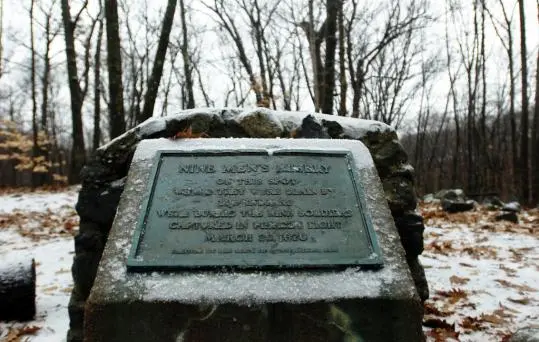
Nine Men's Misery is a low cairn and a bronze tablet in the woods of the Cumberland Monastery grounds in Rhode Island, land that now carries the town's public library, a playground and twelve marked trails. The tablet reads: «On this spot where they were slain by the Indians were buried the nine soldiers captured in Pierce's fight March 26, 1676.» The fight itself was elsewhere, down by the Blackstone in what is now Central Falls, where Captain Michael Peirse of Scituate and some seventy men, English and Christian Indians from Cape Cod, were surrounded by Narragansett forces under the sachem Canonchet. The Rehoboth minister Noah Newman helped bury the dead and wrote the casualty list the next morning: fifty-two English and eleven Indians. Neither his letter nor Increase Mather nor William Hubbard nor the London newsletters mention nine prisoners, a torture, or this place. The name first appears in print in 1834, in a town history whose nine men die fighting with their backs to a rock. The war dance and the tomahawks arrive two years later, offered by their own author as the third of three local traditions.
What is the history of Nine Men's Misery?
The Plymouth Council of War met on 29 February 1675/6 and ordered that the soldiers then under press from the southern towns be at Plymouth on the eighth of the month, «and with them 20 or 30 of the southern Indians, whoe together with the other whoe are vnder Presse, to goe forth vnder the Comand of Captaine Michael Peirse and Lieftenant Samuell Fuller» (Plymouth Colony Records, x, 187). Peirse was of Scituate and had fought in the Narragansett swamp battle the previous December. Increase Mather, writing within months of the event, put the force at «about fifty English, and twenty Indians, who were Friends to the English». William Hubbard described the second group as «twenty of their Christian Indians about Cape Cod, who proved none of his worst Soldiers».
On Saturday 25 March 1676 the company skirmished near Rehoboth and fell back to the garrison to wait for daylight. On Sunday morning it crossed the Blackstone below Pawtucket Falls in pursuit of a party who, in Mather's words, «went limping to make the English believe they were lame, till they had led them into a snare». Canonchet, the Narragansett sachem, had men on both banks. Peirse formed a ring, and the London newsletter «A New and Further Narrative of the State of New-England» printed the formation: «Captain Pierce cast his 63 English and 20 Indians into a Ring, and fought Back to Back, and were double-double Distance, all in one Ring, whilst the Indians were as thick as they could stand, thirty deep.» A messenger had been sent to Captain Andrew Edmunds at Providence; Hubbard's account says the letter was held at the church door until the forenoon service ended, and the relief came too late.
The Rehoboth minister Noah Newman helped bury the dead and wrote to John Cotton at Plymouth the next morning. The enemy, he reported, «hath slain fifty-two of our Englishmen, and eleven Indians». He then set down the English dead town by town, with a name against every one of them: fifteen from Scituate, nine from Marshfield, four from Duxbury, five from Sandwich, six from Barnstable, five from Yarmouth and four from Eastham. The eleven allied Indians appear in his letter as a number. One of the Cape Cod men, Amos, has a name in the record only because Hubbard admired him: after Peirse was shot in the leg Amos kept loading and firing beside him, and then, «perceiving the Enemy had all blacked their Faces, he also stooping down, pulled out some Blacking out of a Pouch he carried with him, discoloured his Face therewith», and walked out through the Narragansett line.
Newman's letter, Mather, Hubbard and the London narratives say nothing about nine prisoners, a march north or a torture. The name reaches print for the first time in John Daggett's «Sketch of the History of Attleborough» in 1834, and the story he collected has the nine men dying in a fight: «The whites, placing their backs to a large rock near by, fought with desperation till every one of them was killed on the spot.» Daggett wrote plainly about his own footing — «I have seen no notice of this occurrence in history; but as to the main fact there can be no doubt» — and could date it no closer than «at or about the time of Pierce's Fight». Two years later Leonard Bliss set out «two or three traditions» of the same event in his «History of Rehoboth» and preferred the third: the nine were survivors taken prisoner and «reserved for torture», seated on a rock in a natural amphitheatre while their captors began a war dance, quarrelled «about the manner of torture» and killed them with tomahawks. Bliss gave the pedigree of that version in one clause: it was «said to have been related to the English by an Indian who was soon after this taken prisoner».
The grave was opened at least once. Daggett reports the bones «disinterred not many years ago, by some physicians (for anatomical purposes)» and put back when the neighbours objected; Bliss dates the raid «about the time of the American Revolution» and attributes it to «some physicians from Providence». William J. Miller recorded in 1880 that a skull from the site was in the museum of Brown University. The Cistercian monks of Our Lady of the Valley, twelve of whom came from Nova Scotia in 1900 and quarried the monastery out of the surrounding stone, cemented the loose heap into the cairn that stands today, and a tablet was placed at the grave on 11 November 1928. The Valley Breeze reported in 2014 that the bones had gone to the Rhode Island Historical Society and were carried back to Cumberland in a crate in 1976 by Albert Klyberg, then the society's president.
Timeline: the documented record of Nine Men's Misery
- 29 February 1675/6 The Plymouth Council of War orders the pressed men of the southern towns to march under Captain Michael Peirse and Lieutenant Samuel Fuller, with «20 or 30 of the southern Indians». The order is printed in Plymouth Colony Records, x, 187, and quoted by Drake in his 1865 edition of Hubbard.
- 26 March 1676 Peirse's company is surrounded on the Blackstone in what is now Central Falls. The London narrative describes the ring of «63 English and 20 Indians» fighting back to back against Narragansett forces under Canonchet.
- 27 March 1676 Noah Newman, minister at Rehoboth, writes to John Cotton the day after helping bury the dead: the enemy «hath slain fifty-two of our Englishmen, and eleven Indians». He names every English casualty by town and gives the eleven allied Indians as a number. He mentions no prisoners.
- April 1676 Canonchet is captured at Pawtuxet a fortnight after the fight, refuses terms and asks not to be tortured. The Pequots shoot him, the Mohegans quarter him and Ninigret's men burn the remains; his head is sent to the council at Hartford.
- 1834 John Daggett prints the name «Nine Men's Misery» for the first time, in his history of Attleborough. His nine men die fighting with their backs to a rock, he can date the episode no closer than «at or about the time of Pierce's Fight», and he writes: «I have seen no notice of this occurrence in history.»
- 1836 Leonard Bliss sets out «two or three traditions» in his history of Rehoboth and prefers the third, in which the nine are prisoners «reserved for torture» and are killed with tomahawks when their captors quarrel. He sources it to a story «said to have been related to the English by an Indian who was soon after this taken prisoner».
- 1880 William J. Miller reprints the Bliss account and records that «A skull of one of the men slain at "Nine Men's Misery," is in the museum of Brown University, at Providence, and plainly shows the "cut" of the tomahawk.»
- 1913 The Rhode Island Committee on Marking Historical Sites, chaired by Wilfred H. Munro, reports to the General Assembly and writes of the tradition: «But, of what happened at Nine Men's Misery there is no real evidence.»
- 11 November 1928 A tablet is placed at the grave. Haley records that the Cistercian monks had built the cairn and that the tablet was set by the Rhode Island Historical Society on this date; the marker itself is inscribed «Erected 1928 by The State of Rhode Island», the society having been the body charged with the state's marking programme.
- 1976 The Valley Breeze reports that Albert Klyberg, then president of the Rhode Island Historical Society, drove the remains back from Providence to Cumberland in a crate for reburial, and that the society now declines to hold human remains in its collections.
- 19 November 2014 Marcia Green reports in The Valley Breeze that Bill and Jim Vieira have filmed at the cairn for the History Channel series «Search for the Lost Giants», looking for giants with double rows of teeth. Two days later Jason Colavito traces the giant back to Bliss's «very large frame» of 1836.
Is there a rational explanation for Nine Men's Misery?
The state of Rhode Island published the flat version in 1913. Its Committee on Marking Historical Sites, chaired by Wilfred H. Munro, retold the tradition of the war dance and the tomahawks and then wrote: «But, of what happened at Nine Men's Misery there is no real evidence.» That sentence sits inside the report of the very body that was putting up markers around the state, fifteen years before the tablet went up at the grave.
The arithmetic has never settled. Mather gave fifty English and twenty allies; the London narrative gave sixty-three and twenty; Newman, counting graves the morning after, gave fifty-two English and eleven Indians dead. The figure of one hundred and forty Narragansett killed comes from prisoners taken later, and Mather printed it with his own hedge: «How many of the Enemy fell we know not certainly, only we hear that some Indians, which have since been taken by the English, confess» it. Drake, editing Hubbard in 1865, noted of the same number that «It is not probable that much over half of that Number was killed.» Ellis and Morris called it «palpably an exaggeration» in 1906, reasoning that at two wounded for each man killed the Narragansett casualties would come to four hundred and twenty, «six times the total number of Peirse's party».
One physical detail can be watched growing, page by page. Daggett in 1834 identified a Bucklin of Rehoboth among the bones by «the remarkable circumstance of a set of double front teeth which he was known to possess». Bliss in 1836 has the same man recognised «from his very large frame, and from a set of double teeth all around». The Providence Journal of 20 January 1886, quoted by Jason Colavito, has «a skeleton of extraordinary size» with «a double set of teeth». In November 2014 the History Channel brought Bill and Jim Vieira to this cairn for an episode of «Search for the Lost Giants», hunting a lost race of giants with double rows of teeth. Colavito laid the three texts side by side and dated each step of the growth.
The claim that the pile of stones is a memorial raised in 1676, and therefore the oldest veterans' memorial in the United States, appears on the town of Cumberland's own visitor sheet, which prints a travel website as its source at the foot of the page. The two earliest descriptions of the pile give it no date at all: Daggett saw «a large pile of stones» in 1834 and Bliss «a heap of small stones, in the shape of the earth on a newly made grave» in 1836.
The torture is the part of the story that reaches us only through the winning side, at second hand, a hundred and sixty years late. What the war's own chronicles do record, and without any discomfort, is what was done to Canonchet a fortnight after the fight. Taken at Pawtuxet and offered his life on terms he refused, he asked, in the words of the London narrative, that «all he desired was not to be tortured»; the Pequots shot him, the Mohegans «cut off his Head and quartered his Body», Ninigret's men burned the quarters, and his head was presented to the council at Hartford. The Historical Marker Database notes today that «The site and surrounding woods are said to be haunted», without naming a witness; the unattributed reports of cries and oppressive silence near the marker that circulate online have no source in any of the documents above.
Can you visit Nine Men's Misery?
The cairn and the tablet stand in the woods of the Cumberland Monastery grounds, 1464 Diamond Hill Road, Cumberland, Rhode Island 02864. The town owns the ground and keeps it open as a park. The Historical Marker Database places the memorial at 41°56.386′ N, 71°24.396′ W and gives the approach: «It can be reached from Diamond Hill Road (Rhode Island Route 114) one mile south of Angell Road (Route 116), on the right when traveling south. From the entrance to the property, drive to the far back right and park, then take trail to marker.» A contributor who walked it on 28 June 2026 added a warning about navigation: «Some common map apps may inaccurately suggest it is in the swamp near the Wetland Trail», when the memorial is off the gravel Nine Men's Misery Trail, whose trees carry red paint. A posted trail map at the entrance marks it correctly. There is no admission charge and no gate on the paths. A sign at the grave records its status as a recognised historical cemetery, and the bronze tablet in the photograph on this page reads: «On this spot where they were slain by the Indians were buried the nine soldiers captured in Pierce's fight March 26, 1676.»
The monastery building is now the Cumberland Public Library, telephone 401-333-2552. Its hours page gave this schedule on 7 September 2026: Monday to Thursday 9:00 to 20:00; Friday 9:00 to 17:00; «Saturday (January - June, September - December): 9:00am - 5:00pm»; «Saturday (July & August): 9:00-1:00»; and «Sunday (first Sunday in October to first Sunday in May): 11:00 - 2:00». The same page marks the turning off Diamond Hill Road about a mile south of the highway exit by «a big granite sign that reads "The Monastery"», with the library set far back from the main road. It keeps a digitised archive of the monastery's own history online. The town's leaflet describes the park's twelve marked paths, the longest «just over one mile», as «crushed stone and hard packed earth», and lists a playground and the Friends' bookstore inside the library.
The battlefield is somewhere else, and the two have been confused in print for a century. Ellis and Morris place the swamp «some miles to the north» of the fight, and record that Welcome Arnold Greene of Providence located the fight itself «at a point a few rods west of the railroad bridge across the Pawtucket River, just north of Central Falls, R. I.» Haley wrote in 1937 that «A memorial tablet has been placed at the upper part of High Street, a little north of the archway under the Providence and Boston Railroad bridge, to mark the site of this historic engagement.» The grave lies in Cumberland; the fight was in Central Falls.
Sources consulted
- Noah Newman; Samuel Deane, ed., «Letter of the Rev. Noah Newman of Rehoboth to the Rev. John Cotton of Plymouth, 27 March 1676, printed in «History of Scituate, Massachusetts, from its First Settlement to 1831», pp. 122-123» — James Loring, Boston, 1831 archive
- Nathaniel Saltonstall; Charles H. Lincoln, ed., «A New and Further Narrative of the State of New-England (1676), in «Narratives of the Indian Wars, 1675-1699», pp. 84-85 and 90-91» — Charles Scribner's Sons, New York, 1913 book
- Increase Mather, «A Brief History of the Warr with the Indians in New-England, p. 25» — Boston, 1676 book
- William Hubbard; Samuel G. Drake, ed., «A Narrative of the Troubles with the Indians in New-England (1677), in «The History of the Indian Wars in New England», ed. Samuel G. Drake, vol. 1, pp. 173-177» — W. Elliot Woodward, Roxbury, 1865 book
- John Daggett, «Sketch of the History of Attleborough, from its Settlement to the Present Time, pp. 51-52» — Dedham, Massachusetts, 1834 book
- Leonard Bliss, Jr., «The History of Rehoboth, Bristol County, Massachusetts, pp. 94-95» — Otis, Broaders and Company, Boston, 1836 book
- William J. Miller, «Notes Concerning the Wampanoag Tribe of Indians, appendix, pp. 135-137» — Sidney S. Rider, Providence, 1880 book
- George W. Ellis and John E. Morris, «King Philip's War, pp. 190-192» — The Grafton Press, New York, 1906 book
- Wilfred H. Munro et al., Rhode Island Historical Society, «Report of Committee on Marking Historical Sites in Rhode Island, made to the General Assembly, January Session 1913, pp. 91-92» — E. L. Freeman Company, Providence, 1914 report
- John Williams Haley, «The Lower Blackstone River Valley: The Story of Pawtucket, Central Falls, Lincoln, and Cumberland, Rhode Island» — Lower Blackstone River Valley District Committee of the Rhode Island and Providence Plantations Tercentenary Committee, 1937 book
- Marcia Green, «Giants at Nine Men's Misery? History Channel investigators on the job» — The Valley Breeze, 2014 newspaper archive
- Jason Colavito, «Tracing the Origins of the «Giant» of Nine Men's Misery (21 November 2014)» — jasoncolavito.com, 2014 web
- F. Robby and G. W. Bartlett, contributors, «Nine Men's Misery Historical Marker (marker 290578): inscription, coordinates and access» — The Historical Marker Database, 2026 web
- Cumberland Public Library, «Cumberland Public Library: address, telephone and opening hours (consulted 7 September 2026)» — cumberlandlibrary.org, 2026 web
- Town of Cumberland, «Town of Cumberland: The Monastery (visitor sheet)» — cumberlandri.gov, 2020 web
Reviewed by V. Serrano on 2026-09-07 · How we verify our content
💬 Field testimonies (0)
No testimonies yet. Add the first.
Add your testimony
🔒 Log in to add a testimony