👻 HAUNTED PLACE · EXP. Nº9478
ACTIVE
Saltair (Utah)
Three buildings have carried the name Saltair on the south shore of the Great Salt Lake, and the ghost story attached to them belongs precisely to none of them.
Where is Saltair (Utah)?
- Location
- Utah, United States
- Type
- Public building
- Coordinates
- 40.747, -112.188
- Last updated
LOCATION
Why is Saltair (Utah) said to be haunted?
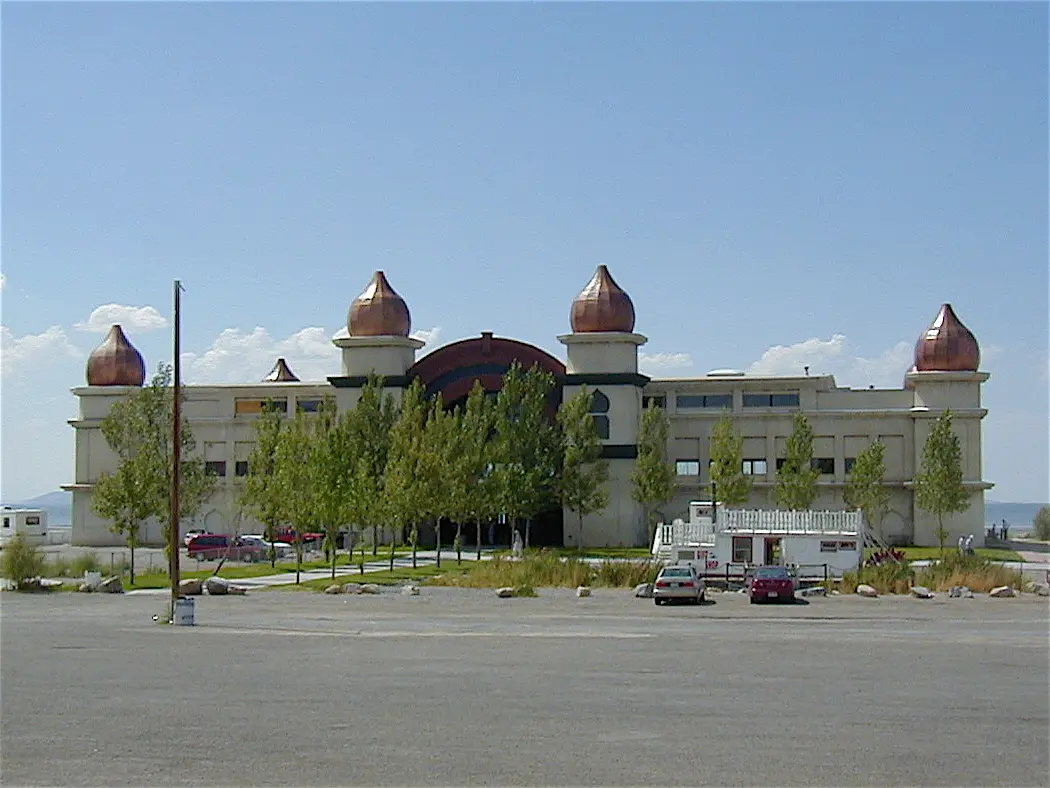
The first, a Moorish pavilion on pilings designed by Richard K. A. Kletting, was built by the Mormon church in 1893 as "a wholesome place of recreation" under church control and as a "Coney Island of the West"; at its peak it drew nearly half a million people a year. It burned on 22 April 1925. A second pavilion opened in 1926, closed for good after the 1958 season and stood empty until fire destroyed it in November 1970. In between, in 1962, its abandoned ballroom became the setting for the climax of Herk Harvey's cult horror film Carnival of Souls, and that is where most of Saltair's haunted reputation comes from. Harvey had driven past the derelict resort in 1961 on his way home to Kansas: "It was the weirdest place I'd ever seen," he said afterwards. A third Saltair, built in 1981 about a mile from the original site, is a working concert venue today. Stories of carousel music carried on the wind at dusk circulate widely, but we could trace no witness, no date and no source for any of them.
What is the history of Saltair (Utah)?
Saltair is three buildings, and almost everything said about it belongs to the second one.
The first was built by the Church of Jesus Christ of Latter-day Saints in 1893, on the south shore of the Great Salt Lake about sixteen miles from downtown Salt Lake City. The church built the railway out to it as well. The architect was Richard K. A. Kletting, who would later design the Utah State Capitol, and what he put on the water was a Moorish pavilion of onion domes standing on pilings. The church had two aims and they pulled against each other. In the words of the apostle Abraham H. Cannon it was to be "a wholesome place of recreation" under church control; it was also to be a "Coney Island of the West", evidence that Utah was not, in the historian John S. McCormick's phrase, "a strange place of alien people and customs". Within a decade the second aim had won at the expense of the first.
Saltair opened on Memorial Day 1893 and was formally dedicated on 8 June. People came for the swimming, because the salt let bathers bob around like corks, and for the dancing, on a floor advertised as the largest in the world — a claim Coney Island was making at the same time. There was a roller coaster, a merry-go-round, a Ferris wheel, midway games, bicycle races, touring vaudeville, rodeos, bullfights, boat rides, fireworks and hot-air balloons. Bathing suits and towels rented for ten cents. Trains on the Salt Lake, Garfield & Western ran every forty-five minutes from half past nine in the morning, and Wallace Stegner, quoted in the McCormicks' history of the resort, remembered that "whole trains spontaneously burst into song". A Deseret News promotional volume of 1902 listed among Salt Lake City's assets "Saltair, the most famous inland bathing resort in the world". By the early 1920s it was drawing nearly half a million people a year.
Fire ended it on 22 April 1925, taking both the pavilion and the Hippodrome, a hall built at the south end in 1910 for roller-skating and films. The Hippodrome was never rebuilt. The pavilion was: Raymond J. Ashton and Raymond L. Evans designed a second Saltair along the general lines of the first, and it went up the following year. It never recovered the old crowds, and the rest of its life reads as a list of injuries. A $100,000 fire in 1931. The Depression. Wind and salt spray eating the paint and the timber, so that the roof needed doing again every year. In 1933 the lake receded and left the resort half a mile from the water it existed for. It shut through the Second World War, reopened, struggled, and on 30 August 1957 lost its giant racer roller coaster when 75-mph winds took the structure down in three minutes — "it was like giant matchsticks crumbling", one workman told the McCormicks. Saltair closed for good after the 1958 season and passed to the state in 1959.
It then stood empty for twelve years, and it is this empty second Saltair — not the 1893 building, which had been ash since 1925 — that everyone pictures. In October 1964 the railway ran a nostalgia excursion out to it, and the Deseret News reported the result: "The day of 7,000 paid admission event is gone. Only about a dozen people showed up for the ride." In November 1970 fire destroyed it.
A third Saltair, a different building on a different footprint roughly a mile from the original, was put up in 1981 and opened in July 1982. The lake promptly rose and put its main floor under five feet of water. In the autumn of 1992 the Great Salt Lake Land Company bought it, spent six months restoring it and adding a concert stage, and reopened on 8 June 1993 — a hundred years to the day after the first Saltair was dedicated. It is a working concert venue still.
Timeline: the documented record of Saltair (Utah)
- 30 May and 8 June 1893 The first Saltair, a Moorish pavilion on pilings designed by Richard K. A. Kletting, opens on Memorial Day and is formally dedicated on 8 June. It is built and owned by the Mormon church, which also builds the railway out to it, and which sells the resort to private Mormon businessmen in 1906.
- 1902 A Deseret News promotional volume lists among Salt Lake City's assets "Saltair, the most famous inland bathing resort in the world". The same book records that Anthon H. Lund, by then second counsellor in the church's First Presidency, sat on the board of the Saltair Beach Company.
- 12 May 1910 A temporary stairway collapses under the crowd leaving a boxing match, dropping nearly a hundred people into the lake. Rumours that thousands are dead sweep Salt Lake City overnight; by morning the tally is bruises and broken bones from flying timber, and the resort's manager blames the weight of the crowd rather than the workmanship.
- 22 April 1925 Fire destroys the 1893 pavilion together with the Hippodrome, a hall added at the south end in 1910 for roller-skating and films. The Hippodrome is never rebuilt.
- 1926 A second Saltair, designed by Raymond J. Ashton and Raymond L. Evans along the general lines of the first, is built on the same site. It never regains the resort's former popularity.
- 1933 Receding lake levels leave the resort half a mile from the water, one of several retreats that stranded a bathing pavilion built out over the lake on pilings.
- 30 August 1957 Winds of 75 mph bring down the giant racer roller coaster in three minutes. "It was like giant matchsticks crumbling", a workman told the historians Nancy D. and John S. McCormick.
- 1958-1959 Saltair closes for good after the 1958 season and is handed over to the state of Utah in 1959. Efforts to save it through the 1960s fail and it stands abandoned.
- 1961 Driving back to Kansas from a shoot in California, the industrial-film director Herk Harvey passes the abandoned pavilion. "It was the weirdest place I'd ever seen", he said later; back home he took the idea to his Centron colleague, the writer John Clifford.
- 1962 Carnival of Souls is shot in about three weeks for roughly $30,000, with its climactic ballroom sequence filmed inside the second Saltair, then four years shut. The film's cult afterlife is the main source of the pavilion's ghostly reputation.
- 21 October 1964 The Deseret News reports on a nostalgia excursion run out to the derelict resort by the Salt Lake, Garfield & Western Railway: "The day of 7,000 paid admission event is gone. Only about a dozen people showed up for the ride."
- November 1970 Fire destroys the second Saltair, the building filmed in Carnival of Souls. Nothing of it survives above ground beyond charred posts and pilings on the flats.
- July 1982 A third Saltair, an entirely different building about a mile from the original site, opens after being put up in 1981. Rising lake levels soon put its main floor under five feet of water.
- 8 June 1993 After six months of restoration by the Great Salt Lake Land Company, which bought the building in the autumn of 1992 and added a concert stage, the third Saltair reopens on the hundredth anniversary of the first Saltair's dedication. It operates as a concert venue today.
Is there a rational explanation for Saltair (Utah)?
Two things need separating here: what happened at Saltair, and what is said to haunt it.
We could not find a single dated, named, first-hand report of anything paranormal at Saltair — not one. That is not for want of looking in the right shelf. Lost Landscapes: Utah's Ghosts, Mysterious Creatures, and Aliens (2007), a compilation of exactly this kind of material, gives Saltair several pages and spends them on the resort's history and on the plot of a film. The much-repeated story of distant carousel music carried on the wind at dusk has no witness, no date and no source we could trace, which means there is nothing in it to test and nothing to refute.
What Saltair does have is a film. In 1961 Herk Harvey, a director of industrial and educational shorts for the Centron Corporation in Lawrence, Kansas, was driving home from a shoot in California and passed the abandoned pavilion. "It was the weirdest place I'd ever seen," he said afterwards. "When I got back to Kansas," he told the commentary track of the film's DVD, "I discussed Saltair with my friend, co-worker and writer John Clifford." Clifford built a script around the location. Carnival of Souls was shot in about three weeks in 1962 for roughly $30,000, and the ghouls waltzing in its ballroom were people in makeup, filmed in a building that had been closed for four years and would burn eight years later.
That is the whole sequence: the resort closed, a film borrowed its emptiness, the film became a cult object, and the atmosphere the film manufactured came back attached to the place. Folklorists have a name for legends generated or reshaped by cinema rather than by local tradition, and Saltair is close to a textbook case — because the ruin the legend describes has not existed since 1970, and the building standing there now dates from 1981.
It is worth saying what did happen. On the evening of 12 May 1910 a temporary stairway collapsed under the crowd leaving a boxing match between Pete Sullivan and "Cyclone" Johnny Thompson, dropping close to a hundred people into the lake. Rumour ran through Salt Lake City that thousands were dead and that the whole resort was sinking. By morning it was clear the water had come up to people's armpits, that the harm done was bruises and broken bones from flying timber — the Utah State Historical Society's account records injuries, not deaths — and that the panic had been considerably worse than the accident. A real emergency produced a rumour that died in a night; a film produced one that has outlived the building twice over.
Can you visit Saltair (Utah)?
Nothing of the first two pavilions survives above ground. Wallace Stegner, writing of the flats in Recapitulation (1979), has them "littered with the stumps of the pilings on which the Saltair Pavilion used to ride above waist-deep water"; Terry Tempest Williams, walking the same shore for Refuge (1991), found "a few charred posts". How much of that is above water depends on where the lake stands in a given year.
The building that carries the name today is the third of them, and it works as a concert venue. The Great Saltair gives its address as "12408 W Saltair Dr, Magna, UT 84044 I-80 West Exit 104", its box office as (801) 857-4722 and [email protected], and its spaces as "Indoors, Amphitheater, Beach". Tickets are sold through Tixr; parking passes come from Afton Tickets at $20. Every event listed on the site when it was consulted on 9 September 2026 was marked "18+". The way in is a ticket to a show.
Off the same interstate exit is Great Salt Lake State Park, whose fees the Utah Division of State Parks published as follows on 9 September 2026: day use "$10 per vehicle up to 8 people"; "$5 per vehicle up to 8 people" for a driver aged 65 or over; "$2 per person" for cyclists and pedestrians; "$10" for an additional vehicle; an annual park pass at "$50". Camping runs "$20 per night" for a primitive tent site; "$40 per night" with water and electrical hookups; "$60 per night" with full hookups. Educational groups pay "$1 per person and $30 for the vehicle" with a reservation and "$3 per person and $30 for the vehicle" without one.
The park's hours on that same page are "Sunrise – Sunset". The visitor centre opens "11:00 am to 7:00 pm" Monday to Thursday and "9:00 am to 7:30 pm" Friday to Sunday.
Sources consulted
- John S. McCormick, «Saltair» — Utah History Encyclopedia, Utah State Historical Society, 1994 archive
- Utah State Historical Society, «Saltair: A Photographic Exhibit» — Utah Division of State History, 2003 archive
- Yvette D. Ison, «Boxing Fans Take the Plunge at Saltair» — History Blazer, Utah State Historical Society, 1995 archive
- Richard Crouse, «The 100 Best Movies You've Never Seen» — ECW Press, Toronto, 2003 book
- John Gaspard, «Fast, Cheap and Under Control: Lessons Learned from the Greatest Low-Budget Movies of All Time» — Michael Wiese Productions, 2006 book
- Arthur T. Sargent, «Utah, the Inland Empire: The Story of the Pioneers, Resources and Industries of the State» — Deseret News, Salt Lake City, 1902 book
- Wallace Stegner, «Recapitulation» — Doubleday, New York, 1979 book
- Terry Tempest Williams, «Refuge: An Unnatural History of Family and Place» — Pantheon Books, New York, 1991 book
- Various, «Lost Landscapes: Utah's Ghosts, Mysterious Creatures, and Aliens» — Cedar Fort, Springville, Utah, 2007 book
- The Great Saltair, «The Great Saltair: venue information, directions and box office» — thesaltair.com, 2026 web
- Utah Division of State Parks, «Great Salt Lake State Park: park fees and visitor information» — Utah State Parks, 2026 web
Reviewed by V. Serrano on 2026-08-11 · How we verify our content
💬 Field testimonies (0)
No testimonies yet. Add the first.
Add your testimony
🔒 Log in to add a testimony