👻 HAUNTED PLACE · EXP. Nº1190
ACTIVE
Theatre in the Park
Theatre in the Park is a location reputed to be haunted in Raleigh, North Carolina, US. Its reputation comes from reported apparitions, unexplained phenomena and eyewitness accounts gathered over time.
Where is Theatre in the Park?
- Location
- Raleigh, North Carolina, US
- Type
- Theater
- Coordinates
- 35.784, -78.663
- Testimonies
- 0
- Last updated
LOCATION
Why is Theatre in the Park said to be haunted?
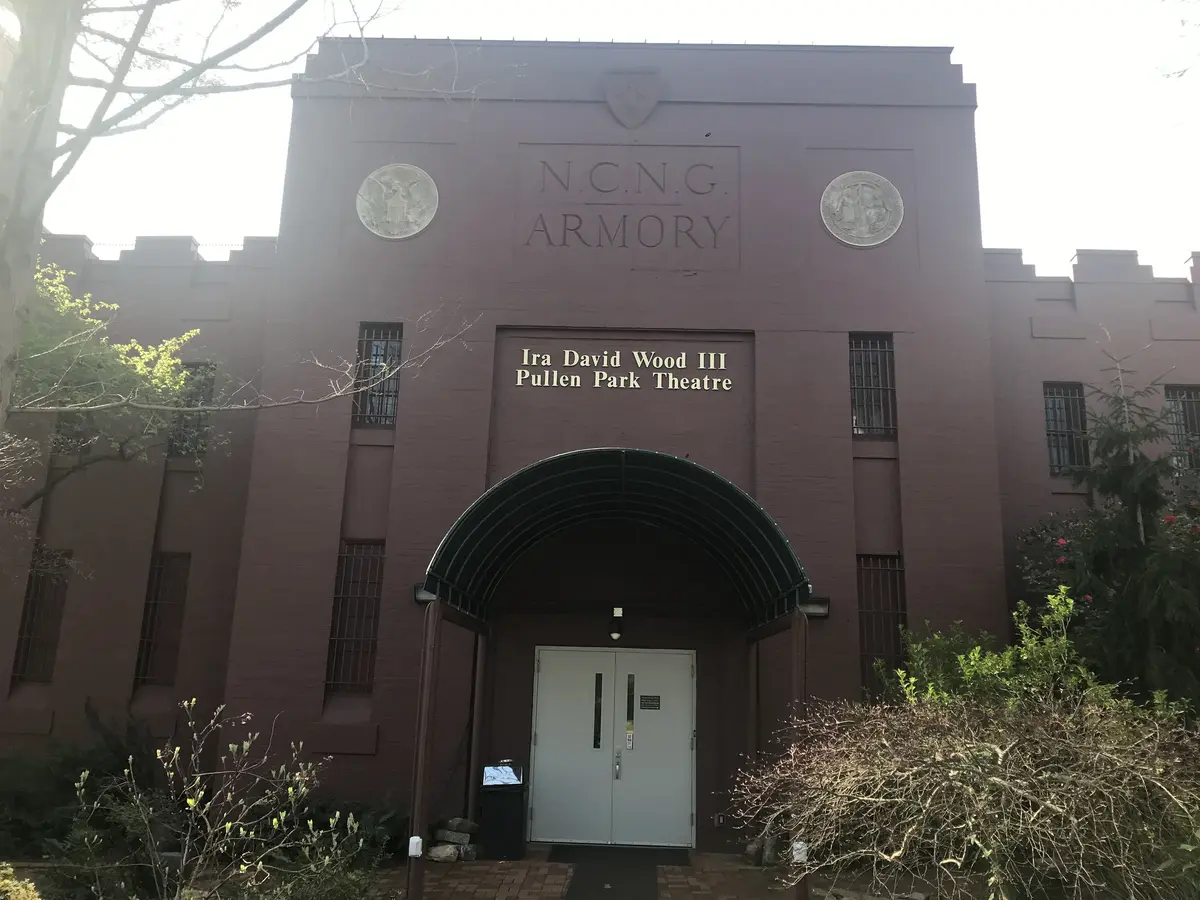
A community theatre in Raleigh, North Carolina, housed in a former National Guard armory at the northern end of Pullen Park, and the rare haunted place where everyone involved is named. The company was chartered in 1947 as The Children's Theatre of Raleigh and moved into the armory in the early 1970s; the building was renovated as a theatre in 1974 and now carries the name of Ira David Wood III, who has run it for decades. Wood is also the source of the ghost: a young boy the cast and crew say they have seen at the front of the building and by the stairwells, with no name, date or incident attached to him. The rest of the record belongs to The Ghost Guild, a North Carolina non-profit that has logged seven investigations here since March 2017 and whose director, Nelson Nauss, told ABC11 about twenty minutes of noise recorded in an empty auditorium — and, in the same breath, that the only way to reproduce it was to walk up stairs that were stowed away that night.
What is the history of Theatre in the Park?
Theatre in the Park is a community theatre in Raleigh, North Carolina, and its ghost story is unusual for one reason: the people who tell it are named, and so is the group that went looking.
The company was chartered in 1947 as The Children's Theatre of Raleigh, Inc. In the early 1970s it changed its name to reflect a wider programme and a new home, and moved into the National Guard armory that stands at the northern end of Pullen Park. North Carolina State University's photograph archive holds an image of that armory and records that in 1974 it was renovated and turned into the theatre. The Ghost Guild, which has worked in the building since 2017, gives a fuller account of its origin — put up in 1936 as the headquarters of the 30th Infantry Division of the National Guard, and converted once the division was inactivated. The two accounts do not sit easily together: the university's record dates the structure to the early 1900s. Nobody has published the paperwork that would settle it, and this entry does not pretend to.
What the building became is not in doubt. It seats around 250, the City of Raleigh lists it as a non-profit community theatre playing to more than 30,000 people a year, and since 2004 it has carried the name of the man who has run it for decades: the Ira David Wood III Pullen Park Theatre. Wood's own adaptation of A Christmas Carol, in which he plays Scrooge, is the company's signature production, staged not here but downtown at the Martin-Marietta Center for the Performing Arts.
The haunting attached to the place is small, specific and told by the staff rather than by a tour operator. Ira David Wood III has described a child: "We have a young boy that inhabits this space… We've seen him." Cast and crew place him at the front of the building and around the stairwells. Nobody offers a name, a date or an incident. Reporters have raised the Pullen family, whose land the park was, and left the connection unconfirmed.
The other recurring detail is the ghost light — the single bulb left burning on an empty stage. Wood gives it the theatrical gloss: "We're leaving them the light to gather around."
The part of the story with dates on it belongs to The Ghost Guild, Inc., a North Carolina non-profit founded on 26 January 2017 whose executive director is Nelson Nauss. It is not a ghost tour: it describes itself as investigating reports of unexplained activity at historically significant sites, using instruments to measure sound, humidity, temperature and pressure, and it is the official paranormal research team for the City of Raleigh's Mordecai Historic Park and for this theatre. Its own public log lists seven visits here — 10 March and 29 April 2017, 27 January and 27 April 2018, 9 May and 26 July 2020, and 26 February 2022.
The episode that reached television came from the first of them. Nauss told WTVD in October 2019 that the auditorium stayed silent while the team was in it; the noises began after they stepped out to the lobby and left a camera running. They grew louder and went on for about twenty minutes, loud enough that the team assumed someone had broken in. They found nobody. Staff have separately reported moving air inside a building they say was sealed.
Timeline: the documented record of Theatre in the Park
- 1936 The Ghost Guild dates the armory to this year, built as the headquarters of the 30th Infantry Division of the National Guard. North Carolina State University's photograph archive instead places the structure in the early 1900s, and no document settling it has been published.
- 1947 The company is chartered as The Children's Theatre of Raleigh, Inc.
- 1974 The armory is renovated and turned into the theatre for Raleigh's Theatre in the Park, according to the caption held with the university's photograph of the building.
- 26 January 2017 The Ghost Guild, Inc. is founded in the Triangle as a North Carolina non-profit, with Nelson Nauss as co-founder and executive director.
- 10 March 2017 First of the Guild's seven logged investigations at the theatre, a video session in the main auditorium. Six more follow: 29 April 2017, 27 January and 27 April 2018, 9 May and 26 July 2020, and 26 February 2022.
- 29 October 2019 WTVD broadcasts the account: Nauss on the twenty minutes of noise recorded while the team was in the lobby, and Ira David Wood III on the boy the cast and crew say they have seen.
- 26 February 2022 Last visit recorded in the Guild's public log for this building.
Is there a rational explanation for Theatre in the Park?
The most deflating detail in this story was supplied by the investigator himself, and it is worth putting first.
Nauss told WTVD that the only way his team could reproduce the noise was by walking up the stairs — and that on the night in question the stairs were pushed in. He offered that as a reason the sound was strange. It is also the strongest clue to what it was. A converted military building with retractable seating is a machine made of steel, timber and masonry that has spent the day expanding in the heat and spends the evening contracting; stowed staging is exactly the kind of assembly that ticks, settles and bangs on its own, and twenty minutes is a long noise for an intruder and a short one for a building cooling down. The team was in the lobby when it started, which is also when a room stops being full of people and starts being an empty box with a camera in it.
The ghost light needs no supernatural account at all, and the theatre profession does not usually give it one. A dark stage with an open orchestra pit and a set half struck is a place where people fall; leaving one bulb burning is a safety habit as old as electric light in theatres. The line about leaving the light for the dead to gather around is a piece of folklore about that habit, told fondly, and Wood tells it that way rather than as evidence.
The boy is where the story is thinnest. In everything published he has no name, no date and no event: he is a recurring impression reported by people who work long hours in a large, poorly lit building, and reported honestly as such. Journalists have floated the Pullen family and then declined to join the dots, which is the correct thing to do with a link nobody can show.
What deserves credit is the shape of the claim rather than its content. Most places in this catalogue offer an anonymous legend and no way to check it. Here there is a named non-profit that publishes the dates it visited, a named executive director who describes on the record the mundane way the sound could be reproduced, and named theatre staff speaking for themselves. That is better documentation than the story it documents — and it is the reason this entry can say what happened without having to decide what it was.
Can you visit Theatre in the Park?
Theatre in the Park occupies the building at 107 Pullen Road, Raleigh, North Carolina 27607, which the City of Raleigh names "the Ira David Wood III Pullen Park Theatre building, a former armory building" at the northern end of Pullen Park. The company's telephone is 919-831-6058 and its office keeps 9 a.m. to 5 p.m., Monday to Friday. Both the company's own site and the city page carried those details on 9 September 2026, and the season advertised that day opened with Evil Dead the Musical from 1 to 11 October.
Ira David Wood III's A Christmas Carol is staged elsewhere. DPAC in Durham lists the 2026 run as seven performances from 16 to 20 December at 123 William V Bill Bell Way, Durham, North Carolina 27701, an hour's drive from Pullen Road.
The Ghost Guild's log for the theatre covers seven dated investigations between 2017 and 2022, each one at the company's invitation. The theatre sells no ticket to a ghost event of any kind.
Pullen Park around the building belongs to the City of Raleigh. Its entrance is at 520 Ashe Avenue and it opens from 7 a.m. to 9 p.m. The city dates the park to 1887 and calls it "the first public park in North Carolina, the 5th oldest operating amusement park in the U.S., and the 16th oldest in the world"; a ride on the carousel or the miniature train costs $2 a person.
Sources consulted
- WTVD, «'Strange and unexplained' noises heard at Raleigh's Theatre in the Park» — ABC11 Raleigh-Durham, 29 October 2019, 2019 newspaper archive
- The Ghost Guild, Inc., «Theatre in the Park — investigation log» — The Ghost Guild, Inc., seven dated investigations 2017-2022, 2022 report
- NC State University Libraries, «National Guard Armory at Pullen Park» — University Archives Photograph Collection, item 0012821, 1969 archive
- City of Raleigh, «Theatre in the Park at Pullen Park» — Parks, Recreation and Cultural Resources, 2026 web
- WUNC, «Paranormal Investigators Take Us Inside Some Of NC's Spookiest Spots» — WUNC / North Carolina Public Radio, 31 October 2019, 2019 newspaper archive
- Raleigh Magazine, «The Ghost Guild Is Exploring the Unknown and Paranormal in NC» — Raleigh Magazine, August 2022, 2022 newspaper archive
Reviewed by V. Serrano on 2026-09-04 · How we verify our content
💬 Field testimonies (0)
No testimonies yet. Add the first.
Add your testimony
🔒 Log in to add a testimony