👻 HAUNTED PLACE · EXP. Nº9477
ACTIVE
Willard Library
Willard Library opened in Evansville, Indiana, on 28 March 1885, endowed by the property speculator Willard Carpenter, who had deeded a fortune into trust in 1876 and died in November 1883 without seeing the doors open.
Where is Willard Library?
- Location
- Indiana, United States
- Type
- Library
- Coordinates
- 37.978, -87.574
- Last updated
LOCATION
Why is Willard Library said to be haunted?
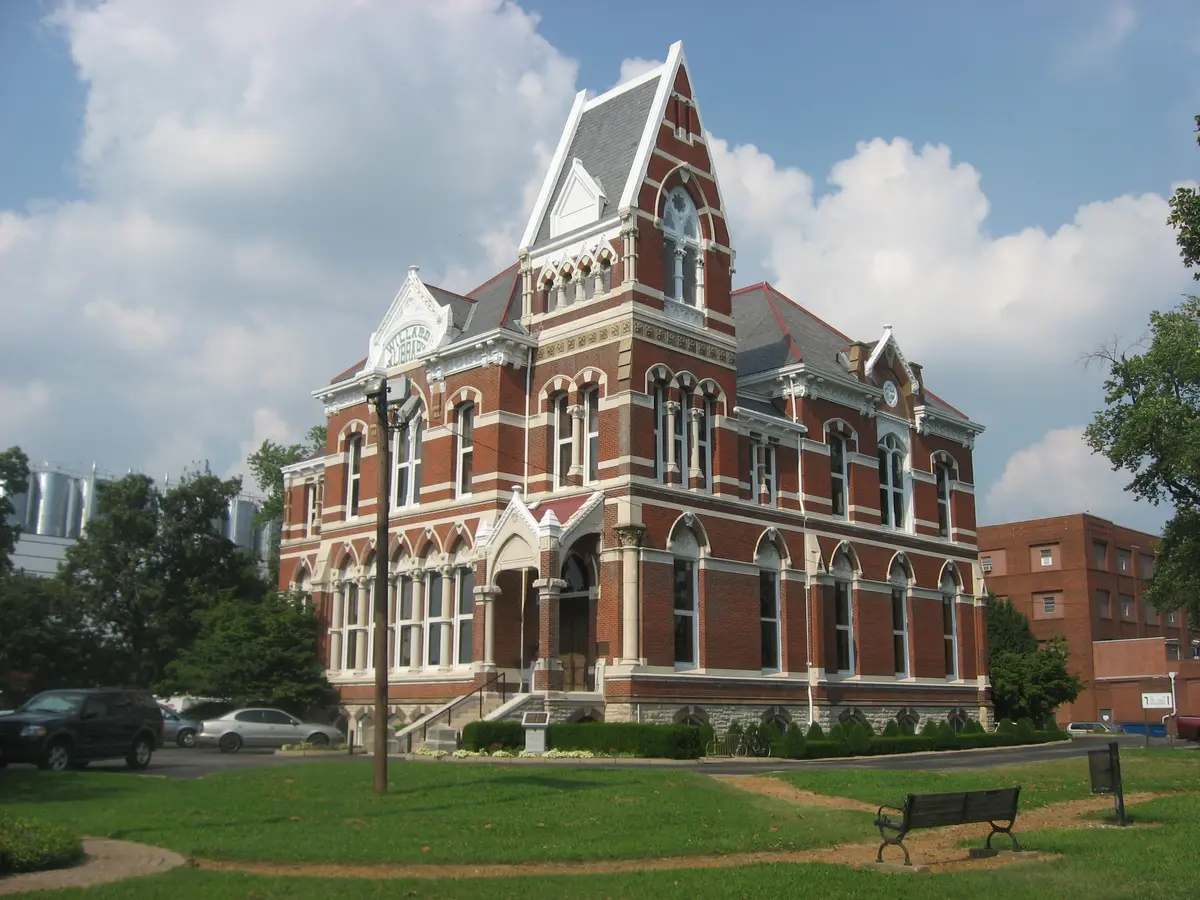
The library describes itself as the oldest public library building in Indiana still in use; the Victorian Gothic shell, begun to plans by Robert Boyd and Henry Brickley and finished by the brothers James and Merritt Reid, was listed on the National Register of Historic Places in 1972. In August 1896 Carpenter's daughter Louise sued the trustees to recover the property, arguing that her father had been of unsound mind and unduly influenced. She lost, and local tradition has identified her ever since with the Grey Lady, the veiled figure in grey that staff have reported in the building since 1937, when an unnamed night janitor said he met her in the basement at three in the morning. The library has never endorsed the identification, and says only that the ghost was first reported to have been seen. On 15 October 1999 a webcam run by the Evansville Courier & Press was pointed at the Research Room; the institution still calls it the world's first ghostcam.
What is the history of Willard Library?
Willard Library exists because a rich man in a hurry ran out of money, and then out of time.
Willard Carpenter was born in Strafford, Vermont, on 15 March 1803, left home at eighteen with seven dollars, and reached Evansville in 1837 at the request of A. B. Carpenter, whom he joined in the wholesale dry-goods and notion business. When Evansville's first city council met on 12 April 1847 he sat on it for the Third Ward, and he married Lucina Burcalow, of Saratoga County, New York, according to Brant and Fuller's county history of 1889. What he wanted to leave behind was a college, a Willard College inspired by the Emma Willard School of Troy, New York. The library's own history is blunt about why the college never happened: railroad ventures had swallowed much of the fortune, land values were depressed, and the men around him argued that a college would struggle. He redirected the plan towards a library.
On 23 August 1876 Carpenter sent six Evansville citizens — Thomas E. Garvin, Alexander Gilchrist, Henry F. Blount, John Laval, Matthew Henning and Charles H. Butterfield — a long letter of instruction endowing "THE WILLARD LIBRARY" with property he valued at $400,000, held in perpetual trust, for books "for the use of the people of all classes, races and sexes, free of charge forever". The trustees accepted in writing on 26 August. Willard and Lucina executed the deed of trust the same day the letter is dated; the library's own account adds that Lucina reportedly opposed the gift and insisted on being given property of her own before she would sign.
Building it took nine years. In the spring of 1877, aged 74, Carpenter made two trips to Chicago to consult architects, and Robert Boyd and Henry Brickley got the commission. Ground was broken on 16 May 1877, the stone foundation reached the top of the water table by 13 August, the stonework was finished on 2 September — and then the trustees sealed the foundations against the weather and stopped, waiting for their land holdings to recover enough value to pay for the rest. Work resumed only in 1882, when Carpenter, impatient, pushed to "hurry matters up". Boyd and Brickley were no longer in business in Evansville, so their successors, the brothers James and Merritt Reid, took the job over. The Reids later moved to California and designed the Hotel del Coronado; the 1972 National Register nomination credits "the eminent architect James W. Reid" alone, while the library credits both brothers. The 1889 county history gives the design to the brothers too, saying that "Reed Bros., architects, planned a building", whereas in the library's account they took over a foundation that had been in the ground for five years.
With construction in full swing in 1883, Carpenter, 80 that March, was on site every day, inspecting the paid workmen and working alongside them. His family was reportedly embarrassed to see him hauling wheelbarrows and climbing on the roof. The 1889 History of Vanderburgh County says that within two months of his death he climbed to the very top of the walls. In late October 1883 he suffered a paralysing stroke and died days later: on 3 November according to the library's timeline, on 6 November according to Brant and Fuller's 1889 county history. The construction cost is disputed in the same way — $60,000 by the library's account, "about $80,000" by the 1889 one. Money ran out before stone carvers could finish the rosettes on the window arches, which is why some of them are still empty.
The trustees completed the building, and the doors opened with ceremony on 28 March 1885, despite atrocious weather. Most of the first 10,000 books were hand-me-downs from two defunct Evansville libraries, topped up by volumes trustee Samuel Bayard went to Cincinnati to buy. The first librarians were Otilda Goslee and Lou Scantlin.
Then the family came back. By the library's telling Carpenter had three children, Louise, Marcia and Albert, and little constructive involvement with any of them (the 1889 county history counts five children, two of them still living in 1889); he allegedly told Louise and her husband they would receive nothing. In August 1896, thirteen years after his death, Louise Carpenter sued the library to recover the property it held. Her argument, as the library quotes it, was that her father "had been of unsound mind and had been unduly influenced in establishing the Library". The court found for the library. What she was attacking was the deed of trust her father had executed in August 1876, seven years before he was climbing his own scaffolding. The English Wikipedia article has her contesting "his last will and testament" instead.
Timeline: the documented record of Willard Library
- 23 August 1876 Willard Carpenter sends six Evansville citizens a letter of instruction endowing "THE WILLARD LIBRARY" with property he values at $400,000, and he and his wife Lucina execute the deed of trust the same day. The trustees accept in writing on 26 August.
- 16 May 1877 Ground is broken to plans by the Chicago-consulted architects Robert Boyd and Henry Brickley. The stonework is finished on 2 September and then sealed against the weather: the trustees halt work for five years waiting for land values to recover.
- 1882 Carpenter, impatient to see the library finished in his lifetime, pushes for work to resume. Boyd and Brickley are no longer in business in Evansville, so their successors, the brothers James and Merritt Reid, take over the half-built shell.
- Early November 1883 Days after a paralysing stroke, Willard Carpenter dies without seeing the library open — on 3 November according to the library's own timeline, on 6 November according to the 1889 History of Vanderburgh County.
- 28 March 1885 The library opens with ceremony in atrocious weather. A reporter shown round complains that there is not enough light fiction on the shelves.
- August 1896 Louise Carpenter sues the library to recover the property it holds, arguing that her father "had been of unsound mind and had been unduly influenced in establishing the Library". The court finds for the library. This suit, not a contested will, is the factual core of the Grey Lady legend.
- 1937 A night janitor, unnamed in the library's accounts and in the newspaper reports of 2000, reports that on a 3 a.m. visit to stoke the coal furnace he met an all-grey veiled woman in the basement, dropped his flashlight and watched her dissolve into the shadows. He quits shortly afterwards. The library's website tells the episode in 1998; the search report of September 2000 cites it from Dennis William Hauck's directory of 1996, and Arthur Myers wrote about the Willard ghost in 1993.
- 13 April 1942 The board allocates $300 to move the children's section into two unused basement rooms; it is finished in 47 days. The room later described as the most haunted in the building did not exist at the time of the first sighting.
- 28 September 1972 Willard Library is listed on the National Register of Historic Places (ref. 72000014). The nomination, signed by the trustees' own secretary, describes an interior unchanged since 1884 and warns that an approaching expressway threatens the park. It says nothing about a ghost.
- 10 September 1980 The remodelled and expanded Margaret Maier Children's Room is dedicated, together with an access ramp. Maier, children's librarian for fifty years, said the Grey Lady followed her home during that renovation and stayed until the work was over.
- 15 October 1999 The library installs what its timeline calls "the world's first ghostcam"; in the first two weeks, the timeline says, more than two million visitors logged on to the library's website to see what was in the camera's view.
- 9-10 September 2000 A team of volunteers led by the clinical psychologist and ghost seeker Tim Harte sets sensors around the library for the night. The psychic Lou Wright, who toured the building earlier in the evening, says she saw a spirit dressed in burgundy in two places. The results, posted on courierpress.com on 14 September, rest on spikes in three "Static H field" monitors that Harte believes are evidence of the ghost, while the report notes that "there are several earthly explanations for these spikes".
- 19 April 2006 Syfy's Ghost Hunters films at Willard. The library's own timeline records that the team "discover nothing while actually filming", and that the presenters reported an unexplained mist in the Bayard Room only during a break.
- 10 August 2010 The most recent sighting the library records: the Assistant Children's Librarian reports the Grey Lady in the basement hallway. The institution has published no later one.
Is there a rational explanation for Willard Library?
The Grey Lady's founding story belongs to the library, and its oldest dated versions can be read today.
The library's website carried it by 21 May 1998, the date of the first Internet Archive capture of its "Legends" section, under the heading "Winter 1937: The first sighting of Willard Library's 'Lady in Grey'". In that telling a janitor came in at 3 a.m. to shovel coal into the furnace, nearly walked into "a ghostly veiled lady dressed in glowing grey", dropped his flashlight and ran from the basement and from the library, "never to return to either again". The library's timeline repeats the episode under 1937 and adds that the night janitor quit his job shortly afterwards. The story was in print before the website: Arthur Myers's A Ghosthunter's Guide (Chicago: Contemporary Books, 1993) already wrote about the Willard ghost and the staff who reported it, among them the children's librarian Margaret Maier, and the report of the instrumented search of September 2000 takes the 1937 custodian from Dennis William Hauck's national directory of haunted places of 1996. The janitor has no name in the 1998 page, in the timeline, in the Courier & Press reports of autumn 2000 or in the library's visitor packet of 2021.
The early accounts also carry two internal problems. The 1998 page says that "the first reported incident happened sixty years ago", which on a page captured in May 1998 points to 1938; the timeline says 1937. And the area now described as the most haunted part of the building, the children's room in the basement, came later. On 13 April 1942, at the request of head librarian Gray Williams, the board allocated $300 to move the children's section and its 8,000 books into two unused basement rooms, and the new room was finished within 47 days. In 1937 the basement held the coal furnace.
The best-known "evidence" came from a camera. On 15 October 1999 a webcam was pointed at the second-floor Research Room; the library's timeline calls it "the world's first ghostcam" and says that more than two million visitors logged on in the first two weeks. The site was run by the Evansville Courier & Press, at courierpress.com/ghost and later at libraryghost.com, whose archived pages are headed "Courierpress.com GhostCam". James Michels, the paper's director of new media, wrote on 7 September 2000 that "about a year ago, we decided to provide Internet users with their own opportunity to see the ghost", and announced a second camera in the children's area, "timed to capture an image once every 10 minutes during the day and once every 30 seconds at night". The cam did not stream video: it served a still frame that refreshed every thirty seconds, and a page of instructions told anyone who spotted the Lady in Grey to save the picture, attach it to an email and describe "exactly what you saw". The paper posted the results in two galleries, "Proof: I saw her!" and "Spoof: I saw her!". One viewer wrote on 20 May 2002 that she and her daughter "had only been watching for about 3 minutes and have caught at least 4 different ghosts!". A low-resolution still, refreshed for a large audience looking for a grey shape and asked to send in what it found, is a machine for producing pareidolia, and the newspaper ran it with a separate gallery for the jokes.
The organised searches produced readings, and the readings were published. On the night of 9 September 2000 Courier & Press staff joined a team organised by the clinical psychologist Timothy M. Harte, with the psychic Lou Wright of Newburgh, Indiana, for a seven-hour watch with sensors meant to pick up "disturbances" in "infrared, ultraviolet, motion and magnetic fields". Wright said she saw the ghost in two places; the paper's report the next day noted that "no other human encountered her during the evening" and that Wright saw the figure "dressed in burgundy, not the expected grey". The findings went up on courierpress.com on 14 September. During the night the only other report came from the site's webmaster, Amy Tate, who briefly noticed a smell like lilacs in the children's reading room. Harte's evidence was three printouts from "Static H field" monitors showing spikes in the magnetic field; the paper's report says that "there are several earthly explanations for these spikes", and Harte concluded: "The place is haunted, man, that's all I'm going to say." On 24 October 2000 thirteen members of the University of Southern Indiana Journalism Club gathered at the library to spend the night there, and the Courier & Press reporter John Martin wrote that their sponsor, Ronald Roat, was "not a believer in ghosts". When Syfy's Ghost Hunters filmed at Willard, the library's timeline records under 19 April 2006 that the team "discover nothing while actually filming", and that its presenters reported an unexplained "mist" in the Bayard Room while taking a break.
The ghost also raises money for the library. Its October tours, which the library says drew 800 people the first time in the late 1990s, are booked through the library's online shop, where the tour tickets were listed at $0 when checked on 10 October 2026, and the tour page asks for donations. The Grey Lady Afternoon Tea of 7 October 2023 was sold by ticket, with "all proceeds" going to the Friends of Willard Library and the library itself. The library's own wording about the ghost stays careful: its visitor packet says of Louise Carpenter that "although we don't know who the ghost is, some people suspect it might be her", and its ghost page says only that the Grey Lady "was first reported to have been seen" in the late 1930s by a custodian. The last sighting it records is dated 10 August 2010, in the basement hallway, by the Assistant Children's Librarian.
Can you visit Willard Library?
Willard Library is a public library in everyday use, set in its own grounds on the corner of First Avenue and the Lloyd Expressway in Evansville, Indiana. Its website gives the address as 21 North First Avenue, Evansville, IN 47710, the telephone as (812) 425-4309, and the grounds as "a 3.5-acre park". The 1972 National Register nomination recorded the park at four and a half acres and warned that the continuation of an expressway along the street in front "will encroach on the Library park and endanger the building".
Hours on the library's site, checked on 23 September 2026: Monday and Tuesday 9:00-20:00; Wednesday to Friday 9:00-17:30; Saturday 9:00-17:00; Sunday 13:00-17:00. Admission is free, as the founding letter of 23 August 1876 requires: Willard Carpenter endowed the library with books "for the use of the people of all classes, races and sexes, free of charge forever".
The rooms the stories attach to are rooms in public use. The Genealogy and Local History Department is on the second floor, together with the Research Room that the first ghost webcam watched from October 1999; the Bayard Room on the same floor houses the books Martha Orr Bayard bequeathed in 1909 from her husband Samuel's library. The Children's Department has been in the basement since the board moved it into two unused rooms in 1942, five years after the janitor's sighting that started the legend. The only enlargement in the building's history is also below ground: an extension of about 8,000 square feet for the archives and a gallery seating 150, proposed in February 2011 and opened on 8 February 2015, which houses the Browning Gallery. In the front flower bed to the right of the entrance, a bronze open book on an unfinished grey granite pedestal commemorates Willard Carpenter; the Captain Henry Vanderburgh Chapter of the Daughters of the American Revolution dedicated it on 22 May 2008.
The ghost has its own section of the website, and the offer changed after 2024. The October Grey Lady Ghost Tours, which the library says drew 800 people the first time in the late 1990s, are described on its ghost-cam page, as of 23 September 2026, as "taking a nice, long hiatus". The site still carries the page of the 2024 edition, 24 to 26 October, with free tickets in groups of 30 and every slot marked full. What the library now offers instead is an after-hours paranormal investigation, open to any team that books through its form: a suggested minimum donation of $250 for six people or fewer, from 6 pm to 2 am on Wednesdays to Sundays, with a member of staff in the building throughout, and a $500 minimum on Halloween. The ghost cams run on the same site, where the old willardghost.com address now redirects; the cameras in the children's rooms are switched off during opening hours. The Grey Lady Tea is listed for 17 October 2026, from 1 to 3 pm, in the Browning Gallery.
Sources consulted
- Mrs. James B. Igleheart, Secretary of the Board of Trustees, «National Register of Historic Places Inventory - Nomination Form: Willard Library (ref. 72000014)» — United States Department of the Interior, National Park Service, 1972 report
- Brant and Fuller, «History of Vanderburgh County, Indiana, chapter X: Libraries - Willard Library» — Democrat Printing Company, Madison, Wisconsin, 1889 book
- Willard Library, «Willard Library Legends: Is Willard Library Haunted? / Winter 1937: The first sighting of Willard Library's 'Lady in Grey' / Who is the Ghost?» — willard.lib.in.us, archived by the Internet Archive on 21 May 1998, 1998 archive
- Willard Library, «Willard Public Library Timeline / A library begins / Speaking ill of the dead» — Official institutional history, willard.lib.in.us, 2026 archive
- James Michels, «We'll join ghost hunters checking out library» — Evansville Courier & Press, 2000 newspaper archive
- John Martin, «'Lady in grey' skeptics will see for themselves» — Evansville Courier & Press, 2000 newspaper archive
- Courierpress.com special report, «Willard Library ghost hunter update: Lady in Grey keeps a low profile» — Evansville Courier & Press, 2000 newspaper archive
- Willard Library, «The Grey Lady of Willard Library, Evansville, Indiana (visitor packet)» — Library leaflet, PDF, 2021 report
- Willard Library, «The Grey Lady Ghost» — willard.lib.in.us/about-us, 2019 web
- Evansville Courier & Press, «Evansville Courier & Press Ghost Cam / Courierpress.com GhostCam» — libraryghost.com, archived by the Internet Archive, 2004 archive
- Willard Library, «A Timeline of Willard Library — cronología institucional con el traslado de la sala infantil (1942), la ghostcam (1999) y el rodaje de Ghost Hunters (2006)» — willard.lib.in.us, archived by the Internet Archive on 6 March 2016, 2016 archive
- Courierpress.com special report, «Ghost hunting expert findings revealed — resultados publicados de la búsqueda instrumentada del 9 de septiembre de 2000» — Evansville Courier & Press, archived by the Internet Archive, 2000 newspaper archive
- Timothy M. Harte, Michael T. Hollinshead, Michael G. Komen, Scott A. Niedl, Hugh Wittenbraker and Thomas Oswald, «META GhostHunt Report: Willard Library Investigation 2, September 9, 2000 — informe del equipo MESA; cita a Hauck (1996) para el conserje de 1937» — Courierpress.com, archived by the Internet Archive, 2000 report
- Arthur Myers, «A Ghosthunter's Guide to Haunted Landmarks, Parks, Churches, and Other Public Places — incluye el fantasma de la Willard Library y al personal que lo vio» — Contemporary Books, Chicago, 1993 book
- Evansville Courier & Press, «We're almost ready to believe you! — instrucciones para guardar y enviar por correo la imagen de la GhostCam» — libraryghost.com, archived by the Internet Archive on 31 December 2004, 2004 archive
- Evansville Courier & Press, «Proof: I saw her! — galería de avistamientos enviados por los espectadores de la GhostCam» — libraryghost.com, archived by the Internet Archive on 19 February 2005, 2005 archive
- Willard Public Library, «Grey Lady Afternoon Tea — té con entrada del 7 de octubre de 2023, a beneficio de los Amigos de la Willard Library» — willard.lib.in.us, 2023 web
- Willard Public Library, «Grey Lady Ghost Tour | October 29 – 9PM — entrada de la visita en la tienda en línea (precio 0 $ el 10-oct-2026)» — willard.lib.in.us (shop), 2026 web
- Willard Public Library, «Grey Lady Ghost Tours October 26-28 — página de las visitas, con petición de donativos» — willard.lib.in.us, 2026 web
Reviewed by V. Serrano on 2026-08-14 · How we verify our content
💬 Field testimonies (0)
No testimonies yet. Add the first.
Add your testimony
🔒 Log in to add a testimony